

What if the resistance you encounter during a transformation isn't a lack of employee stamina, but a systemic depletion of psychological "strokes" caused by unexamined organizational scripts? You likely recognize the weight of this fatigue; it's the heavy sensation of pushing a boulder uphill while watching your most capable managers slip into "quiet quitting" or cynicism. With 73% of HR leaders reporting that their teams are exhausted by constant shifts, simply pushing harder is no longer a viable strategy for managing organizational change fatigue.
We understand the frustration of seeing strategic brilliance falter at the human level. This article moves beyond surface-level burnout by applying Transactional Analysis and systemic frameworks to restore your organization's vital energy. We promise to help you uncover the hidden psychological drivers that cause change to stall and provide a roadmap to build sustainable capacity without depleting your workforce. We'll explore how to transition from merely managing exhaustion to transforming your organizational culture into a space of genuine wholeness and professional flourish.
Key Takeaways
- Identify change fatigue as a systemic exhaustion of collective energy rather than a simple lack of individual resilience.
- Discover how applying Transactional Analysis and the "Stroke Economy" creates a precise diagnostic framework for managing organizational change fatigue.
- Move beyond the "Transactional Management" trap by prioritizing psychological safety and mutual re-contracting before launching new initiatives.
- Learn to identify and close the "Stroke Gap," restoring the vital recognition and validation your team needs to fuel sustainable transformation.
- Recognize that an organization’s capacity for profound evolution is fundamentally limited by the developmental growth and maturity of its leaders.
Beyond Burnout: Defining Organizational Change Fatigue in 2026
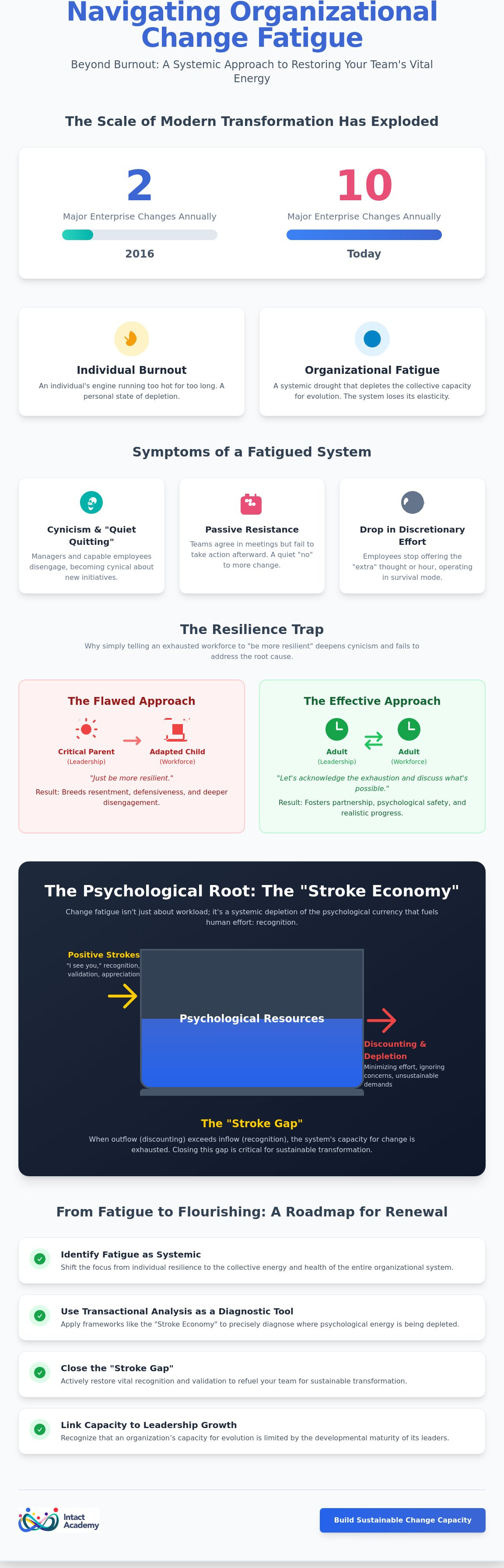
To understand the current state of the global workforce, we must first release the idea that exhaustion is a personal failing. In our current era of "polycrisis," where the average employee navigates ten major enterprise changes annually compared to just two in 2016, the weight of constant adaptation has become a systemic burden. When we look at Defining Organizational Change Fatigue, we must see it not as a collection of tired individuals, but as a systemic depletion of the collective capacity for evolution. Managing organizational change fatigue isn't about fixing broken people; it's about redesigning the architecture of the system they inhabit.
There's a profound difference between individual burnout and organizational fatigue. Burnout is often the result of an individual's engine running too hot for too long. Organizational fatigue, however, is more like a drought that settles over an entire landscape, drying up the creative wells and hardening the soil of collaboration. It's a state where the system itself has lost its elasticity. In 2026, the relentless pace of AI disruption and shifting market realities means that fatigue is often a healthy, self-protective response to an unhealthy environment. It's the system's way of saying "no more" to preserve what little integrity remains.
The Symptoms of a Fatigued System
A fatigued organization doesn't always scream; more often, it goes quiet. You might notice "Passive Resistance," where teams nod in agreement during town halls but fail to take a single step forward once the cameras turn off. This is distinct from "Active Sabotage," which is a high-energy response. Fatigue manifests as a dramatic drop in discretionary effort. Employees stop offering the "extra" thought or the "extra" hour because they're operating in survival mode. Change fatigue is the gap between required adaptation and available psychological resources.
Why Traditional "Resilience" Training Often Backfires
Many leaders attempt to solve this by offering resilience workshops, yet these often deepen the cynicism they're meant to cure. From a Transactional Analysis perspective, telling an exhausted workforce to "be more resilient" often lands as a "Critical Parent" instruction to an "Adapted Child." It implies that the problem lies with the employee's lack of stamina rather than the organization's unsustainable demands. This dynamic breeds resentment and causes employees to retreat further into defensive scripts.
To move forward, we must abandon these surface-level fixes and move toward an "Adult-Adult" contract for change. This requires a level of honesty that many corporate cultures find uncomfortable. It means acknowledging the reality of the exhaustion and inviting the workforce into a mature dialogue about what's possible. Successfully managing organizational change fatigue requires us to stop treating employees as objects to be "managed" and start treating them as partners in a shared systemic reality.
The Psychological Roots of Fatigue: Scripts and Stroke Deprivation
To move beyond the surface of resistance, we must look at the invisible currency that fuels human effort. Transactional Analysis (TA) offers a profound diagnostic lens for this, shifting our focus from what people are doing to why they've lost the psychological energy to do it. In the context of managing organizational change fatigue, we often find that the system is suffering from a profound depletion of "strokes," the fundamental units of human recognition. When a workforce is asked to adapt repeatedly without receiving the necessary validation, they don't just get tired; they enter a state of psychological starvation.
This depletion is often accelerated by a mechanism called "Discounting." This occurs when leadership, perhaps unconsciously, ignores or minimizes aspects of the current reality. They might discount the severity of the effort required, the validity of employee concerns, or the very existence of the fatigue itself. When employees feel their reality is being discounted, they stop investing their "Adult" energy into the transformation. Instead, they retreat into defensive scripts, repeating patterns of behavior that served them in the past but hinder the evolution of the organization today.
The Stroke Economy in Times of Change
A "stroke" is any act that implies "I see you" or "I recognize your presence." In a healthy organization, there's a vibrant exchange of positive strokes that acts as the fuel for innovation. However, during periods of intense transformation, this economy often collapses. Leaders, under pressure themselves, might switch to "negative strokes," using criticism or fear to drive results. While negative strokes provide a temporary jolt of energy, they are toxic over the long term. Change fatigue is frequently a symptom of "Stroke Starvation," where the effort expended far outweighs the recognition received. To restore balance, leaders must intentionally re-inject positive, unconditional strokes into the system, validating the personhood of their team members before demanding their performance. For those seeking to master these systemic nuances, exploring our Executive Coaching programs can provide the necessary depth to lead with psychological precision.
Ego States and Change Dynamics
The interactions between leaders and their teams often fall into predictable patterns based on ego states. When a leader adopts a "Critical Parent" stance, issuing rigid directives and judging performance without empathy, it almost inevitably triggers a "Rebellious Child" response in the workforce. This isn't a lack of professional maturity; it's a natural psychological transaction. The resistance we see is often a protest against the dynamic, not the change itself. By understanding what is transactional analysis, leaders can learn to stay in their "Adult" ego state. This allows for a clear-eyed processing of organizational reality, where challenges are met with curiosity rather than judgment. Managing organizational change fatigue requires moving the entire system toward these Adult-Adult interactions, where mutual respect and shared reality become the foundation for sustainable growth.
Transactional Analysis vs. Traditional Management: Addressing the #1 Objection
The most frequent objection we encounter in the boardroom is a perceived lack of time. "We don't have time for psychology," executives say, "we need results." This perspective creates a false dichotomy between human flourishing and business performance. In reality, the high failure rates of change initiatives suggest we don't have time not to look deeper. If 74% of managers feel unequipped to lead change, it's not because they lack technical skill, but because they are trapped in "Transactional Management." This style focuses on the surface of KPIs and timelines while ignoring the systemic undercurrents that actually drive behavior. Managing organizational change fatigue isn't a distraction from results; it's the only sustainable way to achieve them.
Traditional management treats an organization like a machine, where parts can be swapped or "fixed" to improve output. A systemic approach, however, views the organization as a living entity with its own history and psychological depth. When we move from transactional management to transformational coaching, we stop asking "how do we push this through?" and start asking "what is preventing this system from moving?" This shift allows us to address the "Organizational Script," the unconscious set of patterns that dictates whether a company will flourish or falter. Without this depth, any ROI achieved will be fleeting, as the system eventually reverts to its old, exhausted state.
Mapping the Organizational Script
Every organization operates according to a script, a narrative formed by past successes and, more importantly, past failures. When change initiatives repeatedly fail to stick, it's often because the culture harbors unconscious injunctions like "Don't Succeed" or "Don't Change." These act as invisible barriers to evolution. For example, a tech firm we observed was trapped in a "Hurry Up and Fail" script. They launched products at a frantic pace, yet every launch was sabotaged by internal silos. The fatigue they felt wasn't from the work itself, but from the repetitive nature of the failure. Breaking this script required identifying the injunctions and rewriting the collective narrative toward a state of genuine achievement.
The Leader as a Systemic Architect
To transform a system, a leader must first possess the courage to examine their own leading organizational change patterns. Many well-meaning leaders fall into the "Rescuer" role of the Drama Triangle, attempting to fix their employees' burnout. This inadvertently keeps the workforce in a "Victim" role, deepening their sense of helplessness and fatigue. A systemic architect doesn't try to "fix" people. Instead, they work to heal the system by establishing clear boundaries and fostering Adult-Adult interactions. This shift requires moving beyond the drama of the moment and looking at the structural dynamics that perpetuate exhaustion. It is a transition from being a hero who saves the day to being a mentor who builds a flourishing environment.
Practical Strategies for Systemic Renewal: The Leader as a Change Architect
Moving from the diagnosis of exhaustion to the architecture of renewal requires a deliberate, methodical approach. Managing organizational change fatigue is not a singular event but a process of systemic recalibration. To restore the collective energy of your workforce, you must act as a systemic architect, moving through five critical steps of transformation. This journey begins with Re-contracting for Change, where you establish clear, mutual expectations that move beyond surface-level goals into the realm of psychological commitment. By acknowledging what is truly required from both the leader and the team, you create a foundation of integrity.
The second step involves Closing the Stroke Gap. As we explored previously, recognition is the fuel of the system; you must restore this validation before demanding new effort. This leads to Decontaminating the Adult, a process of using objective data and systemic insight to separate historical fears from current facts. When the "Adult" ego state is clear, you can move to Script Transformation, rewriting the organizational narrative from one of repetitive struggle to one of sustainable achievement. Finally, Systemic Supervision ensures you seek external perspectives to avoid "Organizational Symbiosis," a state where leaders and their teams become trapped in the same blind spots of fatigue.
Contracting for a Sustainable Future
Effective transformation relies on the distinction between a "Legal Contract" and a "Psychological Contract." While a legal contract covers tasks and timelines, the psychological contract addresses the unwritten expectations regarding trust, support, and recognition. When these are ignored, "Hidden Agendas" begin to flourish, siphoning off the energy intended for growth. Clear contracting reduces anxiety and preserves energy. It ensures that every stakeholder understands the mutual exchange of value, preventing the resentment that often fuels systemic fatigue.
Creating a "Safe Container" for Transition
For change to stick, leaders must build a "safe container" that prevents teams from slipping into "Survival Ego States." When trust is broken, employees often retreat into a frightened Child or a defensive Parent state, neither of which is capable of creative adaptation. Holding the anxiety of a team during high-stakes shifts requires a leader who is grounded in their own developmental maturity. This architecture is supported by ongoing professional development for coaches and practitioners who understand these deep-seated human dynamics.
By mastering these architectural steps, you move beyond the frantic energy of crisis management into a steady state of systemic flourishing. If you are ready to deepen your capacity for this work, our programs in Organizational Change offer the structured methodology needed to lead your system toward wholeness.
From Fatigue to Flourishing: Building Sustainable Change Capacity
The journey from systemic depletion to vibrant flourishing isn't a linear path, but a continuous process of recalibration. We've explored how managing organizational change fatigue requires more than temporary relief; it demands a fundamental shift in the psychological scripts that govern the system. When we stop viewing fatigue as a problem to be solved and start seeing it as a signal to be understood, we open the door to profound human transformation. This mastery doesn't happen overnight. It requires a commitment to looking beneath the surface of organizational dynamics to find the wholeness that's often obscured by years of transactional pressure.
It's a sobering yet liberating truth that the maturity of a leader serves as the ultimate ceiling for an organization’s capacity. If you remain tethered to old scripts of rescue or control, the system will inevitably mirror those limitations. True systemic mastery begins with your own evolution. It's about moving beyond the role of a manager into the presence of a wise mentor who provides a stable container for the often-turbulent work of change. This is the difference between a leader who merely survives a transformation and one who architects a culture where people can genuinely flourish.
The Path to Professional Mastery
A weekend workshop or a surface-level certification is rarely enough to navigate the complex human systems we encounter in 2026. Deep systemic change requires a steady, methodical approach to learning that mirrors the process of human growth itself. For those who seek to bridge the gap between psychological depth and professional pragmatism, the TA Foundation Year offers a structured journey toward systemic mastery. In an environment where EMCC and ICF accreditations are the hallmarks of a mature professional, investing in your own development is the most direct way to increase your organization's resilience. It's not just about learning new tools; it's about returning to a state of genuineness that allows you to lead with quiet power.
A Vision of the Whole Organization
The ultimate goal of this work is an organization that learns and adapts without losing its soul. It's a system where recognition flows freely, where contracts are clear, and where the collective energy is directed toward creation rather than survival. This is the legacy of a leader who has mastered the art of systemic change. Managing organizational change fatigue becomes, in this light, an act of stewardship for the human spirit within the business. As you look toward the future of your team, consider this reflective inquiry: What script is your organization writing today? If the current narrative is one of exhaustion, you have the power to begin a new chapter of wholeness.
Architecting a Culture of Systemic Vitality
We've moved from the surface symptoms of burnout to the profound psychological scripts that dictate organizational energy. By identifying the "Stroke Economy" and decontaminating the "Adult" ego state, you gain the tools to stop the cycle of depletion. Successfully managing organizational change fatigue is no longer a matter of luck; it's a matter of systemic precision and developmental maturity. You now have a framework to move beyond the drama of the moment and into the architecture of long-term flourishing.
If you're ready to master these complex human systems, we invite you to deepen your impact with our TA EMCC Senior Practitioner Academy. Led by international systemic change expert Sari van Poelje, our academy is accredited by EMCC, ICF, and EATA. You'll join a global community of practitioners from over 14 countries who are committed to returning their organizations to a state of completeness. The courage to change the system begins with the courage to change yourself. Your organization's potential for renewal is vast and within reach.
Frequently Asked Questions
What are the first signs of organizational change fatigue?
The first signs include a noticeable drop in discretionary effort and an increase in passive-aggressive compliance. You'll see managers nodding in meetings but failing to implement decisions once they leave the room. This silence is often more dangerous than vocal opposition. It signals that the collective energy for adaptation has reached a state of systemic depletion where people no longer have the resources to care.
How does Transactional Analysis help in managing change?
Transactional Analysis provides a diagnostic map to identify the ego states and scripts driving organizational behavior. By analyzing transactions between leaders and teams, we can uncover whether a transformation is being sabotaged by Parent-Child dynamics. This psychological depth is essential for managing organizational change fatigue because it addresses the root causes of resistance rather than just the surface symptoms of the exhaustion.
Can change fatigue be prevented entirely in a fast-paced environment?
While total prevention is unlikely in a polycrisis environment, you can build systemic capacity to prevent fatigue from becoming a chronic state. This involves moving away from constant disruption toward a rhythm of renewal. Leaders who treat change as a series of sprints with scheduled recovery periods ensure that the organization's psychological resources remain replenished and ready for the next necessary evolution.
What is the "Stroke Economy" and why does it matter for leaders?
The "Stroke Economy" refers to the system of recognition and validation that fuels human motivation. In times of change, positive strokes often dry up as leaders focus exclusively on technical tasks and KPIs. This stroke starvation leads to a loss of meaning and purpose. Leaders must intentionally provide authentic recognition to maintain the emotional fuel required for their teams to navigate complex transitions successfully.
How do I tell the difference between resistance and fatigue?
Resistance is often high-energy and directed at a specific goal, whereas fatigue is a low-energy state of generalized apathy. Resistance says "I won't do this," while fatigue says "I simply can't do anything else." Identifying this distinction is critical for managing organizational change fatigue. If you treat exhaustion as if it were mere defiance, you risk deepening the cynicism and driving your best talent away.
Is it possible to "re-contract" for a change initiative that has already started?
It's possible and often necessary to re-contract when an initiative stalls or the external environment shifts. Re-contracting involves a transparent Adult-Adult dialogue about current realities and mutual needs. It allows the leader to acknowledge previous missteps or hidden agendas. This process resets the psychological contract and restores the trust required to move the project forward with renewed integrity and shared purpose.
What role does coaching supervision play in managing change fatigue?
Coaching supervision provides an external reflective space to prevent organizational symbiosis, where leaders become blind to their own systemic fatigue. It acts as a container for the leader's anxiety, ensuring they don't leak their stress onto their teams. Through supervision, architects of change can identify their own blind spots and maintain the clarity needed to lead with quiet power and professional stability.
How can I measure the success of a systemic intervention?
Success is measured by the restoration of discretionary effort and the shift from survival-based scripts to flourishing-based behaviors. You'll see a reduction in quiet quitting and an increase in proactive problem-solving across departments. Beyond KPIs, a successful systemic intervention is evident when the organization begins to adapt fluidly to new challenges without a corresponding spike in employee stress levels or turnover rates.


