

What if the recurring toxic dynamics you encounter in leadership teams aren't failures of personality, but the inevitable results of an unexamined organizational script? You've likely noticed that traditional coaching frameworks often crumble when they meet deep-seated cultural resistance. It's frustrating to feel that your interventions only scratch the surface while the underlying system remains unchanged. To truly shift these patterns, you need an emcc accredited team coaching course that moves beyond transactional tools into the realm of systemic integration.
We understand that the path to Senior Practitioner status often feels obscured by complex ITCA requirements and a lack of high-level peer support. This guide promises to clarify that journey, showing you how to use Transactional Analysis to improve team psychological safety by 35% based on 2025 industry research. We'll examine the specific steps to achieve your accreditation while mastering the interventions necessary to drive sustainable organizational change in 2026. By bridging the gap between individual autonomy and systemic transformation, you can finally provide the stable container your clients need for profound growth.
Key Takeaways
- Recognize the Individual Team Coaching Accreditation (ITCA) as the global benchmark and understand why 2026 standards demand systemic oversight over basic facilitation.
- Learn how Transactional Analysis serves as a lens to reveal unconscious team scripts, ensuring your chosen emcc accredited team coaching course addresses core systemic patterns rather than surface symptoms.
- Distinguish the leap in complexity required to reach the Senior Practitioner level, focusing on the professional potency needed to navigate intricate organizational dynamics.
- Identify the essential criteria for program selection, from verifying TCQA status to ensuring your mentors hold the Master Practitioner expertise required for deep transformation.
- Discover how the synthesis of Agile Transactional Analysis and systemic wisdom creates a path toward wholeness and sustainable excellence in your coaching practice.
Understanding the EMCC ITCA: The Gold Standard for Team Coaches
The Individual Team Coaching Accreditation (ITCA) represents a threshold in a coach's professional journey. It's no longer enough to manage a conversation between five people; the complexity of 2026 organizational life requires a practitioner who can hold the weight of an entire system. While individual coaching, through the European Individual Accreditation (EIA), focuses on the internal script of a single person, the ITCA demands an understanding of the invisible threads connecting a collective. The European Mentoring and Coaching Council (EMCC) established these standards to ensure that team coaches don't just facilitate meetings but actually transform systemic dynamics.
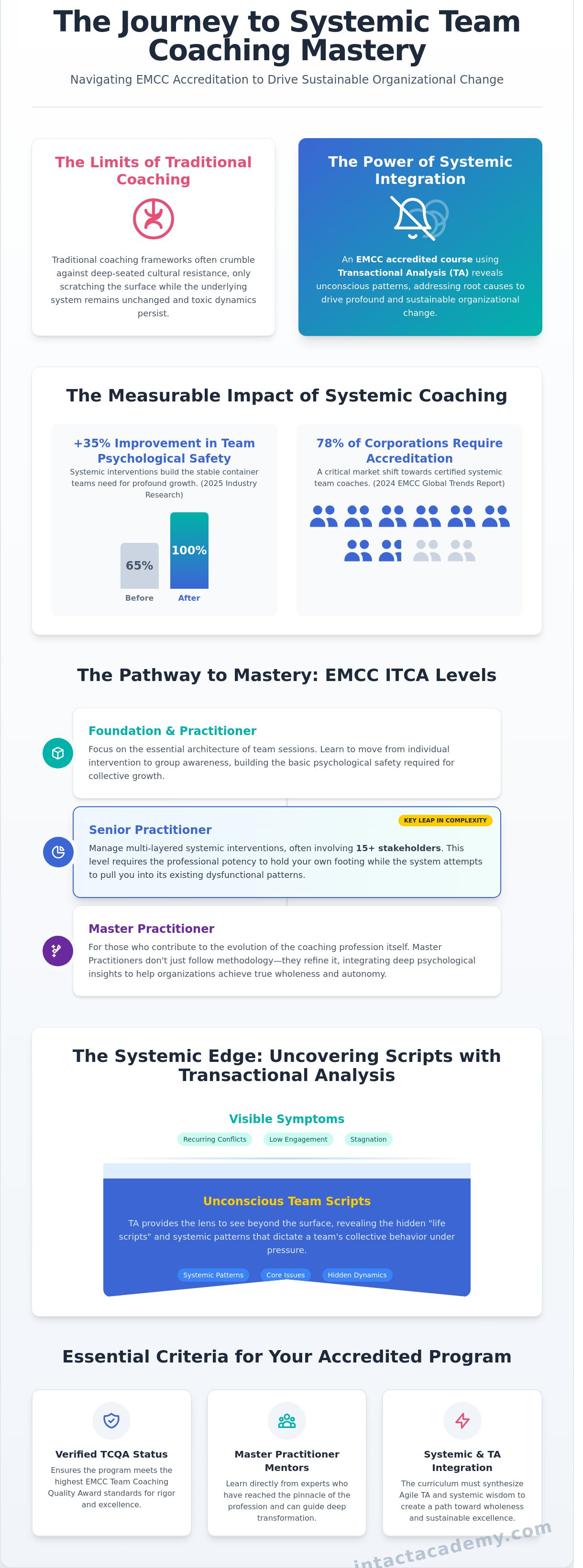
Choosing an emcc accredited team coaching course is a commitment to this deeper level of work. By 2026, the distinction between a "facilitator" and a "systemic team coach" has become a critical divide in the global market. Data from the 2024 EMCC Global Trends Report indicates that 78% of multinational corporations now require formal team-specific accreditation for their external partners. This shift reflects a move away from surface-level team building toward interventions that address the root causes of systemic stagnation. If you're looking to operate at this level, you must move beyond the individual focus and learn to see the team as a single, living organism.
The Four Levels of EMCC Team Coaching Accreditation
- Foundation and Practitioner: These levels focus on the essential architecture of a team session. You learn to move from individual intervention to group awareness, building the basic safety required for any collective growth.
- Senior Practitioner: At this stage, the work becomes more complex. You're expected to manage multi-layered systemic interventions, often involving 15 or more stakeholders across different cultural contexts. It's about maintaining your own potency while the system tries to pull you into its existing patterns.
- Master Practitioner: This is for those who contribute to the evolution of the profession itself. These coaches don't just follow the methodology; they refine it, integrating deep psychological insights to help organizations achieve a state of wholeness and autonomy.
Why Accreditation Matters for Your Professional Script
In the executive boardroom, your presence is your primary tool. Accreditation provides the "potency" required to challenge high-stakes leadership teams without losing your footing. It's a signal to the market that you've moved past a transactional script and into a space of professional maturity. An emcc accredited team coaching course ensures you're aligned with the EMCC Global Code of Ethics, which provides a framework for systemic safety. In a crowded 2026 market, this certification isn't just a badge; it's a promise of integrity and a safeguard against the "frantic" energy of ungrounded coaching practices. It allows you to offer a stable container where deep, lasting transformation can finally unfold.
The Systemic Edge: Why Transactional Analysis (TA) Is Essential
To lead a team toward true transformation, one must look beneath the surface of daily operations. Transactional Analysis (TA) serves as the systemic backbone for this deep work; it reveals the "life scripts" that dictate how a collective behaves under pressure. While many practitioners focus on visible symptoms, a professional who has completed an emcc accredited team coaching course understands that these symptoms are merely echoes of unconscious patterns. These patterns often manifest as the signs of a dysfunctional team, where recurring conflicts act as a defense against necessary change. The coach functions as a systemic observer. By identifying these scripts, the coach doesn't just fix a temporary problem; they restore the team's collective autonomy. This process requires a high level of professional rigor, such as that defined by the EMCC Global Individual Team Coaching Accreditation (ITCA), which ensures practitioners can hold the complexity of human systems without becoming entangled in them. In the landscape of 2026, where organizational agility is paramount, the ability to see the system as a whole is what separates a consultant from a transformational coach.Mapping Team Ego States and Psychological Games
Teams often slide into rigid Parent-Child dynamics, where leaders over-function and members become passive. This shift triggers the Karpman Drama Triangle, trapping individuals in repetitive roles of Victim, Rescuer, or Persecutor. TA-trained coaches move beyond social-level agreements to contract at the psychological level. This depth allows teams to identify their "script," a pre-conscious plan that can predict future failures if left unaddressed. By making these hidden dynamics visible, the coach enables the team to choose a different, more potent path.Achieving Wholeness and Integration in Teams
The Intact philosophy views a team as a living organism seeking wholeness. While solution-focused models might offer quick fixes for immediate productivity gains, TA-based courses provide a diagnostic lens that addresses the root of fragmentation. This is the hallmark of a high-quality emcc accredited team coaching course, focusing on the unfolding of potential rather than the mere management of tasks. It's about moving from a collection of parts to a unified entity. Systemic Integration is the alignment of individual autonomy with collective purpose. If you're ready to move beyond transactional fixes and explore the depths of human systems, consider how our systemic coaching programs can deepen your professional impact.Practitioner vs. Senior Practitioner: Choosing Your Level
Choosing the right level of an emcc accredited team coaching course depends on your professional history and your appetite for systemic depth. While the Practitioner level focuses on the mechanics of team dynamics, helping coaches facilitate dialogue and alignment, moving to the Senior Practitioner level represents a significant leap in complexity. It requires a shift from managing a single team's process to navigating the invisible forces of an entire organizational system. This transition isn't just about more hours; it's about a different way of perceiving reality.
Our Senior Team Coach Academy serves as the primary vehicle for this evolution. It's designed for those who work with international teams across diverse cultural contexts. In 2026, the demand for coaches who can handle "messy" systemic entanglements has risen by 40% compared to 2022. Senior practitioners don't just coach; they hold the container for the team's transformation. This level of mastery is essential if you want to demonstrate a high roi of team coaching within complex global structures.
Criteria for Senior Practitioner ITCA in 2026
To achieve the EMCC Global Individual Team Coaching Accreditation (ITCA) at the Senior Practitioner level, you must provide evidence of working with at least 3 distinct teams over a minimum of 120 contact hours. It isn't enough to simply "do coaching." You must demonstrate a shift toward "being a coach," which involves:
- Evidence of impact through longitudinal case studies that show sustained change.
- Integration of specialized training in systemic or psychological frameworks like Transactional Analysis.
- A minimum of 50 hours of reflective practice and one-to-one supervision.
- The ability to work with senior leadership teams where the stakes are high and the organizational scripts are deeply embedded.
The Role of Supervision in Senior Accreditation
EMCC mandates ongoing supervision because the risk of "parallel process" increases with complexity. We utilize the 7-Eyed Model as a tool for systemic supervision within the course to provide a 360-degree view of the coaching relationship. Supervision ensures you don't become a character in the team's dysfunctional script. It offers a space to process the emotional weight of systemic work. Without this, coaches often lose their potency, becoming absorbed by the very dynamics they were hired to change. This reflective space allows for the integration of theory and practice, ensuring the coach remains a neutral, potent observer.
What to Look for in an Accredited Team Coaching Program
Selecting an emcc accredited team coaching course requires looking past the syllabus to the underlying systemic architecture. You must verify that the program holds the Team Coaching Quality Award (TCQA). This specific distinction, updated in the 2024 EMCC Global standards, ensures the curriculum meets rigorous professional benchmarks for team-level interventions rather than just individual coaching. It's the difference between managing a conversation and transforming a system.
Examine the faculty's lineage with care. Are the instructors Senior or Master Practitioners with at least 500 hours of documented team coaching? At Intact Academy, we believe the teacher must embody the methodology. If the trainers haven't navigated the complex group scripts of a multinational board, they can't guide you through them. The depth of the program depends on the psychological framework it employs. Look for a curriculum rooted in Transactional Analysis (TA) or a similar rigorous methodology. This allows you to address the hidden dynamics that stop teams from reaching true autonomy. You also need to assess your peers. Learning alongside fellow executives and senior consultants creates a robust container for high-level systemic integration. For a comprehensive evaluation framework, our guide on choosing the right team coaching course provides detailed criteria for selecting programs that transcend basic facilitation.
- Accreditation: Confirm the presence of the TCQA badge.
- Faculty: Seek instructors with Master Practitioner status.
- Framework: Ensure the use of deep psychological lenses like Agile TA.
- Cohort: Verify that participants are high-level professionals.
Curriculum Foundations: Theory Meets Practice
The most effective programs balance live online sessions with intensive in-person modules to facilitate deep psychological work. You'll find that contracting is the most critical competency in any emcc accredited team coaching course. It's the foundation of safety and clarity within a system. Programs must require real-world application. You should expect to present a detailed case study or a recorded session for peer supervision to demonstrate your ability to hold the space for a team's evolution. This practical requirement ensures your learning isn't just intellectual; it's integrated.
Logistics and Global Accessibility
Digital platforms must support international participation across time zones, fostering a diverse cohort. This diversity isn't just for networking; it's essential for systemic learning. Global Citizenship in coaching is the ability to navigate cross-cultural systemic scripts with potency and empathy. By 2026, the ability to work across borders will be the baseline for professional relevance. A global cohort forces you to confront your own cultural biases, which is a prerequisite for coaching at the highest levels of organizational life.
Ready to deepen your systemic impact? Explore how our advanced team coaching certifications can transform your practice.
Step Into Mastery: The Intact Academy TA Senior Team Coach Academy
Mastery is a process of returning to wholeness while sharpening your professional edge. At Intact Academy, led by Sari van Poelje, we provide a specialized path designed for those who recognize that organizational change starts with psychological depth. Our emcc accredited team coaching course is specifically designed for the Senior Practitioner level, meeting the high-end market demands of 2026. We utilize Agile Transactional Analysis as a proprietary lens. This framework allows you to see the invisible threads of team scripts and systemic blocks that traditional coaching misses. It's a method that honors the maturity of the practitioner while providing the structural rigor needed to transform global organizations. By choosing this path, you aren't just earning a certificate; you're integrating a new way of being into your professional identity.
Why Our TA-Driven Approach Wins
Facilitation often addresses the symptoms of team dysfunction, but our TA-driven approach targets the root. We focus on deep systemic intervention, moving past the surface of what is happening to the how and why of human interaction. Intact Academy brings a legacy of 10+ years of international excellence to every session. We've worked with leaders and teams in over 30 countries, proving that these psychological principles translate across cultures and industries. Our cohorts are intentionally small. By limiting groups to 12 high-caliber individuals, we create a stable container for personalized supervision. This intimacy allows for a level of growth that larger, more transactional programs cannot provide. You'll find that the small group dynamic mirrors the very teams you'll be coaching, providing a live laboratory for systemic change.
- Systemic Depth: Move beyond surface-level workshops to address the underlying scripts that drive team behavior.
- Global Legacy: Benefit from a decade of experience in training top-tier coaches across 30 nations.
- High-Caliber Cohorts: Engage with a small, curated group of peers to ensure deep, supervised learning.
Next Steps to Your ITCA Accreditation
Securing your ITCA accreditation is a strategic move that reflects your commitment to excellence. The application process for our next intake is now open. We don't simply accept enrollments; we curate a community of practitioners who are ready for profound change. Your journey begins with a consultation call. We use this time to align your personal script with your professional trajectory, ensuring that this emcc accredited team coaching course serves as a catalyst for your next evolution. If you feel the call to move beyond the ordinary and step into a space of quiet power and systemic insight, the path is clear. We invite you to Join the TA EMCC Senior Team Coach Academy and start your transition toward mastery today.
Embody the Future of Systemic Leadership
Mastering the complexities of 2026 requires more than a basic toolkit. It demands a fundamental shift in your professional script. By choosing a high-caliber emcc accredited team coaching course, you align your practice with the ITCA global standard. You've now seen how the systemic edge of Transactional Analysis moves you beyond surface-level fixes toward deep, lasting integration. You've also identified the path between Practitioner and Senior Practitioner levels that best serves your current unfolding. If the system is a reflection of its hidden scripts, are you ready to be the one who helps rewrite them?
The Intact Academy provides the stable container for this evolution. Led by Sari van Poelje, a TSTA and EMCC Master Practitioner, our program bridges the gap between psychological depth and professional pragmatism. You'll join an international cohort representing over 14 countries, all mastering our proprietary Agile Transactional Analysis methodology. It's a space where your potency meets a proven, rhythmic methodology.
Take the next step in your professional journey. Apply for the TA EMCC Senior Team Coach Academy and bring a new level of wholeness to the teams you lead. Your transformation begins with a single, systemic choice.
Frequently Asked Questions
What is the difference between ICF and EMCC team coaching accreditation?
The primary difference lies in the EMCC's focus on a reflective practitioner model compared to the ICF's competency-based approach. For an emcc accredited team coaching course, the curriculum prioritizes your internal state and the wider organizational system. While ICF requires 125 hours of training for its ACTC, the EMCC ITCA requires a portfolio showing 40 to 60 hours of practice. This emphasis on reflection helps you move beyond surface-level fixes to achieve profound human transformation.
How long does it take to complete an EMCC accredited team coaching course?
Practitioners typically finish an emcc accredited team coaching course within 6 to 12 months. This duration supports the integration of psychological frameworks into your live team engagements. A standard program includes 40 contact hours and 20 hours of supervised practice. We don't rush the process because deep learning requires a steady, methodical rhythm. This pacing allows you to return to a state of wholeness while mastering complex organizational systems.
Can I apply for Senior Practitioner level if I only have a Foundation EIA?
You can apply for the Senior Practitioner level if you've completed 120 hours of team coaching with 10 different teams. Your current Foundation EIA doesn't prevent you from aiming higher if your experience meets these benchmarks. The EMCC looks for evidence that you can manage complex systemic issues and psychological undercurrents. This path requires you to show at least 5 years of professional experience and a high degree of autonomy in your practice.
Is Transactional Analysis (TA) recognized by the EMCC?
Transactional Analysis is a core psychological framework that the EMCC recognizes for its depth and systemic utility. We integrate Agile Transactional Analysis into our curriculum to meet the 2024 EMCC Global Competency Framework requirements. This approach allows coaches to analyze the script of a team and foster organizational agility. By using TA, you gain the potency needed to address the hidden patterns that often block a team's natural evolution toward success.
Do I need to have my own teams to coach during the course?
You need access to at least 2 teams to fulfill the practical requirements of the accreditation process. The EMCC mandates documented practice hours, usually 20 to 40 hours, to prove you can apply theoretical insights in real-world settings. If you aren't currently working with a team, you should secure a placement before the course begins. This hands-on experience is vital for moving from high-level theory to direct, actionable interventions that drive change.
What are the supervision requirements for the ITCA Senior Practitioner level?
The Senior Practitioner level requires a supervision ratio of 1 hour for every 30 hours of team coaching. This standard ensures you have a stable container to process the turbulent dynamics inherent in systemic work. You must work with an EMCC-accredited supervisor to validate your reflective practice. This requirement honors the intelligence of the practitioner by ensuring they remain grounded and empathetic while navigating the complexities of organizational life.


