

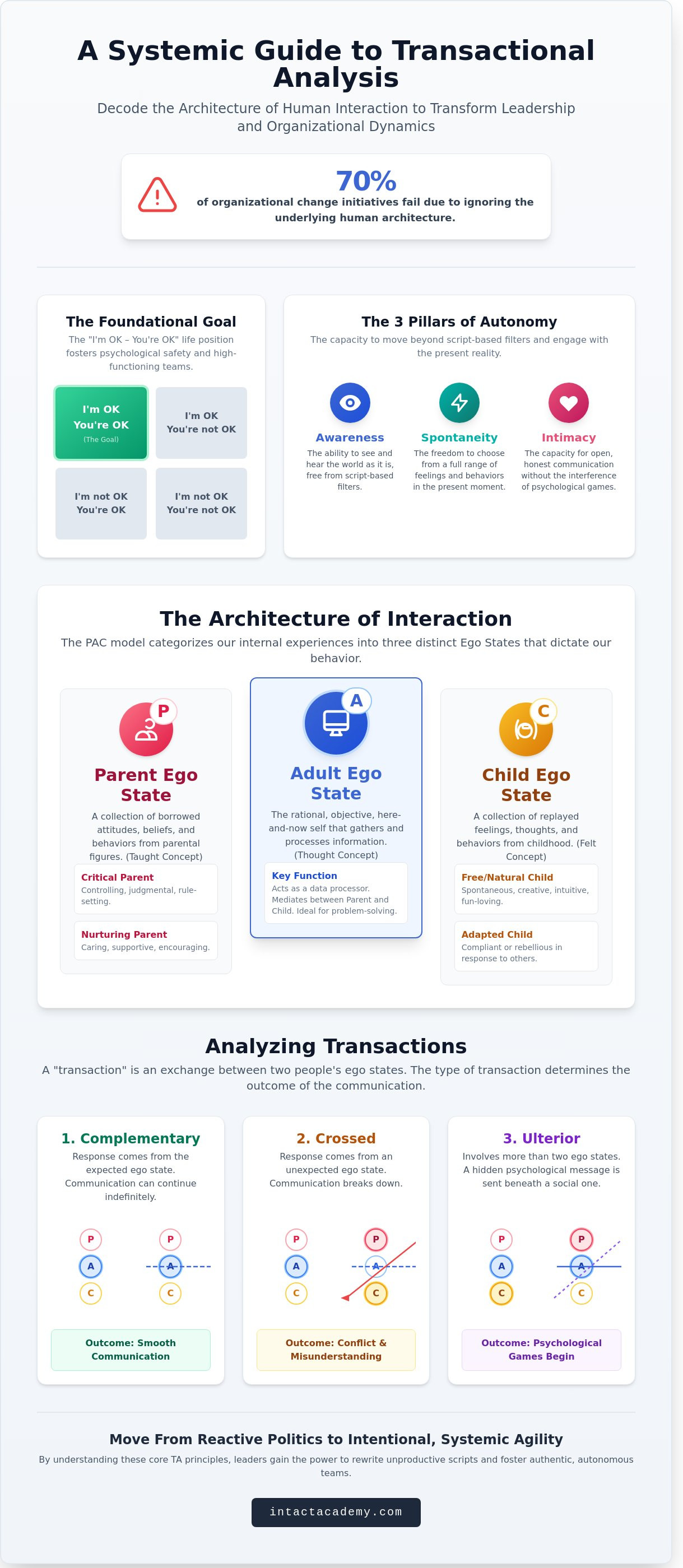
What if the recurring drama in your boardroom isn't a lack of skill, but a hidden script written years before your company even existed? You've likely felt the exhaustion of surface-level coaching that fixes symptoms while the underlying systemic patterns remain untouched. It's frustrating to watch 70 percent of organizational change initiatives fail because they ignore the profound human architecture beneath the surface. To move beyond these plateaus, you need to understand what is transactional analysis and how it serves as a sophisticated map for professional transformation.
We believe that true leadership requires the courage to look inward before taking outward action. This guide provides a systemic exploration of TA principles, offering you the potency to resolve unconscious professional patterns and reclaim your team's autonomy. You'll discover actionable tools for executive coaching and the specific steps toward professional accreditation. We'll show you how integrating these frameworks allows for a return to wholeness and authenticity in every professional interaction. This is your pathway to moving from reactive politics to intentional, systemic agility.
Key Takeaways
- Understand what is transactional analysis by exploring a systemic framework that transforms childhood scripts into adult professional autonomy.
- Learn to decode the architecture of human interaction through ego states, allowing you to de-escalate workplace conflict and foster authentic communication.
- Identify the unconscious life scripts and repetitive psychological games that often hinder systemic growth and organizational agility.
- Elevate your leadership from surface-level tactics to profound character evolution, using precise psychological tools to navigate complex organizational dynamics.
- Discover the path toward professional mastery and accreditation, ensuring your practice is grounded in the depth and integrity required for true human flourishing.
Defining Transactional Analysis: A Systemic Framework for Human Growth
To understand what is transactional analysis, one must view it as more than a psychological theory; it's a practical map for human interaction and organizational health. Developed by Dr. Eric Berne in the late 1950s, this systemic framework posits that our early childhood experiences coalesce into unconscious life "scripts" that dictate our adult professional behaviors. While traditional psychoanalysis often lingers in the past, Transactional Analysis (TA) operates on a contractual basis. It demands clear, observable goals and a mutual commitment to change between the practitioner and the client. This focus on measurable outcomes makes it uniquely suited for the fast-paced demands of the modern boardroom.
This methodology serves as a potent diagnostic tool for leaders who seek to move beyond surface-level fixes. It allows them to identify why certain communication patterns fail and how to realign them for better outcomes. For those seeking a comprehensive overview of Transactional Analysis, the theory provides a structured way to analyze the "transactions" or exchanges between individuals. By identifying these patterns, professionals can move from reactive habits to intentional, autonomous choices. If a leader recognizes their script, they gain the power to rewrite it. In the context of organizational agility, asking what is transactional analysis reveals a framework designed to replace rigid hierarchies with fluid, adult-to-adult interactions.
The Origins of TA: From Clinical Roots to Modern Coaching
Eric Berne's departure from the San Francisco Psychoanalytic Institute in 1956 marked a pivotal shift in behavioral science. He moved away from the opaque, long-term processes of Freud toward a more transparent, accessible system. By the time he published "Games People Play" in 1964, TA had transitioned from a clinical modality into a robust tool for organizational development. This evolution aligns perfectly with contemporary coaching values. It prioritizes a partnership of equals where both parties hold responsibility for the growth process, fostering an environment of mutual respect rather than clinical detachment.
The Philosophy of "I'm OK – You're OK": Establishing Autonomy
The core of TA philosophy rests on the four life positions, with "I'm OK – You're OK" serving as the foundational goal for high-functioning teams. This stance isn't about passive agreement. It represents a deep-seated respect for the inherent value of every individual. In this space, leaders foster true autonomy, which Berne defined through three specific capacities:
- Awareness: The ability to see and hear the world as it is, free from script-based filters.
- Spontaneity: The freedom to choose from a full range of feelings and behaviors in response to the present moment.
- Intimacy: The capacity for open, honest communication without the interference of psychological "games."
When a team operates from this "OK-OK" position, psychological safety becomes a tangible reality rather than a corporate buzzword. It creates a stable container where innovation and vulnerability coexist, allowing the organization to flourish as a whole. This philosophical stance acts as a thematic North Star, guiding individuals back to a state of wholeness and authenticity.
The Architecture of Interaction: Ego States and Transactions
Communication is never just a sequence of words. It's a psychological exchange between specific parts of our personality. When we ask what is transactional analysis, we're essentially looking at the "transaction" as the fundamental unit of social intercourse. Eric Berne, who pioneered this field in the late 1950s, observed that every interaction reveals which internal state is currently in control. For a professional coach or leader, mapping these exchanges provides a blueprint for why certain relationships thrive while others collapse into repetitive, unproductive patterns. By identifying these states, you gain the potency to de-escalate conflict in seconds.
Decoding the PAC Model: Parent, Adult, and Child States
The PAC model is the cornerstone of systemic insight. It categorizes our internal experiences into three distinct ego states that dictate how we show up in the workplace:
- The Parent state: This contains borrowed values, rules, and "shoulds." In leadership, it often manifests as either the Nurturing Parent who supports or the Controlling Parent who demands compliance based on 20-year-old organizational dogmas.
- The Adult state: This is the data-processing center. It deals with objective reality and here-and-now problem solving. It's the state required for effective 21st-century agility.
- The Child state: This holds our emotions, creativity, and archaic reactions to authority. When an executive feels "small" during a board review, they've likely slipped into a Rebellious or Adapted Child state.
You can find a more granular breakdown of these dynamics in our guide to Transactional Analysis Ego States: A Professional Guide to the PAC Model. Recognizing these shifts is the first step toward professional autonomy.
The Three Types of Transactions: Complementary, Crossed, and Ulterior
Transactions are the pulses of organizational life. Complementary transactions occur when the ego states of two people align. If a manager speaks from Adult to Adult and the employee responds in kind, the communication is open and can continue indefinitely. While these feel comfortable, they can sometimes be unproductive if a team remains stuck in a rigid Parent-Child dynamic for years without challenge.
Crossed transactions are the root of 90% of workplace "misunderstandings." These happen when a message is sent from one ego state but receives a response from an unexpected one. If a director asks for a status update (Adult) and the manager responds with defensive anger (Child), the communication line breaks. According to the International Transactional Analysis Association, learning to reset these crossed lines is essential for maintaining systemic health and operational flow.
Ulterior transactions are the most complex. These involve hidden agendas where a social message masks a different psychological intent. In these moments, what is transactional analysis becomes a tool for unmasking double-messages in corporate culture. Identifying the "hidden hook" in a conversation allows you to remain grounded and authentic. If you're ready to bring this level of depth to your leadership, exploring our systemic coaching programs can provide the structured methodology you need to transform these interactions into opportunities for growth.
The Unseen Blueprint: Life Scripts and Psychological Games
Behind every strategic pivot and every interpersonal conflict lies a silent architecture. Most professionals believe they act with pure logic, yet they are often following a script written by the age of seven. When we ask what is transactional analysis in a corporate context, we are essentially asking how these early blueprints dictate modern performance. These unconscious narratives create a glass ceiling for leadership long before a person enters the C-suite. By identifying these patterns, leaders move from being reactive players in a drama they didn't write to becoming conscious authors of their professional destiny.
Life Scripts: Understanding Your Unconscious Professional Narrative
A life script is an unconscious plan for living, formed in childhood and reinforced by early experiences. It functions as a internal GPS, guiding your risk tolerance, career choices, and leadership style. If you find yourself repeatedly hitting the same ceiling or attracting the same type of conflict, you might be operating under a "Don't Succeed" or "Don't Be Important" injunction. Research from 2023 suggests that approximately 65% of executive burnout cases stem not from workload, but from the internal friction of living out a script that no longer fits. You can explore this further in our guide on Transactional Analysis Life Scripts: Uncovering the Unconscious Blueprint of Professional Impact. Coaches use these insights to help leaders rewrite their narratives, replacing limiting beliefs with a sense of potency and autonomy.
Why We Play Games: The Drama Triangle in Corporate Environments
Psychological games are repetitive, dysfunctional patterns of interaction that always end with a predictable, negative payoff. These games provide a counterfeit sense of belonging but destroy systemic productivity. Within the International Transactional Analysis Association framework, these interactions are often mapped using the Drama Triangle, consisting of three specific roles:
- The Persecutor: Blames others to maintain a sense of power.
- The Rescuer: Offers help that isn't requested to feel needed, often creating dependency.
- The Victim: Acts helpless to avoid responsibility, inviting others to rescue or persecute them.
In a 2021 organizational study, it was found that teams caught in these cycles spend up to 2.8 hours per week on office politics rather than core tasks. These patterns are detailed in our analysis of Psychological Games in the Workplace: A Transactional Analysis Perspective on Office Politics. Understanding what is transactional analysis allows a leader to step out of the triangle and move toward the "Winner's Triangle," where vulnerability replaces victimhood and potency replaces persecution. This shift is the first step toward systemic organizational change and a return to professional wholeness.
From Theory to Impact: TA in Leadership and Organizational Change
Understanding what is transactional analysis involves recognizing it as a diagnostic lens for the invisible forces governing team dynamics. It offers a precise language for describing complex systemic issues that otherwise remain nameless and unaddressed. Most leadership development programs fail because they focus on surface-level behaviors. TA moves the needle because it demands a profound evolution of character. It shifts the focus from "managing others" to understanding the internal scripts that dictate how we show up in high-pressure environments.
Systemic TA allows for interventions that stick. When a leader understands their own ego states, they stop reacting to ghosts of the past and start responding to the reality of the present. This clarity is the foundation of professional potency. It ensures that change isn't just a temporary shift in policy, but a permanent evolution in how the organization breathes and functions.
Transactional Analysis as a Tool for Executive Coaching
Executive presence is the byproduct of an integrated Adult ego state. In coaching, we use TA to help leaders identify when they've slipped into a reactive "Child" or a critical "Parent" mode. A 2022 analysis of executive performance showed that leaders who utilized ego-state awareness reduced conflict-related delays by 30%. Contracting for change is our primary tool; it ensures the coach and client are aligned on specific, measurable outcomes. This methodology moves leaders from a state of reactive firefighting to one of proactive, integrated professional impact.
Systemic Transformation: Using TA to Map Organizational Culture
Organizations develop their own "Parent" rules and "Child" emotional atmospheres over time. When a company sees a 20% turnover rate in a single department, it's often a scripted organizational failure rather than a talent issue. We use Agile Transactional Analysis to map these collective ego states and identify where the "group script" is stifling growth. By addressing these root causes, we foster a culture of wholeness. This approach allows teams to move beyond silos and burnout, creating an environment where agility is a natural expression of the system's health. For practitioners seeking to develop these skills, our comprehensive guide on choosing the right team coaching course provides essential criteria for selecting programs that integrate Agile Transactional Analysis with systemic transformation methodologies. When you're ready to implement these insights at scale, our framework for leading organizational change through a systemic and psychological perspective offers a comprehensive methodology for navigating the complex human and systemic layers of transformation.
The journey toward systemic health requires a willingness to look beneath the surface. It's about returning to a state of authenticity where the individual and the organization are no longer at odds. If you're ready to lead with this level of depth, explore our Systemic Leadership and Coaching programs to begin your transformation.
Cultivating Professional Mastery through Accredited TA Training
Understanding what is transactional analysis at a theoretical level is only the first step toward professional excellence. True mastery requires a shift from cognitive knowledge to embodied wisdom. It isn't enough to read the literature; you must live the concepts through supervised practice and systemic integration. This process transforms a collection of psychological tools into a potent professional identity. At Intact Academy, we believe that the learning journey is a systemic evolution where the practitioner becomes the primary instrument of change.
Data from global coaching bodies indicates that practitioners who engage in structured supervision report a 40% increase in their ability to manage complex client dynamics within the first year. This isn't a coincidence. Supervision provides the necessary mirror to identify where your own script might be interfering with your professional potency. It creates a safe container where you can explore the nuances of what is transactional analysis in real-time applications, ensuring that your interventions remain ethical, clear, and impactful. For coaches seeking to move beyond this plateau and evolve from tactical practitioner to systemic master, a structured approach to professional development for coaches grounded in psychological depth and accredited excellence provides the essential framework for navigating complex client dynamics with quiet power and stability.
The Journey to EMCC Senior Practitioner Accreditation
Professional standards provide the essential framework for high-stakes executive work. Our TA training fulfills the rigorous requirements for senior-level coaching certifications, moving you beyond surface-level techniques. If you want to facilitate deep-seated change, then you must align your practice with global benchmarks of excellence. Supervision acts as the rhythmic heartbeat of this growth; it protects the integrity of the work and prevents the unconscious re-enactment of organizational dramas. This path is vital for those seeking an Executive Coaching Certification: A Guide to Mastery and Systemic Impact in 2026.
Why Systemic Depth Matters: The Intact Academy Philosophy
Sari van Poelje's approach bridges the gap between individual psychological depth and organizational pragmatism. By combining TA with systemic insights, the "Intact" philosophy encourages a return to authenticity and wholeness. In a corporate world often fragmented by silos and reactive patterns, returning to an "I'm OK, You're OK" stance is a radical and necessary act of leadership. Our curriculum is designed to help you rediscover this original state of health, both personally and professionally. For those ready to work with entire teams, selecting a comprehensive team coaching course that integrates systemic TA principles ensures you can facilitate transformation at both individual and collective levels.
Getting started on this journey is a deliberate choice. We offer a variety of entry points to suit your current level of experience:
- Introductory Workshops: Short, intensive sessions that provide a foundational grip on systemic TA concepts.
- Masterclasses: Specialized deep dives into topics like organizational scripts, agility, and power dynamics.
- Long-term Academy Programs: Comprehensive 3-year paths that lead to professional certification and profound personal transformation.
These programs translate 35 years of global consulting expertise into actionable frameworks. They invite you to move beyond transactional interactions and toward a state of systemic agility. The journey toward wholeness is a lifelong commitment, but it begins with the courage to look inward and the structure to move forward.
Embrace the Path to Systemic Wholeness
Professional mastery requires more than just new skills; it demands a fundamental shift in how you perceive human systems. You've explored how ego states shape your daily interactions and how unconscious life scripts can limit organizational agility. Understanding what is transactional analysis serves as the essential catalyst for this evolution. It allows you to move beyond psychological games and toward a state of true autonomy. When you integrate these systemic insights, your leadership gains a new level of potency and authenticity. This isn't just about business coaching. It's about returning to a state of wholeness that transforms every transaction you lead.
If you're prepared to bridge the gap between psychological depth and professional pragmatism, our academy offers a structured container for your growth. Led by international expert Sari van Poelje, our EMCC and ICF accredited programs bring together leaders from over 14 countries. We utilize the proprietary lens of Agile Transactional Analysis to ensure your development is both profound and actionable. Explore our TA EMCC Senior Practitioner Academy and deepen your systemic impact. Your capacity for profound change is already within you. It's time to let it unfold.
Frequently Asked Questions
What is the main goal of Transactional Analysis in a professional setting?
The main goal of Transactional Analysis in a professional setting is to achieve autonomy by fostering awareness, spontaneity, and intimacy within organizational structures. By exploring what is transactional analysis, professionals learn to move toward 100% responsibility for their communication and impact. This systemic approach helps leaders transition from unconscious scripts to conscious presence, ensuring that every interaction adds value to the collective goal and promotes psychological safety.
How do the three ego states (Parent, Adult, Child) affect my leadership style?
Your leadership style shifts depending on which ego state you inhabit during a crisis or meeting. If you're in the Parent state, you might find yourself micromanaging or over-nurturing 80% of your team's tasks. The Adult state allows for objective data processing, while the Child state brings creative energy or defensive reactions. Effective leaders learn to integrate these states, using the Adult as a clear-eyed executive to balance the others.
What is a "life script" and how does it influence my career progression?
A life script is an unconscious life plan created by age 7 that dictates how you view success, failure, and your role in the world. In a career context, this might manifest as a "Never" script where you consistently miss out on promotions despite high performance. Research by Eric Berne suggests these patterns repeat until we bring them into Adult awareness. By identifying these early decisions, you can rewrite your professional narrative to align with your current potential.
Is Transactional Analysis the same as psychotherapy?
Transactional Analysis isn't limited to psychotherapy; it's a versatile framework with four distinct fields of application including organizational and educational growth. While it originated in clinical settings, the International Transactional Analysis Association (ITAA) recognizes specific branches for professional development. In our work, we apply TA as a tool for systemic change and professional agility. It's less about healing past trauma and more about optimizing current professional relationships and organizational health.
How can I spot psychological games in my team using TA?
You can spot psychological games by identifying repetitive, ulterior transactions that end in a predictable, negative payoff for all parties. These often follow the Karpman Drama Triangle, where team members rotate between the roles of Victim, Rescuer, and Persecutor. If a 30-minute meeting leaves everyone feeling drained and confused, a game is likely in play. Recognizing these patterns allows you to stop the "switch" and return to productive, Adult-to-Adult communication.
What are the benefits of getting an EMCC accreditation through TA training?
An EMCC accreditation through TA training provides a globally recognized validation of your coaching mastery and ethical standards. This certification signals to clients that you possess the 8 core competencies required for professional practice at a Foundation or Practitioner level. It bridges the gap between psychological theory and executive coaching. Graduates often report a 40% increase in client retention because they address the systemic roots of behavior rather than just surface-level symptoms.
Can Transactional Analysis be used for organizational change management?
Transactional Analysis is a powerful engine for organizational change management because it addresses both the individual and the systemic structure. By analyzing the "organizational script," leaders can identify why 70% of change initiatives typically fail due to cultural resistance. We use Agile Transactional Analysis to create flexible, autonomous teams that can pivot during market shifts. This methodology ensures that structural changes are supported by the underlying psychological contracts within the workforce.
How long does it take to become proficient in using TA for coaching?
Proficiency begins with the TA 101 introductory course, which typically lasts 2 days and covers the core concepts. To truly integrate these tools into coaching, most professionals complete a 1-year Foundation certificate. Achieving status as a Certified Transactional Analyst (CTA) requires 750 hours of practical application and 600 hours of training. This path ensures you don't just learn the theory but embody the methodology in every high-stakes professional interaction.


