

What if the true measure of a leader's growth isn't found in a post-workshop survey, but in the subtle shift of a team’s collective nervous system during a crisis? With 77% of organizations globally reporting a persistent leadership gap, the pressure of measuring the impact of leadership development has moved beyond simple accounting into the realm of systemic integrity. You've likely felt the hollow satisfaction of "smile sheets" and superficial metrics that fail to capture the visceral reality of human change. It's exhausting to balance the demand for hard ROI with the quiet knowledge that deep behavioral evolution doesn't always fit neatly into a spreadsheet.
In this article, we move beyond the binary of profit and loss to explore a more rigorous, systemic method for evaluating growth. You'll discover how to look past surface-level performance to identify the psychological markers of a leader who has truly returned to a state of completeness and genuineness. We'll provide a robust evaluative framework and the specific tools needed to track behavioral evolution, giving you the confidence to champion the long-term value of coaching and organizational flourishing. We're moving from reactive metrics to a narrative of profound, sustainable transformation.
Key Takeaways
- Move beyond the "smile sheet" trap by identifying why immediate satisfaction scores often fail to predict long-term systemic change.
- Learn a sophisticated framework for measuring the impact of leadership development that integrates traditional Kirkpatrick levels with deep psychological needs analysis.
- Discover how to quantify profound shifts in transactional maturity, such as the movement from reactive ego states to autonomous interactions.
- Establish a robust measurement strategy by defining success through contracting and integrating multi-source feedback before the first session begins.
- Explore how bridging psychological theory with rigorous professional standards creates a stable container for measurable, long-term organizational transformation.
The Limitations of ROI: Why Traditional Leadership Metrics Fall Short in 2026
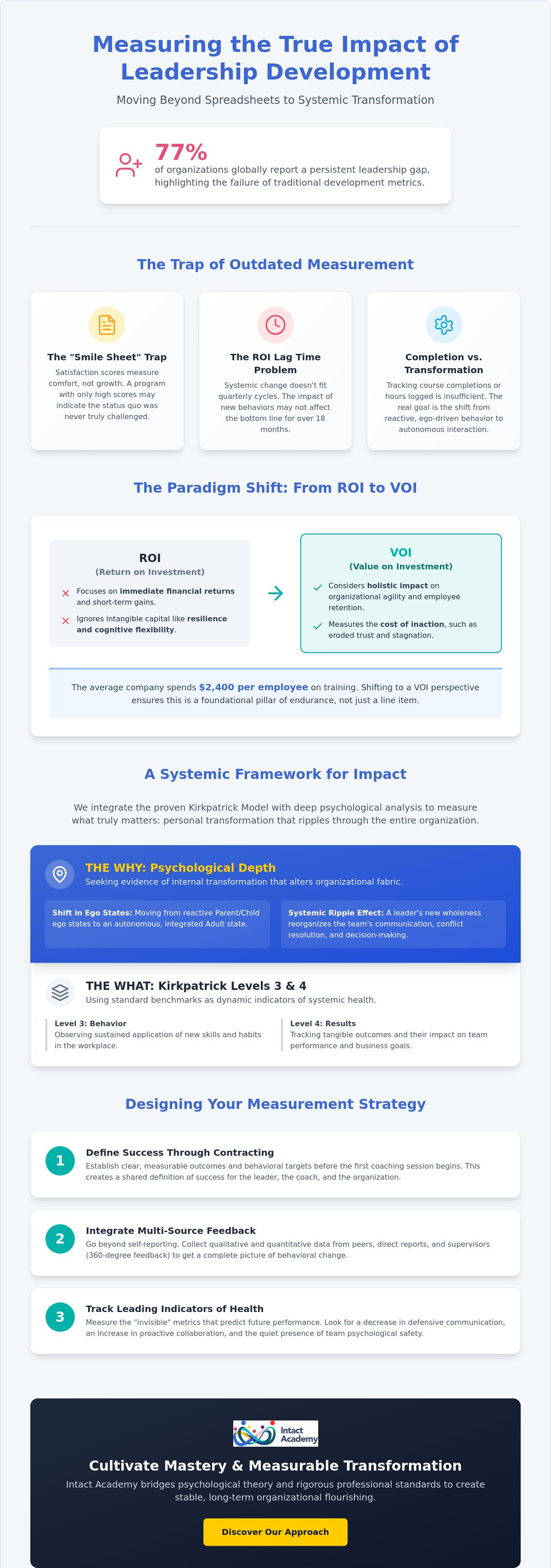
The pressure to quantify the human experience often leads us toward the easiest data points rather than the most meaningful ones. Many organizations remain tethered to participant satisfaction scores, colloquially known as "smile sheets," to justify their developmental spend. These metrics measure comfort, not growth. They tell us if the catering was adequate or if the facilitator was charismatic, but they offer no insight into whether a leader's internal architecture has actually shifted. Real Leadership development is often a disruptive process. If a program only yields high satisfaction scores, it may suggest that the status quo was never truly challenged.
When we discuss measuring the impact of leadership development, we must also confront the lag time problem. Systemic change doesn't happen on a quarterly cycle. A leader might adopt a new way of listening today, but the resulting increase in team psychological safety and innovation may not manifest in the bottom line for another eighteen months. Traditional ROI calculations are often too blunt an instrument to capture this slow, steady evolution. They prioritize immediate financial returns while ignoring the cultivation of intangible capital, the internal resilience and cognitive flexibility that allow an organization to survive a volatile market.
We're seeing a necessary shift from measuring completion to measuring transformation. It's no longer enough to track how many executives finished a course or how many hours were logged in a digital portal. True mastery is found in the movement from reactive, ego-driven behaviors to autonomous, adult-to-adult transactions. This transformation requires a deeper level of inquiry that looks past the spreadsheet to the very core of organizational health.
Beyond the Spreadsheet: Capturing Qualitative Evolution
Capturing the invisible indicators of success requires a move toward transformational insights. We look for the subtle cues: a decrease in defensive communication, an increase in proactive collaboration, and the quiet presence of psychological safety. These aren't just soft metrics; they're the leading indicators of future performance. To quantify these shifts without losing their nuance, we use structured self-reflection and observational data that track how leaders navigate tension and complexity within their systems.
The ROI vs. VOI (Value on Investment) Debate
Value on Investment (VOI) offers a more holistic alternative to traditional financial return. It asks us to consider the broader impact on organizational agility and employee retention. We must also measure the cost of inaction. What's the price of a leader who refuses to evolve? In 2026, with the average company spending $2,400 per employee on training, the risk isn't just lost capital. It's the erosion of trust and the eventual stagnation of the entire system. Aligning metrics with long-term health ensures that development isn't just a line item, but a foundational pillar of endurance.
A Systemic Framework for Impact: Integrating Kirkpatrick with Psychological Depth
Integrating psychological depth into the Kirkpatrick model requires a willingness to look beneath the surface of observable behavior. While Kirkpatrick's levels 3 and 4 (behavior and results) are standard benchmarks, they're often treated as static end-points. When measuring the impact of leadership development through a systemic lens, these levels become dynamic indicators of health. We aren't just looking for new habits. We're seeking evidence of personal transformation in leadership that alters the very fabric of the organization.
One leader's shift from a Parent ego state to an Adult state creates a cascade. It changes how teams communicate, how conflict is resolved, and how decisions are made. This ripple effect is where true systemic impact resides. If a leader returns to a state of wholeness, the system around them must eventually reorganize to match that new frequency. Transactional Analysis (TA) provides the language for this, explaining that behavioral changes stick only when they're supported by a shift in the leader’s internal script. Without this psychological alignment, new behaviors are often just performances that fail under pressure.
Understanding these dynamics is a core component of our Team Coaching approach, where we facilitate the move from individual insight to collective action.
The Baseline: Using Needs Analysis as an Evaluative Tool
Before any intervention, a systemic audit is essential to identify the hidden organizational scripts that act as silent barriers to progress. Competitors often overlook the unconscious biases that skew baseline data. By conducting a deep psychological needs analysis, we establish a grounded starting point that honors the complexity of the human system. Systemic baseline evaluation is the process of mapping existing transactional patterns and unconscious organizational narratives to identify the precise psychological shifts required for genuine autonomy.
Level 4 Results: Measuring Systemic Health
True results are found in the longevity of change. By utilizing a comprehensive organizational culture assessment, we can track how individual growth translates into collective resilience. We see this in measurable improvements in decision-making speed and a reduction in systemic friction. Evaluating these outcomes six months post-intervention ensures that the development wasn't a fleeting performance but a permanent evolution. This longitudinal view is vital for measuring the impact of leadership development in a way that satisfies both the board's demand for data and the system's need for depth.
Measuring the Unseen: Quantifying Shifts in Ego States and Scripts
Traditional metrics often fail because they stay on the surface. To truly master measuring the impact of leadership development, we must venture into the invisible architecture of the human psyche. This means moving beyond what a leader does to understanding who they are becoming. We look for transactional maturity. This is the measurable shift from reactive Parent-Child dynamics to stable, Adult-to-Adult interactions. When a leader operates from their Adult ego state, they process reality in the present moment rather than repeating old, defensive patterns from the past.
The Kirkpatrick model provides a useful framework for measuring leadership development, but it requires a psychological layer to capture internal evolution. We track script transformation by analyzing self-reflection data. This data reveals how a leader is rewriting their internal narrative to move toward greater autonomy. We also observe "Presence" as a behavioral metric. It's not a vague charisma; it's the observable ability to remain grounded, attentive, and authentic under pressure. It's the physical and psychological evidence of a leader returning to a state of completeness and genuineness.
From Reactive to Proactive: Tracking Ego State Shifts
We define leadership growth by the movement from a "Critical Parent" state, which relies on control and judgment, to a "Nurturing Parent" or "Adult" state. Using 360-degree feedback, we map the frequency of these transactions. When a leader shifts toward Adult-to-Adult communication, we see a direct correlation with team innovation. The team no longer waits for permission. They begin to own their outcomes. This shift is a leading indicator of systemic agility and long-term health.
Dissolving Workplace Games: A Metric for High Performance
Psychological games are repetitive, ulterior transactions that end in a predictable "payoff" of negative emotions. They're expensive. They drain energy and stall decision-making. We measure the reduction of these games by tracking the frequency of "straight" versus "ulterior" transactions over time. As these games dissolve, psychological safety increases. We quantify this by observing the rise in honest, direct feedback within executive teams. The games stop. The real work begins. This measurable increase in transparency is the hallmark of a high-performing, psychologically mature system.
Designing Your Measurement Strategy: From Data Collection to Sustainable Insight
With organizations spending an average of $2,400 per employee annually on training, a strategy for measuring the impact of leadership development is no longer optional. It's a fundamental requirement for organizational integrity. This strategy is only as strong as the container built to hold it. It requires a move from retrospective justification to proactive design. We don't wait until the program ends to ask if it worked. Instead, we weave evaluative threads into the very fabric of the developmental journey. This methodical approach ensures that data collection isn't a burdensome afterthought, but a source of continuous, sustainable insight for the entire system.
To move beyond surface-level metrics, we follow a structured four-step process:
- Step 1: Contracting for Impact. We define success before the first session, ensuring that individual growth is tethered to the organization’s systemic health.
- Step 2: Multi-Source Feedback. We integrate 360-degree assessments, self-reports, and behavioral observation to create a triangulated view of evolution.
- Step 3: Longitudinal Tracking. We measure progress at three, six, and twelve-month intervals to confirm that new patterns have become the "new normal."
- Step 4: The Supervision Audit. We use systemic supervision to validate the depth and sustainability of the intervention.
Contracting for Change: The Foundation of Measurement
Evaluation is built on the bedrock of the contract. Clear coaching contracting is essential because it establishes the psychological boundaries and professional expectations for the work ahead. We align personal growth goals with systemic needs, setting both "soft" KPIs, like emotional regulation, and "hard" KPIs, like improved decision-making speed. This clarity allows us to honor the complexity of human growth without losing sight of business objectives. It ensures that every stakeholder understands what is being measured and why it matters.
Longitudinal Tracking: Ensuring the Change Sticks
Change is a process, not an event. Longitudinal tracking ensures that the transformation sticks and prevents leaders from "rubber-banding" back to old, reactive scripts when pressure mounts. We design follow-up mechanisms and encourage peer coaching to sustain the momentum. This data doesn't just measure the past. It refines future development initiatives, ensuring the organization remains agile and resilient. By measuring the "new normal" over time, we provide the board with evidence of profound, sustainable transformation.
To master the art of systemic growth and professional depth, explore our Systemic Supervision programs.
Cultivating Mastery: How Intact Academy Bridges Theory and Measurable Transformation
The journey of measuring the impact of leadership development culminates in the ability to hold both the psychological truth of the individual and the systemic needs of the organization. At Intact Academy, we don't treat these as separate domains. Our approach is rooted in the belief that rigorous professional standards and deep human insight are the two pillars of sustainable change. Through our TA EMCC Senior Practitioner Academy, we provide a stable container where complex organizational dynamics become visible and manageable. This isn't just about learning a new toolset. It's about an evolution of the practitioner’s own presence and authority.
Our executive coaching certification is designed for those who recognize that surface-level ROI is insufficient. It prepares leaders to navigate the deep currents of organizational scripts and ego states, ensuring that every intervention has a measurable, lasting effect. We validate this impact through accredited Systemic Supervision, which serves as a mirror for the coach and a safeguard for the organization. This process ensures that the coach remains grounded while the system evolves, preventing the "rubber-banding" effect discussed in previous sections.
Mastering the Art of Systemic Impact
The work of Sari van Poelje exemplifies this integration by blending the agility of modern business with the depth of Transactional Analysis. By applying Agile TA, leaders can facilitate rapid shifts that are nonetheless grounded in psychological reality. Consider a leadership team stalled by unspoken conflict. By identifying the ulterior transactions and shifting the collective script, we move them from entrenched dysfunction to systemic wholeness. International accreditation from bodies like the EMCC and ICF serves as our baseline. It ensures that the transformation we facilitate meets the highest global standards for professional excellence and ethical rigor.
Your Journey to Evaluative Mastery
We invite you to move beyond the transactional nature of typical business coaching. True mastery in measuring the impact of leadership development requires the courage to look inward before attempting to change the outward system. Our next cohort is forming, offering a space for deep professional transformation and the cultivation of genuine mastery. You'll join a global community of practitioners dedicated to the flourishing of human systems. This is more than a training program; it's an invitation to return to a state of completeness. Impact is not merely a number on a ledger. It's the quiet, powerful sound of a system finally becoming whole.
Toward a New Standard of Organizational Wholeness
The journey toward meaningful change requires us to look past the spreadsheet and into the heart of the human system. We've explored why traditional ROI often fails to capture the subtle, profound shifts in transactional maturity and internal scripts that define true growth. By adopting a systemic framework, measuring the impact of leadership development becomes a process of witnessing a system return to its state of completeness. You now have the tools to track these invisible markers, from ego state shifts to the dissolution of psychological games, ensuring that transformation is both observable and sustainable.
This path to evaluative mastery is not one you must walk alone. Led by world-renowned expert Sari van Poelje, our programs have empowered professionals from over 14 countries to bridge the gap between psychological depth and business results. We invite you to deepen your practice within a stable, expert container that honors your professional maturity.
Explore our TA EMCC Senior Practitioner Academy for deep, measurable leadership mastery through our EMCC and ICF accredited programs. The courage to measure what truly matters is the first step toward a flourishing, autonomous organization.
Frequently Asked Questions
How do you measure the ROI of leadership development when results are qualitative?
Qualitative results are captured by translating behavioral shifts into Value on Investment (VOI). Instead of searching for immediate dollar signs, we track indicators like reduced turnover, increased decision-making speed, and the presence of psychological safety. These metrics reflect the health of the organizational system. By measuring the impact of leadership development through these qualitative lenses, you create a narrative of long-term resilience that traditional accounting often misses.
What is the best framework for measuring the impact of executive coaching?
The most effective framework integrates the four levels of Kirkpatrick with deep psychological needs analysis and multi-source feedback. This approach goes beyond mere participation to analyze how leadership behaviors actually change in the workplace. We look for evidence of personal transformation that alters team dynamics. By combining hard KPIs with observational data, you build a robust evaluative structure that honors both business pragmatism and human depth.
Can Transactional Analysis really be used to track leadership growth?
Transactional Analysis offers a precise methodology for tracking evolution by mapping a leader's movement between ego states. We observe the frequency of Adult-to-Adult transactions compared to reactive Parent-Child patterns. As a leader moves toward autonomy, their internal script changes; this is a highly reliable indicator of growth. This psychological depth provides a level of detail that generic competency models simply can't match.
How long does it take to see the measurable impact of a leadership program?
While subtle behavioral shifts can be observed almost immediately, systemic impact usually manifests between 6 and 18 months. Real transformation requires time for new patterns to settle and for the team to reorganize around the leader's evolved presence. Longitudinal tracking at 3, 6, and 12 months is essential. This steady rhythm ensures that measuring the impact of leadership development captures lasting change rather than a temporary boost in morale.
What are the most common mistakes when evaluating leadership development?
The most frequent error is over-reliance on "smile sheets" or participant satisfaction scores. These measure comfort rather than growth. Other mistakes include failing to establish a psychological baseline and ignoring the systemic context in which the leader operates. Without a clear contract and a deep understanding of organizational scripts, any measurement will remain superficial. You must look for transformation, not just completion.
How do you measure psychological safety as a leadership outcome?
Psychological safety is quantified through behavioral observation and the frequency of "straight" transactions within a team. We track how often team members offer honest feedback or challenge ideas without fear of retribution. A reduction in psychological games is a direct indicator of increased safety. By measuring these specific interactions, you turn a soft concept into a concrete marker of a high-performing leadership culture.
Why is a baseline needs analysis critical for measuring impact?
A baseline needs analysis is critical because it identifies the existing organizational scripts and transactional patterns before an intervention begins. Without this data, you have no grounded "before" state to compare against. It reveals the hidden barriers to change that might skew your results. This analytical foundation ensures that your measurement strategy is built on reality rather than assumptions.
Is it possible to measure the ROI of team coaching specifically?
Measuring the impact of team coaching is entirely possible through metrics like team cycle times and conflict resolution speed. We also look for a reduction in systemic friction and the elimination of repetitive workplace games. These shifts lead to more efficient decision-making and higher levels of collective autonomy. When the team system becomes more functional, the resulting productivity gains provide a clear, measurable return on the investment.


