

The most costly error a leader can make is not a failed strategy, but the misapplication of human development. When the boundaries between developmental roles blur, accountability vanishes into a fog of ambiguity that stalls organizational progress. You have likely witnessed mentoring programs that gradually devolve into unstructured social chats; perhaps you've felt the frustration of coaching that remains an isolated island, disconnected from the broader systemic goals of your business. Understanding the nuance of mentoring vs coaching in the workplace is no longer just a human resources task. It's a strategic imperative for any leader committed to genuine flourishing.
We recognize the weight of this responsibility and the desire to move beyond transactional training toward something more complete. This exploration provides a clear framework to assign the right developmental intervention at the right time. You will discover the psychological distinctions that define these roles and the measurable ROI of professional accreditation in a market where 70% of individuals report improved performance through structured support. This journey will help you shift your organizational culture from tactical responses to a sophisticated, systemic environment of growth and human transformation.
- Distinguish between the wisdom-led transfer of mentoring and the performance-driven, non-directive process of professional coaching.
- Apply Transactional Analysis to navigate the complex ego states that shape developmental relationships and organizational power dynamics.
- Utilize a strategic framework for mentoring vs coaching in the workplace to align individual growth with your organization's systemic goals.
- Recognize the necessity of systemic supervision and professional accreditation as essential safeguards for sustaining high-level leadership impact.
- Discover how a holistic approach to human development can shift your culture from tactical training to profound transformation.
Defining the Developmental Contract: What is Mentoring and Coaching?
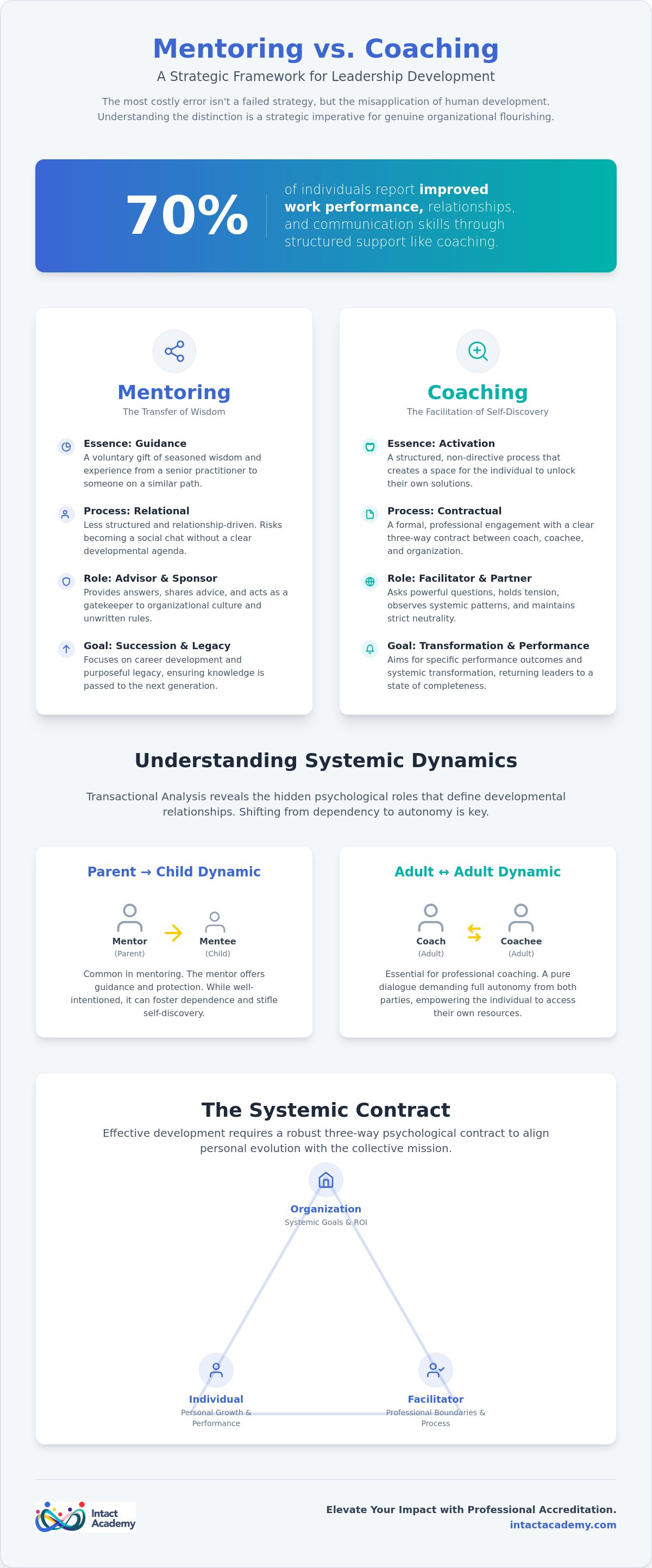
To understand growth, we must first understand the boundaries that contain it. In many organizations, the terms are used interchangeably, yet the psychological weight they carry is vastly different. Mentoring is fundamentally a voluntary gift; it is the transfer of seasoned wisdom and experience from a senior practitioner to someone navigating a similar path. Coaching, by contrast, is a structured and non-directive process. It does not provide answers but instead creates a space for self-discovery and specific performance outcomes. This Coaching definition highlights a shift from telling to asking, from expertise to facilitation.
The true challenge of mentoring vs coaching in the workplace often lies in the "psychological contract." These are the unstated, often unconscious expectations that both parties bring to the table. When a mentee expects a career advocate but receives only technical advice, or when a coachee expects a friend but encounters a rigorous challenger, the intervention derails. In a professional setting, this relationship cannot exist in a vacuum. It requires a robust three-way contract between the facilitator, the individual, and the organization itself. This systemic alignment ensures that personal evolution serves the collective mission.
The Essence of Modern Mentoring
Modern mentoring has evolved far beyond the informal "Old Boys Club" of the past. Today, it serves as a strategic and inclusive vehicle for knowledge transfer. The mentor acts as a vital gatekeeper to organizational culture, translating the unwritten rules that define success. For this to flourish in 2026, mentoring requires a clear developmental agenda. Without structure, these sessions risk becoming pleasant social chats that offer comfort but lack the friction necessary for growth. It is about purposeful legacy.
The Professionalism of Executive Coaching
Executive coaching has matured into a disciplined profession that demands more than just good listening skills. It is now a catalyst for those pursuing executive coaching certification, moving away from "fixing" underperformers toward facilitating systemic transformation. High-stakes interventions require specific competencies: the ability to hold tension, the capacity to observe organizational patterns, and the integrity to remain neutral. It is about helping leaders return to a state of completeness so they can lead with genuine authority. This depth of practice distinguishes a certified professional from a well-meaning amateur.
The Systemic Mechanics: Ego States and Power Dynamics
Growth does not occur in a vacuum. It happens within the invisible architecture of human interaction, where every exchange carries a hidden blueprint. To truly grasp the distinction between mentoring vs coaching in the workplace, we must look beneath the surface of the conversation at the ego states we inhabit. Transactional Analysis (TA) provides us with the vocabulary to understand these dynamics, moving us away from surface-level management toward profound human transformation. Every professional interaction is a transaction between three internal states: the Parent, the Adult, and the Child.
In traditional mentoring, there is a natural tendency to slip into a "Nurturing Parent" role. The mentor offers guidance, protection, and wisdom. While this is often well-intentioned, it can inadvertently cast the mentee into a "Natural Child" ego state, where they seek permission or validation rather than their own truth. Coaching, by contrast, thrives in a pure Adult-to-Adult dialogue. It demands that both parties show up with full autonomy. By stripping away the hierarchy, coaching empowers the individual to access their own internal resources. Effective mentoring and coaching in an organization depends on the leader's ability to recognize when these psychological positions become stagnant or counterproductive.
Transactional Analysis and Role Clarity
When roles are poorly defined, organizations often fall prey to "psychological games." These are repetitive, unproductive patterns of communication, such as the "Yes, But" game, where a mentee asks for advice only to reject every suggestion offered. By learning what is transactional analysis, practitioners can map these relationship patterns and intervene before they derail progress. Shifting from directive advice to reflective inquiry allows the relationship to return to a state of completeness and genuine Adult-to-Adult connection.
Power and Vulnerability in Professional Growth
The "Expert Trap" is a common pitfall for senior leaders. When mentors over-direct, they may inadvertently stifle the very innovation they hope to foster. Creating true psychological safety requires clean contracting and clear boundaries, ensuring that vulnerability is met with empathy rather than judgment. A leader who can fluidly switch between coaching and mentoring mindsets understands the systemic impact of their presence. They know when to offer the stabilizing hand of experience and when to step back to allow the individual's own potential to unfold. For those seeking to master these complex dynamics, engaging in systemic supervision provides the necessary container for professional reflection and growth.
Strategic Implementation: Choosing the Right Intervention
Selecting the correct developmental tool is not merely a matter of preference; it is a matter of systemic alignment. When leaders weigh the merits of mentoring vs coaching in the workplace, they must first diagnose the nature of the developmental need. Is the individual facing a specific behavioral performance gap that requires the reflective inquiry of a coach? Or are they navigating a complex career trajectory that necessitates the seasoned wisdom of a mentor? Misidentifying these needs leads to a dilution of impact. A mentor who gives advice when a coachee needs to find their own Adult autonomy can inadvertently create dependency, stalling the very growth they intend to foster.
The decision to hire an external executive coach versus assigning an internal mentor often hinges on the level of objectivity required. External coaches provide a "clean" space, free from the internal politics and systemic biases of the organization. This is essential for high-stakes leadership transitions or behavioral shifts. Internal mentors, however, are the vital custodians of organizational culture. They offer the context and "unwritten rules" that an outsider cannot provide. Integrating these distinct roles is a cornerstone of leading organizational change, as it ensures that individual evolution remains anchored to the collective mission.
The ROI of Targeted Development
Success in these interventions is measured through different lenses. Mentoring success is often reflected in long-term retention, cultural continuity, and the preservation of institutional knowledge. Coaching success is more immediate, evidenced by measurable behavioral change and enhanced leadership presence. Research indicates that 70% of individuals who receive coaching report improved work performance, yet this ROI is only captured when the program is rigorously structured. Informal programs that lack a clear contract often fail to move the needle, as they lack the friction and accountability required for genuine transformation.
Hybrid Models and Internal Academies
Many organizations are now moving toward hybrid models that build internal coaching capabilities. This involves training mentors in coaching skills, facilitating an evolution toward the "Manager as Coach." This shift does not replace traditional mentoring but supplements it, allowing leaders to pivot between directive guidance and non-directive inquiry as the situation demands. By establishing internal academies, businesses create a sustainable pipeline of growth that remains aligned with their "Thematic North Star." This systemic approach ensures that the organization provides a stable container for human flourishing, allowing every employee to return to a state of completeness and professional mastery.
The Path to Mastery: Accreditation and Supervision
Mastery in human development is a continuous process of refinement rather than a final destination. While many discuss mentoring vs coaching in the workplace as binary choices, the true differentiator in organizational impact is the level of professional accreditation behind the intervention. Credibility is not merely about a certificate; it is about the rigorous ethical framework and psychological depth that bodies like the EMCC and ICF provide. For an organization to trust its leadership evolution to an internal or external practitioner, that individual must demonstrate a commitment to standards that transcend basic tactical skills. This commitment ensures that the developmental space remains a sanctuary for genuine growth rather than a theater for ego.
Understanding Professional Standards in 2026
The role of an EMCC Senior Practitioner involves more than facilitating a conversation; it requires the capacity to drive systemic change. True professional development for coaches must move beyond the surface of tools and techniques to address the psychological undercurrents of the workplace. There is a profound difference between "knowing" the steps of a coaching model and "embodying" a coaching presence that creates safety for deep reflection. This embodiment allows the practitioner to hold the tension of organizational complexity without becoming reactive or entangled in the system's defensive patterns. It is the journey from doing coaching to being a coach.
The Role of Systemic Supervision
Systemic supervision serves as the non-negotiable safety net for professional practice, particularly when navigating the complexities of mentoring vs coaching in the workplace. It provides a reflective space where practitioners can uncover their own blind spots and ensure they are not inadvertently playing out "psychological games" within their client relationships. As of March 2026, professional standards emphasize that maintaining a high level of practice requires regular supervision, with a recommended ratio of one hour for every 35 hours of coaching. This practice protects the organization from "rogue" interventions that may feel helpful in the moment but lack systemic alignment. Even for internal senior mentors, a culture of supervised mentoring ensures that wisdom is shared with integrity and ethical clarity.
The journey toward becoming a Senior Team Coach or Supervisor is one of increasing responsibility and systemic awareness. It requires a willingness to look inward and the courage to challenge established norms. By adhering to these high standards, practitioners maintain their integrity even in high-pressure corporate environments where the temptation to prioritize short-term results over human flourishing is constant. To begin your own journey toward professional mastery, explore our TA EMCC Senior Practitioner academy and discover the depth of your own potential.
Elevating Your Impact with Intact Academy
True leadership development requires a sanctuary where psychological theory meets profound human experience. We have explored the nuances of mentoring vs coaching in the workplace, yet the practical application of these concepts demands a disciplined community of practice. At Intact Academy, we don't just teach techniques; we facilitate the evolution of the practitioner. Our methodology is rooted in the integration of Transactional Analysis (TA) and systemic organizational theory. This unique combination allows you to look beyond the surface of corporate dynamics to address the underlying patterns that either hinder or catalyze growth.
The path to professional mastery is rarely walked alone. It is forged through reflective inquiry and the guidance of those who have navigated the inner workings of global organizations. You'll learn from Sari van Poelje and a global team of experts dedicated to the flourishing of individuals and systems alike. By joining our community, you're not just earning a credential; you're committing to a philosophy of wholeness and genuineness that distinguishes our graduates in a crowded market. It's an invitation to return to your most capable self so you can lead others to do the same.
Accredited Programs for Global Professionals
Our curriculum is designed for those who seek high-level impact and organizational credibility. We offer rigorous pathways that meet the highest international standards, ensuring your practice is grounded in both ethics and excellence. Our primary offerings include:
- TA EMCC Senior Practitioner academy: For those ready to deepen their psychological depth and systemic influence.
- TA EMCC Senior Team Coach Academy: Designed for practitioners who wish to master the complexities of group dynamics and collective performance.
- TA EMCC Senior Supervisor academy: For experienced coaches seeking to provide the essential safety net of systemic supervision.
These programs provide more than just knowledge; they offer a transformative experience that translates to real-world results. Whether you're an internal leader or an external consultant, international certification from the EMCC through our academy elevates your professional standing and your ability to drive sustainable change.
Commitment to Sustainable Transformation
We believe that organizational health is not achieved through surface-level fixes but through deep, systemic transformation. The Intact Academy promise is one of professional mastery through psychological rigor. We don't rush the process of learning because we understand that profound change takes time and a stable container. Our methodology ensures that you develop the quiet power and authoritative presence needed to navigate high-pressure corporate environments with integrity. If you're ready to move from tactical responses to a systemic culture of growth, the next step is a conversation. We invite you to book a consultation to explore how our accredited pathways can align with your professional journey and your organization's thematic North Star.
Cultivating a Culture of Systemic Flourishing
The distinction between mentoring vs coaching in the workplace is not a mere semantic choice; it's a strategic commitment to the psychological safety and professional autonomy of your people. By mastering the nuances of the developmental contract and navigating the invisible ego states that shape every transaction, you move beyond surface-level fixes. You begin to build an organization that values wholeness and genuine human transformation. This journey requires more than just goodwill. It demands the rigor of accreditation and the reflective space of systemic supervision to ensure every intervention serves the collective mission.
We invite you to deepen your own practice alongside a global community of professionals from over 14 countries. Our EMCC and ICF accredited programs, led by world-renowned expert Sari van Poelje, provide the stable container needed for this profound work. Now is the time to shift from tactical management to systemic mastery. Explore our TA EMCC Senior Practitioner Academy for systemic mastery and begin your evolution toward a more complete, authoritative presence. The path to organizational health starts with your own commitment to excellence.
Frequently Asked Questions
What is the primary difference between mentoring and coaching in a corporate setting?
Mentoring is fundamentally a wisdom-led transfer of experience from a senior practitioner, while coaching is a structured, non-directive process focused on performance outcomes. The choice between mentoring vs coaching in the workplace depends on the developmental goal. Mentoring supports long-term career navigation and the preservation of institutional knowledge. Coaching facilitates immediate behavioral shifts and unlocks an individual's internal potential without providing direct answers.
Can a manager be a mentor and a coach to the same employee?
A manager can effectively inhabit both roles by utilizing clear contracting to signal which "hat" they are wearing. Success requires the manager to be transparent about whether they are offering directive advice based on their experience or facilitating the employee's own problem-solving process. Without this clarity, the employee may feel confused by shifting expectations, which can stall their professional evolution and damage the psychological contract.
When should an organization choose external coaching over internal mentoring?
Organizations should opt for external coaching when a leader requires a high degree of objectivity or is addressing deep-seated behavioral patterns. External practitioners provide a "clean" space free from internal politics. Internal mentoring is more suitable for technical skill gaps, cultural onboarding, or succession planning. Choosing the right intervention ensures that the organization’s systemic goals are met with the most appropriate level of expertise.
What are the benefits of EMCC accreditation for internal corporate coaches?
EMCC accreditation serves as a mark of professional maturity and ethical integrity for internal coaches. It provides a rigorous framework for handling the psychological complexities inherent in organizational life. Accredited coaches are trained to recognize systemic patterns and maintain boundaries, which protects both the individual and the company. This standard of excellence elevates the internal coaching function from a tactical tool to a strategic asset.
How does Transactional Analysis help in differentiating these roles?
Transactional Analysis provides a map of the ego states involved in professional growth. It helps practitioners ensure that coaching remains a pure Adult-to-Adult interaction that fosters autonomy. In contrast, mentoring can consciously utilize the Nurturing Parent state to offer stabilizing guidance. By understanding these dynamics, leaders can avoid the "Parent-Child" trap that often leads to dependency and hinders an individual's return to a state of completeness.
What is systemic team coaching and how does it differ from 1-on-1 coaching?
Systemic team coaching treats the entire team as a single organism rather than a collection of individuals. While 1-on-1 coaching focuses on personal performance, team coaching addresses the collective dynamics and the team's relationship with external stakeholders. This approach ensures that the team’s evolution is aligned with the wider organizational system. It creates a stable container for group flourishing and collective accountability within high-pressure environments.
Why is supervision necessary for experienced mentors and coaches?
Supervision is a non-negotiable requirement for maintaining ethical standards and professional mastery. It provides a reflective space where even the most experienced practitioners can uncover their own blind spots. By engaging in regular supervision, coaches and mentors ensure they aren't inadvertently projecting their own issues onto their clients. This practice acts as a vital safety net, protecting the organization from interventions that lack systemic alignment or ethical clarity.
How do I measure the success of a workplace mentoring program?
Measuring the success of a workplace mentoring program requires looking at long-term retention data and cultural continuity. Qualitative evidence, such as the successful transfer of institutional wisdom and increased mentee confidence, provides deep insight into the program's value. When comparing mentoring vs coaching in the workplace, mentoring ROI is often seen in the preservation of legacy and the strengthening of the organizational fabric over several years.


