

What if the "difficult" client sitting across from you isn't a problem to be solved, but a systemic mirror reflecting a knot you've yet to untangle? You've likely felt that subtle tightening in your chest when a session loops in circles, or the quiet anxiety of managing complex ethical boundaries within a high-stakes organizational system. It's a common threshold in a coach's journey, a point where intuition alone no longer feels like enough to hold the weight of a client's transformation. To bridge this gap, integrating robust models of coaching supervision is essential for any practitioner who wants to move from surface-level results to profound human change.
We understand that the path to mastery isn't walked alone; it requires a stable container for your own psychological and professional evolution. This guide explores how a systemic, Transactional Analysis-led approach to supervision can dissolve the repetitive patterns you encounter and replace them with a grounded, authoritative presence. We'll examine the core frameworks that facilitate EMCC and ICF accreditation, acknowledging the March 2026 requirement for quarterly supervision sessions, while diving into the unconscious dynamics that dictate the success of your coaching relationships. You'll discover a structured path toward greater professional confidence and a deeper understanding of the systems you inhabit.
Key Takeaways
- Understand the evolution from simple administrative oversight to a restorative process that nurtures your internal state and professional integrity.
- Master systemic models of coaching supervision, such as the 7-Eyed Model, to illuminate the hidden psychological forces influencing your client's progress.
- Learn to apply Transactional Analysis frameworks like the "Three-Cornered Contract" to navigate complex organizational boundaries with clarity and grace.
- Discover how to align your supervisory framework with your career stage, moving toward the mastery offered by the TA EMCC Senior Supervisor Academy.
Beyond Management: The Evolution of Coaching Supervision Models
Coaching supervision isn't a performance review or a checklist of administrative tasks. It's a deeply collaborative process designed to foster professional development and maintain the highest levels of quality assurance. While traditional management focuses on output and KPIs, supervision invites the practitioner into a sanctuary of reflection. Within the broader practice of Coaching, supervision acts as the conscience of the craft, ensuring that the coach remains as healthy and effective as the clients they serve. It's an evolution from being "checked up on" to being "checked in with," shifting the focus from oversight to growth.
Central to this evolution is the concept of the "Third Eye." This is the objective perspective provided by the supervisor, a vantage point that remains unentangled in the immediate emotional currents of the coaching room. By stepping into this space, you gain the clarity needed to see the systemic patterns that are often invisible when you're in the thick of a session. Understanding what is transactional analysis is pivotal here; it provides the psychological map needed to build a container that can hold the weight of complex human dynamics without collapsing under the pressure of the client's system.
The Three Functions of Supervision: Inskipp and Proctor
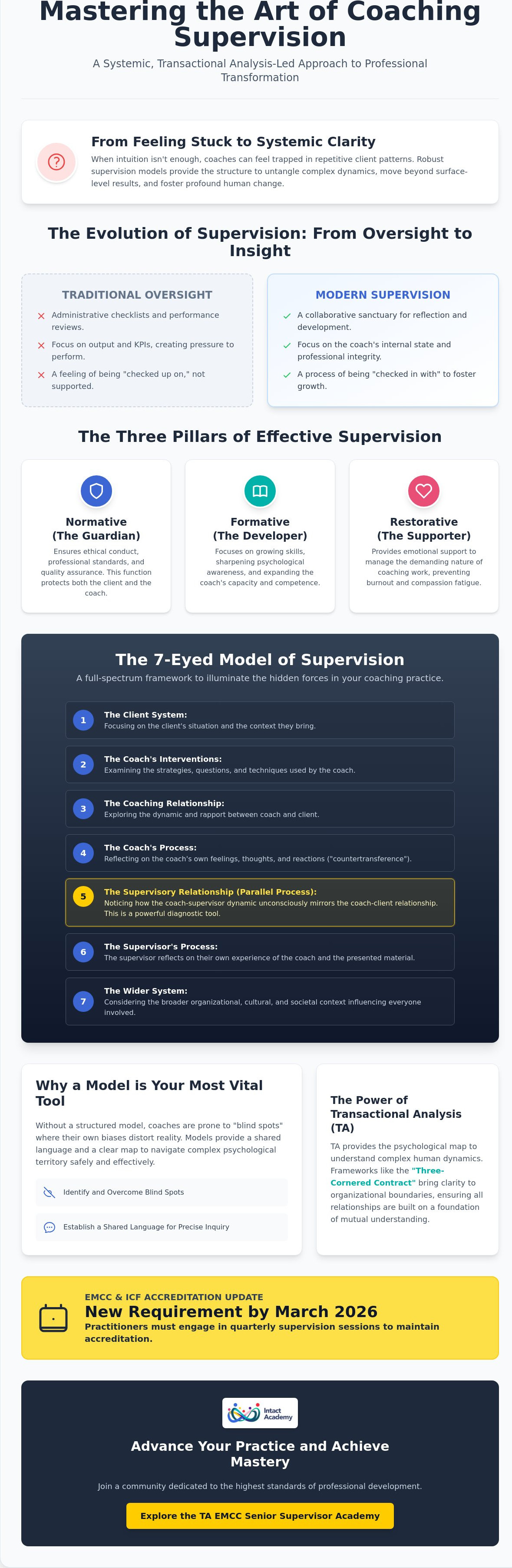
To understand how models of coaching supervision operate in practice, we must look at the foundational functions defined by Francesca Inskipp and Brigid Proctor. First, the Normative function addresses the ethical and quality standards of the profession. It's the "guardian" aspect that ensures safety for both coach and client. Second, the Formative function focuses on development. It's about growing your skills, sharpening your psychological awareness, and expanding your capacity for empathy. Finally, the Restorative function provides essential support. Coaching is emotionally demanding work, and this function helps manage compassion fatigue, allowing you to return to a state of wholeness and genuine presence.
Why Models Matter: Creating a Shared Language
Models serve as a bridge between intuitive reflection and structured, systemic inquiry. Without a model, a coach is prone to "blind spots," those hidden areas where their own history or the client's narrative distorts the reality of the situation. A robust model provides a shared language that allows supervisor and supervisee to explore these dynamics with precision. This structured approach is particularly vital during the coaching contracting phase. By using a model to define the boundaries of the work, you ensure that the relationship is built on a foundation of mutual understanding and psychological safety. It's the difference between guessing your way through a complex system and navigating it with a clear, authoritative map.
The 7-Eyed Model and the Full Spectrum Approach
To move from a surface-level understanding of your practice to a state of systemic mastery, you need a framework that captures the invisible threads connecting you, your client, and the wider organization. Peter Hawkins and Nick Smith’s 7-Eyed Model remains one of the most influential models of coaching supervision because it refuses to look at the coaching session in isolation. It invites you to expand your field of vision, moving from the microscopic details of a conversation to the macroscopic pressures of the corporate environment. This transition from the immediate encounter to the systemic context is what distinguishes a senior practitioner from a novice.
The Parallel Process is the unconscious replication of client dynamics within the supervision relationship. When you find yourself feeling uncharacteristically stuck or defensive with your supervisor, you're often acting out the very tension your client feels in their own workplace. By identifying these echoes, supervision becomes a powerful diagnostic tool. It allows you to process the client's "unthought knowns" through your own emotional and somatic experience, creating a safe space where these dynamics can be understood rather than simply repeated.
Navigating the 7 Eyes: From Client to System
Eyes 1 through 3 focus on the immediate coaching session: the client’s narrative, the coach’s strategic choices, and the unique chemistry of their relationship. As we move to Eyes 4 and 5, the focus shifts inward, examining the coach’s internal psychological reactions and how these might mirror the client’s own struggles. Finally, Eyes 6 and 7 pull back the lens to include the supervisor’s experience and the vast, often invisible, organizational systems that shape every interaction. This holistic view ensures that no part of the human or business experience is left in the dark.
The Full Spectrum Model: Holistic Awareness
While the 7-Eyed Model provides a logical map, Edna Murdoch’s Full Spectrum approach offers a more somatic and creative lens. It prioritizes the "Internal Supervisor," that quiet voice of self-regulation that guides you when you're in the heat of a challenging session. This model is particularly effective for professional development for coaches who seek to deepen their presence and emotional resonance. Engaging with Systemic Supervision can help you cultivate this internal observer, turning every challenge into a catalyst for professional evolution.
Systemic and Transactional Analysis Models in Supervision
Transactional Analysis (TA) offers an exceptionally clear lens for understanding the psychological currents that flow beneath professional interactions. In the context of models of coaching supervision, TA provides more than just theory; it offers a precise diagnostic language for mapping the "games" and scripts that play out in executive suites. At the heart of this approach is the "OK-OK" position. It's a fundamental stance of mutual respect and autonomy that allows the supervisor to remain grounded while the coach explores their own vulnerabilities. This stance ensures that the supervisory space remains a place of growth rather than judgment.
One of the most practical tools within this framework is the "Three-Cornered Contract," a concept pioneered by Fanita English. It clarifies the often-murky relationships between the coach, the client, and the sponsoring organization. Without this clarity, coaches frequently fall into the Drama Triangle, unknowingly taking on the role of the "Rescuer." Supervision identifies these patterns, helping you realize when you're working harder than your client or protecting them from necessary organizational friction. It's about moving from a reactive state to one of systemic awareness.
Ego States and Supervision: Mapping the Dialogue
Understanding Parent, Adult, and Child ego states allows a coach to see exactly where a session lost its way. Perhaps a client’s rebellious "Child" energy triggered your "Critical Parent," leading to a prescriptive approach that stifled their autonomy. Supervision helps you identify these hooks and return to a grounded "Adult" state. We also explore TA "Scripts," the unconscious life plans that dictate how we respond to authority or conflict. By recognizing your own script, you can prevent your personal history from coloring the client's organizational reality. This level of self-awareness is what transforms a good coach into a master practitioner.
Systemic Lenses: The Organization as the Client
A systemic supervisor looks beyond the individual to see the "hidden loyalties" that bind people to failing strategies or toxic cultures. This is where Sari van Poelje has made significant contributions, integrating agile TA into the supervisory process to address the speed and complexity of modern business. We uncover the "unspoken contracts" that often sabotage organizational change, ensuring the coach isn't just treating a symptom while the system remains unwell. It's a process of revealing the invisible architecture of the workplace to create lasting, sustainable impact. By examining these systemic layers, you ensure your interventions are both ethically sound and strategically effective.
Choosing the Right Model for Your Practice and Context
Selecting from the various models of coaching supervision is not merely a matter of personal preference; it is a strategic decision that must align with your developmental stage and the complexity of the systems you inhabit. For a novice coach, a model that emphasizes normative and formative functions provides the necessary scaffolding to build ethical confidence. As you progress toward mastery, your needs shift toward frameworks that offer greater psychological depth and systemic breadth. The best model is one that challenges the coach’s current "Life Script" and comfort zone, forcing a confrontation with the unconscious biases that limit professional impact.
Your specific niche also dictates the most effective supervisory lens. If you are pursuing an executive coaching certification, you require a model that can map the intricate power dynamics and organizational maturity of the corporate world. A coach working with high-level leaders cannot rely on a model that only looks at the individual. You must account for the cultural context, the stakeholder expectations, and the systemic pressures that influence every decision. This alignment ensures that supervision isn't just a reflective exercise but a rigorous tool for professional excellence.
Selection Criteria for Senior Practitioners
For those operating at a senior level, the criteria for a supervision model become more demanding. You must ask whether the framework accounts for multiple stakeholders and the "hidden" clients within a system. Does the model provide the tools to handle unconscious transference and counter-transference safely? Most importantly, a senior practitioner’s model must resonate with their core values of wholeness and genuineness. It should facilitate a return to a state of completeness, allowing you to show up for your clients with a quiet power that is both stable and deeply human.
Individual vs. Group Supervision Models
The choice between individual and group supervision depends on your current learning objectives. The Relational Model in one-on-one supervision offers an intimate space for deep psychological inquiry, allowing for a focused exploration of your internal processes. Conversely, group supervision models, such as the Action Learning approach, leverage collective intelligence to solve complex problems. These group settings are particularly effective when you are leading organizational change initiatives, as the diverse perspectives of the group mirror the complexity of the organizations you are trying to transform. Each format provides a different type of mirror, reflecting different facets of your professional self.
If you are ready to deepen your systemic impact and move toward the highest standards of the profession, consider joining our Systemic Supervision program to find the model that best supports your evolution.
The Path to Mastery: Joining the TA EMCC Senior Supervisor Academy
Professional mastery isn't a final destination but a rhythmic, career-long commitment to excellence. As you evolve, the models of coaching supervision you employ must also mature, moving from tactical interventions to a deep, systemic presence. This journey requires more than just knowledge; it demands a stable container where you can explore the shadows of your practice and emerge with greater clarity. Intact Academy provides this sanctuary, offering a space where the often-turbulent work of personal and professional change is held with expertise and empathy. It’s about more than just business coaching; it's about the profound human transformation that happens when a coach is truly supported.
Sari van Poelje’s systemic approach to supervisor training is unique. It doesn't just teach you how to supervise; it invites you to become a guardian of professional integrity and a wise global mentor. By integrating Transactional Analysis with complex organizational systems, Sari helps you navigate the invisible currents that define modern business leadership. This is where high-level theoretical frameworks meet direct, actionable insight, ensuring that you remain grounded even as you facilitate the process of becoming for others. It's a voice that values integrity, depth, and the courage to change.
Accreditation and Professional Recognition
The road to becoming an EMCC Senior Supervisor is rigorous and deeply rewarding. As of March 2026, the requirement for quarterly supervision sessions for all accredited practitioners highlights the industry's shift toward greater accountability and professionalism. With approximately 45% of professional coaches now engaging in some form of supervision, the demand for high-level supervisors has never been greater. Our academy supports you in building a sophisticated professional supervision portfolio that meets these international standards. Achieving this level of certification isn't just about a title; it's about the impact you have on a global scale. It signals to your clients and the wider coaching community that you operate with a rare level of depth, stable power, and systemic awareness.
Transforming Your Practice with Intact Academy
The TA EMCC Senior Supervisor academy curriculum is designed for those who have seen the inner workings of organizations and remain committed to their flourishing. You'll join an international community of systemic practitioners who value psychological depth over surface-level solutions. This collective intelligence becomes a powerful mirror, reflecting your growth and challenging your assumptions in a way that honors your intelligence and maturity. This focus on wholeness serves as the thematic North Star for everything we do. If you're ready to step into a state of completeness and genuineness, it's time to elevate your craft. We invite you to Apply for the TA EMCC Senior Supervisor Academy and deepen your systemic impact.
Advancing Toward Professional Wholeness
The journey toward mastery is a process of shedding the superficial to embrace the systemic. We have explored how different models of coaching supervision serve as vital mirrors, allowing you to see beyond the individual and into the complex organizational systems your clients inhabit. By integrating the psychological precision of Transactional Analysis with the structural clarity of frameworks like the 7-Eyed Model, you move closer to a state of professional genuineness. This evolution isn't just about meeting accreditation standards. It's about the courage to look inward so you can show up more fully for those you lead.
If you're ready to transition from practitioner to systemic leader, our programs offer the depth you require. Led by global expert Sari van Poelje, our EMCC and ICF accredited programs provide a stable container for this profound work. You can Elevate your practice at the TA EMCC Senior Supervisor Academy and begin your transformation today. Your commitment to this path ensures that you remain a grounding force for change in an increasingly complex world. We look forward to supporting your evolution.
Frequently Asked Questions
What is the difference between the 7-Eyed Model and other supervision frameworks?
The 7-Eyed Model is distinct because it explicitly integrates the wider organizational system and the supervisor's own experience, whereas many other models of coaching supervision focus primarily on the coach-client dyad. It provides a multi-dimensional map that tracks the flow of influence from the client's narrative to the supervisor's internal reactions. This allows for a more holistic analysis of the psychological and systemic forces at play during any given session.
How does Transactional Analysis improve the effectiveness of coaching supervision?
Transactional Analysis improves effectiveness by providing a precise psychological language to identify the "games" and unconscious scripts that hinder professional growth. It allows both supervisor and coach to map ego-state transactions in real time, identifying exactly where a session became hooked or prescriptive. This clarity transforms vague intuition into actionable insight, helping the coach return to a grounded, Adult presence that fosters client autonomy and sustainable change.
Is coaching supervision mandatory for EMCC or ICF accreditation?
Supervision is a mandatory requirement for EMCC accredited practitioners, who must document at least one session per quarter as of March 2026. For the ICF, supervision is currently mandatory only for the Advanced Certification in Team Coaching (ACTC). However, the ICF strongly encourages it for all credential holders and allows up to 10 hours of supervision to count toward Continuing Coach Education units for credential renewal.
Can I use multiple models of coaching supervision simultaneously?
You can certainly integrate multiple frameworks to create a more robust and flexible supervisory practice. Many senior practitioners use the 7-Eyed Model as a structural foundation while layering in Transactional Analysis to explore deep psychological dynamics. This integrative approach allows you to adapt your lens based on the specific needs of the coach or the complexity of the organizational system they are navigating.
What is a "parallel process" in coaching supervision?
A parallel process occurs when the unconscious dynamics of the coaching relationship are mirrored within the supervision relationship itself. For example, if a coach feels overwhelmed by a demanding client, they might unconsciously present as demanding or helpless during their own supervision session. Identifying these echoes provides a powerful diagnostic tool, allowing the supervisor to address the client’s underlying issues through the immediate experience of the supervision dyad.
How often should an executive coach seek supervision?
Executive coaches should seek supervision at a frequency that matches the intensity and volume of their practice, though the EMCC requires a minimum of one session per quarter. For those managing high-stakes organizational contracts or complex systemic change, a monthly cadence is often recommended. This regular rhythm ensures that ethical boundaries remain secure and that the coach has a consistent space to process the emotional labor of executive work.
What is the "internal supervisor" and how do I develop it?
The internal supervisor is the capacity for self-observation and self-regulation that a coach maintains during a live session. You develop this internal observer through consistent external supervision, where the supervisor’s reflective questions and presence are eventually internalized. Over time, you begin to notice your own ego-state shifts, somatic reactions, and systemic blind spots in the moment, allowing you to adjust your interventions without needing immediate external guidance.
Why is systemic thinking crucial for supervising team coaches?
Systemic thinking is crucial because team coaching involves navigating a web of interconnected relationships rather than a single individual's narrative. A supervisor must help the team coach see the collective patterns, group-level ego states, and organizational pressures that influence the team's performance. Without a systemic lens, supervision risks becoming stuck in individual personality conflicts, missing the broader cultural and structural forces that truly dictate the team's success.


