

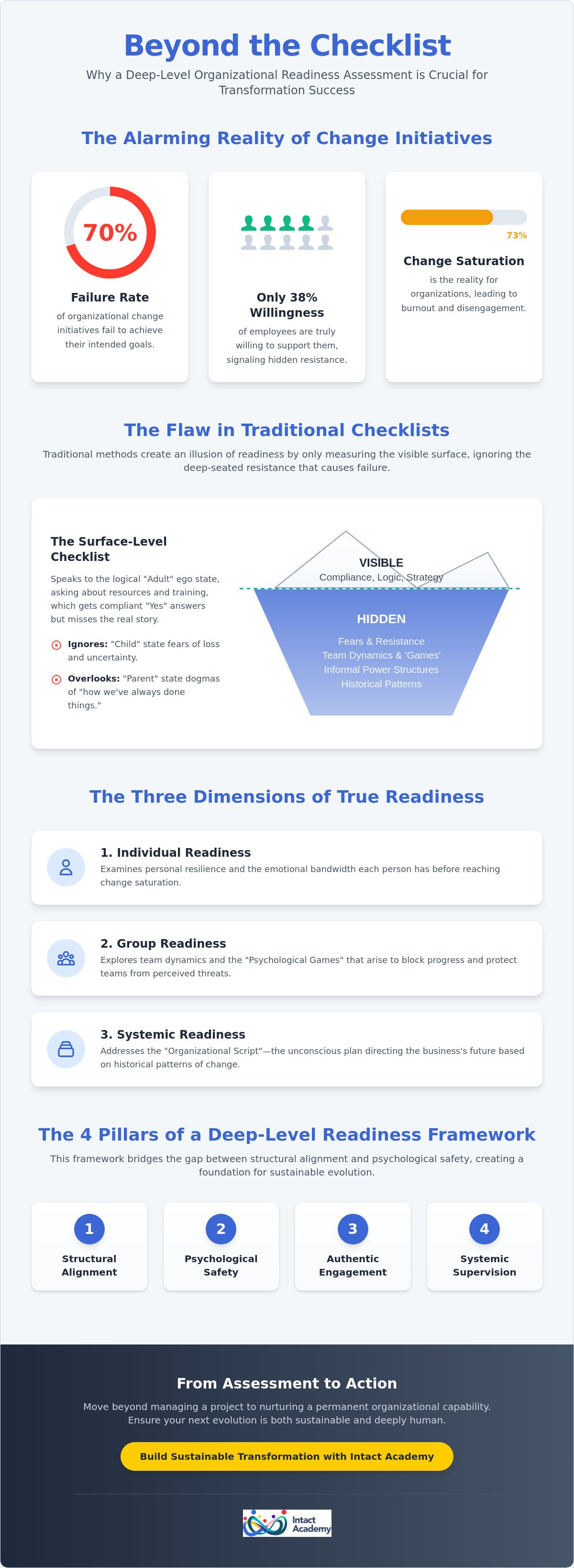
Why do we continue to invest millions in transformations when only 38% of employees are truly willing to support them? In an era where 73% of organizations have reached a state of change saturation, the traditional checklist is no longer a safety net; it's a blindfold. You likely recognize the quiet tension of surface-level compliance, where teams nod in meetings but harbor the hidden resistance that leads to the 70% failure rate seen across the industry. It's a heavy burden to carry, knowing that without deep buy-in, even the most brilliant strategy can crumble under the weight of human burnout.
This guide offers a different path, inviting you to move beyond the transactional and into the realm of profound human transformation. By conducting a systemic and psychological organizational change readiness assessment, you can uncover the invisible barriers that stall progress. We'll provide a robust framework to measure readiness at its core, giving you the clarity to proceed with integrity or the courage to pivot your strategy. You'll discover how to transition from managing a project to nurturing a permanent organizational capability, ensuring your next evolution is both sustainable and deeply human.
Key Takeaways
- Understand why many initiatives falter by shifting from surface-level checklists to a diagnostic process that evaluates both organizational capacity and deep-seated willingness.
- Learn how to conduct a comprehensive organizational change readiness assessment that integrates Transactional Analysis to reveal the hidden systemic dynamics of your workplace.
- Uncover the "Organizational Script" to identify unconscious patterns and historical re-enactments that may be quietly sabotaging your current transformation efforts.
- Discover a four-pillar framework that bridges the gap between structural alignment and the psychological safety necessary for authentic team engagement.
- Gain the tools to "re-contract" with your organization and use systemic supervision to guide leaders through the complexities of sustainable evolution.
The Anatomy of an Organizational Change Readiness Assessment
An organizational change readiness assessment serves as the vital heartbeat monitor for any transformation. It's far more than a simple audit of resources or a timeline of deliverables. Instead, it is a diagnostic process that measures two distinct yet inseparable forces: the structural capacity to move and the psychological willingness to arrive. According to data from Speakwise in May 2026, 70% of organizational change initiatives fail to achieve their intended goals. This staggering statistic isn't usually a result of poor strategy or inadequate funding. It happens because leaders misjudge the invisible readiness of their people. While technical readiness ensures the tools and systems are in place, it's the psychological readiness, the collective mindset and culture, that determines whether those tools will ever be used. This systemic approach to change management honors the complexity of human systems, recognizing that an organization is a living organism, not a machine to be reconfigured.
Why Traditional Checklists Often Fail
Most readiness surveys are designed to speak to the "Adult" ego state. They ask logical questions about training and resources, receiving logical, compliant answers in return. However, these checklists often ignore the "Child" fears of loss and the "Parent" dogmas of "how we've always done things." This creates an illusion of readiness. When an employee checks "Yes" on a survey, it often signals a willingness to comply rather than a commitment to the vision. True readiness requires looking beneath the surface to the informal power structures and the silent agreements that dictate how work actually gets done. Without this depth, you're merely measuring the shadow of the organization, not its substance.
The Three Dimensions of Readiness
To truly understand if a system is prepared for evolution, we must examine it through three interconnected lenses. By assessing these layers, we move from a surface-level scan to a profound understanding of the organization's true state of becoming:
- Individual: This focuses on personal resilience and the psychological contract. It's about how much emotional bandwidth each person has left before they reach "change saturation," a state currently affecting 73% of organizations according to a 2025 HIGH5 Strengths Test.
- Group: This explores team dynamics and the "Psychological Games" that often arise to block progress. It's the study of how teams protect themselves from the perceived threat of the new.
- Systemic: This addresses the organizational script, the unconscious plan that directs the business's future based on historical patterns of change. It asks whether the organization is repeating old failures or truly moving toward wholeness.
A Systemic Perspective: Using Transactional Analysis for Deeper Insight
To move beyond the visible structures of an organization, we must employ tools that can peer into the unconscious layers of the system. While evidence-based frameworks like the Organizational Readiness to Change Assessment (ORCA) offer essential data on structural capacity, they often leave the psychological landscape untouched. This is where Transactional Analysis (TA) serves as a profound diagnostic X-ray. By understanding what is transactional analysis, leaders gain a sophisticated language to describe the hidden dynamics that either fuel or frustrate progress. At the heart of this approach is the concept of "Contracting," which acts as the foundational agreement for any organizational change readiness assessment. It's a process of ensuring that all parties are aligned not just on the "what," but on the "how" and the "why" of the transformation. Without this clear psychological agreement, even the most robust strategy remains a hollow shell.
Mapping the Organizational Ego States
Every organization operates through a shifting blend of three ego states. Is your leadership stuck in a "Critical Parent" mode, where dogmatic rules and rigid hierarchies stifle the very innovation you claim to seek? Conversely, does the workforce inhabit an "Adapted Child" culture, where compliance is performed on the surface while passive-aggressive resistance simmers beneath? A truly ready system moves toward an "Adult-Adult" change contract. In this state, the organization exchanges data and reality-tests scenarios with maturity, allowing for a grounded approach to transformation that honors the intelligence of every stakeholder.
The Psychological Contract and Change
The success of a transition often rests on the psychological contract, the unwritten and often unspoken set of expectations between employees and the organization. When change is introduced, this contract is often violated without acknowledgment. A shift in roles or workflows can feel like a betrayal of trust, leading to an immediate state of unreadiness. To navigate this, we must assess the "stroke" economy. Strokes are units of recognition and value that drive human energy. If a change initiative fails to provide the necessary strokes of validation, the system will quickly deplete its resilience. Developing a culture that values these human needs is the first step toward effective organizational change.
Evaluating the "Organizational Script": Why History Matters
Every organization carries an invisible narrative, a collection of unwritten rules and shared memories that dictate its future path. In the framework of Transactional Analysis, we call this the "Organizational Script." It's the unconscious plan for the business, often imprinted by the founder's original vision or the specific circumstances of the company's birth. When you conduct an organizational change readiness assessment, you aren't just looking at current workflows; you're deciphering this script to see if the system is programmed for success or for "almost" success. Many organizations find themselves trapped in re-enactment patterns, where they unconsciously repeat historical failures under new names. This script acts as a powerful gravity, pulling even the most innovative strategies back into familiar, safe, yet ultimately stagnant orbits.
The founder's influence remains a potent force long after they've left the boardroom. Their personal values, fears, and triumphs become the DNA of the culture. If a founder valued absolute control, the organization may struggle with the autonomy required for modern digital shifts. Assessing script readiness means asking whether the current change initiative aligns with this deep-seated identity or if it's a transplant the system's "immune response" will eventually reject. By surfacing these historical imprints, we allow the organization to choose a new path rather than simply following an old, forgotten map.
Identifying "Red-Flag" Patterns
Some scripts contain "injunctions," which are unconscious prohibitions that block growth. The "Don’t Succeed" injunction is particularly pervasive, where a system sabotages its own expansion because success feels like a betrayal of its original, humble roots. We also see "drivers" like "Hurry Up," which creates a frantic energy that risks total burnout during rapid transformation. Historical traumas, such as a painful merger from 2018 or a period of mass layoffs, create a lasting systemic unreadiness. These events leave scars in the collective psyche that must be acknowledged before the organization can move forward with genuine confidence.
The Power of Systemic Constellations
To make these invisible scripts visible, we often use systemic mapping or constellations. This process allows us to see where energy is blocked within the hierarchy and where the flow of progress has been interrupted. It often reveals "excluded" members or departments, those who have been forgotten or marginalized but who hold the key to the system's readiness. By bringing these elements back into view, we restore the system's integrity. Successfully leading organizational change requires honoring what came before, ensuring that the past serves as a foundation rather than a prison. This depth of insight ensures your organizational change readiness assessment captures the true potential of the collective, allowing for a transformation that is both genuine and lasting.
The 4 Pillars of a Deep-Level Readiness Framework
Building on the historical scripts we've identified, we must now construct a framework for measurement. A truly effective organizational change readiness assessment rests on four distinct pillars that bridge the gap between structural requirements and human needs. While many approaches focus solely on the first pillar, a systemic view requires us to look deeper into the collective psyche of the organization.
- Pillar 1: Structural Alignment: This covers the tangible elements like tools, roles, and resources. It's the baseline of change, ensuring the "Adult" part of the system has the equipment it needs to function.
- Pillar 2: Psychological Safety: This is the freedom to express doubt, fear, or dissent without the threat of punishment. Without safety, resistance goes underground, becoming a silent anchor that drags down progress.
- Pillar 3: Competency & Mastery: We must ask if people have the internal resources to adapt. It's not just about technical skill, but the emotional maturity to navigate the "liminal space" between the old and the new.
- Pillar 4: Systemic Health: This involves the alignment of the Ego States with the change goals. It ensures the "Parent" values support the shift, the "Adult" manages the data, and the "Child" finds creative energy in the new vision.
Conducting the Assessment: Methodology
Moving beyond surface-level surveys requires a more nuanced approach. We recommend "Diagonal Slice" interviews, where we engage individuals from different levels and departments simultaneously. This reveals how information and energy flow across silos, addressing the common gap in departmental interaction. We also observe "Transactions" in various settings. How people talk about the change in the canteen often reveals a different reality than what's presented in the boardroom. In this phase, the change agent acts as a systemic supervisor, holding a mirror to the organization's hidden dynamics. To deepen your own capacity for this work, consider exploring our organizational change programs designed for senior practitioners.
Indicators of High Readiness
When an organization is truly ready, you'll see a high level of "Adult" energy in meetings. The focus shifts from finding someone to blame for challenges to collective problem-solving. There's also clear "Contracting," where every stakeholder knows exactly what they're expected to give and what they'll get in return. Perhaps most importantly, a ready culture allows for "Grief." It honors the loss of the old way of doing things, recognizing that every beginning is also an ending. This emotional honesty prevents the "re-enactment" patterns discussed earlier and creates a stable container for sustainable transformation.
From Assessment to Action: Building Sustainable Transformation
Once the insights from an organizational change readiness assessment are gathered, the organization stands at a threshold. The data collected isn't merely a set of metrics; it's a mirror reflecting the system's current state of being. To move forward, leadership must engage in "re-contracting" with the entire organization. This involves taking the raw truths uncovered, whether they involve hidden resistance or script-driven fears, and bringing them into an Adult-Adult dialogue. By acknowledging the gaps between the current reality and the desired future, you create a transparent agreement that honors the psychological needs of every stakeholder. This step is what bridges the chasm between "knowing" the system is ready and the embodied experience of "being" ready for the journey ahead.
Sustainable transformation requires more than a one-time diagnostic. It demands a commitment to deep-level organizational evolution where the human element is prioritized over transactional speed. At Intact Academy, we partner with organizations to ensure that the findings of your organizational change readiness assessment don't just sit on a shelf but become the catalyst for a state of completeness and genuineness. We help you navigate the complexities of human behavior, ensuring that your systemic health supports your strategic goals for the long term.
The Role of Professional Supervision
Leading a system through profound change is an emotionally taxing process that often pulls leaders into the very "Psychological Games" they're trying to resolve. This is why systemic supervision is indispensable. It provides a "holding space" where change leaders can process their own psychological responses and remain objective. Supervision acts as a container, preventing the leader from becoming an unconscious participant in the organization's historical scripts. For those steering these transitions, engaging in professional development for coaches and leaders offers the mastery needed to maintain systemic clarity when the environment becomes turbulent.
Next Steps for Systemic Mastery
True mastery in managing change comes from a blend of psychological depth and professional pragmatism. While internal teams provide essential context, the value of an external perspective is often the key to uncovering the deep "Script" patterns that internal eyes are too close to see. We invite you to explore our TA EMCC Senior Team Coach Academy, where we equip practitioners with the sophisticated tools of Transactional Analysis to facilitate these high-level transformations. If you're ready to move beyond surface-level checklists and foster a culture of resilience and wholeness, we are here to guide that evolution. Explore our Organizational Change consultancy and training to begin the process of returning your organization to its most authentic and capable state.
Cultivating the Courage for Genuine Transformation
True transformation isn't a project to be completed; it's a state of becoming that requires looking inward before taking outward action. We've explored how a deep-level organizational change readiness assessment transcends surface-level compliance by addressing the unconscious scripts and psychological contracts that define your culture. By aligning structural pillars with systemic health, you create a stable container where innovation isn't just a goal but an inevitable outcome of collective growth. This journey requires moving beyond transactional checklists to embrace the profound human dynamics that drive sustainable success.
Led by Sari van Poelje, a global expert in Transactional Analysis and systemic change, Intact Academy offers the structured methodology needed to move from diagnostic insight to profound human transformation. Our EMCC and ICF accredited programs serve a sophisticated global community from over 14 countries, providing the intellectual rigor and empathetic space required for sustainable evolution. Deepen your impact with our Organizational Change consultancy and discover how to return your system to a state of completeness and genuineness. The path to a flourishing future starts with a single, courageous inquiry into the heart of your organization.
Frequently Asked Questions
What is the primary goal of an organizational change readiness assessment?
The primary goal of an organizational change readiness assessment is to diagnose whether a system possesses both the structural capacity and the psychological willingness to evolve. It serves as a protective measure to ensure that resources aren't poured into a system that's unconsciously programmed to fail. By identifying hidden systemic barriers early, leaders can decide whether to proceed, pivot, or first focus on healing the organizational culture before moving forward.
How does Transactional Analysis improve change management outcomes?
Transactional Analysis improves outcomes by providing a sophisticated language for the unwritten rules and ego states that drive organizational behavior. It allows practitioners to see beyond surface-level compliance and address the dogmatic Parent or fearful Child states that often sabotage progress. By understanding the "Organizational Script," leaders can facilitate a more genuine transformation that respects the human elements of the system rather than treating it like a machine.
What are the most common signs of organizational unreadiness?
Common signs of unreadiness include a culture of passive-aggressive compliance, high burnout rates, and the repetition of historical failures. When 73% of organizations report being at or beyond "change saturation" according to a 2025 HIGH5 Strengths Test, a lack of emotional bandwidth becomes a critical indicator. You might also notice a leadership style that stifles the creative energy necessary for innovation, leading to surface-level buy-in without deep commitment.
Can an organization be ready structurally but unready psychologically?
Yes, an organization can be structurally prepared while remaining psychologically unready. This discrepancy is a leading cause for the 70% failure rate in change initiatives seen across the industry. While the Adult part of the system may have the necessary tools and roles, the Child part may be gripped by fear or the Parent part may be tethered to outdated values. This misalignment creates a fragile foundation that crumbles under the pressure of implementation.
How long does a deep-level systemic readiness assessment typically take?
A comprehensive organizational change readiness assessment typically spans four to eight weeks. This timeframe allows for "Diagonal Slice" interviews across all levels of the hierarchy and for the careful observation of daily transactions. It's a methodical process that doesn't rush the system, ensuring that insights have time to resonate and form a stable foundation for action. This deliberate pace allows for a narrative arc to build from identifying struggles to presenting solutions.
Who should lead the change readiness assessment process?
The process is best led by an objective external consultant or a senior internal practitioner who has been trained in systemic supervision. This leader must have the capacity to remain outside the organization's psychological games while offering a grounded, empathetic perspective. Their role is to hold a mirror to the system, ensuring the assessment is conducted with integrity. It's vital that the lead remains a stable container for the often-turbulent work of professional change.
What is the difference between a culture survey and a readiness assessment?
A culture survey measures the current state of "how we do things here," whereas a readiness assessment measures the capacity for "how we will become something new." While surveys provide a snapshot of the current climate, an assessment evaluates the psychological contract and the system's resilience for future movement. It focuses on the evolution of the organization rather than just its static climate, looking for the courage to change rather than just the current mood.
How do you handle resistance discovered during the assessment phase?
Resistance discovered during the assessment is treated as valuable systemic data rather than an obstacle to be removed. We address it by "re-contracting" with the organization, acknowledging the underlying fears or historical traumas that the resistance represents. By honoring these human responses, we can integrate them into the change strategy. This approach moves the system toward a state of completeness, ensuring that the transformation is both genuine and lasting.


