

What if the polite, polished survey results sitting on your desk are actually the loudest signal of organizational dysfunction? You have likely felt the frustration of applying rigid frameworks to complex, agile environments, only to find that the data hides more than it reveals. When you rely on standard organizational diagnosis tools for consultants, it's easy to feel like a surface-level observer who treats symptoms while the underlying systemic patterns remain untouched. You aren't alone in wanting to move beyond the superficial and reach the heart of why a system behaves the way it does.
This guide offers a path toward that deeper understanding, where business strategy and human psychology finally meet. We will explore how to uncover the true drivers of behavior by treating diagnosis not as a static report, but as a living intervention that begins the moment you ask your first question. You'll discover a framework for 2026 that builds profound credibility with C-suite clients and facilitates sustainable, systemic transformation. We will examine the psychological tools necessary to navigate a landscape of geopolitical upheaval and shifting trust, ensuring your work leads to a state of genuine organizational wholeness.
Key Takeaways
- Learn to navigate the "Iceberg Effect" by looking beyond surface metrics to uncover the hidden psychological drivers that dictate organizational behavior.
- Master essential organizational diagnosis tools for consultants, including the Burke-Litwin and Weisbord models, to ensure internal consistency and environmental alignment.
- Utilize Transactional Analysis to identify ego states and unconscious organizational scripts that prevent teams from achieving their full potential.
- Develop the discernment to select diagnostic frameworks based on a client's organizational maturity and the specific nature of the systemic intervention.
- Integrate business strategy with human psychology to transition from treating symptoms to facilitating profound, sustainable transformation.
Beyond Surface Metrics: Why Organizational Diagnosis Needs Psychological Depth
True Organizational Diagnosis is never a static event. It isn't a post-mortem or a clinical autopsy of past failures; it's a living process of inquiry that begins the moment a consultant enters the room. For many, the search for organizational diagnosis tools for consultants ends with a digital survey or a structural chart. Yet, these methods often only capture the surface. They fail to reach the heartbeat of the organization. In 2026, where geopolitical upheaval and AI-driven anxiety are the norms, we must look deeper. We must understand that the diagnostic process itself is the first step in the intervention.
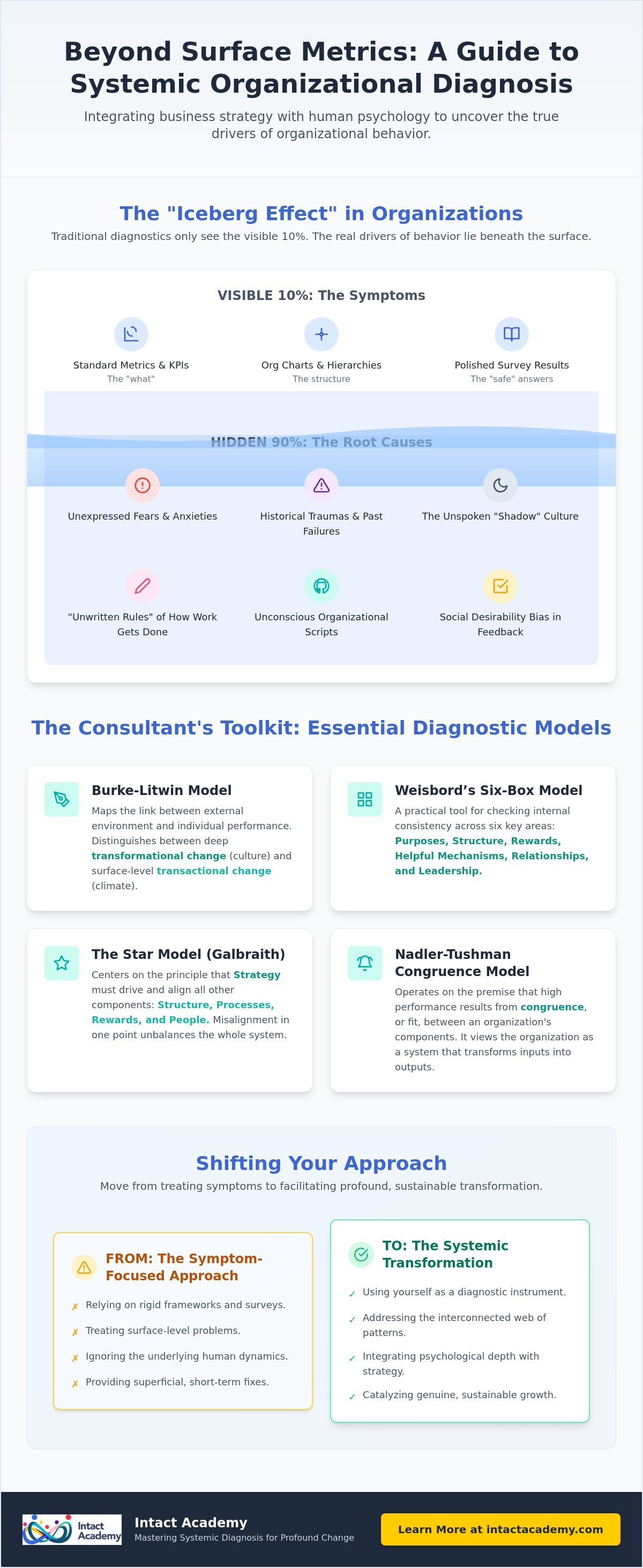
Consider the 'Iceberg Effect' in professional consulting. Standard metrics and visible hierarchies represent only the 10 percent of the organization above the waterline. The remaining 90 percent consists of invisible drivers: unexpressed fears, historical traumas, and the unspoken 'shadow' culture. If you ignore these depths, your solutions will remain superficial. You'll find yourself treating symptoms while the underlying systemic patterns continue to pull the organization off course. To be effective, you must use yourself as a diagnostic instrument. Your own reactions, the subtle tensions you feel in a board meeting, and the unexplained fatigue after a site visit are all data points. They reflect the system's internal state.
The Limits of Traditional Survey-Based Diagnostics
Traditional surveys often fall victim to 'Social Desirability Bias.' Employees don't always share the truth; they share what they believe is safe to say. This creates a sanitized version of reality that hides the real problems. These tools are excellent for identifying technical problems, such as a broken reporting line or a software bottleneck. However, they are ill-equipped for adaptive challenges. These are the human problems that require a change in values, beliefs, and behaviors. When you rely solely on rigid models, you miss the unwritten rules that actually govern how work gets done.
A Systemic Perspective on Organizational Health
A systemic approach views the organization as a web of interconnected scripts and patterns. It honors the principle of wholeness, acknowledging that you cannot change a part without affecting the entire system. By addressing the person, the team, and the organizational structure simultaneously, you create the conditions for genuine growth. This integrated perspective is essential for leading organizational change that actually lasts. When you use organizational diagnosis tools for consultants that prioritize psychological depth, you stop being a reporter of facts and start being a catalyst for profound human transformation.
The Consultant's Toolkit: 5 Essential Organizational Diagnosis Models
Selecting the right organizational diagnosis tools for consultants requires a balance of intellectual rigor and intuitive resonance. These models aren't mere templates; they're sophisticated lenses that help you see through the noise of daily operations. In a 2026 landscape defined by volatility, having a structured yet flexible approach is what distinguishes a mentor from a mere technician. You must be able to identify not just what is happening, but the systemic 'why' behind it.
- Burke-Litwin Model: This framework maps the intricate link between the external environment and individual performance. It's particularly effective for distinguishing between transformational change, which alters the culture, and transactional change, which merely adjusts the climate.
- Weisbord’s Six-Box Model: A practical tool for checking internal consistency. It asks whether the organization's purposes, structures, and rewards are actually in harmony or if they're working at cross-purposes.
- The Star Model (Galbraith): This model centers on the idea that strategy must drive structure, processes, rewards, and people practices. If one point of the star is misaligned, the whole system loses its balance.
- Nadler-Tushman Congruence Model: It operates on the principle that a system's effectiveness is determined by the 'fit' between its components. It's a powerful Diagnostic Tool for Agile Enterprises that need to pivot quickly without losing their core identity.
- Systemic Mapping: This modern approach allows you to visualize the hidden loyalties and historical patterns that govern behavior. It moves beyond the visible chart to reveal the true energetic flow of the organization.
Classic Models vs. Modern Systemic Frameworks
While structural models like Burke-Litwin remain foundational, the rise of remote and hybrid work demands a shift toward process-oriented diagnostics. You're no longer just looking at office layouts; you're examining the digital connective tissue of the team. This evolution is why modern professional development for coaches now places such a heavy emphasis on systemic diagnostic skills. You must be able to read the room even when the room is virtual. The goal is to see the organization as a living organism rather than a machine.
Integrating the 'Hard' and 'Soft' Elements of Diagnosis
Strategy and structure provide the skeleton of an organization, but culture and internal scripts are its soul. When you present your findings to C-suite executives, the challenge is to make the 'soft' psychological data feel as concrete as a balance sheet. Using the right organizational diagnosis tools for consultants allows you to bridge this gap, speaking the language of 'congruence' to show how a lack of psychological safety directly impacts operational excellence. If you're looking to deepen your capacity for this work, exploring our TA EMCC Senior Practitioner academy can provide the structured methodology you need to navigate these complex human systems with confidence.
Uncovering the Unconscious: Transactional Analysis as a Diagnostic Tool
While structural models provide a necessary map of the organization, they often fail to explain why smart people repeatedly engage in counterproductive behaviors. To reach that level of insight, we must look at the unconscious life of the system. Transactional Analysis (TA) offers some of the most profound organizational diagnosis tools for consultants because it allows us to decode the psychological DNA of a company. It moves the focus from what people are doing to how they are being, revealing the hidden transactions that either fuel or frustrate progress.
By observing the Ego States present in a boardroom, you can diagnose communication blocks in real time. Is the leadership operating from a Controlling Parent state, demanding compliance while stifling innovation? Or is the team stuck in a Rebellious Child dynamic, subtly sabotaging initiatives they don't feel they own? A healthy, high-performing system requires a robust Adult-to-Adult connection, where data is processed objectively and decisions are made without the interference of historical baggage. When these states are misaligned, the organization begins to play "Games." These are repetitive, unproductive patterns of interaction that always end in a predictable "payoff" of frustration or blame, ultimately draining the organization's ROI and morale.
Mapping Organizational Scripts and Life Positions
The culture of a company is often a reflection of its foundational history. A founder's personal life script, their unconscious plan for how life should be lived, can easily become the company's organizational script. If a founder believed that "success only comes through struggle," you will likely find a system that creates unnecessary crises to justify its existence. Organizational scripts are the invisible blueprint for systemic behavior. Diagnosing whether a culture operates from an "I'm OK, You're OK" position or falls into a defensive "I'm OK, You're Not OK" stance is critical. This Organizational Diagnosis Toolkit from Western Michigan University emphasizes that understanding these foundational beliefs is essential for any consultant aiming for long-term change.
Transactional Analysis for Systemic Insight
Moving beyond individual coaching to understand what is transactional analysis in a corporate context allows you to contract for change with much higher precision. You can identify the unconscious "Drivers" that push a workforce toward burnout. Patterns like "Be Perfect" or "Hurry Up" often masquerade as professional virtues, yet they create a systemic undercurrent of anxiety that prevents true excellence. By diagnosing these drivers early, you can help leaders shift from a state of drivenness to a state of purposeful action. You aren't just fixing a process; you're helping the system return to its natural state of wholeness and genuineness.
Criteria for Selecting the Right Diagnostic Tool for Your Intervention
Organizational maturity plays a decisive role in this selection. Some clients are ready for a deep psychological dive, while others require the safety of concrete, data-driven metrics. Pushing a system too far, too fast, can trigger defensive mechanisms that halt progress entirely. You must also assess your own competency. Do you have the mastery to hold the space for what the tool reveals? A powerful diagnostic can unearth historical traumas or C-suite power struggles that require a high level of professional containment to manage effectively. You aren't just an observer; you're the container for the system's transformation.
A Framework for Diagnostic Selection
In a high-stakes crisis, speed is essential. Rapid systemic mapping often beats a 50-question survey because it captures the energetic blockages in real time. For long-term cultural shifts, you might combine TA scripts with structural audits to ensure the soul and skeleton of the company evolve together. When the focus is on team performance, integrating established frameworks with systemic team coaching tools provides a balanced view of both relational health and operational output. Scalability is the final filter. A tool that works for a 10-person startup must be adapted or replaced when facing the complexity of a 10,000-person global firm.
The Ethical Responsibility of Diagnosis
Diagnosis carries a heavy ethical weight. There is a danger of labeling an organization, which can create a self-fulfilling prophecy of dysfunction. Your role is to manage the anxiety of the system during the diagnostic phase, providing a stable space for the uncertainty that change brings. You must ensure the diagnosis serves the whole system, not just the person paying the bill. A truly ethical consultant looks beyond the executive mandate to see what the entire organization needs to flourish. If you're ready to lead these complex interventions with integrity and depth, our Organizational Change services offer the systemic expertise required for lasting impact.
Mastering Systemic Diagnosis with Intact Academy
Mastering the use of organizational diagnosis tools for consultants isn't just about collecting a set of technical skills. It's about a fundamental shift in how you perceive and interact with complex human systems. At Intact Academy, we believe the most powerful diagnostic instrument is the consultant themselves. Our approach integrates the precision of Transactional Analysis with the breadth of systemic thinking and the groundedness of professional pragmatism. This combination allows you to move beyond the checklist and into a state of "being" a systemic presence. When you embody this presence, you stop "doing" a diagnosis and start "witnessing" the system's truth. Your observations then carry the weight of both insight and authority.
This level of diagnostic mastery is not an optional add-on. It's a foundational prerequisite for achieving a high-level executive coaching certification. You can't effectively coach a leader or a team without first understanding the systemic currents that pull them off course. By developing your diagnostic muscle within our academies, you learn to identify the subtle ego states and unconscious scripts we've explored throughout this guide. This ensures your interventions remain both precise and sustainable, moving the organization toward a state of genuine wholeness rather than just temporary efficiency.
The TA EMCC Senior Practitioner Academy
Deepening your impact requires more than just reading about theory. It requires a rigorous, psychologically-informed training environment where you can test your insights. Our TA EMCC Senior Practitioner Academy is designed for those who wish to see what's often left unseen in the corporate world. By mastering Transactional Analysis in an organizational context, you gain the ability to decode the hidden transactions that define a company's culture. You'll also join a global network of peers who share your commitment to profound transformation. This community creates a space for mutual growth and shared wisdom that transcends geographical boundaries, offering support as you navigate the complexities of high-level consulting.
Your Journey Toward Diagnostic Mastery
Refining your diagnostic skills is a continuous process that benefits from systemic supervision. Supervision provides the mirror necessary to identify your own blind spots. It ensures your personal history doesn't cloud your professional judgment when using organizational diagnosis tools for consultants. It's a space where the anxiety of the system can be processed safely, allowing you to return to your clients with renewed clarity and strength. As you continue this journey, you're invited to join a community that values depth, integrity, and the return to a state of completeness. We don't just teach you to use tools; we support you in becoming the kind of consultant who can hold the weight of complex systemic change.
Explore our TA EMCC Senior Practitioner Academy to master the art of systemic diagnosis
Toward a State of Systemic Wholeness
True transformation begins when you look beneath the surface of organizational charts and survey results to see the living, breathing system. By integrating psychological depth with structural clarity, you move from treating symptoms to facilitating genuine evolution. You've seen how the right organizational diagnosis tools for consultants allow you to decode unconscious scripts and navigate the "Iceberg Effect" with confidence. This journey requires more than just technical knowledge; it demands the courage to act as a stable container for systemic change. It's about returning the organization to its natural state of completeness and genuineness.
If you're ready to master this art, our EMCC and ICF accredited programs offer the pathway you need. Led by world-renowned expert Sari van Poelje, our community includes participants from 14+ countries worldwide who are committed to profound human and business flourishing. Deepen your diagnostic impact: Join the TA EMCC Senior Practitioner Academy today. Your evolution as a mentor is the catalyst for the evolution of the systems you serve. Step into a space where insight meets structured methodology and lead with quiet power and integrity.
Frequently Asked Questions
What is the difference between organizational diagnosis and an organizational audit?
Diagnosis is a systemic inquiry into the "why" and "how" of behavior, while an audit is a compliance-based check against "what" exists. Diagnosis seeks to uncover hidden patterns and psychological drivers that influence performance. An audit focuses on verifying records, structures, and stated policies to ensure they meet specific standards. While an audit looks for deviations from a rule, a diagnosis looks for the root cause of a system's struggle.
How do I choose the best organizational diagnostic model for a small business?
Weisbord’s Six-Box Model is often the most effective for small businesses because it provides a rapid, holistic check of internal consistency. It allows a consultant to quickly assess purpose, structure, and rewards without overwhelming a lean team with complex data. For smaller systems, the focus should be on agility and the immediate alignment of founder vision with team execution. This model ensures that every part of the business supports the core mission.
Can Transactional Analysis be used for large-scale organizational diagnosis?
Transactional Analysis is highly effective for large-scale diagnosis when applied to "organizational scripts" and cultural patterns. By identifying the dominant ego states and "drivers" within a global firm, you can pinpoint why entire departments remain stuck in repetitive cycles. TA provides a common language that scales across borders. It helps large systems return to a state of adult-to-adult communication, ensuring that professional maturity permeates every level of the global hierarchy.
How long should an organizational diagnosis phase typically last?
A diagnostic phase typically lasts between four and twelve weeks, depending on the complexity of the system and the depth of the inquiry. A rapid systemic mapping might take a few days, while a deep psychological dive into a global firm requires time for interviews and observation. The goal is to allow enough time for patterns to emerge without stalling the momentum for change. It's a balance between thoroughness and the need for timely action.
What are the most common mistakes consultants make during the diagnostic process?
One of the most common mistakes is treating the diagnosis as a static report rather than a living intervention. Consultants often over-rely on organizational diagnosis tools for consultants that focus solely on structural metrics, ignoring the psychological shadow culture. Another error is failing to use the consultant's own reactions as data. This misses the subtle energetic blockages within the leadership team that are only visible through a systemic lens.
How do I handle a client who is resistant to the findings of a diagnostic tool?
Resistance should be treated as valuable diagnostic data rather than an obstacle to be overcome. When a client rejects findings, it often signals a defensive reaction to perceived criticism or a fear of losing a familiar organizational script. A consultant must hold this resistance with empathy, inviting the client into an Adult-to-Adult dialogue. This creates a safe space to explore what the findings represent for the system's future and its potential for transformation.
Is it better to use a proprietary tool or a classic academic framework?
Classic academic frameworks provide a foundation of reliability, while proprietary tools often offer modern pragmatism for specific niches. In 2026, the best approach is often a blend of both worlds. Use classic models for structural credibility and integrate systemic mapping for psychological depth. The choice ultimately depends on whether you need to validate the formal hierarchy or heal the underlying relational dynamics that govern the organization's soul.
What role does psychological safety play in the accuracy of diagnostic data?
Psychological safety is the bedrock of accurate diagnostic data because without it, employees will only provide polite answers that hide the truth. When people feel safe, they share the unwritten rules and hidden loyalties that actually drive the system. Using organizational diagnosis tools for consultants in an environment of fear results in sanitized data. This leads to ineffective interventions that fail to address the profound human struggles at the heart of the business.


