

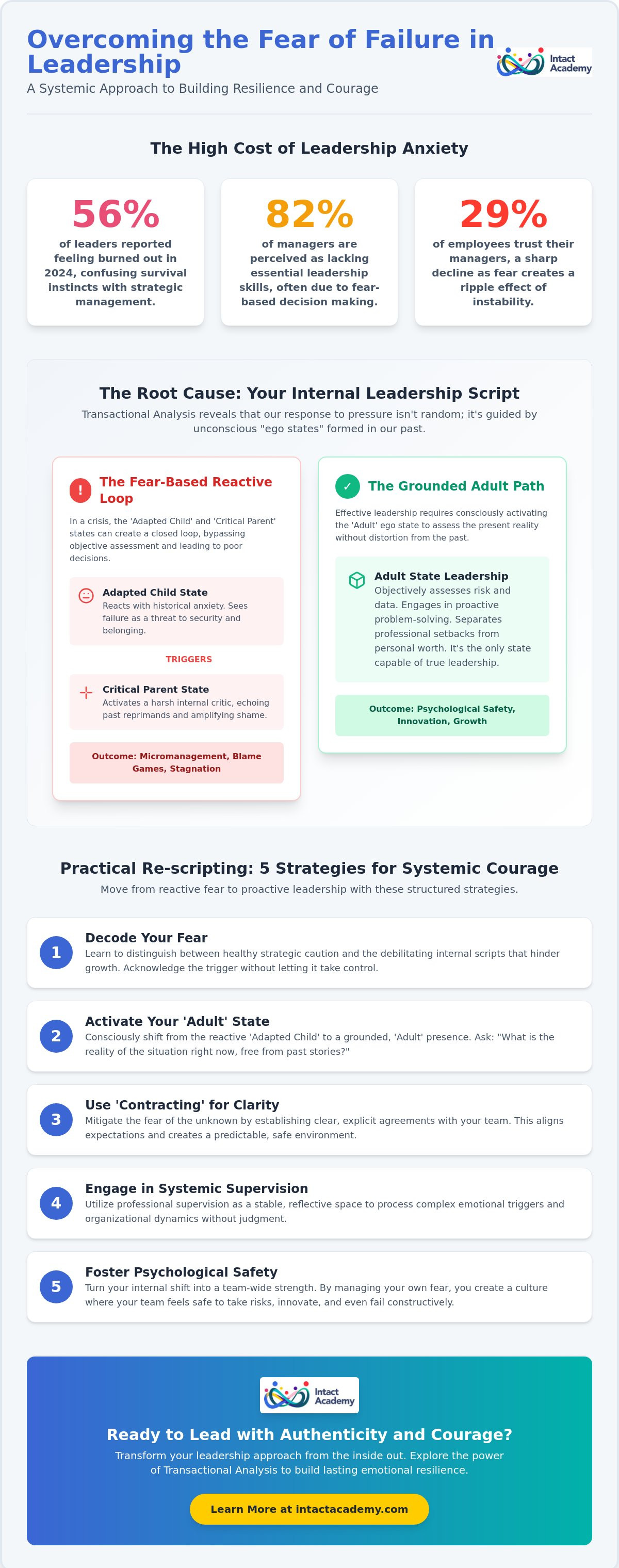
What if the persistent anxiety you feel before a high-stakes decision isn't a lack of competence, but a scripted response designed to protect a version of you that no longer exists? For many executives, the weight of leadership feels less like strategic management and more like a constant battle against being "found out." You've likely experienced that familiar tightening of the chest or the analysis paralysis that stifles innovation, even as you project an image of absolute control. It's a heavy burden to carry, especially when 56% of leaders reported feeling burned out in 2024. Acknowledging this internal friction is the first step toward overcoming fear of failure in leadership, moving you away from reactive survival and toward a state of genuine professional wholeness.
In the following sections, you'll discover how to transform this paralyzing dread into a catalyst for growth using the structured methodology of Transactional Analysis. We'll move beyond surface-level coaching to explore the systemic roots of your triggers, providing you with a clear framework to build lasting emotional resilience. By understanding these internal dynamics, you'll gain the tools to foster psychological safety within your team, ensuring that fear no longer dictates the boundaries of what your organization can achieve. Let's begin the process of returning to your most capable, authentic self.
Key Takeaways
- Decode the psychological anatomy of fear to distinguish between healthy strategic caution and the debilitating internal scripts that hinder your professional growth.
- Explore how the frameworks of Transactional Analysis help you transition from the reactive 'Adapted Child' ego state into a grounded, 'Adult' leadership presence.
- Implement five practical re-scripting strategies specifically designed for overcoming fear of failure in leadership and reclaiming your agency in high-stakes environments.
- Recognize the vital role of systemic supervision in providing a stable, reflective environment to process complex emotional triggers and organizational dynamics.
- Learn to use 'Contracting' as a tool for systemic clarity, ensuring that expectations are aligned and the fear of the unknown is mitigated for both you and your team.
The Anatomy of Fear: Why Leaders Internalize Failure
Leadership at the executive level is rarely about the technicality of the task; it's about the emotional management of risk. In high-stakes environments, failure isn't just a line item on a quarterly report. It feels like a fundamental threat to one's professional identity. This phenomenon is deeply linked to the psychological construct of FNE, where the leader's worth becomes tethered to external validation. While healthy caution acts as a strategic compass, debilitating atychiphobia creates a state of paralysis. In its most fundamental form, leadership fear represents an internal collision where the historical anxieties of the Adapted Child ego state overwhelm the objective, present-moment processing of the Adult.
When leaders succumb to this pressure, the organizational cost is immense. Avoidance doesn't look like doing nothing; it often looks like doing too much of the wrong things. It manifests as micromanagement, where the leader attempts to control every variable to prevent a perceived catastrophe. This stagnation is a primary reason why 82% of managers are perceived as lacking leadership skills according to a 2024 Gallup poll. By prioritizing safety over innovation, they inadvertently signal that mistakes are intolerable, which is a direct obstacle to overcoming fear of failure in leadership.
Ego States and the Fear Response
Within the framework of Transactional Analysis, we see the 'Adapted Child' as the part of our personality that learned to comply or rebel to maintain belonging. When a project falters, this state interprets the setback as a loss of security. Simultaneously, the 'Parent' ego state may activate as a harsh internal critic, echoing past reprimands that amplify the shame of a mistake. In moments of crisis, these two states often form a closed loop, bypassing the 'Adult' state. The Adult is the only part of us capable of assessing reality without the distortion of past trauma. Without the Adult in the driver's seat, leadership becomes a defensive maneuver rather than a proactive choice.
The Systemic Ripple Effect
A leader's internal state is never private; it creates a systemic ripple that defines the organizational shadow. If you lead from a place of anxiety, that tension permeates the team, eroding the psychological safety necessary for creative problem-solving. This is reflected in the sharp decline of employee trust in managers, which dropped to just 29% in 2024. To avoid the vulnerability of failure, leaders might engage in Psychological Games. These are unconscious patterns of communication used to shift blame or avoid accountability. These games provide a temporary sense of relief but ultimately stifle the maturity and growth of the entire system, making overcoming fear of failure in leadership a collective necessity rather than just an individual goal.
Uncovering the Script: How Past Experiences Dictate Present Leadership
To understand why the prospect of a missed target feels like a personal catastrophe, we must look beyond current market pressures. We need to explore what is Transactional Analysis and its profound concept of the Life Script. This script is an unconscious plan, formulated in early childhood as a means of psychological survival. It acts as a hidden blueprint, dictating how you handle power, risk, and the inevitable setbacks of the executive suite. When you find yourself paralyzed by a decision, it's often because your current situation has triggered an old chapter of this internal manual.
These scripts are built upon 'injunctions'—negative messages received from figures of authority during your formative years. A common injunction for high achievers is 'Don't make mistakes.' When this rule is internalized, it manifests as 'Driver' behaviors, specifically the relentless push for perfectionism. You aren't simply aiming for excellence; you're following a subconscious command to avoid the perceived shame of being 'wrong.' Overcoming fear of failure in leadership requires a 're-decision' process. This is the conscious act of acknowledging that these old survival strategies, while once useful, no longer serve the mature, capable executive you've become.
Identifying Your Leadership Injunctions
Injunctions operate below the level of conscious thought, yet they surface clearly during performance reviews or sudden market shifts. They define the boundaries of what you believe is possible for yourself. Consider if any of these common scripts resonate with your internal dialogue:
- 'Don't be important': This leads to a tendency to downplay your achievements or avoid the spotlight, even when your role demands visibility.
- 'Don't succeed': This creates a recurring pattern of self-sabotage just as a project reaches its peak, often driven by an unconscious fear of the responsibilities that come with higher status.
- 'Don't be you': This forces you to adopt a rigid professional persona that feels 'safe' but lacks the authenticity required to inspire others.
Mapping your 'Internal Critic' to these specific influences allows you to separate your true leadership potential from these outdated rules. It's a process of returning to a state of genuineness where your actions are no longer dictated by past constraints.
The Script as a Barrier to Innovation
The modern business world rewards agility, yet a script demanding absolute certainty makes the concept of 'failing fast' feel like a threat to your existence. This tension between the organization's need for change and the script's need for safety is a primary driver of leadership burnout. Moving from a script-bound leader to an autonomous professional involves reclaiming your wholeness and the freedom to act in the here-and-now. For those seeking to integrate these insights into their professional practice, our TA EMCC Senior Practitioner academy offers a rigorous path toward mastering these systemic dynamics.
Beyond the Ego: Shifting from 'Adapted Child' to 'Adult' Leadership
If the Life Script is a ghost of our past, the Adult ego state is our anchor in the present. In Transactional Analysis, the Adult is the part of the personality that functions like a sophisticated data processor. It's objective, rational, and operates in the "here and now," unburdened by the historical anxieties of the Child or the rigid moralizing of the Parent. For an executive, this state is the seat of true mastery. It allows you to look at a failing project not as a personal indictment, but as a complex system requiring adjustment. Overcoming fear of failure in leadership is essentially the work of strengthening this Adult state so it can remain operational even when the stakes are high.
Often, a leader's Adult state is "contaminated" by other ego states. You might believe you're making a logical decision, but it's actually being filtered through a Parent prejudice—such as the belief that "showing vulnerability is weak"—or a Child fear that "mistakes lead to abandonment." De-contaminating the Adult involves the surgical precision of identifying these intrusions. It's about asking: "Is this thought based on current reality, or is it an echo of a past injunction?" Developing this level of internal clarity is a core component of achieving an executive coaching certification, where leaders learn to hold a stable container for both themselves and their teams.
The Adult State: Leading from the 'Here and Now'
When a high-stakes initiative goes off-track, the instinctive response is often a regression into the Adapted Child. To counter this, grounding techniques are essential. The Adult state asks for data: What are the specific metrics? What variables changed? By focusing on systemic observation, you separate your "Self" from the "Outcome." You aren't your failure; you're the professional observing a failed process. This distinction is vital for maintaining emotional resilience. It replaces catastrophic thinking with a methodical approach to problem-solving, ensuring that one setback doesn't trigger a systemic collapse of your confidence.
Contracting for Autonomy
Fear often thrives in the gaps of the unsaid. In Transactional Analysis, "Contracting" is a powerful tool used to mitigate the fear of the unknown by setting explicit, mutual expectations. It's a psychological agreement that provides safety for all parties. In organizational settings, we often use the Three-Cornered Contract, which aligns the needs of the leader, the team, and the organization. This clarity reduces the psychological threat of failure because the boundaries of success and the protocols for setbacks are already established. By leading from a stance of "I’m OK, You’re OK," you foster a culture where overcoming fear of failure in leadership becomes a shared journey toward collective autonomy and genuineness.
Practical Re-scripting: 5 Strategies for Systemic Courage
Practical re-scripting is the bridge between cognitive understanding and behavioral mastery. It requires a deliberate interruption of the automated responses that have historically kept you safe but now keep you small. To achieve overcoming fear of failure in leadership, you must practice these five systemic strategies until they become your new professional baseline:
- Step 1: Awareness. Naming the ego state currently in control. If you feel a surge of panic or an urge to hide, you're likely operating from the Adapted Child.
- Step 2: Analysis. Identifying the 'Game' or 'Script' being triggered. Ask yourself which early injunction, such as "Don't make mistakes," is currently speaking.
- Step 3: De-escalation. Using 'Adult' logic to challenge 'Child' fears. Replace the internal critic's voice with objective, present-moment data about the actual risks involved.
- Step 4: Re-decision. Choosing a new, courageous response in the moment. This is the act of autonomy where you decide to act differently than your script demands.
- Step 5: Integration. Reinforcing the new behavior through systemic feedback. Share your learning with a trusted peer or supervisor to lock in the change and prevent a return to old patterns.
This process isn't about the absence of fear, but the presence of a structured methodology to manage it. When you move through these steps, you're not just solving a business problem; you're evolving your psychological capacity. It's a journey from being script-bound to being truly autonomous.
Breaking the Cycle of Psychological Games
In failure scenarios, leaders often fall into the 'Drama Triangle,' alternating between the roles of Victim (blaming circumstances), Rescuer (over-functioning for the team), and Persecutor (blaming others). Stepping out of this triangle requires a swift return to the Adult state. You must stop playing the game to resolve conflicts objectively. When a leader operates from their Adult state, expressing vulnerability acts as a bridge of authenticity that invites mutual trust and systemic transparency. This shift moves the entire organizational system away from blame and toward genuine accountability.
Fostering Systemic Psychological Safety
Your internal shift has a profound effect on the organizational culture. By modeling 'Adult' responses to failure, you provide your team with 'Permission' to innovate and 'Protection' when things go wrong. Instead of rigid 'Performance Contracts' that punish variance, implement 'Learning Contracts' that prioritize the evolution of the team's collective intelligence. This systemic approach transforms the workplace into a stable container for growth. To deepen your ability to lead these transformations and foster a culture of resilience, consider joining our TA EMCC Senior Team Coach Academy, where we master the art of systemic psychological safety.
Mastering the Art of Failure through Professional Supervision
Leadership at the highest levels often feels like a solitary journey, yet the psychological demands of the role require a witness. When you're responsible for navigating organizational change and holding the anxieties of an entire team, the need for a stable container for your own growth becomes paramount. Professional supervision isn't a remedial measure; it's an elite practice for those committed to overcoming fear of failure in leadership. It offers a reflective space where the internal scripts and systemic pressures that drive atychiphobia can be unpacked, examined, and ultimately integrated into a more resilient professional identity.
This deep transformation is at the heart of what we do at the TA EMCC Senior Practitioner academy. We believe that mastery isn't the absence of mistakes, but the presence of the awareness to use them as essential feedback. When failure is viewed through a systemic lens, it ceases to be a threat to your identity and becomes a vital data point in the process of becoming a more effective, genuine leader. It's about moving from a state of reactive defense to a state of proactive wholeness, where your value as a leader is no longer tied to a perfect outcome but to your capacity for presence and growth.
The Power of Systemic Supervision
Systemic supervision utilizes sophisticated frameworks like the 7-Eyed Model to view failure from multiple perspectives simultaneously. This approach allows us to look at the leader's internal state, the team dynamics, and the broader organizational culture all at once. It's particularly effective at uncovering "parallel processes," where a leader's unacknowledged fear of failure unconsciously infects their coaches or consultants. By naming these dynamics in a safe, supervised environment, you prevent the spread of systemic anxiety. Our academy focuses on creating practitioners who are not only skilled in theory but are also deeply resilient in their own psychological makeup, ensuring they can hold the space for others without becoming overwhelmed by the system's shadow.
Choosing a Path to Wholeness
The journey toward systemic mastery requires a rare blend of psychological depth and professional pragmatism. It's a commitment to looking inward to lead outward with greater clarity. As you move from understanding the roots of your fear to actively re-scripting your leadership style, you'll find that your capacity to foster innovation and psychological safety grows exponentially. The transition from a script-bound executive to an autonomous leader is the ultimate professional evolution. It marks the moment you stop managing your reputation and start leading your people. If you're ready to deepen your impact and master these profound human systems, explore our professional development for coaches to take the next step in your path to mastery.
The Path to Systemic Autonomy
True leadership mastery requires more than a strategic pivot; it demands an internal re-alignment. By identifying the childhood scripts and injunctions that once served as survival mechanisms, you can consciously return to your Adult state. This shift allows you to view setbacks as essential feedback rather than a threat to your professional identity. When you operate from a place of wholeness, you create a stable container where innovation and psychological safety can flourish. Overcoming fear of failure in leadership is a profound process of reclaiming your agency, moving you from a script-bound existence to one of genuine systemic impact.
If you're ready to integrate these psychological frameworks into your own professional practice, we invite you to join our community of global thinkers. Elevate your leadership impact and Join the TA EMCC Senior Practitioner Academy. Led by international expert Sari van Poelje, our EMCC and ICF accredited programs bring together participants from over 14 countries to master the art of human transformation. You have the capacity to lead with courage, integrity, and a deep sense of purpose. The journey toward your most authentic professional self begins with a single, conscious choice.
Frequently Asked Questions
What is the difference between fear of failure and imposter syndrome?
Fear of failure focuses on the catastrophic consequences of a mistake, while imposter syndrome is the persistent belief that your success is unearned. Though they manifest differently, both often stem from an "Adapted Child" script that ties personal worth to external validation. In leadership, fear of failure prevents action, whereas imposter syndrome makes the leader feel like a fraud regardless of their achievements.
How can Transactional Analysis help a leader who is a perfectionist?
Transactional Analysis identifies perfectionism as a "Be Perfect" driver, an unconscious command to maintain worth through flawlessness. By recognizing this as a scripted response rather than a strategic choice, you can move into the Adult ego state. This shift allows you to pursue excellence without the debilitating anxiety that usually accompanies the possibility of a single error.
Is fear of failure always a negative trait in leadership?
Healthy caution is a strategic asset, but chronic fear is a systemic liability. Realistic risk assessment is necessary for sound decision making, yet the paralyzing dread associated with failure stifles innovation and reduces psychological safety. The goal is to transform this fear into a functional awareness, ensuring that risk management doesn't become a scripted emotional barrier to progress.
How do I know if my fear of failure is a 'Scripted' response?
You can identify a scripted response by its intensity and its repetitive nature. If your reaction to a potential setback feels disproportionate to the actual risk, or if you feel a sense of "here we go again," you're likely triggered. These patterns often mirror early childhood injunctions that no longer apply to your mature executive reality or the complexities of your current role.
Can a leader's fear of failure cause high employee turnover?
A leader's anxiety creates a shadow that permeates the organizational culture, often leading to a sharp decline in employee trust. When you project fear onto your team, it reduces the psychological safety required for high performance. This environment of micromanagement and blame is a primary driver for high-potential employees choosing to leave for organizations that better support their well-being.
What are the first steps to take when a major project fails?
The first step is to ground yourself in the Adult ego state to process the failure as systemic data rather than a personal indictment. Use "Contracting" to clarify the next steps with stakeholders and conduct an objective review of the variables involved. This prevents a regression into the Adapted Child and allows you to lead the team through the setback with resilience and clarity.
How does systemic supervision differ from standard executive coaching?
Systemic supervision provides a stable container to explore the deeper psychological and relational dynamics that standard coaching might miss. While coaching often focuses on surface level performance and goals, supervision looks at your internal scripts and how they interact with the organizational system. It specifically addresses blind spots and parallel processes that hinder overcoming fear of failure in leadership.
Can I change my Life Script as an adult leader?
You can absolutely change your Life Script through the process of "re-decision." As an adult, you have the capacity to acknowledge that your old survival strategies are no longer necessary for your current success. By working through systemic frameworks, you can reclaim your wholeness and choose a new, autonomous path for overcoming fear of failure in leadership that honors your professional maturity.


