

What if the very peer group you rely on for support is actually acting as a barrier to your professional evolution? It's a common struggle for the independent practitioner: the desire for connection often leads to informal gatherings that, while warm and validating, lack the psychological depth required to navigate the complex systemic pressures of modern leadership. You likely recognize the feeling of leaving a session with a sense of camaraderie, yet still carrying the heavy, unresolved residue of a client's unconscious scripts. Without the application of specific coaching supervision models, these groups frequently remain at the surface, missing the opportunity for the deep, restorative work that professional coaching demands.
We understand that the transition from casual conversation to rigorous professional challenge requires more than just good intentions. With the 2026 launch of the ICF Coaching Supervisor Specialization and mandatory requirements from bodies like the EMCC, the industry is moving toward a higher standard of accountability. This article promises to help you master the art of collective reflection by exploring frameworks that transform your practice from the inside out. You'll learn how to move beyond basic peer support into a structured, systemic framework designed to reveal parallel processes and psychological games that often remain hidden. We will preview a methodology for creating a sustainable, high-integrity container that honors your maturity as a coach while ensuring you never have to navigate the turbulent waters of human transformation alone.
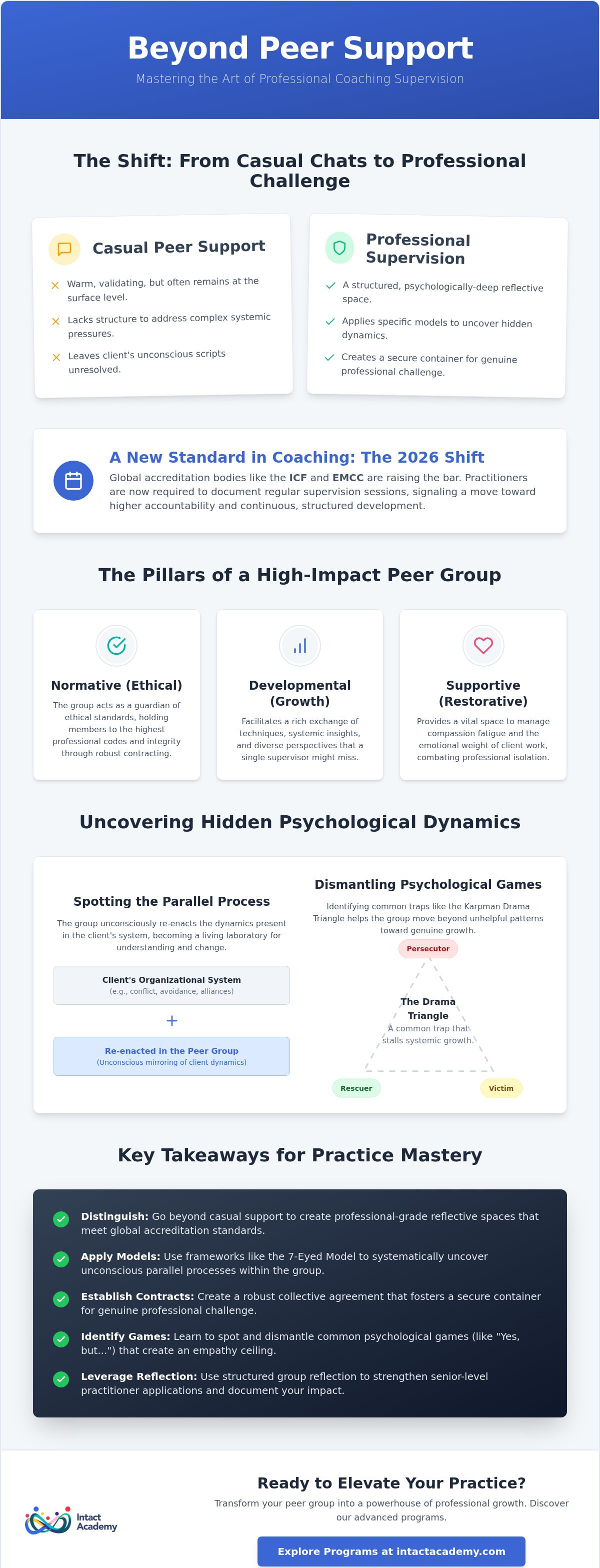
Key Takeaways
- Distinguish between casual peer support and professional-grade reflective spaces that meet the rigorous standards of evolving global accreditations.
- Learn how to apply advanced coaching supervision models, such as the 7-Eyed Model, to uncover unconscious parallel processes within your group dynamic.
- Establish a robust collective contract that moves beyond mutual validation to create a secure container for genuine professional challenge.
- Identify and dismantle common psychological games like the "Yes, but..." trap that often create an empathy ceiling and stall systemic growth.
- Leverage structured group reflection to strengthen senior-level practitioner applications and document your ongoing impact on organizational systems.
What are Peer Coaching Supervision Groups? A Systemic Definition
Peer coaching supervision is far more than a gathering of colleagues; it is a collaborative, non-hierarchical reflective space where practitioners engage in a shared commitment to professional excellence. Unlike formal supervision, which often relies on the expertise of a senior mentor, or mentor coaching, which focuses on the tactical application of core competencies, peer groups operate on the principle of mutual accountability. This distinction is vital for the modern practitioner. As of March 2026, the European Mentoring and Coaching Council (EMCC) requires practitioners to document quarterly supervision sessions, signaling a global shift toward continuous, structured development. For a peer group to function effectively, it requires an Adult-to-Adult ego state from every participant. This psychological stance ensures that the group doesn't slip into parental instruction or childlike dependency, allowing for a truly systemic dialogue that honors the maturity of each coach.
The Three Functions of Supervision in a Peer Context
In the context of peer work, traditional coaching supervision models, such as the Inskipp and Proctor framework, take on a unique flavor. The collective nature of the group enhances each of the three core functions:
- Normative: The group acts as a guardian of ethical standards. Through robust contracting, members hold one another to the highest professional codes, ensuring that the practice remains grounded in integrity.
- Developmental: This function focuses on the cross-pollination of techniques and systemic insights. In a peer setting, the diverse backgrounds of participants allow for a rich exchange of perspectives that a single supervisor might miss.
- Supportive: Independent practice can be isolating. The group provides a vital restorative space, helping coaches manage compassion fatigue and the emotional weight of their client work.
Peer Groups as a 'Stable Container' for Change
A peer group acts as a stable container, a concept rooted in the idea that the group environment mimics organizational systems more accurately than one-on-one sessions. When we enter this space, we aren't just discussing a client; we're often unconsciously re-enacting the very dynamics present in the client's organization. This makes the group a living laboratory for change. To navigate these complexities, many practitioners find it useful to explore what is transactional analysis and how it serves as a lens for understanding these group dynamics. By establishing psychological safety as a foundation, the group becomes a place where rigorous challenge is not only possible but welcomed as a catalyst for human transformation. It is this depth of reflection that 2026 standards now require for those seeking senior-level accreditation.
The Psychology of the Group: Spotting Parallel Processes and Games
Peer groups often carry the emotional residue of their clients' struggles without realizing they've invited that weight into the room. This phenomenon occurs when the dynamics of the coaching relationship are unconsciously re-enacted within the supervision group itself. By aligning with the Association for Coaching's definition of supervision, we recognize that this reflective space isn't merely about tactical skill; it's about the entire psychological field. Applying coaching supervision models like the Seven-Eyed Model in a peer setting allows the group to rotate focus through multiple perspectives, from the client's internal world to the group's own immediate reactions. This democratic application of theory ensures that the group maintains a high level of psychological rigor without needing a formal lead.
Identifying "Psychological Games" is essential for maintaining a healthy group container. We often see the Karpman Drama Triangle play out when a coach presents a difficult case. If the group isn't careful, members might slip into a Rescuer role, offering endless advice, while the presenting coach adopts a Victim stance. This dynamic keeps the work at a surface level. Moving from the sympathy of a Child ego state to the empathy of an Adult ego state requires the courage to name these patterns as they happen. It's about moving beyond "I feel for you" to "I notice we are re-enacting the client's helplessness." For those seeking deeper mastery, exploring systemic supervision provides the framework to turn these observations into professional breakthroughs.
Mapping Unconscious Patterns in Professional Practice
Effective peer work requires listening for what's not being said. We must distinguish between the Social Level of communication, the literal words spoken, and the Psychological Level, which carries the underlying emotional intent. When a peer group masters this distinction, they can spot the "unsaid" organizational scripts that drive client behavior. Parallel Process is a systemic mirror of the coaching relationship. By observing how the group feels during a case presentation, peers gain immediate insight into the client's own organizational environment.
The Role of Systemic Team Coaching in Peer Groups
A peer supervision group functions as a micro-team, providing a safe space to practice complex systemic interventions. This experience is invaluable for coaches involved in leading organizational change. By analyzing the group's own dynamics, members develop the "Senior Practitioner" eye necessary to identify the scripts that govern large-scale systems. This process transforms the group from a simple support network into a sophisticated engine for professional evolution and systemic impact.
How to Set Up a High-Impact Peer Supervision Group
Creating a peer supervision group requires more than a shared calendar and good intentions. It demands a deliberate selection of participants whose professional backgrounds are complementary rather than identical. If every member shares the same niche, the group risks a collective blind spot. Instead, seek a diversity of organizational scripts and psychological perspectives. This variety ensures that when you apply various coaching supervision models, the feedback remains multifaceted. Consistency is the heartbeat of this work. A monthly cadence allows for the slow, steady development of systemic insight, providing the stability needed for deep reflection. Role rotation is equally vital. By alternating between the Presenter, the Facilitator, and the Systemic Observers, each member sharpens their ability to hold the space for others while remaining grounded in their own practice.
Step 1: The Multi-Party Contract
The most common reason peer groups lose their edge is a lack of rigorous contracting. A professional-grade group must move beyond a simple social agreement into a multi-party contract that aligns with EMCC or ICF codes of ethics. This contract establishes the right to challenge one another from an Adult-to-Adult ego state, ensuring that feedback doesn't slip into parental instruction or critical judgment. You should define boundaries around confidentiality and attendance early. Re-contracting every six months allows the group to evolve, reflecting on whether the current container still provides the necessary psychological safety and professional stretch.
Step 2: Structuring the Session for Depth
A structured session prevents the drift into "chatty" support that often undermines peer work. Begin with a check-in to tune into the "here and now" of the group's energy. When moving to the case presentation, consider using the Balint Group approach or a TA Script model to present the client's story. It's essential to include a dedicated Reflection Phase. During this time, the group digests the case silently or through reflective inquiry before jumping into problem-solving. This pause allows the parallel processes discussed in previous sections to surface, ensuring the group addresses the systemic root rather than just the surface-level symptoms.
Step 3: Closing and Integration
The final minutes of a session are as important as the presentation itself. Capturing the "learning harvest" ensures that insights are translated into professional development logs, which are crucial for maintaining accreditation standards. Use a structured check-out to ensure the presenter feels supported and integrated. The goal is for the presenter to leave with a sense of clarity and renewed energy, rather than feeling exposed or overwhelmed by the group's feedback. This careful closing maintains the integrity of the stable container you've built.
Breaking the 'Empathy Ceiling': When Peer Groups Circle
Peer groups often reach a plateau where warmth inadvertently replaces work. This phenomenon, known as the "empathy ceiling," occurs when the group's desire for psychological safety devolves into collusive validation. Instead of acting as a systemic mirror, the group begins to protect the presenter from the discomfort of growth. You might notice the conversation circling the same dynamics, where the group offers sympathetic nods rather than the sharp, restorative inquiries required for true transformation. When we rely on coaching supervision models without a commitment to radical candor, we risk reinforcing the coach's existing blind spots rather than illuminating them. This is particularly prevalent when the entire group shares a similar organizational script, such as a background in a specific industry, leading to a collective inability to see the systemic toxicity a client might be describing.
One of the most common indicators of this ceiling is the "Yes, but..." game. In this Transactional Analysis dynamic, the group offers helpful suggestions while the presenter systematically discounts them. This isn't a failure of skill; it's a script-driven re-enactment of the client's own helplessness. If your group finds itself stuck in these repetitive loops, it may be time to seek an external perspective. Recognizing these patterns is the first step toward reclaiming the group's developmental power. To deepen your ability to navigate these complex human systems, consider exploring our systemic supervision programs, which provide the framework needed to break through these invisible barriers.
Moving Beyond 'Nice' to 'Transformational'
Transformational peer work requires the courage to move beyond being "nice." It involves distinguishing between helpful advice, which often comes from a Parental ego state, and developmental inquiry, which invites the presenter into an Adult-to-Adult exploration of the system. This shift requires a robust systemic framework where radical candor is viewed as an act of professional integrity. When peers work in the same industry, they must be particularly vigilant about political dynamics. The group must remain a space where the organizational scripts of the outside world are analyzed, not replicated.
When to Transition to Formal Supervision
While peer groups are invaluable, they have inherent limitations. High-stakes ethical dilemmas or complex systemic re-enactments often require the oversight of a Master Supervisor. Peer-only models can sometimes lack the necessary distance to handle deep ethical complexity. Integrating group work with formal professional development for coaches ensures that your practice remains grounded in global standards. The synergy between rigorous peer reflection and a formal executive coaching certification allows you to document your systemic impact with the precision required for senior-level accreditation. Knowing when to step out of the peer circle and into a formal supervisory container is a hallmark of professional maturity.
Integrating Peer Reflection into Your Path to Mastery
Mastery in our profession is not a static destination; it's a continuous process of becoming. For the practitioner seeking to elevate their practice, peer reflection serves as a vital bridge between individual experience and systemic wisdom. Engaging in these groups is particularly significant for those pursuing the EMCC Senior Practitioner or Senior Team Coach academies. These advanced accreditations require more than just hours of practice; they demand evidence of a coach's ability to think and act systemically. By consistently applying coaching supervision models within a peer container, you develop the capacity to see the organizational scripts that others miss. This practice allows you to pilot new Transactional Analysis interventions in a secure environment, ensuring that when you step into a boardroom, your approach is grounded in both theory and tested experience.
The role of the reflective log in this journey cannot be overstated. It's not merely a diary of sessions, but a portfolio of systemic impact. When you document the breakthroughs achieved in your peer group, you're providing tangible evidence of your professional evolution. This commitment to transparency and growth is a hallmark of global citizenship. It signals to clients and accrediting bodies alike that you're part of a community of practice dedicated to maintaining the highest ethical standards. As the industry moves toward greater regulation in 2026, this habit of structured reflection becomes your most valuable professional asset.
Building a Portfolio of Evidence for Accreditation
To leverage peer work for formal recognition, precision in documentation is essential. The ICF allows credential holders to count up to 10 hours of coaching supervision toward their Continuing Coach Education (CCE) units for renewal. Similarly, as of March 2026, the EMCC requires practitioners to document at least one supervision session per quarter. When writing your reflective practice essays, focus on how the group's collective inquiry shifted your perspective on a complex case. For those looking to deepen the theoretical backbone of their reflection, linking these peer insights to the TA Foundation Year provides a rigorous framework for understanding the psychological layers of your work.
The Wise Global Mentor: A Vision for 2026
The evolution of a coach often follows a path from individual expert to systemic facilitator. In this new era, the "wise global mentor" is someone who recognizes that their growth is inextricably linked to the growth of their peers. This vision of collective flourishing is at the heart of the community of practice led by Sari van Poelje. It's an invitation to move beyond transactional coaching into a realm of profound human transformation. We invite you to join our upcoming Systemic Supervision Masterclass, where you'll refine your peer group techniques and learn to hold a stable container for even the most turbulent organizational changes. Together, we can return to a state of completeness and genuineness that transforms not just our clients, but ourselves.
Cultivating a Legacy of Systemic Excellence
The journey toward professional mastery requires us to move beyond the safety of common support and into the rigors of systemic reflection. By mastering various coaching supervision models within a peer context, you transform your practice from a solitary endeavor into a shared pursuit of human flourishing. You've seen how to dismantle the empathy ceiling, spot the subtle re-enactments of parallel processes, and establish the robust contracts necessary for profound change. These practices don't just solve immediate client dilemmas; they build the internal capacity required for senior leadership and organizational transformation.
As the industry moves toward higher standards of accountability, your commitment to deep, reflective practice distinguishes you as a leader in the field. It's an invitation to transition from an individual expert to a systemic facilitator within a global community of practice. Deepen your impact with our TA EMCC Senior Supervisor Academy. Our programs are accredited by the EMCC and ICF, bringing together a global community from more than 14 countries under the guidance of systemic expert Sari van Poelje. Your path to mastery is a collective one, and it begins with the courage to look deeper together.
Frequently Asked Questions
Is peer coaching supervision enough to satisfy ICF or EMCC requirements?
Peer supervision is a valuable supplement but rarely replaces formal requirements entirely. The ICF allows credential holders to count up to 10 hours of supervision toward their three-year renewal cycle. As of March 2026, the EMCC mandates at least one supervision session per quarter for accredited practitioners. While peer groups provide necessary reflective space, they often lack the formal oversight required for senior-level accreditation. It's best to use them alongside individual systemic supervision.
What is the ideal size for a peer coaching supervision group?
A group of three to five practitioners is generally considered the ideal size for deep work. This range is small enough to maintain psychological safety yet large enough to provide a diverse array of systemic perspectives. If a group grows beyond five, the time available for each case presentation diminishes. This often forces the dialogue to stay at a surface level, preventing the deep, rhythmic reflection that characterizes high-impact professional development.
How do we handle a situation where one peer dominates the group conversation?
Address the imbalance as a systemic dynamic within the group's stable container. Use role rotation, such as a designated Facilitator and a Systemic Observer, to manage the flow of conversation. If one person dominates, it's often a parallel process mirroring a client's organizational script. Naming this pattern from an Adult-to-Adult ego state allows the group to return to its contract of mutual accountability and shared reflection.
Can peer supervision be done effectively in an online or hybrid format?
Digital environments are highly effective if the group establishes clear boundaries and high-quality video connections. Maintaining a stable container online requires seeing the subtle non-verbal cues essential for spotting parallel processes. Participants must ensure a private, uninterrupted space to honor the integrity of the work. Hybrid formats work well when the group meets in person once or twice a year to strengthen their relational bond and psychological depth.
What is the difference between peer supervision and a 'mastermind' group?
Peer supervision focuses on the psychological and systemic field between the coach and the client. Unlike mastermind groups, which prioritize business strategy and transactional advice, supervision utilizes coaching supervision models to examine unconscious patterns and ethical integrity. A mastermind group seeks to expand your business reach; a supervision group seeks to expand your capacity for human transformation. Both are useful, but their intentions remain distinct.
How do we ensure confidentiality when peers are also market competitors?
Confidentiality is maintained through rigorous multi-party contracting and the anonymization of client data. When peers are competitors, the focus should shift from the client's specific business details to the coach's internal reactions and the group's systemic observations. This approach protects proprietary information while allowing for deep professional challenge. A mature group recognizes that the goal is collective flourishing rather than individual competitive advantage.
What should we do if we feel the peer group has reached a 'plateau' in its learning?
A plateau often signals that the group has reached an empathy ceiling or a shared blind spot. When this happens, it's helpful to re-contract or invite a guest Senior Supervisor to facilitate a session. This external perspective can illuminate the unconscious scripts that the group has collectively accepted. Breaking the plateau requires the courage to move beyond mutual validation and back into the realm of rigorous, transformational inquiry.
How often should a peer supervision group meet for maximum impact?
Monthly meetings provide the necessary cadence for consistent systemic growth. This frequency allows enough time for practitioners to integrate their learning between sessions while maintaining the momentum of the group's developmental arc. Meeting less frequently often results in sessions becoming catch-up conversations rather than deep reflective work. Consistency is the heartbeat of professional mastery, ensuring the group remains a reliable space for navigating complex organizational changes.


