

What if the administrative weight of your EIA portfolio isn't a hurdle to clear, but the very crucible where your professional identity is finally forged? You've likely spent years facilitating transformation, yet the prospect of preparing for EMCC senior practitioner assessment can still evoke a quiet sense of fraudulence. It's a common paradox; as your work grows more complex, the task of articulating your unique coaching presence feels increasingly elusive. You aren't just looking for a badge. You're seeking a mirror that reflects the maturity of your practice and the depth of your systemic impact.
This guide serves as that mirror, offering a clear roadmap to transition from the Practitioner level into the mastery required for Senior Practitioner accreditation. We'll move beyond the surface requirements of 250 contact hours and five years of experience to address the psychological core of the EIA. By examining the 2026 standards for supervision and reflective practice, you'll learn how to transform your portfolio into a narrative of professional wholeness. We'll explore the specific evidence needed to validate your ability to hold systemic complexity, ensuring your application is as grounded as it is aspirational. This is your invitation to return to a state of professional genuineness and claim your place as a senior leader in the coaching field.
Key Takeaways
- Understand the 2026 EMCC Global Individual Accreditation standards to build a grounded foundation when preparing for EMCC senior practitioner assessment.
- Integrate Transactional Analysis into your portfolio to demonstrate the psychological maturity and internal supervision required at the senior level.
- Learn to reframe everyday client engagements as systemic interventions by identifying the subtle organizational undercurrents that define your impact.
- Master the structure of reflective logs and critical incidents to move beyond mere reporting toward a profound evaluation of your coaching presence.
- Discover how an integrated academy approach can streamline your accreditation journey while fostering a state of professional completeness.
The EIA Framework: Defining the Senior Practitioner Standard
The European Mentoring and Coaching Council (EMCC) establishes a standard that is less about rigid adherence to rules and more about the integration of professional maturity. When you're preparing for EMCC senior practitioner assessment, you're stepping into a space that demands both rigorous evidence and deep introspection. The Global Individual Accreditation (EIA) is the hallmark of this journey. It's distinct from the European Quality Award (EQA), which accredits training programs. While an EQA program provides the map, the EIA is your personal testimony of the territory you've actually traversed. It's the difference between knowing the theory and embodying the practice.
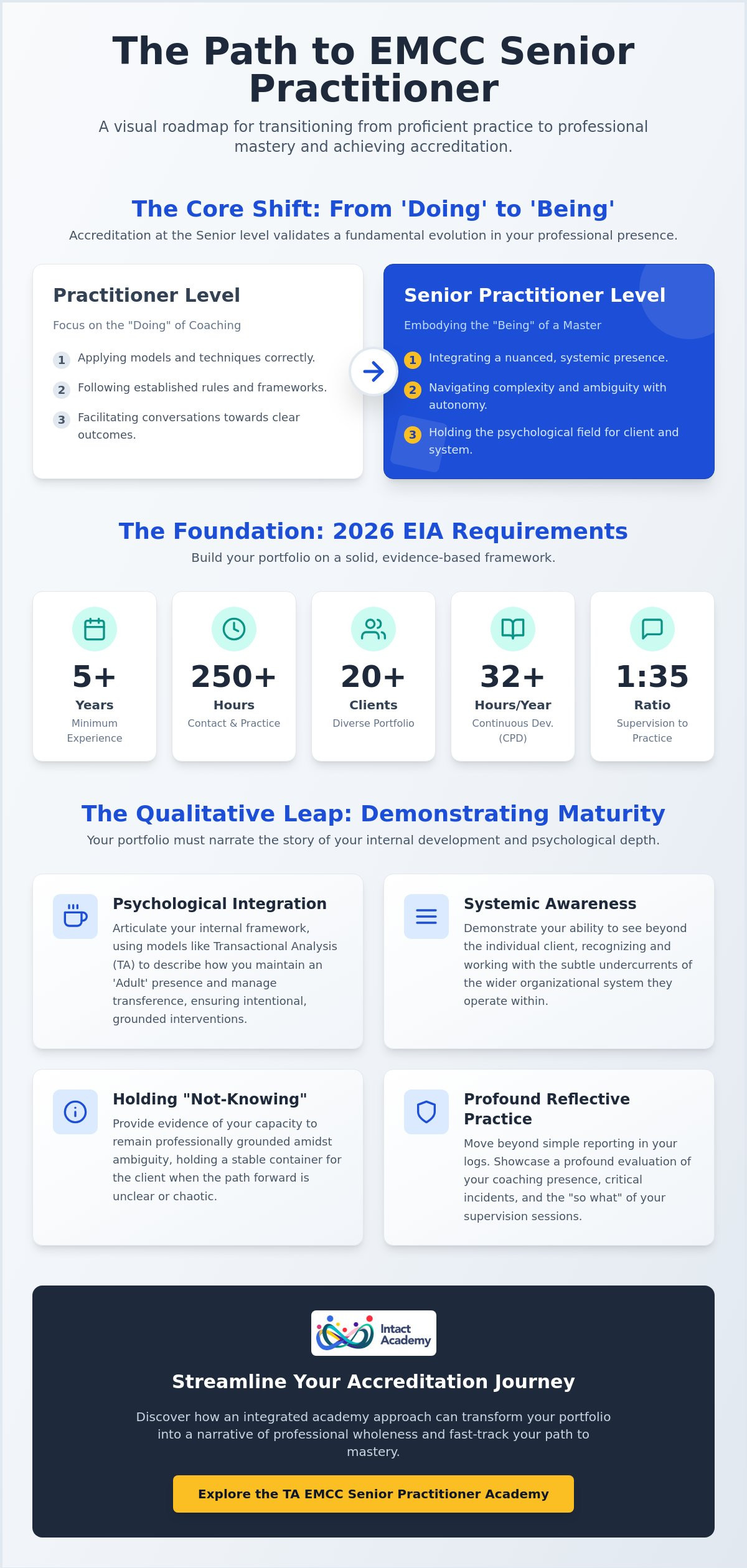
The transition from Practitioner to Senior Practitioner represents the most profound shift in a coach's evolution. It's the point where the scaffolding of basic technique falls away to reveal a more nuanced, systemic presence. This move is significant because it requires you to navigate eight core competencies with a high degree of autonomy. These range from managing the coaching contract to enabling profound insight, yet they all anchor back to your capacity for self-reflection. You're no longer just facilitating a conversation; you're managing the complex psychological field between you, the client, and the wider organization. This level of accreditation validates your ability to work with ambiguity and "not-knowing" without losing your professional grounding.
The Quantitative Requirements for 2026
Constructing your portfolio requires a steady, methodical approach to your professional history. You'll need to verify at least 250 hours of coaching practice distributed across a minimum of 20 clients. This isn't merely a log of hours. It's a documentation of a five-year minimum experience that shows a clear developmental arc. Your Continuous Professional Development (CPD) must reflect at least 32 hours of annual learning. However, the assessors look for the "so what" behind these numbers. They want to see how your one hour of supervision for every 35 hours of practice has refined your internal compass. It's a record of becoming, not just a list of tasks completed.
The Qualitative Shift: Doing vs. Being
The true challenge of the Senior Practitioner level lies in the shift from "doing" to "being." This involves moving beyond the mechanical application of models to a state of "professional presence." In your written submission, you must show how you integrate your own psychological awareness into the coaching room. You aren't just applying Transactional Analysis or systemic theory; you're embodying it. This means recognizing that the client is part of a wider, often turbulent, organizational system. Your evidence must demonstrate that you can work with these undercurrents, holding a stable container for the client even when the organizational dynamics are chaotic and the path forward is unclear.
The Psychological Shift: Using TA to Demonstrate Maturity
While many see the accreditation process as a bureaucratic hurdle, it's actually a profound developmental milestone. When preparing for EMCC senior practitioner assessment, you're asked to demonstrate a shift in your internal architecture. Transactional Analysis (TA) provides the perfect lens for this transformation. It allows you to articulate your professional arc from a novice following rules to a master navigating the nuances of the human psyche. This shift is less about what you do and more about the quality of your presence in the room.
Your internal supervisor acts as the silent witness to every intervention. By utilizing the TA framework of Ego States, you can describe how you maintain a grounded Adult presence, even when a client's Child or Parent state is activated. This awareness is a hallmark of senior-level maturity. It ensures that your interventions are chosen with intention rather than dictated by habit. This internal stability is vital when preparing for EMCC senior practitioner assessment, as it proves you can hold a safe container for the client's vulnerability without becoming entangled in their emotional process.
In high-stakes executive environments, the pressure to "fix" or "rescue" is intense. Demonstrating an Adult-to-Adult contract proves you can resist these systemic pulls. You aren't a magician; you're a partner. This level of maturity also allows you to identify "Psychological Games" within team dynamics. Recognizing a "Yes, But" or "Kick Me" game allows you to intervene systemically, shifting the team from repetitive cycles toward authentic growth and shared responsibility.
Mastering the Coaching Contract
Senior-level contracting is never just about the individual. It's a systemic web involving the organization, the sponsor, and the coachee. This aligns with the EMCC competency of "Managing the Contracting Process." Writing about "multi-party contracting" in your portfolio shows you understand that individual growth must serve the organizational whole. The TA EMCC Senior Practitioner academy provides a structured environment to master these complex relational contracts and refine your systemic lens.
Working with the Unconscious
This is where the Practitioner truly becomes "Senior." You must identify "Script patterns," the unconscious life plans clients repeat, and facilitate their awareness. Staying out of the "Drama Triangle" is essential to maintain your professional potency. Use your counter-transference as a diagnostic tool. Your own feelings in the session are data about the system; if you feel a sudden sense of boredom or urgency, it likely reflects an organizational undercurrent rather than just a personal reaction.
Creating Your Evidence: The Reflective Practice Portfolio
If the psychological shift discussed previously is the engine of your practice, your portfolio is the map of where that engine has taken you. Creating your evidence is a deliberate act of curation. It requires you to look back at your coaching logs not as a diary, but as a data set for your own growth. Just as you might use ATS Verification to ensure your resume is technically sound for modern career opportunities, your accreditation portfolio must be precisely calibrated for the EMCC assessors. When preparing for EMCC senior practitioner assessment, your goal is to bridge the gap between your lived experience and the EMCC competency framework for 2026. This isn't about proving you're perfect; it's about proving you're aware.
Assessors look for three "Critical Incidents" that showcase your ability to handle systemic friction. Don't choose your easiest wins. Instead, select moments where the organizational undercurrents were strong and your professional presence was tested. These incidents, combined with client feedback that speaks to your senior-level impact, form the backbone of a successful submission. By mapping your coaching logs to the specific competencies, you provide a clear, evidence-based narrative of your ability to hold complex, multi-layered engagements.
The Art of the Reflective Log
Descriptive writing is the enemy of a senior-level portfolio. While a practitioner might describe a session, a senior practitioner analyzes it. You must move from reporting to transformative reflection. Using the "So What? Now What?" model ensures your insights are actionable. For every log entry, ask yourself: Why did I intervene this way? What does this reveal about my internal supervisor? Link these reflections back to the TA theories or systemic models mentioned earlier to show a consistent, integrated approach. This level of analytical depth proves you've moved beyond the "doing" of coaching into the "being" of a senior practitioner.
Coaching Supervision as Evidence
Supervision is the stable container where your most profound learning occurs. While the EMCC requires a minimum of one hour of supervision per 35 hours of coaching, senior practitioners treat this as a baseline rather than a target. In your portfolio, write about how a specific supervision session fundamentally altered your approach to a complex case. Framing your growth through the 7-eyed model of supervision allows you to demonstrate awareness of the client, the interventions, and the wider systemic context. This shows the assessor that your practice is not static; it's a living, evolving process of becoming. When you're preparing for EMCC senior practitioner assessment, this evidence of supervised evolution is what distinguishes a competent coach from a master of the craft.
Overcoming the #1 Objection: "I Don’t Have Enough Complexity"
Many coaches hesitate when preparing for EMCC senior practitioner assessment because they believe their client cases lack sufficient "complexity." They imagine that senior-level work must involve high-stakes mergers or visible organizational crises. However, complexity is not a property of the client's situation; it is a quality of the coach’s perception. A seemingly simple request to improve "time management" often masks deep-seated systemic tensions. When you look beneath the surface, you might find a client who is carrying the weight of a dysfunctional department or acting out a corporate culture of burnout. Your task is to show the assessors that you see these invisible threads.
The difference between a "difficult client" and a "complex system" lies in your ability to hold the wider context. A difficult client is a person you struggle to manage. A complex system is a web of relationships, histories, and power dynamics where you are one of many moving parts. By reframing even transactional engagements as systemic interventions, you demonstrate the maturity required for the Senior Practitioner level. You are no longer just fixing a problem; you are facilitating a shift in the system's equilibrium. This perspective ensures that your impact is felt far beyond the individual coaching session.
Identifying Systemic Dynamics
To demonstrate senior-level mastery, you must prove you are coaching the system through the individual. This involves applying leading organizational change principles to your case studies. You aren't just looking at individual behavior. You are analyzing how the organizational culture influences the coachee and, conversely, how the coachee’s growth can ripple outward. In your portfolio, describe how you identified a systemic pattern, such as a recurring "blame culture," and how your presence helped the client navigate that culture with greater agency. This evidence shows you can work with the "undercurrents" that others might miss.
Articulating Your Unique Value
Your Statement of Coaching Philosophy is the heart of your submission. It shouldn't be a list of tools; it should be a declaration of your "presence." This is where you describe how you show up as a stable, ethical container for the client's transformation. Articulating this requires a blend of psychological precision and professional gravitas. You must move beyond vague descriptors like "empathetic" to explain how your presence serves as a diagnostic tool for the system. Your ethical maturity is also on trial here. You must show that you can navigate the "grey areas" of organizational life where there are no easy answers. If you are ready to refine this articulation, consider how our TA EMCC Senior Practitioner academy can help you find your professional voice and claim your mastery.
The Path to Mastery: The TA EMCC Senior Practitioner Academy
The journey toward Senior Practitioner status often feels like a solitary climb, yet it requires a stable, collective container to be truly transformative. When preparing for EMCC senior practitioner assessment, the administrative and psychological weight can feel overwhelming. Our TA EMCC Senior Practitioner academy is designed to hold this complexity for you. By offering an integrated EQA and EIA approach, we streamline the accreditation process. This allows you to focus on the evolution of your practice rather than the friction of the paperwork. You aren't just following a syllabus; you're entering a year-long immersion into professional mastery.
This path involves deep-dive mentoring with Sari van Poelje and our international faculty, providing you with a mirror for your own systemic impact. You'll join peer learning groups that are intentionally curated to mirror the systemic complexity of the C-suite environments where you work. In these spaces, you move beyond the mechanics of coaching. You transition from a coach who "does" to a master who "is." This shift in being is the ultimate requirement for the Senior Practitioner level, ensuring your presence becomes a catalyst for profound human and organizational transformation.
The Intact Academy Difference
We believe that Transactional Analysis is the ultimate framework for senior accreditation because it addresses the hidden psychological and systemic layers of every engagement. Our curriculum maps directly to the 2026 EMCC EIA standards, ensuring that every hour you spend in the academy is evidence for your portfolio. Beyond the training, you gain access to a global network of senior practitioners and supervisors. This community provides the ongoing validation and challenge needed to maintain your professional equilibrium in a rapidly changing world.
Next Steps for Your Accreditation
As you move forward, consider where you stand on the professional development for coaches roadmap. Mastery is a process of returning to a state of completeness and genuineness in your work. If you're ready to claim your place as a senior leader, the next cohort of the TA EMCC Senior Practitioner academy is your gateway. Before you submit your application, use this final checklist: have you articulated your unique presence, documented your 250 hours with analytical depth, and integrated a systemic psychological framework? If the answer is yes, you're no longer just preparing for EMCC senior practitioner assessment; you're already embodying the standard.
Claiming Your Professional Mastery
The journey to becoming a Senior Practitioner is a process of shedding the technical scaffolding of the novice to reveal the authentic presence of the master. We've explored how preparing for EMCC senior practitioner assessment requires more than just logging hours; it demands a profound psychological shift. By integrating Transactional Analysis and embracing the systemic complexity inherent in every client engagement, you move beyond the surface of coaching into the heart of human transformation. Your portfolio isn't a burden of evidence. It's a narrative of your evolution.
The path to this level of accreditation is best traveled within a stable, expert container. Our EMCC EQA-Accredited Programs, led by Sari van Poelje, TSTA-O, offer a unique space for this growth. With international participants from 14+ countries, you'll join a global community dedicated to professional wholeness and systemic depth. This collective environment provides the mirror you need to see your own mastery clearly.
Join the TA EMCC Senior Practitioner Academy and bridge the gap to mastery.
The transition to Senior Practitioner is your invitation to step into a state of professional completeness. Trust in your experience, honor your growth, and allow your unique coaching presence to finally take center stage. You're ready to claim the validation your practice deserves.
Frequently Asked Questions
What is the difference between EMCC Practitioner and Senior Practitioner?
The primary difference lies in the level of autonomy and the capacity to hold systemic complexity. While a Practitioner focuses on the effective application of models, a Senior Practitioner demonstrates an integrated professional presence that accounts for organizational undercurrents. This level requires a shift from transactional problem-solving to transformative intervention, proving you can work with the wider system rather than just the individual.
How many hours of coaching are required for EMCC Senior Practitioner in 2026?
You must document a minimum of 250 contact hours of coaching practice for the Senior Practitioner level in 2026. These hours should be spread across at least 20 clients over a five-year period. This requirement ensures that you've encountered a sufficient range of professional challenges to justify a senior-level accreditation and have the experience to back your systemic insights.
Can I apply for EIA Senior Practitioner without an EQA-accredited course?
Yes, you can apply for the EIA via the "experience route" even if you haven't completed an EQA-accredited program. However, preparing for EMCC senior practitioner assessment through this route involves a more rigorous mapping of your evidence against the competency framework. An EQA program simplifies this by providing a pre-validated pathway that streamlines the evidence-gathering process for your portfolio.
How do I choose a supervisor for my Senior Practitioner assessment?
Choose a supervisor who is experienced in working with systemic and psychological dynamics. They should ideally hold an EMCC Supervisor accreditation and be able to challenge your internal supervisor effectively. Their role is to provide a stable container for your most complex cases, helping you articulate the psychological "why" behind your interventions during the accreditation process.
What happens if my EMCC assessment is deferred or rejected?
A deferral is treated as a developmental inquiry rather than a final judgment. The EMCC provides specific feedback on which competencies require further evidence or deeper reflection. You're typically given a timeframe to resubmit your portfolio, allowing you to refine your practice in the areas identified by the assessors and demonstrate the required level of maturity.
How long does the EMCC Senior Practitioner accreditation process take?
The administrative assessment process usually takes between three and six months once your portfolio is submitted. However, the internal journey of preparing for EMCC senior practitioner assessment often spans a year of deliberate practice. This timeframe allows for the methodical gathering of reflective evidence and the integration of feedback from your supervisor and peer groups.
Is Transactional Analysis required for EMCC accreditation?
Transactional Analysis is not a mandatory requirement, but the EMCC demands a consistent and coherent psychological framework to demonstrate senior-level maturity. Using TA allows you to explain complex relational dynamics and script patterns with high precision. It provides a shared language for professional evolution, making it easier for assessors to see the depth of your coaching presence.
What counts as "Reflective Practice" for the EIA portfolio?
Reflective practice consists of analytical logs, critical incident reports, and documented supervision sessions that show transformative growth. It isn't a mere description of what happened in a session. Instead, it's a profound evaluation of your internal process, showing how you've evolved your approach to handle organizational complexity and maintain your professional equilibrium under pressure.


