

What if the persistent impasse you're facing with a complex client isn't a lack of technique, but a vital piece of systemic data waiting to be decoded? It's a heavy burden to carry the ethical complexities and emotional residue of global organizations alone. You've likely felt that familiar sense of stagnation, where your usual tools no longer reach the psychological depths required for true change. We understand that this isolation isn't just exhausting; it's a barrier to the mastery you seek.
Engaging in professional coaching supervision online offers a systemic sanctuary where you can return to a state of completeness and genuineness. By integrating psychological depth with professional pragmatism, you'll learn to transform your practice from a series of transactions into a catalyst for profound human evolution. It's about moving beyond skill toward a more reflective, grounded presence that honors both your growth and the client's success.
In this guide, we'll examine the 2026 standards for ICF and EMCC accreditation, including the new Coaching Supervisor Specialization. We'll also explore how a Transactional Analysis framework provides the structural methodology needed to navigate organizational systems with clarity. You'll discover how to restore your professional resilience and prepare for the next level of your coaching journey.
Key Takeaways
- Understand how engaging in professional coaching supervision online creates a collaborative sanctuary for reflective learning, bridging the gap between isolated practice and global expertise.
- Discover how Transactional Analysis (TA) provides a rigorous systemic roadmap for decoding the unconscious psychological dynamics that influence client-coach interactions.
- Clarify the distinction between mentor coaching for technical competency and supervision for expanding your psychological capacity to handle complex organizational challenges.
- Identify the specific developmental steps required to meet the evolving 2026 EMCC and ICF accreditation standards for senior-level coaching and supervision.
- Learn how systemic supervision pathways can transform your professional presence, moving your practice from transactional service delivery toward deep, human transformation.
Defining the Sanctuary: What is Professional Coaching Supervision Online?
The practice of professional coaching supervision online is far more than a digital convenience; it's a profound commitment to your own developmental evolution. Supervision is a formal, collaborative process of reflective learning. It's a dedicated space where a coach steps back from the immediacy of their work to observe the hidden currents of their practice. Unlike administrative management, which focuses on KPIs and contractual obligations, supervision is an essentially human endeavor. It provides a "supervisory container" that holds the coach, the client, and the wider organizational system in a state of shared inquiry. This container allows for the exploration of unconscious dynamics that often go unnoticed in the heat of a high-stakes engagement.
Within the broader field of Coaching, supervision serves as the critical bridge between technical skill and psychological mastery. It's the place where you return to a state of completeness, ensuring that the emotional residue of complex assignments doesn't cloud your professional judgment. As the global coaching market reaches 122,974 practitioners in 2026, the distinction between those who merely perform a service and those who embody a grounded presence becomes increasingly vital for organizational success.
The Three Pillars of Supervision: Formative, Normative, and Restorative
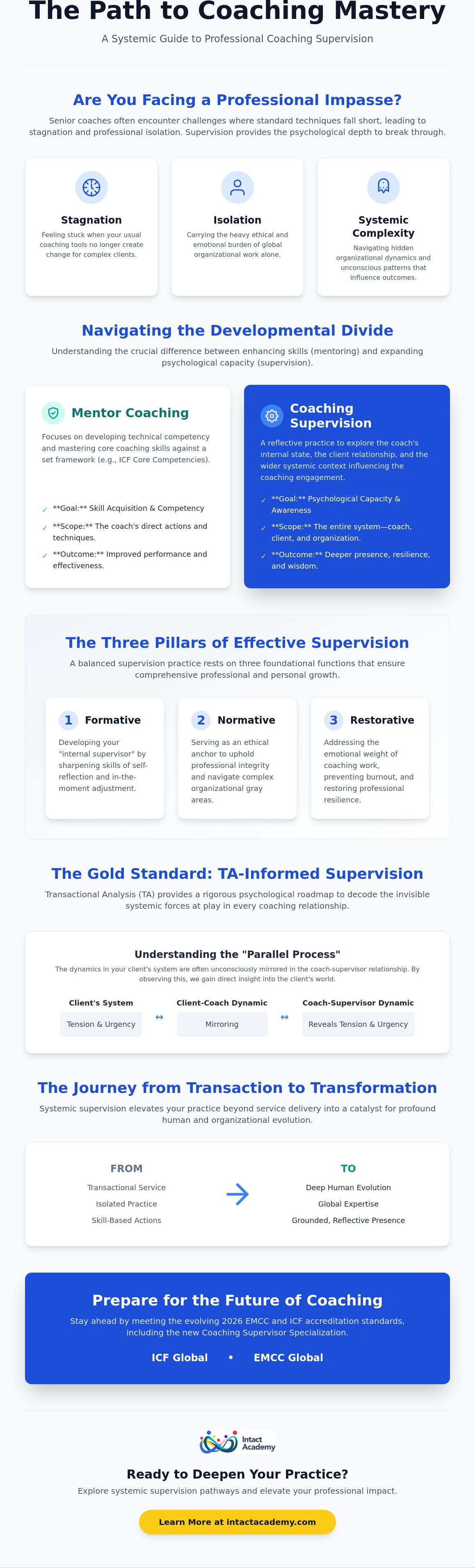
Effective supervision rests upon three foundational functions that support a coach’s long-term flourishing. The formative pillar focuses on the continuous development of your "internal supervisor," sharpening your ability to self-reflect and adjust in the moment of coaching. The normative pillar acts as an ethical anchor; it helps you uphold professional integrity and navigate the complex gray areas inherent in global organizations. Finally, the restorative pillar addresses the emotional weight of the work. It provides a necessary outlet for the pressures of executive coaching, preventing stagnation and restoring your professional resilience so you can remain a stable presence for your clients.
Why 'Online' is the New Frontier for Systemic Insight
Choosing to engage in professional coaching supervision online allows you to break the "local bubble" of your immediate geographic circle. This access to global expertise is vital for understanding the systemic nuances of international business. In a virtual environment, we often find a unique form of psychological intimacy that allows for deeper focus and less external distraction. Digital platforms now facilitate sophisticated systemic mapping and the visualization of Transactional Analysis scripts, making complex organizational dynamics visible and manageable. This online path ensures that you aren't limited by proximity, but empowered by the best psychological insights the world has to offer.
The Systemic Lens: Why TA-Informed Supervision is the Gold Standard
Coaching exists within a web of relationships. It's never just a dialogue between two individuals; it's an intersection of two systems. To navigate this complexity, professional coaching supervision online must move beyond surface-level feedback. It requires a rigorous psychological framework to decode the silent signals that dictate behavior. This is where understanding what is transactional analysis becomes a transformative advantage. TA provides a precise roadmap for identifying script patterns and unconscious dynamics that might otherwise remain invisible to the untrained eye.
One of the most profound phenomena in this work is the "Parallel Process." You might notice that the same tension, confusion, or urgency present in your client's organization begins to manifest within your supervision session. The client-coach dynamic mirrors the coach-supervisor dynamic. By observing this resonance, we gain immediate, systemic insight into the organizational culture without ever stepping into the client’s office. This level of awareness allows you to shift from being a participant in the system's dysfunction to being a catalyst for its health.
Mapping Ego States and Psychological Games
Coaches often find themselves "hooked" by a client's specific energy. In TA terms, this usually means being pulled into a Parent or Child ego state. Perhaps you feel an overwhelming urge to "save" a struggling executive, or you find yourself becoming uncharacteristically critical. Recognizing these shifts is essential for maintaining professional distance. We also look for psychological games like "Yes, But," where a client asks for advice only to reject every suggestion. These games are not obstacles; they are data points about the client’s internal script. TA life scripts are the unconscious blueprints that dictate how individuals perceive their worth and influence their leadership styles.
The 7-Eyed Model through a Systemic TA Filter
The 7-Eyed Model is a staple of professional coaching supervision online, but its power is magnified when viewed through a TA lens. We pay particular attention to "Eye 5," which focuses on the relationship between the supervisor and the coach. By integrating TA’s concept of transference, we can see how the coach's own history interacts with the client’s system. This isn't just about individual insight. It's about understanding how these psychological threads weave through the entire organization, affecting stakeholders you may never meet. For those seeking to master these complex dynamics, exploring the TA EMCC Senior Supervisor academy offers a path to senior-level expertise and systemic mastery.
Mentor Coaching vs. Supervision: Navigating the Developmental Divide
The journey of a coach often begins with a focus on technical mastery, yet it eventually reaches a threshold where skill alone is insufficient. It's vital to distinguish between mentor coaching and supervision, as they serve different developmental needs. Mentor coaching is primarily concerned with competency. It's a focused audit of your technical moves, ensuring you're hitting the specific notes of the ICF Core Competencies. In contrast, professional coaching supervision online is about expanding your capacity. It doesn't just ask if you're doing the coaching right; it explores who you're being while you do it. This shift is a fundamental part of professional development for coaches, marking the transition from transactional skill-building toward a path of systemic wholeness.
Many senior practitioners believe that reaching a certain level of accreditation signals the end of their developmental needs. They ask, "I'm already accredited, why do I need this?" The answer lies in the reality that as your clients' challenges become more complex, your own psychological "blind spots" can become more significant. Mastery isn't a destination where you stop learning; it's a state of continuous, reflective evolution. Supervision provides the restorative space needed to examine the "who you are" that technical mentoring often ignores, allowing you to remain a clean vessel for your clients’ transformation.
When to Seek a Mentor Coach vs. a Systemic Supervisor
Choosing the right support depends on your current learning edge. You should seek a mentor coach when you're preparing for an initial credential or when you want to perfect the technical execution of your coaching sessions. It's about sharpening the tools in your kit. Conversely, you should engage in professional coaching supervision online when you're navigating an impasse with a client, facing an ethical gray area, or feeling the weight of systemic resistance within a global organization. During an EMCC Senior Practitioner journey, these two roles complement each other. The mentor ensures your "moves" meet professional standards, while the supervisor ensures you have the psychological depth to handle the impact of those moves within a complex system.
Addressing the Imposter Syndrome in Senior Coaching
Even the most experienced coaches aren't immune to feelings of inadequacy, especially when operating in high-stakes executive settings. Supervision acts as a "secure base," a term from attachment theory that describes a safe environment from which one can explore the world. Within this base, you can voice your anxieties and explore your feelings of being an "imposter" without judgment. This process allows you to move from "doing" coaching, which is often a performance driven by anxiety, to "being" a transformational presence. Your supervisor serves as a wise mentor in this evolution, helping you integrate your professional identity so you can stand with quiet power in any organizational environment.
The Path to Mastery: Preparing for EMCC and ICF Accreditation Online
Achieving a senior level credential is a methodical process of aligning your inner experience with external standards. It requires a transition from sporadic reflection to a disciplined, systemic inquiry. To navigate this path, you must first audit your current coaching hours to identify your "learning edge." This is the point where your existing skills meet their limit and where your growth truly begins. Engaging in professional coaching supervision online provides the structured environment necessary to bridge this gap, ensuring that your development is both psychologically deep and professionally pragmatic.
Selecting a supervisor with systemic and Transactional Analysis (TA) expertise is the next critical step. You need a mentor who can see beyond the surface of your client interactions to the underlying organizational scripts. Once you've found this partner, you'll establish a "Supervision Contract" that honors both your personal growth and the ethical requirements of the profession. This contract serves as the foundation for consistent reflective practice, combining real-time online sessions with disciplined journaling. Finally, ensure you document every hour. As of June 2026, the ICF allows up to 10 hours of supervision to count toward your CCE renewal, while the EMCC mandates at least one session per quarter to maintain accreditation.
Meeting the Requirements for EMCC Senior Practitioner and Beyond
Supervision is a core component of the executive coaching certification process. It provides the evidence of reflective maturity that accrediting bodies demand. Online formats offer the flexibility to choose between individual sessions for deep personal work or group formats that provide a broader systemic perspective. For those aiming for the "Senior Supervisor" level of mastery, the focus shifts toward holding the space for other coaches, requiring an even more rigorous integration of psychological theory and professional ethics. It's a journey of becoming a stable container for the development of others.
Ethics in the Digital Age: A Core Supervision Topic
The shift to virtual work brings unique ethical challenges that require careful navigation. Maintaining confidentiality in virtual organizational settings is no longer just about secure passwords; it's about understanding the psychological boundaries of a digital workspace. You must manage these boundaries with sensitivity when coaching across diverse global cultures and shifting time zones. The supervisor acts as a steadying presence, ensuring the coach's ethical compass remains calibrated even when organizational pressures pull it off course. This ongoing ethical dialogue is what keeps your practice grounded and integral.
If you're ready to align your practice with global standards and deepen your systemic impact, consider joining our TA EMCC Senior Supervisor academy to begin your journey toward senior-level mastery.
The Intact Academy Difference: Systemic Supervision for Global Impact
The choice of a developmental partner is a statement of intent. It reflects your commitment to the depth of your practice and the integrity of your professional identity. At Intact Academy, we offer the TA EMCC Senior Supervisor academy as a premier path for those who seek to move beyond the technical and into the transformational. Under the leadership of Sari van Poelje, whose international expertise in organizational change and Transactional Analysis spans decades, our programs provide the intellectual rigor and psychological safety required for true mastery. It's a space where complex systemic issues feel manageable through insight and structured methodology.
Our core philosophy is rooted in the return to a state of completeness and genuineness. We believe that a coach’s greatest tool is their own integrated presence. When you engage in professional coaching supervision online with us, you aren't just receiving feedback; you're entering a systemic sanctuary. You'll join a vibrant global community of practitioners from over 14 countries, each committed to flourishing within their own organizational systems. This diversity of perspective ensures that your learning is never confined to a single cultural or professional bubble, allowing you to develop a truly global citizen's perspective on human behavior.
Our Methodology: Beyond Transactional Coaching
We don't settle for surface-level interventions. Our methodology integrates systemic organizational change with deep psychological insights, creating a stable container for what can often be a turbulent process of professional growth. While many providers focus on quick-fix techniques, we emphasize sustainable transformation. The "Academy" environment we cultivate is intentional; it's a space where you can slow down, reflect, and allow profound concepts to resonate before taking outward action. This methodical rhythm mirrors the process of deep learning itself, ensuring that the changes you make are both lasting and impactful for the organizations you serve.
Taking the Next Step Toward Systemic Mastery
The path to becoming a senior supervisor or a master practitioner is a deliberate process of becoming. We invite you to explore our various workshops, masterclasses, and full certification programs designed to support you at every stage of your evolution. Whether you're looking to refine your team coaching skills or seeking a senior-level supervisor accreditation, our international team provides the grounded, authoritative guidance you need. Mastery isn't a destination, but a continuous commitment to excellence and integrity.
You can book a consultancy session or a dedicated supervision session to experience the Intact Academy difference firsthand. It's time to move beyond the transactional and embrace a practice that honors the complexity of human behavior and the demands of modern business. Deepen your impact with Intact Academy's professional supervision.
Stepping into Your Systemic Future
The journey toward professional mastery is a quiet, deliberate process of returning to a state of wholeness. We've explored how the shift from technical competence to psychological capacity marks the vital transition from practitioner to master. By integrating Transactional Analysis with systemic insight, you don't just solve client problems; you learn to decode the very architecture of human systems. Engaging in professional coaching supervision online provides the stable container necessary for this evolution, ensuring you remain grounded while navigating the complexities of the modern global landscape.
At Intact Academy, we provide a path that is both academically rigorous and deeply human. Our programs are accredited by the EMCC and ICF, ensuring your growth is recognized by the world's leading professional bodies. Led by global expert Sari van Poelje, you'll join a community of practitioners from more than 14 countries, all committed to sustainable transformation and genuine presence.
It's time to honor your own development with the same care you give your clients. Join the TA EMCC Senior Supervisor Academy and step into the next phase of your professional journey. Your evolution is the catalyst for the profound change your clients seek.
Frequently Asked Questions
What is the difference between coaching supervision and mentor coaching?
Mentor coaching focuses on the technical mastery of specific competencies, while professional coaching supervision online expands your capacity to hold complex psychological and systemic dynamics. While a mentor helps you sharpen your tools and meet credentialing standards, a supervisor helps you understand the "who" behind the work. This distinction is critical for senior coaches moving from transactional skill-building toward a state of deep, reflective maturity.
Is online coaching supervision as effective as in-person sessions?
Online supervision is highly effective because it removes geographic constraints, allowing you to access global psychological expertise that might be unavailable locally. The digital environment often fosters a unique form of psychological intimacy and focus. This "virtual sanctuary" allows for deep reflective work and the use of digital systemic mapping tools that can enhance the clarity of complex organizational dynamics across different cultures.
How many hours of supervision do I need for EMCC or ICF accreditation?
As of June 2026, the ICF allows up to 10 hours of coaching supervision to count toward CCE renewal requirements for ACC, PCC, and MCC credentials. For the Advanced Certification in Team Coaching (ACTC), a minimum of 5 hours is required with a specialized supervisor. The EMCC maintains a consistent standard, requiring accredited coaches to undergo at least one supervision session per quarter to ensure ongoing reflective practice and professional integrity.
Can I use Transactional Analysis in my coaching without being a therapist?
You can absolutely integrate Transactional Analysis into your practice without being a therapist. TA is a robust psychological theory used extensively in organizational development and professional coaching to analyze communication patterns and systemic scripts. While it offers deep psychological depth, its application in coaching focuses on enhancing executive presence and organizational health rather than clinical treatment. It serves as a pragmatic roadmap for professional transformation.
What should I look for when choosing a professional coaching supervisor online?
When selecting a provider for professional coaching supervision online, prioritize those with senior-level accreditation from the EMCC or ICF. Look for a supervisor who possesses deep systemic and psychological expertise, specifically in frameworks like Transactional Analysis. It's essential to find someone who acts as a stable container for your growth, challenging you to explore your ethical blind spots while supporting your journey toward professional mastery.
Does Intact Academy provide group supervision or only 1:1 sessions?
Intact Academy provides both individual 1:1 supervision and group supervision formats to meet your developmental needs. Our TA EMCC Senior Supervisor Academy is designed to offer a collaborative learning environment where practitioners benefit from diverse systemic perspectives. Individual sessions allow for personalized psychological exploration, while group formats provide a broader view of organizational dynamics and shared ethical inquiry among a community of global peers.
How does systemic supervision help with organizational change initiatives?
Systemic supervision helps you decode the unconscious organizational scripts that often derail change initiatives. By examining the parallel process, you gain immediate insight into how the client's organizational culture is manifesting in your coaching relationship. This awareness allows you to shift from being reactive to the system's pressures to being a grounded catalyst for sustainable transformation, ensuring your interventions address the root causes of stagnation.
What happens during a typical online supervision session?
A typical session involves a collaborative, reflective dialogue centered on your current coaching engagements. You'll explore specific cases where you feel an impasse or ethical tension, using systemic mapping or TA scripts to visualize the dynamics at play. The process is both formative, building your internal supervisor, and restorative, ensuring you have the emotional resilience to continue your work with a sense of completeness and genuineness.


