

What if the "irrational" resistance you encounter during organizational change isn't a lack of competence, but a subconscious loyalty to an invisible script? You've likely felt the frustration of implementing a clear strategy only to watch it dissolve into familiar, dysfunctional patterns. It's a common struggle for leaders who realize that traditional incentives often fail to address the core psychological drivers in the workplace. These deep-seated dynamics operate beneath the surface of professional logic, governing how we interact, how we fail, and how we ultimately succeed.
You're right to feel that surface-level interventions often miss the mark; they treat the symptoms while leaving the underlying ego states untouched. This guide moves beyond standard motivation theories to explore the systemic forces and unconscious games that define your organizational culture. We'll examine how returning to a state of completeness and genuineness can transform interpersonal conflict into a catalyst for growth. You'll gain a structured methodology to decode these hidden scripts, allowing you to lead with a sense of quiet power and profound systemic insight.
Key Takeaways
- Learn to look beneath traditional incentives to address the unconscious scripts that truly govern professional behavior and response to stress.
- Utilize the Parent-Adult-Child framework to map interpersonal dynamics and bring clarity to complex meetings and high-stakes negotiations.
- Recognize the hidden payoffs in office "games" and learn to disrupt the Karpman Drama Triangle to resolve persistent interpersonal conflicts.
- Move your team toward a state of autonomy and genuineness by replacing rigid, repetitive patterns with Adult-level awareness and spontaneity.
- Understand how mastering the psychological drivers in the workplace creates a foundation for systemic organizational change and lasting professional flourishing.
Beyond Surface Motivation: Defining Psychological Drivers in the Workplace
Most organizational strategies rely on the "carrot and stick" approach, assuming that employees are purely rational actors motivated by reward or deterred by consequence. This transactional perspective fails to account for the true psychological drivers in the workplace. These drivers are the unconscious needs, life scripts, and ego states that dictate how an individual responds to authority, handles peer pressure, or navigates high-stakes stress. While much of the current corporate discourse focuses on psychosocial risks, such as environmental stressors or workload, it often neglects the internal psychological predispositions that determine how one perceives those risks.
For a Senior Practitioner in coaching or organizational change, understanding these internal psychological drivers in the workplace is the hallmark of their expertise. It requires moving beyond what people do to understand why they do it. This depth of insight is often rooted in frameworks like Transactional Analysis, which provides a map for the professional mind and the invisible contracts we sign with our colleagues and leaders. When we decode these internal scripts, we move from surface-level management into the realm of profound human transformation.
The Shift from Transactional to Transformational Understanding
Traditional management training often attempts to fix behaviors through policy, yet these interventions frequently fail because they don't address the root-cause scripts. A systemic coach acts as a mirror, reflecting these hidden drivers back to the team. This reflection allows for a shift in narrative. Instead of labeling an employee as "difficult," we begin to see a person operating from a survival script that now creates friction. This systemic awareness transforms the work from managing people to facilitating human flourishing.
Identifying the 'Invisible' Forces in Professional Settings
In professional settings, these forces often manifest as repetitive drama that seems to defy logic. You might notice the same conflicts arising regardless of the team members involved. These patterns are often echoes of early life patterns, where strategies developed in childhood are unconsciously applied to executive presence and decision-making today. Psychological drivers are the unseen blueprint of organizational culture. By identifying these blueprints, we move from being victims of our history to authors of our professional future.
The Architecture of the Workplace Mind: Ego States and Life Scripts
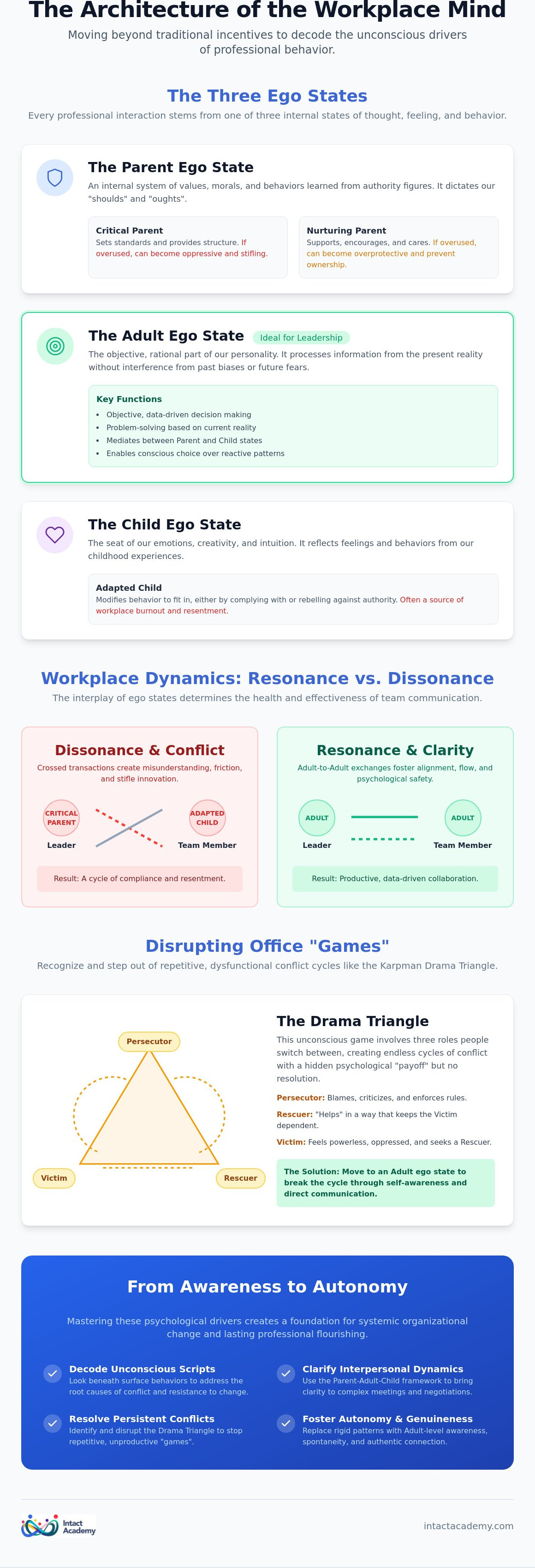
To understand why organizations behave as they do, we must look at the internal architecture of the individuals within them. Transactional Analysis (TA) offers a precise map for this journey. It posits that every professional interaction occurs from one of three ego states: Parent, Adult, or Child. These aren't just roles we play; they're entire systems of thought, feeling, and behavior. When a leader speaks from a Critical Parent state, they might trigger an Adapted Child response in their team, creating a cycle of compliance and resentment that stifles innovation. This dynamic is a fundamental component of Organizational Behavior, yet it's often overlooked in standard leadership training.
These internal frameworks act as the primary psychological drivers in the workplace. They determine whether a team experiences resonance—a state of alignment and flow—or dissonance, where hidden agendas and old patterns create friction. By identifying which ego state is active during a meeting or negotiation, you gain the power to shift the conversation toward a more productive, Adult-to-Adult exchange. It's about moving from reactive patterns to conscious choice.
Mapping Ego States in Corporate Leadership
In management, the Parent ego state manifests in two distinct ways. The Critical Parent sets standards and provides structure, but can become oppressive if overused. The Nurturing Parent supports and encourages, yet can become overprotective, preventing team members from taking ownership. Conversely, the Adapted Child state is often the source of workplace burnout; it's the part of us that seeks to please authority or rebels against it at the expense of our own well-being. Cultivating the Adult state is essential for objective, data-driven decision making. It allows us to process current reality without the interference of past biases.
Uncovering the Life Scripts Behind Career Trajectories
Life scripts are the unconscious plans we drafted in our earliest years to ensure safety and recognition. These scripts are often fueled by "Driver" behaviors: Be Perfect, Hurry Up, Please Others, Try Hard, and Be Strong. You've likely seen these in action. The "Be Perfect" leader may struggle to delegate, while the "Hurry Up" executive creates constant, unnecessary urgency. While these drivers can propel a career forward, they often lead to organizational paralysis when the script no longer fits the current reality. Understanding these scripts is vital when leading organizational change, as any shift in the system threatens the individual's sense of psychological safety. These deep-seated patterns are the psychological drivers in the workplace that determine whether a transformation succeeds or stagnates. If you're ready to deepen your understanding of these dynamics, exploring our TA EMCC Senior Practitioner academy can provide the systemic tools needed for this profound work.
Decoding the 'Games' We Play: Unconscious Drivers of Conflict
Conflict in the office often feels like a broken record. You might see the same arguments between the same departments, month after month, regardless of the specific project at hand. These aren't just communication breakdowns; they're what Transactional Analysis defines as "Psychological Games." A Game is a series of repetitive, socially plausible transactions that lead to a predictable, often negative, outcome. While they seem counterproductive, they're actually powerful psychological drivers in the workplace. They provide a "payoff"—a familiar, albeit unhelpful, emotional state that reinforces an individual's unconscious Life Script.
Some leaders worry that these concepts feel too clinical for a professional environment. However, understanding the underlying mechanics of human interaction is essential for maintaining psychological health in the workplace. It's not about clinical diagnosis; it's about operational efficacy. When we ignore the unconscious drivers of conflict, we're essentially trying to fix a systemic software bug by merely polishing the monitor. Teams often subconsciously choose the "safety" of familiar conflict over the "risk" of genuine resolution because conflict satisfies their script needs for recognition, even if that recognition is negative.
The Drama Triangle in Executive Teams
The Karpman Drama Triangle is a classic map of these dysfunctional dynamics, consisting of three roles: the Persecutor, the Rescuer, and the Victim. In executive settings, these roles are often played with high stakes. The Rescuer manager, for instance, might think they're being supportive, but by over-functioning and "saving" their subordinates, they actually prevent team growth and stifle autonomy. Meanwhile, the Victim role often drives passive-aggressive resistance to change, where employees act as if they're powerless despite having the agency to succeed. Breaking this cycle requires moving toward the "Winners Triangle," where Rescuing becomes Caring, Persecuting becomes Assertiveness, and Victimhood becomes Vulnerability.
Payoffs and Rackets: The Hidden Economy of Emotion
Why would a team stay stuck in a cycle of frustration? The answer lies in "Racket Feelings." These are familiar emotions—like chronic stress, inadequacy, or irritation—that we've learned to substitute for more authentic, but perhaps more vulnerable, feelings. Some corporate cultures actually thrive on "stress" as a psychological payoff; the frantic energy feels like productivity, even when it leads to burnout. To understand how these transactions form the backbone of organizational life, you can refer to our guide on what is transactional analysis. Recognizing these psychological drivers in the workplace allows you to stop the game, return to a state of genuineness, and foster a culture of true Adult-to-Adult cooperation.
From Awareness to Autonomy: Shifting Workplace Dynamics
Moving beyond the repetitive cycles of psychological games requires more than just a change in policy; it demands a shift in consciousness. In Transactional Analysis, this shift is defined as the movement toward Autonomy. Autonomy is not merely independence. It is the integration of three distinct capacities: awareness, spontaneity, and intimacy. Awareness allows us to see the organizational landscape as it truly is, rather than through the distorted lens of our early programming. Spontaneity gives us the freedom to choose an ego state that fits the present situation. Intimacy enables us to communicate directly, without the hidden agendas that often serve as the primary psychological drivers in the workplace.
When a team moves from "Script" behavior to "Adult" autonomy, the energy of the organization transforms. Instead of reacting to perceived threats or seeking familiar payoffs, individuals begin to operate from a place of presence and genuineness. This transition is not accidental. It requires a deliberate dismantling of old patterns and the courage to engage in honest, game-free transactions. For those facilitating this change, the challenge is to intervene effectively without slipping into the role of the "Rescuer," which only reinforces the very dynamics you seek to resolve.
Contracting for Change and Clarity
One of the most powerful tools for redefining psychological drivers in the workplace is the process of multi-layered contracting. Most organizations stop at the administrative contract, which covers tasks and timelines. However, professional mastery requires addressing the professional and psychological contracts as well. The psychological contract involves the unspoken expectations and emotional needs that often drive behavior beneath the surface. By making these implicit agreements explicit, you eliminate the "dark space" where psychological games typically hide. This level of precision is a core component of advanced professional development for coaches, ensuring that every intervention is grounded in clear, Adult-to-Adult agreement.
Building a Culture of Psychological Safety through TA
Psychological safety is often discussed as a vague environmental factor, but TA provides a concrete mechanism for building it through the use of "Strokes." A stroke is a unit of recognition; it is the fundamental way we acknowledge another person's existence. High-performing teams thrive on positive, conditional strokes that recognize specific achievements, as well as positive, unconditional strokes that value the person's inherent worth. This creates an "I’m OK – You’re OK" cultural position, which is the only psychological stance from which sustainable success can emerge. Autonomy in the workplace is the ability to respond to the present moment without the interference of past scripts. To foster this level of transformation within your own organization, consider the systemic impact of our Team Coaching programs, which are designed to return teams to a state of collective wholeness.
Mastering the Art of Systemic Impact with Intact Academy
Understanding the psychological drivers in the workplace is the first step toward profound change, but applying this knowledge within a complex organization requires a higher level of mastery. Surface-level coaching often falters because it lacks the systemic depth to hold the tension of unconscious dynamics. When a leader or coach only addresses what is visible, they risk becoming part of the very "game" they are trying to resolve. At Intact Academy, we bridge the gap between deep psychological insight and pragmatic business results, providing the structured methodology needed to navigate the turbulent waters of organizational life with clarity and calm authority.
The journey to becoming a Senior Practitioner is as much about personal evolution as it is about professional skill. It involves moving beyond the role of a facilitator and stepping into the presence of a wise mentor. This transformation is supported by systemic supervision, which acts as a stable container for the often-intense work of organizational change. Supervision ensures that you maintain your professional integrity and depth, allowing you to remain objective while engaging with the hidden scripts that govern your environment. It's a process of returning to a state of completeness, where your actions are aligned with your deepest insights.
Advanced Training for Transformational Leaders
Our TA EMCC Senior Practitioner academy is designed for those who seek to lead at the intersection of human behavior and business strategy. This program offers a rigorous exploration of Transactional Analysis within a systemic framework, ensuring that you can map and influence the psychological drivers in the workplace with precision. By achieving international accreditation through bodies like the EMCC or ICF, you join a global community of change agents dedicated to human flourishing. This isn't just a certification; it's an invitation to a global citizenship of professionals who value depth, integrity, and the courage to foster genuine change in every executive setting.
Your Path to Mastery and Wholeness
Deep psychological work requires the courage to look inward before taking outward action. It asks us to move from "doing" coaching as a set of techniques to "being" a transformational presence within the system. This shift allows you to respond to the present moment with spontaneity and awareness, free from the interference of past scripts. As you conclude this guide, consider where your own journey of mastery begins. We invite you to explore the TA EMCC Senior Team Coach Academy, a space designed for those ready to facilitate profound human transformation and achieve lasting systemic impact.
Cultivating Systemic Excellence and Wholeness
True organizational transformation begins when we have the courage to look beneath the surface of professional logic. By decoding the ego states and life scripts that govern our interactions, we move from being reactive participants in psychological games to becoming autonomous leaders. This shift allows us to address the deep-seated psychological drivers in the workplace with clarity and precision, replacing repetitive conflict with genuine Adult-to-Adult cooperation. You've now gained the conceptual framework to recognize these hidden dynamics; the next step is mastering the methodology required to facilitate lasting change.
Our academy, led by international expert Sari van Poelje, brings together participants from over 14 countries to bridge the gap between psychological depth and pragmatic results. With dual accreditation from the EMCC and ICF, we provide a stable container for your professional evolution. We invite you to elevate your coaching impact by exploring our TA EMCC Senior Practitioner Academy. It's a journey of returning to your most genuine self, and we are here to support your flourishing every step of the way.
Frequently Asked Questions
What are the most common psychological drivers in corporate environments?
The most common drivers are often rooted in the "Drivers" of Transactional Analysis, such as the internal imperatives to "Be Perfect" or "Hurry Up." These unconscious needs dictate how individuals manage quality, time, and interpersonal boundaries. Additionally, the fundamental need for "strokes" or recognition remains a primary force. When healthy recognition is unavailable, employees may unconsciously provoke conflict to satisfy this basic human requirement for acknowledgment and visibility.
How can I tell if my team is stuck in a 'Life Script'?
You can identify a Life Script by observing repetitive, dysfunctional patterns that persist despite logical interventions or strategy changes. If a team consistently falls into the same conflict regardless of the project, they're likely operating from a shared unconscious script. These patterns often feel predictable or "staged." They manifest as a collective inability to respond to the present moment, favoring instead a familiar drama that reinforces old beliefs.
Is Transactional Analysis (TA) effective for C-suite executive coaching?
Transactional Analysis is exceptionally effective for C-suite coaching because it provides a rigorous, systemic framework for understanding high-stakes interpersonal dynamics. Executives often face complex "games" and power struggles that can't be resolved through simple management tactics. By mapping ego states, TA allows leaders to move from reactive positions into a state of Adult autonomy. This clarity is essential for making objective decisions while maintaining a transformational presence.
What is the difference between a psychological driver and simple motivation?
The primary difference lies in the origin and consciousness of the behavior. Simple motivation is often conscious and driven by external rewards like compensation or title. In contrast, psychological drivers in the workplace are unconscious scripts and internal needs that operate beneath the surface of professional logic. While motivation tells us what we want to achieve, psychological drivers explain why we repeat certain behaviors, even when they conflict with our goals.
Can psychological drivers be changed, or are they permanent?
Psychological drivers are not permanent; they're learned strategies that can be updated through awareness and deliberate "redecision." While these scripts were often formed in early life for safety, they can be rewritten when they no longer serve the adult professional. This process requires moving from unconscious reaction to conscious choice. Through systemic coaching, individuals learn to recognize their active ego states and choose responses that align with their current reality.
How does systemic team coaching address unconscious workplace dynamics?
Systemic team coaching addresses these dynamics by treating the team as a single, living organism with its own shared scripts and "games." The coach observes the transactions between members to identify the hidden payoffs that maintain dysfunction. By introducing clear contracting and healthy stroke patterns, the coach helps the team move toward a state of collective autonomy. This approach ensures that individual growth and organizational success are inextricably linked and mutually supportive.
Why is psychological safety considered a driver of performance?
Psychological safety is a driver of performance because it allows individuals to operate from their "Adult" ego state without fear of "Parental" criticism. When employees feel safe, they can engage in spontaneous and creative thinking, which is the foundation for innovation. Research from February 2026 indicates that workplaces with high psychological safety see 81% higher employee engagement. Without this safety, the system retreats into defensive states, leading to compliance rather than excellence.
What role does a coach play in uncovering these hidden drivers?
A coach acts as a systemic mirror, reflecting the unconscious psychological drivers in the workplace back to the individual or team. Their role isn't to provide answers, but to observe transactions and highlight the "games" that prevent progress. By maintaining an objective, Adult stance, the coach creates a safe space for others to explore their internal scripts. This facilitated awareness is the catalyst that allows professionals to return to a state of genuineness.


