

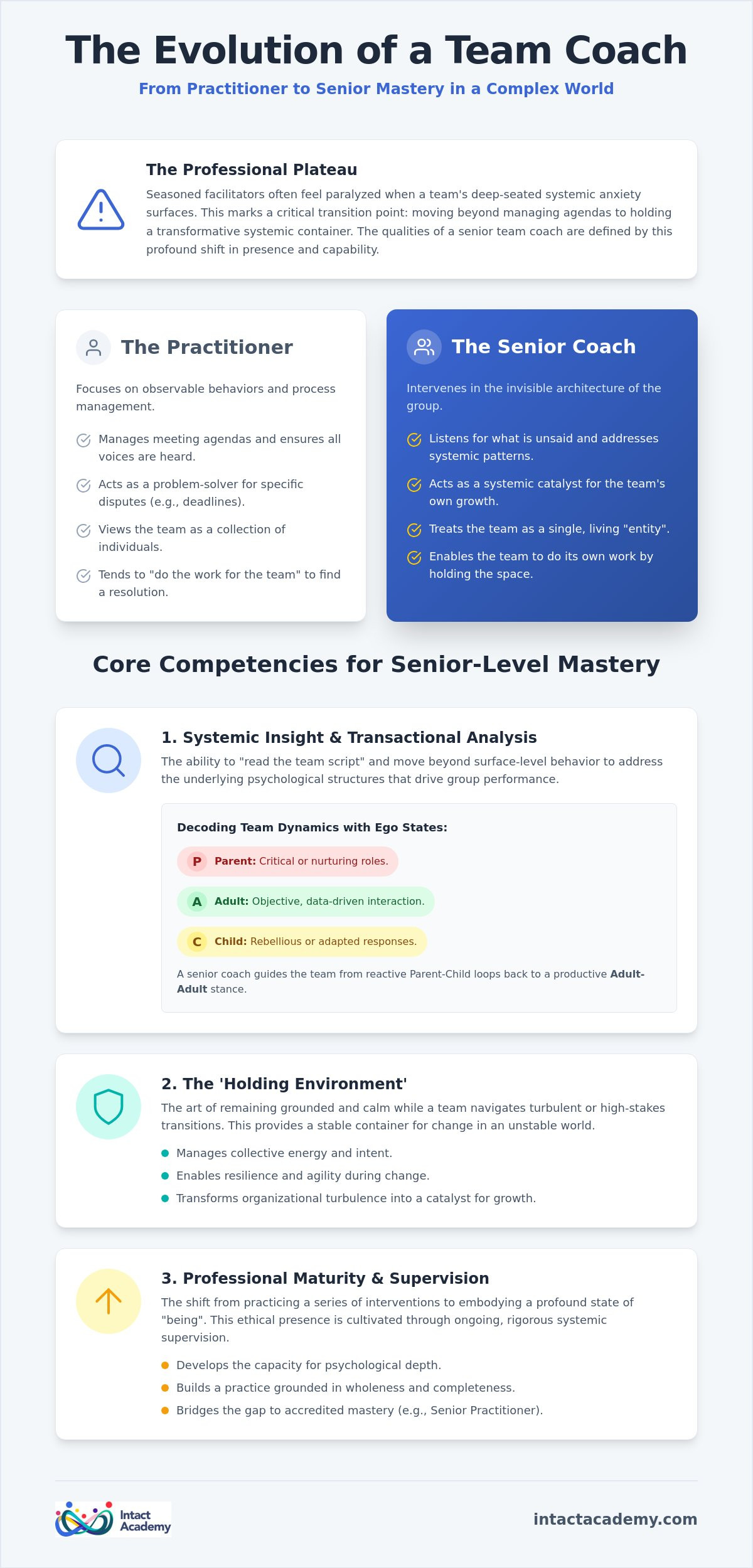
Why does a seasoned facilitator, capable of managing the most vocal personalities, often find themselves paralyzed when a team's underlying systemic anxiety begins to surface? It's a quiet, heavy realization that many practitioners face as they hit a professional plateau. You might feel overwhelmed by chaotic team dynamics or struggle to articulate the true value of your interventions to stakeholders. The qualities of a senior team coach in 2026 require more than just a toolkit of exercises. They demand a profound shift in presence and the capacity to hold a systemic container.
If you're ready to move from basic facilitation to true mastery, you're in the right place. We'll explore the advanced psychological and systemic competencies needed to navigate modern organizational complexity. You'll discover a clear roadmap for senior-level growth, including how Transactional Analysis applies to team scripts. This journey doesn't just prepare you for Senior Practitioner accreditation; it offers a way to return to a state of completeness in your practice, turning turbulent organizational energy into a catalyst for transformation.
Key Takeaways
- Learn why senior team coaching requires a fundamental shift from managing meeting agendas to intervening in complex, unconscious organizational systems.
- Discover how to use Transactional Analysis to decode the "Team Script," revealing the hidden patterns that dictate how groups react to pressure.
- Master the art of creating a "holding environment" to remain grounded and calm while a team navigates turbulent or high-stakes transitions.
- Understand how ongoing systemic supervision transforms your professional practice from a series of interventions into a profound state of "being."
- Identify the specific qualities of a senior team coach required to bridge the gap between basic practitioner skills and accredited mastery.
Defining the Senior Team Coach: Beyond Basic Facilitation
To understand the qualities of a senior team coach, one must first look past the mechanics of facilitation. While a facilitator might ensure every voice is heard during a strategy session, the senior coach is listening for what remains unsaid. They don't just lead meetings; they intervene in the invisible architecture of the group. This distinction is vital as we move toward 2027, where updated industry standards emphasize a deeper alignment with systemic competencies. The role is no longer about managing a process, but about holding a space for profound transformation.
The transition from 'Practitioner' to 'Senior' level is defined by the capacity to handle psychological depth and systemic complexity. A practitioner might help a team resolve a specific dispute over a deadline or a project milestone. In contrast, a senior coach explores the recurring patterns of conflict that suggest a deeper, unconscious team script. They've moved from the role of a problem-solver to that of a systemic catalyst. Their primary goal isn't to fix the team's immediate issue, but to evolve the team's inherent capacity to navigate its own complexity. It's a shift from doing the work for the team to enabling the team to do the work for itself.
The Entity-First Perspective
At this advanced level, the coach treats the team as a single, living entity rather than a mere collection of individuals. It's easy to fall into the trap of individual coaching in a group setting, but a senior coach maintains a neutral, systemic stance. They observe the boundaries, the shared goals, and the collective defense mechanisms that emerge when the group is under pressure. By focusing on the "entity," they ensure that the intervention serves the health and efficacy of the entire organizational system rather than just the preferences of its most vocal members.
Strategic Alignment and the 2026 Business Landscape
In a business landscape increasingly shaped by rapid AI integration and hybrid work structures, the human element has become the primary differentiator for success. Organizations now seek sustainable transformation rather than short-term fixes that fade once the coach leaves the room. The qualities of a senior team coach allow them to bridge the gap between human behavior and strategic business results. Systemic team coaching is the management of collective energy and intent. This focus on wholeness ensures that the team remains resilient and agile, even as the global market continues its unpredictable evolution. It provides a stable container for change in a world that often feels anything but stable.
For organizations looking to bring this level of systemic insight into their corporate events, explore Professional Speaking and Workshop Facilitation Fees to see how Ingrid Marsh can support your team's transformation.
Systemic Insight and Transactional Analysis: Reading the Team Script
Teams are stories in motion. While a junior practitioner sees a disagreement over a budget, a senior coach hears the echoes of a decade-old organizational failure. One of the defining qualities of a senior team coach is the ability to see the script beneath the performance. This is where understanding what is transactional analysis becomes a transformative diagnostic tool. It allows us to move beyond surface-level behavior and address the underlying psychological structures that drive team performance.
At the heart of this approach are Ego States: Parent, Adult, and Child. High-performing teams operate primarily from an Adult-Adult stance, characterized by objective data sharing and mutual respect. However, under pressure, teams often regress. You might see a leader shift into a "Critical Parent" role, which inevitably pulls the rest of the team into a "Rebellious" or "Adapted Child" state. This loop stifles innovation and creates a culture of permission-seeking. A senior coach identifies these shifts in real-time, helping the system return to an Adult state where genuine work can happen.
Uncovering the Unconscious Team Script
Every team follows a script. This is a life plan created early in the team's history, often influenced by the founders' values or significant past crises. These scripts act as hidden contracts, dictating what is "safe" to say and what must remain hidden. For instance, "The Hero Leader" script creates a system where the team remains passive, waiting for a savior to make every decision. Conversely, "The Rescuing Team" script might see members constantly overworking to cover for a struggling colleague, eventually leading to systemic burnout. Mapping these scripts helps the team understand why they react to pressure in predictable, often self-sabotaging ways. It makes the unconscious conscious.
From Psychological Games to Adult-Adult Transactions
In high-stakes environments, teams often engage in "Workplace Games." The most common is the "Yes, But" game. A leader asks for solutions, yet every suggestion is met with a reason why it won't work. This isn't a failure of logic; it's a psychological game designed to maintain the status quo while appearing to seek change. If a coach isn't careful, they can be pulled into the "Drama Triangle," acting as a Rescuer who eventually becomes the Victim when their advice fails.
A senior coach remains grounded. They model healthy transactions by refusing to play the game, instead reflecting the team's patterns back to them with empathy and clarity. They don't take the bait. By facilitating the transition back to Adult-Adult communication, the coach ensures that strategic decisions are based on reality rather than reactive scripts. If you are looking to deepen your impact in these complex environments, exploring a systemic approach to team coaching can provide the structural safety needed for this deep work.
The 'Holding Environment': Managing Turbulence in High-Stakes Teams
When a high-stakes executive team reaches a boiling point, the atmosphere becomes thick with unspoken tension. At this moment, the qualities of a senior team coach move from the intellectual to the visceral. Presence is the anchor. It's the capacity to remain steady while the system around you experiences the tremors of change or the heat of conflict. This groundedness provides the team with a psychological "holding environment," a space where anxiety can be contained rather than acted out. Without this container, teams often spiral into reactive behaviors that stall progress and damage relationships.
Within this environment, the senior coach finds the courage to name the "elephant in the room." This isn't an act of aggression or a desire to provoke. Instead, it's an act of systemic empathy. By naming the unspoken, you release the team from the burden of carrying a secret that everyone knows but no one dares acknowledge. This intervention requires deep trust in your own professional maturity and a belief that the system is resilient enough to hear the truth if it's delivered with care. You're not just a witness; you're a steadying force that allows the team to face its own reality.
The Architecture of Psychological Safety
Senior coaches recognize that the safety of the container is far more important than the day's agenda. If the environment isn't secure, the most brilliant strategic plan will fail to gain traction. It's crucial to distinguish between comfort and safety. Comfort avoids friction; safety allows for it. In high-conflict executive teams, de-escalation isn't about silencing voices. It's about ensuring that when difficult truths are spoken, they don't destroy the system's underlying bonds. You aren't there to make people feel good; you're there to make it safe for them to do the hard work of becoming a cohesive unit.
Harnessing the Parallel Process
One of the most advanced qualities of a senior team coach is the ability to work with the "parallel process." This occurs when the coach begins to feel the very emotions the team is suppressing. If you feel a sudden wave of boredom, irritation, or panic, it's rarely just yours. It's data. The parallel process is a mirror for organizational culture, reflecting the hidden dynamics that the team hasn't yet verbalized. A senior coach uses these somatic and emotional responses as a diagnostic tool, reflecting them back to the team without taking them on as their own. This boundary-keeping ensures you remain a clear mirror rather than a participant in the team's anxiety.
Professional Maturity: The Role of Supervision and Ethical Presence
Professional maturity isn't a destination reached by simply clocking hours. It's an internal state of readiness that allows a practitioner to remain effective within the most volatile organizational systems. One of the most overlooked qualities of a senior team coach is the recognition that their own psyche is the primary tool of the trade. This requires a relentless commitment to professional development for coaches that goes beyond learning new techniques. It involves a shift from "doing" coaching to "being" a coach, where your presence alone acts as a stabilizing force for the team.
A senior coach develops a robust professional philosophy that acts as a North Star during complex interventions. This philosophy isn't just a set of beliefs; it's a lived commitment to systemic wholeness and integrity. It guides you when you're faced with the "Yes, But" games or the seductive pull of the drama triangle mentioned earlier. Without this philosophical grounding, a coach risks becoming a mere technician, applying tools without the depth required to sustain real change.
Supervision as a Quality of Mastery
Ongoing supervision is the hallmark of a senior practitioner. It serves as a vital mirror, preventing "systemic blindness," a state where the coach becomes so enmeshed in the team's dynamics that they lose their neutral stance. While mentor coaching focuses on skills, systemic supervision explores the coach's internal responses to the system. This is why EMCC Senior Practitioner levels require documented supervision. It's a non-negotiable practice that prevents burnout and ensures the coach doesn't unconsciously "take on" the team's suppressed anxiety or trauma. It's about maintaining your own professional health to better serve the collective.
Ethical Presence in a Global Context
Navigating the tension between the "Sponsor," such as an HR Director or CEO, and the "Client," which is the team itself, requires sophisticated ethical presence. Senior coaches often face pressure to "fix" specific individuals or report back on private team dynamics. Maintaining integrity in these multi-stakeholder contracts means prioritizing the health of the system over the desire to please the person paying the invoice. This also demands a high degree of cultural sensitivity. In a globalized business environment, understanding how different systemic scripts manifest across cultures is essential for respectful and effective intervention. You must be as comfortable in a boardroom in London as you are in a developmental space in Singapore, always valuing the human element above all else.
To truly master these complexities and move toward a higher level of professional accreditation, engaging in Systemic Supervision is the most direct path to sustainable growth and ethical clarity.
Cultivating Senior Competencies: The Path to Accreditation
The transition from practitioner to senior status is rarely a linear progression. It's a metamorphosis. While your initial training provided the essential scaffolding, reaching senior-level mastery requires you to step away from the rigidity of following a single model. You must begin to integrate multiple frameworks into a cohesive, intuitive practice that responds to the unique rhythm of the team. Cultivating the qualities of a senior team coach involves a commitment to lifelong learning and the courage to face your own professional plateaus. Selecting the right team coaching course is a pivotal decision in this journey, as it provides the intellectual rigor and systemic depth necessary for this evolution.
Mastery is found at the intersection of Transactional Analysis, systemic theory, and years of grounded practical experience. It's about moving beyond the "how-to" of coaching and entering the "why" of human systems. An accredited academy approach offers more than just curriculum; it provides a community of practice where complex case studies are dissected and new ways of being are explored. This environment allows you to return to a state of completeness in your professional identity, ensuring that your interventions are as profound as they are practical.
The Journey to EMCC Senior Practitioner
Accreditation at the EMCC Senior Practitioner or Senior Team Coach level serves as a formal recognition of professional maturity. Assessors aren't looking for a perfect application of a textbook technique. They're looking for evidence of integration. They examine your coaching logs and case studies for a deep understanding of systemic interventions and the ability to reflect on your own presence within the work. You must demonstrate that you no longer just follow a model; you have become the model. The TA EMCC Senior Team Coach Academy is designed specifically to facilitate this transition, bridging the gap between theoretical knowledge and the lived experience of holding a systemic container.
Measuring the Impact of Senior Coaching
Measuring success at this level requires a shift in perspective. Satisfaction surveys and immediate post-session feedback are surface-level metrics that rarely capture the true health of a system. A senior coach tracks long-term cultural shifts and the sustainability of change within the organization. We look for systemic ROI, observing how the team’s new capacity for Adult-Adult transactions influences wider organizational performance over time. We ask: is the team more resilient? Are they solving their own problems without external intervention? This focus on wholeness and genuine transformation is what distinguishes the qualities of a senior team coach from those of a transactional provider.
Ready to deepen your impact and move toward the next level of your professional journey? Explore the TA EMCC Senior Team Coach Academy and discover how systemic mastery can transform your practice.
Mastering the Systemic Container
The evolution from a skilled facilitator to a senior practitioner is a journey toward professional wholeness. It requires more than just new tools; it demands a fundamental shift in how you perceive and inhabit organizational systems. By mastering the qualities of a senior team coach, you move beyond surface-level interventions to address the unconscious scripts that dictate a team's potential. You've learned that holding a stable container and engaging in systemic supervision aren't just professional requirements. They are the bedrock of a sustainable, high-impact practice.
If you're ready to bridge the gap between practitioner skills and accredited mastery, our programs offer a globally recognized path. Led by Sari van Poelje, a global TA expert, our EMCC and ICF accredited programs have welcomed participants from over 14 countries. This is your invitation to join a sophisticated community of learners dedicated to profound human transformation. Enroll in the TA EMCC Senior Team Coach Academy to master these qualities and step into your full potential. The path to senior-level mastery is open, and the impact you can create is truly limitless.
Frequently Asked Questions
What is the difference between a team coach and a senior team coach?
A senior team coach operates with a significantly higher level of systemic complexity and psychological depth. While a practitioner often focuses on group facilitation and immediate goal attainment, a senior coach intervenes in the unconscious scripts and hidden dynamics that govern a team's behavior. They treat the team as a single, living entity rather than a mere collection of individuals.
How does Transactional Analysis help in team coaching?
Transactional Analysis (TA) serves as a precise diagnostic framework for understanding the invisible architecture of a group. It allows coaches to identify Ego State regressions and "Workplace Games" that stall strategic progress. By decoding the collective team script, TA helps the group transition from reactive, historical patterns to objective, Adult-Adult communication.
Is EMCC Senior Practitioner accreditation necessary for team coaches?
Accreditation is increasingly essential as the industry moves toward greater professionalization. Research from the 2025 ICF Global Coaching Study indicates that 73% of coaches agree that clients and organizations expect them to hold a professional credential. Achieving EMCC Senior Practitioner status demonstrates a proven capacity to manage high-stakes, multi-stakeholder environments with ethical maturity.
Can a senior team coach also work as an executive coach?
The competencies of a senior team coach are highly complementary to executive coaching. Both roles require deep systemic insight and the ability to hold a safe psychological container for growth. While an executive coach focuses on the individual's journey within the system, the senior team coach manages the collective energy and strategic intent of the entire group.
How long does it take to develop the qualities of a senior team coach?
Developing the qualities of a senior team coach is a methodical process of integration that typically spans several years of dedicated practice. It requires a blend of advanced theoretical study, such as Transactional Analysis, and hundreds of hours of supervised experience. This evolution is defined by the depth of your professional maturity rather than a simple count of hours.
What is the role of supervision in senior-level coaching?
Supervision acts as a vital mirror that prevents systemic blindness and professional burnout. It provides a reflective space for the coach to explore their somatic and emotional responses to the team's underlying anxiety. This practice ensures the coach remains a neutral, grounded presence, preventing them from being pulled into the team's unconscious drama or scripts.
How do senior team coaches handle conflict in executive teams?
Senior coaches handle conflict by creating a "holding environment" where tension can be processed rather than suppressed. They use the qualities of a senior team coach to name the "elephant in the room" with systemic empathy and grounded presence. This intervention allows the team to face difficult truths without destroying the underlying bonds of the system.
What are the most important ethical considerations for senior coaches?
The most critical ethical challenge involves managing the tension between the "Sponsor" who pays and the "Client" being coached. Senior coaches must maintain integrity by prioritizing the systemic health of the team over the desire to please individual stakeholders. They navigate these complex, multi-stakeholder contracts with transparency, cultural sensitivity, and a commitment to professional wholeness.


