
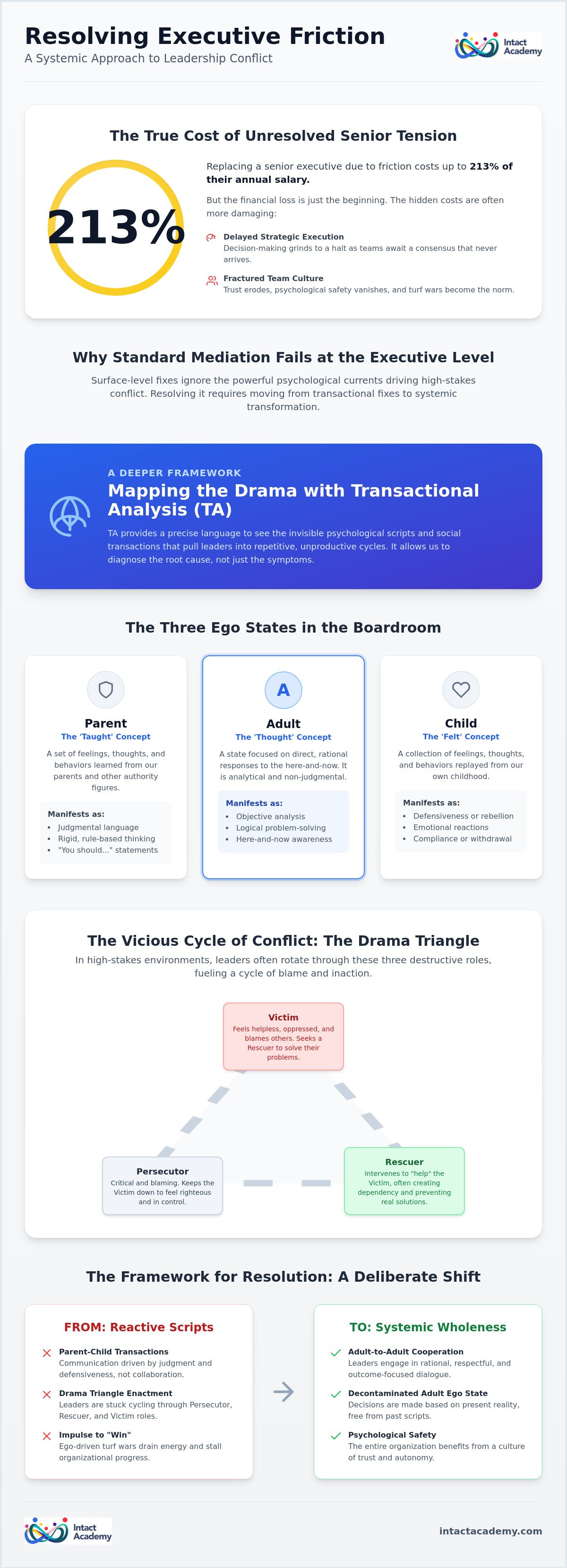
Replacing a senior executive who departs due to unresolved friction can cost your organization up to 213% of their annual salary. Beyond the staggering financial loss, the invisible tax of delayed strategic execution and a fractured culture often feels even more heavy. You've likely observed how resolving conflict between senior leaders requires more than a simple handshake or a superficial mediation session. When high-power confrontations become the norm, they signal a deeper systemic misalignment that threatens the very core of your professional stability.
It's exhausting to manage the ego-driven turf wars that drain your energy and stall progress. This article promises to guide you through a more profound methodology. You'll discover how to move beyond surface-level fixes by using Transactional Analysis to resolve the deep-seated psychological patterns driving executive friction. We'll examine the shift from reactive, script-based behaviors to a state of genuine Adult-to-Adult cooperation. By understanding the psychological games at play, you can foster a sustainable organizational transformation that honors both individual growth and collective success.
Key Takeaways
- Understand why senior-level friction is rarely about business strategy and almost always a systemic symptom of unconscious organizational scripts.
- Learn to identify Parent, Adult, and Child ego states to diagnose the social transactions that fuel executive power struggles.
- Discover a structured framework for resolving conflict between senior leaders by establishing multi-cornered contracts and decontaminating the Adult ego state.
- Shift from the impulse of "winning" toward a state of systemic wholeness that restores psychological safety across the entire organization.
- Recognize deep-level conflict resolution as a path toward professional mastery and a return to genuine, autonomous leadership.
Beyond Personality Clashes: The High Stakes of Executive Friction
At the highest levels of an organization, conflict is rarely a simple disagreement over a spreadsheet or a strategic roadmap. It's almost always about the "how" and the "who." While technical disagreements are part of a healthy executive ecosystem, resolving conflict between senior leaders requires looking beneath the surface of the "what." When we focus only on the business logic of a dispute, we ignore the powerful psychological currents that actually drive the friction.
Healthy intellectual debate fuels innovation; it's a rigorous testing of ideas that leads to better outcomes. Conversely, destructive psychological friction is a repetitive cycle that drains energy without producing clarity. This friction acts as a systemic mirror, reflecting deeper issues that standard management techniques cannot touch. Instead of viewing this as a problem to be fixed, we should see the resolution process as a vital step in leading organizational change. It's an evolution of the leadership team itself toward a state of higher functioning and collective maturity.
The Cost of Unresolved Senior Tension
When leaders are at odds, the entire organization feels the tremor. Trust erodes, and the speed of decision-making slows to a crawl as teams wait for a consensus that never comes. In this vacuum, backchanneling and turf wars become the primary modes of operation. When leaders retreat into silos, they create a culture of psychological unsafety that trickles down to every level. Organizational conflict at this level isn't just a distraction; it's a systemic drain on the company's future. The financial impact is stark: the cost to replace a senior executive who leaves due to unresolved friction can reach up to 213% of their annual salary.
When Mediation Isn’t Enough
Standard HR mediation often falls short because it treats the symptoms rather than the source. High-power executives often find surface-level interventions patronizing or irrelevant to the complex, high-stakes pressures they face. Resolving conflict between senior leaders demands a more rhythmic and balanced approach to human dynamics. It requires a container where leaders can look inward at their own psychological scripts before they attempt to fix the person across the table. This shift moves the conversation from transactional fixes to systemic transformation. It honors the intelligence of the leaders while addressing the profound human patterns that keep them stuck in opposition.
Mapping the Drama: Using Transactional Analysis to Diagnose Conflict
To move beyond the surface of executive friction, we must look at the hidden architecture of human interaction. Transactional Analysis (TA) provides a precise language for these "social transactions," allowing us to see the invisible threads that pull leaders into repetitive, unproductive cycles. Resolving conflict between senior leaders isn't just about finding a middle ground; it's about identifying the psychological scripts that dictate how they respond to pressure. When a boardroom debate shifts from strategic disagreement to personal antagonism, a "transaction" has occurred that bypasses the rational mind and taps into deeper, often unconscious, patterns.
The primary engine of this friction is often the Drama Triangle, a model consisting of three roles: the Persecutor, the Rescuer, and the Victim. In high-stakes environments, leaders often rotate through these positions with dizzying speed. A CEO might start as a Rescuer, trying to "fix" a struggling department, only to become a Persecutor when results don't improve, eventually feeling like a Victim when the board demands answers. Breaking this cycle requires more than just willpower. It requires a structured methodology to return to a state of autonomy and genuineness.
The Three Ego States in the Boardroom
In TA, we categorize our internal states into three distinct Ego States: Parent, Adult, and Child. While many conflict resolution strategies focus on the mechanics of dialogue, TA examines the internal state of the speaker. The "Critical Parent" manifests as judgmental, finger-pointing, and rigid. The "Adapted Child" appears as defensive, overly compliant, or subtly rebellious. For example, if a CEO (Parent) demands, "Why isn't this done yet?" and a CFO (Child) responds with, "I'm doing the best I can with the mess you gave me," the transaction is crossed. Sustainable resolution only occurs in the "Adult" state, where both parties remain objective, present-centered, and respectful of reality.
Identifying Psychological Games
A "Game" in psychological terms is a repetitive sequence of transactions with a hidden agenda and a predictable, often negative, "payoff." You've likely seen these in action. In the game of "Now I’ve Got You," one leader waits for another to make a minor error just to pounce and prove their superiority. In "Corner," a leader is put in a position where no matter what choice they make, they're wrong. These games aren't accidental; they're unconscious attempts to confirm old beliefs about oneself or others. If you're ready to deepen your understanding of these dynamics, explore our guide on what is transactional analysis for a more comprehensive study. Recognizing the moment a productive conversation turns into a game is the first step toward stopping it. Our Team Coaching services provide the container needed to expose these games safely and return the team to Adult-to-Adult cooperation.
The Systemic Mirror: Why Leader Conflict Reflects Organizational Scripts
When two senior executives are locked in a persistent struggle, it's easy to assume the problem lies within their individual personalities. We look at their clashing styles or their differing priorities and hope that a few sessions of mediation will bridge the gap. However, resolving conflict between senior leaders requires us to look beyond the individuals and acknowledge the "invisible third party" in the room: the organization itself. Often, what appears to be a personal dispute is actually a systemic symptom. The leaders are simply acting out the unresolved tensions of the wider system, serving as lightning rods for a deeper, institutional friction.
This phenomenon is frequently driven by what we call "Parallel Processes." In these scenarios, the friction between two leaders mirrors a long standing conflict between their respective departments. If Operations and Sales have been at odds for a decade, the new leaders of those divisions will likely find themselves in conflict regardless of their personal intentions. They've inherited a script that demands opposition. To find a way forward, we must investigate the conflict resolution strategies for leaders that account for these systemic undercurrents rather than just the surface dialogue.
Uncovering the Organizational Script
Every company operates according to an "Organizational Script." This is the unconscious blueprint that dictates how the collective handles stress, success, and failure. Sometimes, a conflict isn't just a nuisance; it's a "systemic requirement" that allows the rest of the company to avoid facing a different, more painful reality. We must ask: what is this conflict doing for the organization? Organizations often recruit leaders to play specific roles in their internal theatre, casting them in dramas that were written long before they arrived. When leaders understand their "Life Scripts" and how they align with the corporate drama, they can begin to choose a different path, moving from reactive roles to autonomous leadership.
The Role of the CEO as a Systemic Anchor
The CEO serves as the primary anchor for the entire organizational system. Their own psychological script can inadvertently reward or punish specific conflict styles, creating a ripple effect that touches every level of the hierarchy. If a CEO retreats into a "Child" ego state under pressure, the rest of the team will likely respond by shifting into "Parent" roles, leading to a cycle of micromanagement or rebellion. Breaking this cycle requires the CEO to remain firmly in the "Adult" ego state, providing a stable container for the team's evolution. This perspective is central to the work of Sari van Poelje, who emphasizes that systemic leadership is about mastering the connection between individual growth and organizational success. When the anchor shifts, the entire system must find a new, more healthy equilibrium.
A Framework for Resolution: Moving to Adult-to-Adult Cooperation
Moving from a state of friction to one of collaboration requires a deliberate, step-by-step process that addresses both the visible business goals and the invisible psychological undercurrents. Resolving conflict between senior leaders isn't a matter of forced compromise; it's a journey toward Adult-to-Adult autonomy. This transformation begins by identifying where the rational mind has been hijacked by old scripts and consciously choosing a new way of being present. The following framework provides a structured container for this profound shift.
- Step 1: Establishing a Multi-Cornered Contract. We define exactly what change is being sought, ensuring every stakeholder is clear on their responsibility.
- Step 2: Decontamination of the Adult Ego State. This involves separating historical baggage and "Parent" or "Child" reactions from the current boardroom reality.
- Step 3: Crossing the Transaction. When met with a "Parent" demand or a "Child" rebellion, the leader responds from the "Adult" state, effectively breaking the cycle of the game.
- Step 4: Redecision. Leaders make a conscious choice to interact in a way that serves the strategic goal rather than their unconscious payoff.
- Step 5: Integration. We embed these new behaviors into the team’s operating rhythm, ensuring the transformation is sustainable.
The Art of Professional Contracting
In the realm of resolving conflict between senior leaders, the "contract" is our most vital tool. We must distinguish between the "hard" business contract—which covers administrative details like timelines and fees—and the "psychological" contract. The psychological level addresses the unspoken expectations and fears that often derail progress. True resolution requires clarity on three levels: the administrative (the what), the professional (the how), and the psychological (the why). Mastering these nuances is a hallmark of professional excellence, often explored in depth within our executive coaching certification program. Without an explicit agreement on all three levels, the "invisible third party" of the organization will continue to pull leaders back into their old roles.
Breaking the Drama Triangle
To move toward wholeness, leaders must learn to step off the Drama Triangle. This means evolving from a "Persecutor" into a "Challenger" who provides healthy pressure without judgment, and from a "Victim" into a "Creator" who takes full responsibility for their output. We use "strokes"—intentional acts of professional recognition—to reinforce these positive, Adult-to-Adult transactions. This shift changes the energy of the boardroom from one of defense to one of innovation. To maintain this state during high-pressure meetings, leaders can use this brief self-monitoring checklist:
- Is my current response based on data or a historical script?
- Am I speaking to the other person as an equal or am I "talking down" or "looking up"?
- What is the professional goal of this specific transaction?
If your leadership team is stuck in repetitive cycles that hinder growth, our Team Coaching programs offer the structured methodology needed to return to a state of genuine cooperation.
Cultivating Systemic Leadership: From Conflict to Wholeness
In the final analysis, resolving conflict between senior leaders is not a pursuit of victory or a mere silencing of dissent. It is a profound return to a state of genuineness and completeness. When we view friction through a systemic lens, we see it as an invitation for deep learning. It's a signal that the current organizational script has reached its limit and that a new level of evolution is required. This perspective transforms conflict from a source of anxiety into a catalyst for systemic transformation, allowing the organization to transcend its previous boundaries.
For those committed to the highest standards of leadership, mastering these psychological dynamics is no longer optional. It is a core competency, particularly for those pursuing professional development for coaches. By moving beyond surface-level mediation, you create a space where complex human systems can flourish. At Intact Academy, we provide the stable container necessary for this transformative work, ensuring that profound psychological insights remain grounded in professional pragmatism and actionable methodology.
The Journey to Senior Mastery
Mastering Transactional Analysis allows a leader to elevate their impact from the tactical to the transformational. It provides the tools to see the invisible transactions that drive behavior and the courage to address them with integrity. However, this journey is rarely one to be taken alone. The value of systemic supervision and consultancy cannot be overstated; they provide the reflective space needed to maintain a healthy executive team amidst the pressures of global business. Leading with depth requires a commitment to one's own growth as much as the growth of the organization. It's an invitation to lead with a quiet power that honors the maturity of every individual in the room.
Next Steps for Your Executive Team
If your organization is ready to move beyond repetitive cycles of friction, we invite you to explore the TA EMCC Senior Team Coach Academy. This program is designed for those who wish to drive long-term cultural change by mastering the systemic and psychological frameworks that underpin high-performing teams. For tailored support, you may also contact Intact Academy to discuss our Organizational Change consultancy services. Together, we can navigate the turbulent waters of executive dynamics and find a path toward sustainable health. The ultimate goal is a state of aspirational wholeness, where an Adult-led organization operates with clarity, genuineness, and a shared sense of purpose.
Embracing the Path to Systemic Wholeness
Resolving conflict between senior leaders is an act of profound transformation that ripples through the entire organizational fabric. By shifting from reactive psychological games to autonomous Adult-to-Adult cooperation, you restore both strategic momentum and human integrity. We've explored how identifying organizational scripts and breaking the Drama Triangle provides a stable container for this evolution. It's a journey from friction to wholeness that honors the intelligence and maturity of your executive team.
If you're ready to lead this change, the next step is to deepen your own professional mastery within a global cohort. Our programs are led by international expert Sari van Poelje and are accredited by both the EMCC and ICF. With participants joining from over 14 countries, you'll enter a diverse community dedicated to systemic excellence. Elevate your leadership impact: Join the TA EMCC Senior Team Coach Academy.
The transition from conflict to collaboration is a testament to your courage. It's a commitment to a future where genuineness and professional pragmatism coexist for the flourishing of your entire system. We invite you to step into this state of professional mastery with clarity and depth.
Frequently Asked Questions
How can I tell if a conflict between leaders is personal or systemic?
You can distinguish systemic conflict by its repetitive nature across different individuals in the same roles. If the friction between two leaders reflects historical tensions between their departments, it's likely a systemic requirement rather than a personal failing. Personal conflict usually resolves with better communication, while systemic issues require a shift in the organizational script to prevent the same drama from recurring when new incumbents step into those high-power positions.
Is Transactional Analysis too "therapeutic" for a corporate environment?
Transactional Analysis is a social psychology framework designed specifically for understanding human interaction, making it highly effective for resolving conflict between senior leaders. While it has clinical roots, its application in the boardroom focuses on professional autonomy and Adult-to-Adult transactions. It provides a pragmatic, structured language that helps executives decontaminate their decision-making from unconscious biases and historical scripts without requiring a clinical environment. This approach honors the maturity of the leader while addressing complex human dynamics.
What is the "Drama Triangle" and how does it manifest in executive teams?
The Drama Triangle manifests when leaders adopt roles as Persecutors, Rescuers, or Victims during high-stakes stress. A CFO might feel like a Victim of difficult targets, while a CEO acts as a Persecutor by demanding immediate results. This cycle creates a psychological game where the payoff is emotional justification rather than strategic progress. Recognizing these roles allows teams to shift toward healthier Challenger and Creator dynamics, returning the boardroom to a state of professional genuineness.
Can a CEO resolve conflict between senior leaders without outside help?
While a CEO can initiate the shift to an Adult ego state, they are often an involved party in the organizational system. Their own presence may inadvertently trigger Child or Parent reactions in their direct reports. External facilitators provide a neutral, stable container that allows the CEO to step out of the drama and observe the systemic patterns from an objective, professional perspective, ensuring that the resolution is both deep and sustainable.
What should I do if one leader refuses to move out of a "Child" ego state?
How long does it typically take to resolve a deep-seated executive rivalry using TA?
Sustainable transformation typically requires six to twelve months of rhythmic, methodical work. While immediate crossed transactions can be corrected in a single session, rewriting a deep-seated organizational script takes time. This duration allows for the decontamination of ego states and the integration of new behaviors into the company's operating rhythm. It ensures that the return to professional wholeness is permanent rather than a temporary fix to a surface-level problem.
What is "Contracting" in the context of team coaching and conflict resolution?
Contracting is the process of establishing mutual agreement on the administrative, professional, and psychological levels of an engagement. It defines the change being sought and identifies who is responsible for specific actions. In resolving conflict between senior leaders, a multi-cornered contract ensures everyone is aligned on the strategic goal and the psychological boundaries of the process. This clarity prevents the organizational script from pulling leaders back into their old, reactive roles.
Is it possible to resolve conflict between senior leaders remotely or online?
It is entirely possible to resolve executive friction in a hybrid or remote setting by using structured, TA-based interventions. Online environments often highlight crossed transactions more clearly because the lack of physical presence forces a greater focus on verbal and social cues. The key is to maintain a steady, methodical pace that allows for deep reflection and the decontamination of the Adult state despite the digital distance, ensuring the process remains grounded and transformative.


