

What if the true return on investment of executive coaching isn't found in a temporary performance spike, but in the quiet elimination of systemic psychological waste? While research indicates a median ROI of 7x the initial spend, many leaders still find it difficult to justify these costs to data-driven boards who demand more than anecdotal success. It's a common tension; you see the potential for profound transformation, yet the metrics often feel too fragile to support a long-term strategic vision.
We understand the frustration of witnessing individual breakthroughs that don't always permeate the wider organizational culture. This guide provides a sophisticated framework for 2026 to help you move beyond surface-level metrics into the realm of profound systemic impact. You'll discover how to link behavioral change to tangible financial returns and gain the clarity needed to select high-level accredited coaches. We'll examine the methodology of quantifying transformation, ensuring your investment fosters a state of completeness and genuine performance that lasts well beyond the final session.
Key Takeaways
- Identify and mitigate "psychological waste," the hidden financial leakage caused by unconscious C-suite dynamics that traditional metrics often overlook.
- Transition from subjective feedback to a robust framework that measures the "Ripple Effect" of behavioral changes across your entire organizational system.
- Master a step-by-step protocol to calculate the return on investment of executive coaching by aligning deep systemic scripts with measurable, bottom-line outcomes.
- Discover why high-level EMCC accreditation ensures a more profound impact, shifting the focus from individual performance spikes to sustainable, systemic health.
Beyond the 7x Stat: Why Traditional ROI Measures Often Fail Executive Coaching
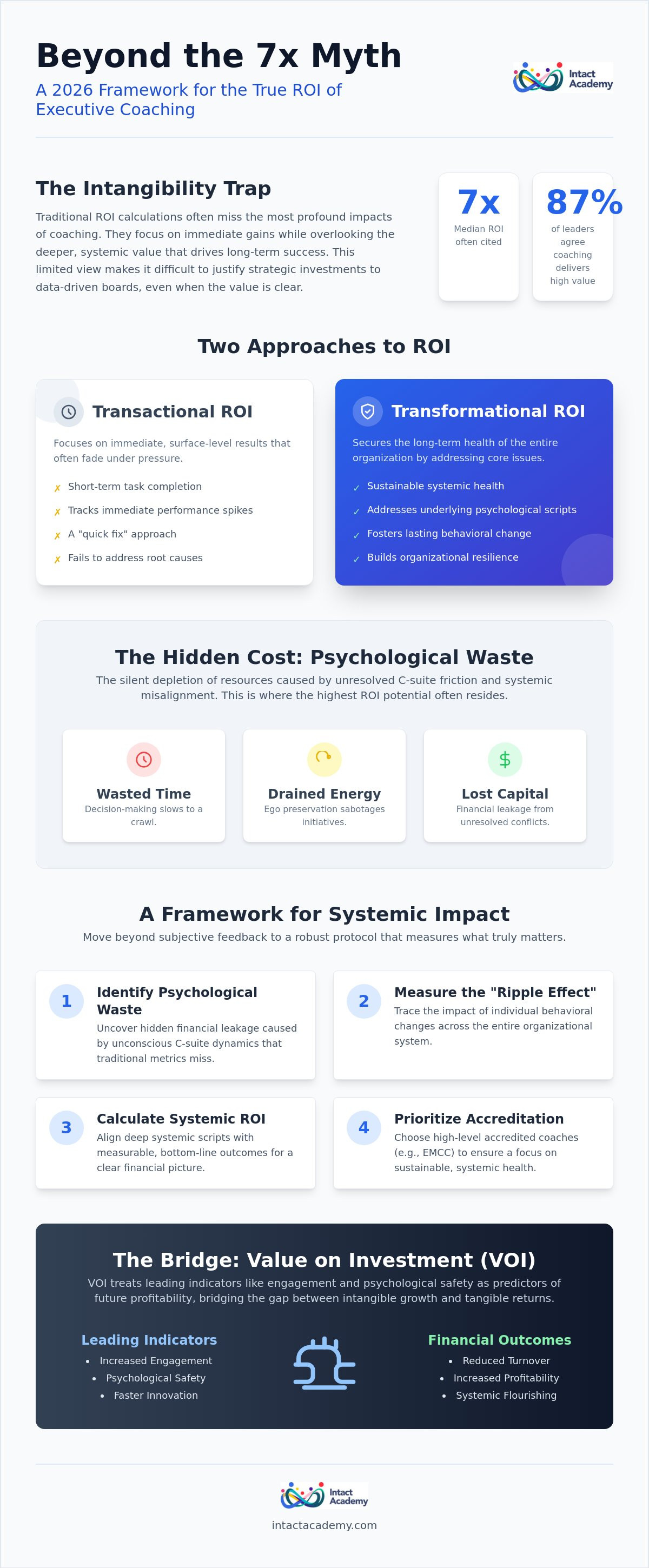
The widely cited 7x return on investment is a comforting anchor, yet it often fails to capture the true weight of leadership evolution. In the current business climate, we must look deeper than surface-level metrics. A narrow focus on immediate financial gains creates what we call the "Intangibility Trap," where the most profound shifts are dismissed because they don't fit neatly into a traditional spreadsheet. While 87% of leaders agree that coaching delivers high value, many still find themselves silenced when facing a data-driven board. This silence isn't a lack of results. It's a lack of a shared language that connects human growth to systemic health.
We must distinguish between Transactional ROI and Transformational ROI. Transactional ROI tracks short-term task completion and immediate performance spikes. It's the "quick fix" that often fades when the pressure mounts. In contrast, Transformational ROI secures the long-term health of the entire organizational system by addressing the underlying psychological scripts that drive behavior. To truly understand the return on investment of executive coaching, we have to move from a cost-benefit mindset to one of systemic value.
The Limitations of the Standard ROI Formula
The standard formula of (Earnings minus Cost) divided by Cost is a blunt instrument for the delicate work of human development. It assumes that growth is linear and immediate. However, leadership behavioral shifts often involve a significant time-lag. A breakthrough in a coaching session today might not manifest as a strategic pivot for several months. Standard formulas ignore vital variables such as reduced turnover, the prevention of "psychological games" that drain resources, and the increased speed of decision-making. When we examine business and executive coaching, we see a process that thrives on nuance, something a basic accounting equation simply cannot hold. It's about the evolution of the person within the system, not just the output of a machine.
The Shift Toward Value on Investment (VOI)
Value on Investment (VOI) serves as the essential bridge to sustainable financial returns. It treats employee engagement and psychological safety not as soft metrics, but as leading indicators of future profitability. When a leader becomes more self-aware, the "psychological waste" within their team decreases, allowing for a more fluid exchange of ideas and faster innovation. By measuring these precursors, we can predict the eventual return on investment of executive coaching before the final numbers settle on the balance sheet. VOI represents the measurable expansion of systemic capacity and relational health that creates the necessary conditions for long-term financial flourishing.
The Hidden Cost of Psychological Waste: A Systemic View of ROI
To measure the true return on investment of executive coaching, one must account for the silent depletion of resources known as psychological waste. This isn't a vague concept. It's the tangible loss of time, energy, and capital caused by unresolved interpersonal friction and systemic misalignment. We use the lens of Transactional Analysis (TA) to identify these leaks. TA allows us to see the organization as a living system driven by unconscious scripts rather than just a collection of job descriptions. When these scripts are out of sync with the organization's goals, the result is financial leakage that no traditional spreadsheet can fully capture.
Psychological games in the C-suite are perhaps the most expensive hidden costs in modern business. These are repetitive, dishonest interactions that lead to a "payoff" of negative emotions and stalled progress. When executives engage in these games, decision-making slows to a crawl. Strategic initiatives are sabotaged by ego preservation. While reports from the International Coaching Federation emphasize the broad benefits of professional development, the specific financial recovery from stopping these games is where the highest ROI often resides. By addressing the root of conflict rather than the symptoms, coaching eliminates the systemic resistance that prevents change from taking hold.
These patterns are often rooted in "Life Scripts," which are unconscious blueprints formed early in life that dictate how we handle power, failure, and collaboration. When a leadership team’s collective scripts favor "avoiding conflict" or "perfectionism at all costs," the organization enters a state of paralysis. Coaching helps leaders rewrite these scripts to align with the demands of the 2026 landscape. It moves the individual toward a state of completeness, ensuring their personal history no longer dictates the organization's future. This transformation is the foundation of a sustainable return on investment of executive coaching.
Stopping the 'Drama Triangle' in Leadership
Leadership often falls into the trap of the "Drama Triangle," where individuals cycle through the roles of Persecutor, Rescuer, and Victim. A "Rescuer" leader might constantly step in to fix a team's mistakes, inadvertently creating a "Victim" culture of learned helplessness. This dynamic is a massive drain on productivity and psychological safety. Executive coaching breaks these cycles by inviting leaders back to a state of professional pragmatism. By teaching leaders to recognize these roles, we restore accountability and save the thousands of hours typically lost to managing "office politics."
From Ego States to Bottom-Line Results
Streamlining project execution requires moving from "Parent-Child" dynamics to "Adult-to-Adult" transactions. When a leader operates from a "Critical Parent" state, they often trigger a "Rebellious Child" response in their staff, which stifles innovation and autonomy. Understanding what is transactional analysis helps leaders recognize these ego states in real-time. By fostering Adult transactions, coaching empowers teams to take ownership of their results, directly boosting the bottom line. For those ready to explore these dynamics deeper, our systemic coaching approach offers a stable container for this profound transformation.
Measuring the Intangible: A Framework for Quantifying Behavioral Transformation
Measuring the return on investment of executive coaching requires a departure from the purely anecdotal. We must move beyond "feeling better" and toward observable behavioral indicators that signal a shift in the organizational system. When we observe a leader, we aren't just looking for new skills; we're looking for a change in their systemic posture. This involves tracking how a leader manages their internal ego states during high-pressure negotiations or how they dismantle the "Drama Triangle" patterns we explored previously. These aren't just soft shifts. They're precise, repeatable changes in how a human being interfaces with their environment.
The "Ripple Effect" model serves as our primary tool for capturing these shifts. It acknowledges that an executive does not exist in a vacuum. When a leader returns to a state of completeness and adult pragmatism, the impact cascades through their direct reports and teams. We measure this through organizational culture assessments that track leading indicators such as psychological safety and reduced conflict. For example, systemic interventions in global tech firms have demonstrated that when leadership teams resolve deep-seated "psychological games," the resulting clarity and speed of execution lead to measurable operating margin growth. The data shows that a healthy system is, by its very nature, a more profitable one.
The 4 Levels of Coaching Evaluation
- Reaction: We begin by gauging the executive's perception of the engagement. Does the space feel safe? Is the methodology challenging their existing scripts?
- Learning: Here, we track the shift in ego states. The leader demonstrates an awareness of systemic patterns and can identify when they are slipping into "Parent" or "Child" dynamics.
- Behavior: This level focuses on applied changes. We look for increased leadership presence, more effective conflict resolution, and a move away from rescuer behaviors.
- Results: Finally, we link these behaviors to the bottom line. This includes improvements in employee retention, team productivity, and overall strategic alignment.
Quantifying the Cost of 'Not Coaching'
To truly understand the return on investment of executive coaching, we must also calculate the price of inaction. Executive turnover and failed leadership transitions represent a massive financial burden. A toxic culture doesn't just slow down work; it actively destroys your recruitment efforts and brand reputation over time. While a failed C-suite hire can cost an organization up to 213% of the executive's annual salary, a year of high-level coaching represents a fraction of that risk, acting as a profound insurance policy for systemic stability. We aren't just investing in growth; we're mitigating the catastrophic costs of systemic failure.
Calculating Your 2026 Leadership Investment: A Step-by-Step ROI Protocol
- Step 1: Baseline Assessment. We begin by identifying the specific systemic scripts and "psychological games" currently hindering performance. We look for patterns of resistance or "Parent-Child" dynamics that drain resources.
- Step 2: Goal Alignment. We move into contracting for specific, measurable behavioral outcomes. This ensures the leader's growth is directly tied to the organization's strategic needs.
- Step 3: Intervention. The coaching process unfolds through a Transactional Analysis and systemic lens. We focus on returning the leader to a state of Adult-to-Adult pragmatism.
- Step 4: Post-Engagement Audit. We measure the delta in leadership presence and team psychological safety. We look for the "Ripple Effect" mentioned earlier, tracking how the leader's shift has influenced their direct reports.
- Step 5: Value Attribution. Finally, we assign financial weight to the observed improvements. Whether it's reduced turnover, faster decision-making, or the successful delivery of a major project, we translate behavioral shifts into bottom-line data to prove the return on investment of executive coaching.
Contracting for Success
The initial contract is the most critical factor in determining long-term ROI. Without clear boundaries and shared expectations between the coach, the executive, and the organization, the intervention risks becoming a surface-level exercise. We align individual development goals with high-level strategic objectives to ensure the work remains relevant. This level of precision requires a high degree of professional development for coaches, as the ability to facilitate these tripartite agreements is a hallmark of senior-level mastery. When the contract is sound, the path to transformation is clear.
The Role of Stakeholder Centered Coaching
We believe that measuring transformation shouldn't happen in a vacuum. By involving the board and direct reports in the measurement process, we create a feedback loop that validates behavioral shifts in real-time. This approach uses 360-degree TA assessments to track ego-state evolution across the leadership team. It ensures that the leader isn't just changing in the coaching room, but is actively reshaping the culture around them. For organizations seeking to secure their future through deep human transformation, our systemic coaching interventions provide the structured methodology required for lasting success.
Scaling Impact: How EMCC-Accredited Mastery Secures Your Organizational Future
The ultimate return on investment of executive coaching is realized when the work transcends the individual and begins to reshape the entire organizational fabric. While many professional bodies offer general credentials, the level of accreditation is a primary predictor of systemic success. A Senior Practitioner doesn't just listen; they hold a mirror to the organization's collective unconscious. They possess the psychological maturity to witness complex dynamics without becoming entangled in them. This level of mastery is what separates a temporary performance spike from a permanent cultural evolution.
We must distinguish between coaching the individual and coaching the system. Coaching an individual in isolation often yields results that are quickly eroded by a resistant environment. Coaching the system, however, addresses the foundational scripts that govern every interaction, from the boardroom to the front line. Our TA EMCC Senior Practitioner Academy is designed specifically for this level of high-stakes impact. We prepare coaches to navigate the intricate psychological architecture of the modern C-suite, ensuring that every intervention contributes to a state of organizational completeness and genuine performance.
The ROI of Senior-Level Mastery
Senior executives operate in environments of immense pressure and systemic complexity. They require a coach who can move beyond simple goal-setting to navigate the deep-seated psychological games and corporate scripts that stifle progress. A coach with senior-level mastery understands that a leader's internal state is the primary driver of their external impact. For organizations seeking to build this level of internal capability, an executive coaching certification provides the necessary rigorous training. This level of expertise ensures that the coach remains a stable container for the often-turbulent work of professional change, protecting the organization's most valuable human assets.
Building a Coaching Culture for Long-Term ROI
True ROI isn't a destination but a continuous process of becoming. We help organizations move from isolated engagements to a systemic coaching infrastructure where growth is embedded in the cultural DNA. This infrastructure is supported by systemic supervision, which acts as a vital quality assurance mechanism for the ongoing return on investment of executive coaching. Supervision ensures that coaching pools remain ethical, effective, and aligned with the organization's evolving needs. By fostering a culture of reflective practice and Adult-to-Adult transactions, you secure your organizational future against the volatility of the years ahead. Deepen your impact with our TA EMCC Senior Practitioner Academy and join a global community dedicated to profound human transformation.
Securing Your Systemic Future
The path to a sustainable return on investment of executive coaching begins with a shift in perspective; it requires moving from a transactional cost-benefit mindset to one of systemic evolution. By identifying the hidden costs of psychological waste and rewriting the unconscious scripts that hinder performance, your organization can unlock a state of genuine completeness. We've established that true value is found in the ripple effect of behavioral transformation, where the clarity of a single leader fosters resilience and innovation across entire teams.
Success in this complex landscape demands a methodology that is as rigorous as it is empathetic. Our approach is led by international expert Sari van Poelje and is currently utilized in over 14 countries to drive profound organizational change. Accredited by both the EMCC and ICF, we offer the professional depth and stable container needed to navigate the highest levels of leadership development. Explore our TA EMCC Senior Practitioner Academy to master the art of systemic ROI. You have the power to transform the hidden scripts of your organization into a legacy of lasting health and performance.
Frequently Asked Questions
What is the average ROI of executive coaching in 2026?
The median return on investment of executive coaching remains approximately 7x the initial spend according to current industry benchmarks. While 86% of organizations report recouping their investment, some studies highlight returns as high as 788% when accounting for the financial benefits of employee retention. These figures reflect the tangible gains realized when leadership development aligns with systemic health and strategic clarity.
How long does it take to see a return on investment from executive coaching?
Measurable returns typically manifest within six to twelve months, though the specific timeline depends on the depth of the intervention. While immediate shifts in leadership presence may be observed earlier, the systemic ripple effect on team productivity and cultural stability requires consistent application. We view coaching as a methodical process of becoming rather than a series of quick fixes, allowing for more durable financial outcomes.
Can you measure the ROI of 'soft skills' like emotional intelligence?
You can measure the ROI of emotional intelligence by tracking specific behavioral indicators and their impact on operational metrics. By observing shifts in conflict resolution and decision-making speed, we link these transformations to reduced psychological waste and lower turnover costs. Quantifying these changes involves moving from subjective impressions to a structured audit of team psychological safety and strategic alignment.
What is the difference between ROI and VOI in leadership development?
ROI focuses on direct financial gains relative to cost, while Value on Investment (VOI) measures the broader systemic benefits that serve as leading indicators of future profitability. VOI captures improvements in employee engagement, leadership resilience, and cultural health. We see VOI as the essential foundation; it creates the psychological conditions necessary for the eventual return on investment of executive coaching to materialize on the balance sheet.
How does Transactional Analysis improve the ROI of a coaching engagement?
Transactional Analysis improves ROI by identifying and eliminating the unconscious psychological games that cause financial leakage within leadership teams. By moving executives from reactive dynamics to pragmatic Adult-to-Adult transactions, we streamline project execution and reduce systemic resistance. This psychological precision ensures that behavioral changes are rooted in deep self-awareness rather than surface-level habit modification, leading to more sustainable organizational transformation.
Is external executive coaching more cost-effective than internal coaching?
External coaches often provide a higher long-term ROI for C-suite leaders due to their systemic neutrality and specialized accreditation. While internal coaching is effective for middle-management development, senior executives require the stable container that only an external partner can provide to navigate complex corporate scripts. The objective perspective of an accredited external coach is essential for dismantling the deep-seated patterns that internal staff might be too close to influence.
What are the most common mistakes when calculating coaching ROI?
The most common mistake is focusing exclusively on short-term performance spikes while ignoring the long-term costs of systemic failure or executive turnover. Many organizations also fail to establish a baseline assessment, making it impossible to measure the true delta in leadership behavior. Relying solely on anecdotal feedback rather than observable indicators leads to a fragile data set that fails to withstand the scrutiny of a data-driven board.
How do I present executive coaching ROI to a skeptical board?
Present your findings by linking behavioral transformation directly to the mitigation of psychological waste and the achievement of strategic objectives. Use a structured framework to show how the return on investment of executive coaching is reflected in reduced turnover and increased operational speed. By framing coaching as a pragmatic risk-management strategy for your most valuable human assets, you move the conversation from soft spend to essential systemic investment.


