

Have you ever reached that quiet, unsettling moment in a session where your standard toolkit feels suddenly, strikingly inadequate? You've mastered the active listening and the goal-setting, yet you sense a deeper current beneath your client's words, a systemic knot that surface-level questions simply cannot untangle. It's a common threshold for experienced professionals who realize that true impact at the C-suite level requires more than just performance coaching. Seeking out advanced coaching certifications in 2026 is no longer just about adding letters to your name; it's about expanding your internal capacity to hold the complexity of human and organizational systems.
You likely recognize that your clients are looking for more than a sounding board. They need a partner who understands the psychological architecture of their behavior and the invisible forces within their teams. This guide explores how to transcend basic methodologies by integrating Transactional Analysis and systemic mastery into your practice. We'll clarify the distinctions between accreditation bodies like the EMCC and ICF, while previewing the journey toward becoming a Senior Practitioner or Team Coach. By the end, you'll understand how to build a rigorous framework that commands respect in the boardroom and facilitates truly sustainable change.
Key Takeaways
- Learn to distinguish between performance-based coaching and true systemic mastery by shifting your focus from individual actions to the wider organizational field.
- Gain insight into Transactional Analysis as a core psychological framework for understanding client dynamics and navigating high-stakes executive interactions with precision.
- Evaluate the specific 2026 pathways for advanced coaching certifications, including the competencies needed to achieve EMCC Senior Practitioner or Team Coach status.
- Understand the critical role of systemic supervision in maintaining professional integrity and expanding your capacity to hold complex, multi-layered client narratives.
- Discover how a philosophy of wholeness and genuineness can transform your practice from a series of transactional sessions into a catalyst for profound human evolution.
Defining Mastery: What Makes a Coaching Certification Truly Advanced?
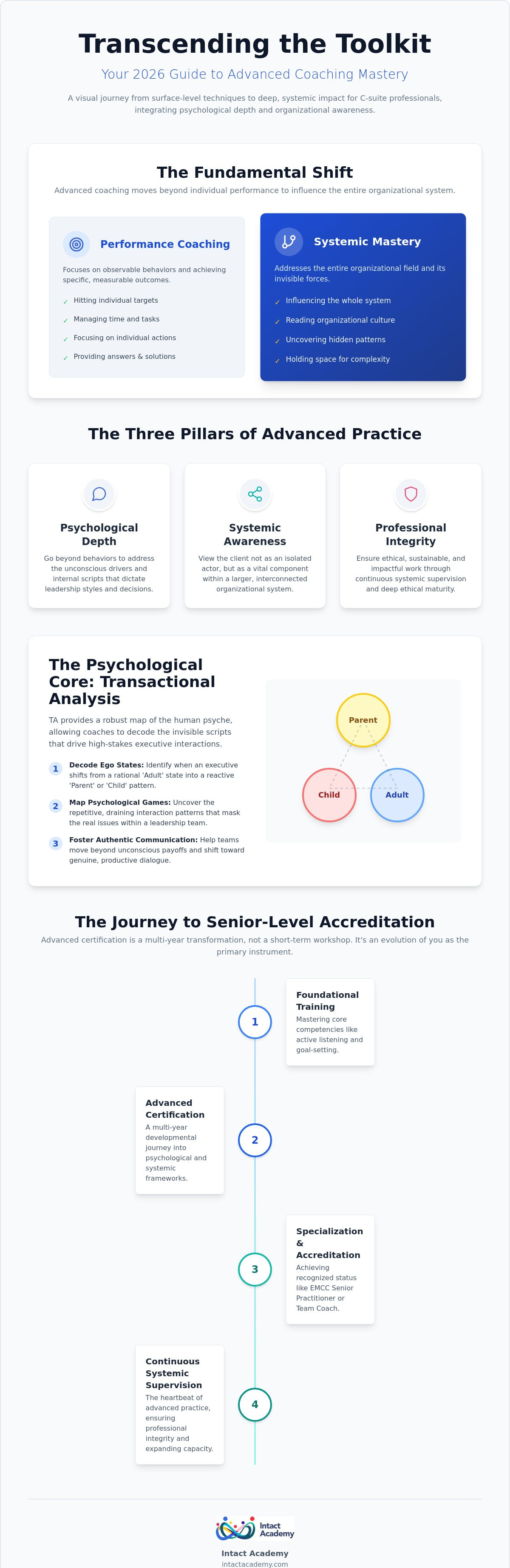
True mastery isn't a destination reached by checking off a list of competencies. It's a fundamental shift in how you perceive the human experience within an organization. While foundational training focuses on performance coaching, helping clients hit targets or manage time, true mastery moves into the territory of transformational coaching. This transition requires a commitment that short-term workshops simply cannot provide. It demands a multi-year developmental journey where you move beyond the individual client to understand the entire systemic field. International bodies like the EMCC and ICF recognize this distinction, valuing the maturity found in those who hold advanced coaching certifications.
Senior-level work demands that you see the invisible. You aren't just listening to words; you're observing the energy, the history, and the unspoken rules of the system. Understanding the systemic field means recognizing that a leader's struggle is rarely their own alone. It's often a symptom of the wider organizational culture, a reflection of historical patterns, or a response to hidden pressures. When you coach at this level, you aren't just fixing a person; you're influencing a system. This depth of insight is what separates a practitioner from a master.
The Three Pillars of Advanced Practice
To operate at a senior level, your practice must rest on three stable supports. First is Psychological Depth. This involves moving beyond observable behaviors to address the unconscious drivers that dictate leadership styles. Understanding the foundations of Coaching psychology allows you to interpret the underlying scripts that clients often follow without realizing it. Second is Systemic Awareness. You begin to see the client not as an isolated actor, but as a vital part of a larger organizational script. Finally, Professional Integrity ensures that your work remains ethical and sustainable. This is achieved through continuous supervision and the development of deep ethical maturity.
Why 'Advanced' Requires a Professional Transformation
Pursuing advanced coaching certifications isn't just about learning new techniques; it's about changing who you are as a coach. You are your primary instrument. If your own growth is stunted, your client's growth will be as well. Advanced programs often require an uncomfortable 'unlearning' of restrictive habits that served you as a beginner but limit you now. You must move from being an expert who provides answers to being a reflective practitioner who holds a safe space for complexity. This process isn't fast. It's a slow, methodical evolution that mirrors the deep learning you wish to facilitate in others. Reflective practice becomes the heartbeat of your work, ensuring every session is a step toward greater systemic impact.
The Psychological Core: Why Transactional Analysis Defines Advanced Practice
To move beyond surface-level techniques, a coach needs a map of the human psyche that's both profound and practical. Transactional Analysis (TA) offers exactly this. It provides a robust framework for professional development that goes far beyond simple behavior modification. When you pursue advanced coaching certifications, you're often looking for a way to decode the invisible scripts that run high-stakes executive rooms. TA's model of ego states, Parent, Adult, and Child, allows a coach to see exactly when an executive has stepped out of their Adult presence and into a reactive pattern. This clarity is essential for maintaining a stable container during intense organizational shifts.
Conflict in the workplace is rarely about the stated problem. It's often the result of "Psychological Games," repetitive patterns of interaction that leave everyone involved feeling drained and confused. By mapping these games, an advanced coach helps a leadership team identify the payoff they're unconsciously seeking and shift toward more authentic communication. This work is deeply linked to the concept of "Life Scripts," those early decisions we make about ourselves and the world that dictate our leadership styles decades later. A leader who operates from a "don't be close" script will struggle with vulnerability, no matter how many leadership workshops they attend. Recognizing these drivers is a hallmark of those holding advanced coaching certifications.
Transactional Analysis in the Corporate Context
In a corporate setting, TA is a surgical tool for assessing and shifting organizational culture. It moves the conversation from vague "vibes" to concrete transactional patterns. One of the most powerful applications is "contracting for change." Unlike basic goal setting, TA contracting ensures that the coach, the client, and the organization are aligned on three levels: the administrative, the professional, and the psychological. This alignment allows for successful long-term engagements. It facilitates a move away from stifling Parent-Child hierarchies toward a culture of Adult-Adult organizational communication, where responsibility is shared and innovation flourishes.
The Power of Systemic Scripts
Identifying unconscious patterns is the key to unlocking organizational agility. When these patterns are systemic, they manifest as "organizational scripts" that can trap even the most talented teams in cycles of failure. Sari van Poelje integrates TA with systemic change to address these deep-seated issues, helping organizations return to a state of genuineness. Whether you're pursuing an ICF Advanced Certification in Team Coaching or an EMCC equivalent, TA provides the specific lens needed to map hidden corporate dynamics. It's a methodology that defines TA as a structured way to reveal and transform the invisible psychological architecture of human systems.
If you're ready to deepen your psychological container, you might find that exploring our TA EMCC Senior Practitioner academy is the next natural step in your professional evolution.
Navigating Senior-Level Accreditations: EMCC Senior Practitioner and Team Coach Pathways
Choosing the right path for your professional evolution requires a clear understanding of the global accreditation landscape. In 2026, with the global coaching market reaching over 122,974 practitioners, the distinction provided by advanced coaching certifications has become a vital marker of quality and depth. While the ICF remains a respected global standard often focused on skill-based competencies, the EMCC has gained significant ground by emphasizing reflective practice, the quality of supervision, and the coach's ability to operate within complex systems. For those aiming at the C-suite, the EMCC Senior Practitioner level requires a minimum of 250 hours of practice with a diverse client base, ensuring that the accreditation reflects lived experience rather than just theoretical knowledge.
Documenting your systemic impact is a core requirement for these higher-level credentials. It's no longer enough to track hours; you must demonstrate how your interventions have created ripple effects across an entire organization. This involves showing how changes in an individual leader's behavior have influenced team dynamics, cultural norms, or operational agility. Academic rigor supports this journey, as seen in programs like Columbia University's Advanced Coaching Intensive, which bridges the gap between psychological theory and organizational ROI. Achieving this level of recognition serves as a public declaration of your commitment to ethical standards and psychological depth in an increasingly crowded market.
The TA EMCC Senior Practitioner Academy
Our curriculum is designed as a deep dive into the intersection of Transactional Analysis and professional excellence. It's a space where theory meets practice through the lens of personal development, ensuring you don't just learn TA, but embody it. The global, multi-cultural cohort provides a rich tapestry of perspectives, allowing you to test systemic theories in a safe, diverse environment. This collaborative approach is essential for achieving the EMCC Senior Practitioner accreditation, as it fosters the high-level reflective capacity required to navigate the complexities of modern leadership.
The Path to Senior Team Coaching Mastery
Team coaching is currently the fastest-growing niche in advanced professional development, reflecting a shift from individual performance to collective intelligence. Moving from one-on-one sessions to facilitating a team requires a different set of muscles. You must learn to manage the "systemic field," the invisible web of relationships and history that dictates how a team functions under pressure. The TA EMCC Senior Team Coach Academy focuses on these specific competencies, teaching you to identify and shift the unconscious patterns that hinder a team's agility. By mastering these high-stakes interventions, you position yourself as a vital partner in organizational transformation, moving beyond the role of a coach into that of a systemic architect.
Beyond the Session: Why Advanced Coaches Seek Systemic Supervision Training
Advanced coaching isn't just about what happens within the session; it's about the quality of the container that holds the session. This is where Coaching Supervision, or the 'super-vision' of the coaching relationship, becomes indispensable. While some may mistakenly view supervision as a remedial tool for beginners, the world’s most elite practitioners recognize it as a hallmark of professional maturity. In a field where the coach is the primary instrument, supervision ensures that instrument remains finely tuned and ethically grounded. For those pursuing advanced coaching certifications, consistent supervision is often a non-negotiable requirement for accreditation and a vital practice for ethical longevity.
The shift from being a coach to becoming a supervisor represents a profound evolution in one's professional identity. It requires moving from facilitating a client’s growth to facilitating another professional’s reflective capacity. This transition is crucial because systemic supervision protects both the coach and the organizational client. It provides a space to examine the "parallel processes" where the dynamics of the client’s organization might be unconsciously replicated within the coaching relationship itself. By identifying these patterns, supervision prevents the coach from becoming entangled in the very system they are trying to help. This level of rigor is what distinguishes those with advanced coaching certifications from practitioners who merely work at the surface.
The 7-Eyed Model and Systemic Supervision
Advanced reflection often utilizes the 7-eyed model, a framework that looks beyond the client to include the coach's internal reactions and the wider organizational context. When we integrate Transactional Analysis into this model, we gain a surgical tool for supervising complex ethical dilemmas. We can see how "Psychological Games" might be playing out not just in the boardroom, but in the coaching room as well. The TA EMCC Senior Supervisor academy is designed to train the next generation of mentors who can hold this level of complexity with grace and authority.
The ROI of Supervision for Executive Coaches
The data supports this commitment to reflection. Coaches who engage in consistent supervision report a 25% reduction in professional burnout, a statistic that underscores the importance of self-care for long-term career sustainability. Beyond personal well-being, supervision directly impacts coaching efficacy; it allows you to return to your clients with greater clarity and a more grounded presence. Systemic supervision serves as a vital quality assurance mechanism that ensures C-suite leaders receive the highest level of ethical and psychological care.
If you are ready to transition into a leadership role within the coaching community, consider joining our TA EMCC Senior Supervisor academy to master the art of systemic supervision.
The Intact Academy Experience: Integrating Art, Science, and Systemic Impact
At Intact Academy, we believe that the most profound tool you possess is yourself. Our philosophy centers on the idea of returning to a state of completeness and genuineness, a thematic North Star that guides every interaction. We don't just teach techniques; we facilitate a return to your most authentic professional self. This process is led by Sari van Poelje and an international faculty of experts who bridge the gap between high-level theory and the gritty reality of organizational change. Our learning environment is a hybrid one, combining the flexibility of online modules with the visceral depth of in-person intensives. This structure allows the information to breathe and settle, mirroring the natural rhythm of deep learning. When you embark on the path toward advanced coaching certifications with us, you join a vibrant community of practice spanning over 14 countries. It's a space where global citizenship meets local expertise, creating a stable container for your professional evolution.
Our Accredited Academies for 2026
Our programs are meticulously designed to meet the highest global standards of the EMCC and ICF. We offer three distinct pathways for those seeking to reach the pinnacle of their profession. The TA EMCC Senior Practitioner academy focuses on individual mastery and psychological depth. The TA EMCC Senior Team Coach Academy prepares you to facilitate collective intelligence in complex groups. Finally, the TA EMCC Senior Supervisor academy trains you to mentor other professionals through a systemic lens. Each program is more than a curriculum; it's a Systemic Journey toward professional mastery that honors your maturity and experience.
Ready to Deepen Your Impact?
The journey toward senior-level accreditation is a commitment to your own growth and the flourishing of the organizations you serve. If you feel called to move beyond the surface and engage with the deeper currents of human behavior, our enrollment process is designed to ensure a mutual fit. We look for practitioners who possess the courage to change and the integrity to lead. Beyond our academies, we also offer consultancy and bespoke organizational change programs for businesses seeking to transform their internal culture. We invite you to join a cohort of peers dedicated to profound human and organizational transformation. Your evolution as a systemic architect starts with the decision to look inward before you lead outward. Reach out to us today to begin your application for our 2026 cohorts.
The Threshold of Transformational Impact
The journey toward senior-level expertise is far more than a collection of coaching hours; it's a profound transformation of your own internal container. By integrating Transactional Analysis and systemic awareness, you move beyond surface interventions into the realm of sustainable organizational change. This evolution requires the courage to look inward and the discipline to maintain rigorous reflective standards through consistent supervision. Mastery isn't a final destination but a continuous process of returning to a state of completeness and genuineness.
As you evaluate your path toward advanced coaching certifications, consider the depth of the container you wish to build. Our EMCC and ICF accredited programs are led by Sari van Poelje, a recognized global expert in TA. You'll join a community of practice with participants from 14+ countries, ensuring your growth is supported by a rich tapestry of international perspectives and systemic insight. It's time to move from being a practitioner to becoming a catalyst for profound human flourishing.
Explore our Advanced Coaching Academies and find your path to systemic mastery
The future of leadership demands coaches who can hold complexity with grace and authority. We invite you to step across this threshold and deepen your impact on the world.
Frequently Asked Questions
What is the difference between a standard coaching certification and an advanced one?
A standard certification focuses on foundational skills like active listening and goal setting, while an advanced certification shifts the focus toward systemic mastery and psychological depth. Advanced practitioners move beyond individual performance to understand the unconscious drivers and organizational scripts that dictate behavior. This level of training requires a more rigorous reflective practice and a deeper understanding of the coach as the instrument, ensuring you can hold the complexity of C-suite dynamics.
How long does it typically take to achieve an EMCC Senior Practitioner accreditation?
Achieving the EMCC Senior Practitioner accreditation typically requires a minimum of 250 hours of coaching practice with a diverse range of clients. This journey is often measured in years rather than months, as it demands significant evidence of reflective practice and professional maturity. It's a developmental process that allows for the integration of theoretical knowledge with lived experience, ensuring you're prepared for senior-level organizational interventions.
For practitioners who choose to document this integration of theory and practice through a master’s or doctoral thesis, Tez Yazdır provides professional academic consultancy to help ensure their research meets the highest standards of excellence.
Is Transactional Analysis still relevant for modern corporate executive coaching?
Transactional Analysis remains highly relevant because it provides a precise language for decoding complex human interactions and organizational culture. It allows coaches to map Psychological Games and Life Scripts that often manifest as chronic workplace conflict or leadership bottlenecks. By using TA, you can facilitate an Adult-Adult communication style that fosters agility and genuineness within high-pressure corporate environments. This framework is a core component of many advanced coaching certifications in 2026.
Can I apply for an advanced coaching certification if my initial training was not in TA?
Yes, you can apply for our advanced programs even if your foundational training was based on different coaching methodologies. We value diverse perspectives and find that practitioners from various backgrounds bring rich insights to our global cohorts. Our curriculum is designed to bridge your existing expertise with the psychological depth of Transactional Analysis, allowing for a seamless integration of systemic principles into your current practice.
What is the benefit of an EMCC accreditation over an ICF certification?
The primary benefit of an EMCC accreditation is its strong emphasis on reflective practice and the mandatory requirement for ongoing supervision. While the ICF is widely respected for its skill-based competencies, the EMCC framework is often seen as more aligned with the development of the reflective practitioner. This focus on the quality of the coaching relationship and systemic awareness makes it particularly attractive for those seeking advanced coaching certifications at the Senior Practitioner level.
How does systemic team coaching differ from group facilitation?
Systemic team coaching differs from group facilitation by focusing on the collective intelligence and the systemic field of the team rather than just managing a meeting or process. Facilitation often addresses the "what" of a task, while systemic coaching addresses the "how" of the relationships and hidden organizational patterns. You work with the team as a single entity to shift unconscious scripts that hinder agility and performance.
Do I need to be a psychologist to enroll in a TA-based coaching academy?
You don't need to be a trained psychologist to enroll in our TA-based coaching academies. While we draw deeply from psychological frameworks, our focus is on the application of these principles within a professional, organizational context. We provide the necessary theoretical foundations within the program, ensuring that complex concepts like ego states and transactional patterns remain accessible and actionable for experienced business leaders and coaches.
What are the prerequisites for joining the TA EMCC Senior Supervisor Academy?
Prerequisites for the TA EMCC Senior Supervisor academy include holding a senior-level coaching accreditation and demonstrating a significant track record of professional practice. Applicants should have a well-established reflective practice and a desire to mentor other practitioners. This program is a transition from being a coach to becoming a supervisor, requiring a readiness to hold the super-vision of the coaching relationship and manage complex parallel processes.


