

Most organizations approach leadership development as a logistical challenge; however, a calendar full of sessions rarely equates to a shift in consciousness. You have likely witnessed the quiet frustration of a program that looks perfect on paper but fails to penetrate the deeper layers of an executive's psychological script. With nearly 70% of C-suite leaders facing burnout in 2026 according to recent industry data, the stakes for professional support have never been higher. When there is a gap between individual evolution and organizational needs, even the most expensive initiatives can feel like a fleeting performance rather than a permanent transformation.
If you are responsible for designing an executive coaching program, you know that the "invisible" impact of psychological growth is the most difficult to measure and the most vital to capture. This guide offers a clear roadmap for architecting high-impact programs that transcend surface-level behavioral changes. You will learn to navigate the complexities of multi-party contracting and apply systemic frameworks that ensure every coaching hour serves the larger organizational destiny. We will explore how to build a stable container for change that honors the intelligence of your leaders while driving the profound human transformation your business requires.
Key Takeaways
- Move beyond surface level behavioral changes by understanding how systemic coaching drives profound organizational culture shifts.
- Discover the psychological architecture required to align an executive’s personal life script with the broader organizational narrative for lasting impact.
- Master the nuances of multi-party contracting to create absolute clarity between the coach, the coachee, and organizational stakeholders.
- Follow a structured, phase based roadmap for designing an executive coaching program that prioritizes systemic mapping and deep psychological inquiry.
- Learn how a philosophy of completeness and genuineness provides a stable container for both professional growth and personal evolution.
The Evolution of Executive Coaching: From Performance to Transformation
The historical view of executive development often focused on remediation, acting as a reactive measure to correct perceived flaws in leadership. As we look toward 2026, the paradigm has shifted toward strategic, systemic intervention. When designing an executive coaching program in this context, we must move beyond the "performance fix" and aim for leadership wholeness. Modern leaders aren't just managers of tasks; they're the architects of organizational energy. Their psychological state directly influences the culture, and their growth must be viewed through a systemic lens rather than as an isolated event.
The discipline of business and executive coaching has matured from a niche intervention into a cornerstone of organizational health. Today, the coach acts as a stable container for the turbulence of change. By providing a reflective space, the coach allows the leader to process complex dynamics without being overwhelmed by the immediate demands of the system. This stability is essential in a world where 70% of executives report significant burnout. We aren't just improving outputs; we're preserving the human core of the enterprise. True transformation requires a return to a state of completeness and genuineness, ensuring that growth is not a temporary mask but a permanent evolution.
The Systemic Perspective in Program Design
Individual change is fragile if the surrounding system remains rigid. In every engagement, there are "unseen" stakeholders, including the board, direct reports, and the organizational history itself. When designing an executive coaching program, you must map these connections early. Executive presence is not a solo performance; it is a reflection of systemic health. If the leader shifts but the team's expectations don't, the old patterns will eventually resurface. We look for the ripples, not just the splash. Alignment ensures that the individual's growth serves the collective destiny of the organization.
Transactional Analysis as a Design Tool
To understand the hidden currents of leadership, we utilize the framework of Transactional Analysis (TA). You might ask, what is transactional analysis and how does it apply to the boardroom? It provides a language for understanding "scripts," which are unconscious life plans that dictate how we respond to stress and authority. By identifying "ego states," coaches help executives see when they're acting from past conditioning rather than current reality. Mapping these unconscious patterns within a leadership team allows for a deeper level of intervention. It addresses the root causes of organizational friction rather than just managing the symptoms.
The Psychological Architecture of a High-Impact Program
When designing an executive coaching program, we must look beneath the surface of KPIs and competency models to the invisible psychological architecture that governs human behavior. This architecture is the scaffolding that allows a leader to safely deconstruct old habits and rebuild more authentic ways of being. It's not enough to change what a leader does; we must address who they are becoming. By mapping an executive's "Life Script", the unconscious narrative formed in early life, to the "Organizational Script", we reveal why certain cultural shifts remain stagnant despite strategic efforts. This alignment ensures that personal growth and corporate destiny move in the same direction.
High-impact programs prioritize the development of Autonomy, defined in Transactional Analysis as the capacity for Awareness, Spontaneity, and Intimacy. This isn't about soft skills; it's about the cognitive and emotional flexibility required to lead in a volatile 2026. While many science-based coaching approaches focus on the cognitive-behavioral aspects of leadership, a systemic framework provides a "holding space" where executives can explore their vulnerabilities without fear of judgment. This safety is the prerequisite for genuine risk-taking. Creating such a container is a vital step when designing an executive coaching program that aims for more than just incremental change.
Ego States and Executive Presence
The boardroom is often a theater for Parent-Adult-Child dynamics. Program design must identify when a leadership culture is dominated by the "Critical Parent", which often stifles creativity through perfectionism and blame. By cultivating the "Integrating Adult", coaches help leaders process data and emotions in real-time, leading to more grounded, systemic decision-making. Those seeking to master these dynamics often find that systemic supervision and advanced training provide the necessary depth to navigate such complex interpersonal landscapes with grace and authority.
Addressing Psychological Games
Senior teams frequently fall into the "Drama Triangle", rotating between the roles of Persecutor, Rescuer, and Victim. These psychological games, such as the classic "Yes, but..." response, drain organizational energy and prevent honest communication. A well-designed program includes specific interventions to spot these games as they happen. The goal is to shift the leadership team from transactional games toward authentic transactions, where clarity and mutual respect replace hidden agendas and defensive posturing. This shift allows the organization to return to a state of completeness and collective focus.
The Multi-Party Contract: Aligning Individual and Organization
Many organizations assume that a signed agreement between a coach and an executive is sufficient for success. However, when designing an executive coaching program, the most critical work happens before the first session begins. It lies in the multi-party contract. This is a complex alignment between the coach, the coachee, and the organizational sponsor. We must navigate the inherent tension where the organization pays for the service, yet the individual owns the growth. Without a formal three-way meeting to align these interests, the program risks becoming a disjointed effort that satisfies neither the leader’s personal evolution nor the company’s strategic goals.
Facilitating this three-way dialogue requires the coach to act as a neutral systemic architect. During this meeting, the group must define what success looks like for the individual and the system simultaneously. This process naturally raises questions about confidentiality. While the organization requires accountability for its investment, the executive needs a "holding space" where they can be vulnerable without fear of professional repercussion. We solve this by contracting for "process reporting" rather than "content reporting." The organization learns about the themes and progress of the growth, while the specific, sensitive details of the sessions remain private. This balance preserves trust while ensuring the program remains anchored in organizational reality.
The Administrative vs. The Psychological Contract
We distinguish between three distinct layers of contracting. The Administrative contract is the skeleton; it covers the "how," including fees, scheduling, and reporting structures. The Professional contract defines the "what," such as the specific competencies and behavioral goals. Yet, it's the Psychological contract, the "why" and the "unspoken," that determines the ultimate outcome. When you're designing an executive coaching program, you must bring these implicit expectations into the light. If a sponsor secretly expects the coach to "fix" a leader without the organization changing its own culture, the engagement will likely fail. Success requires that all parties move toward a state of completeness and shared honesty.
Measuring Systemic Impact and ROI
Traditional metrics, often dismissed as "happy sheets," fail to capture the profound human transformation we seek. To measure true ROI, we look for qualitative systemic shifts rather than just individual habit changes. Is the executive demonstrating increased "Integrating Adult" behavior in high-stakes boardrooms? Has the team's reliance on the "Drama Triangle" decreased? We use 360-degree feedback to validate this psychological growth, linking the leader's evolution to tangible team performance metrics. When the "invisible" psychological work produces visible cultural results, the value of the program becomes undeniable.
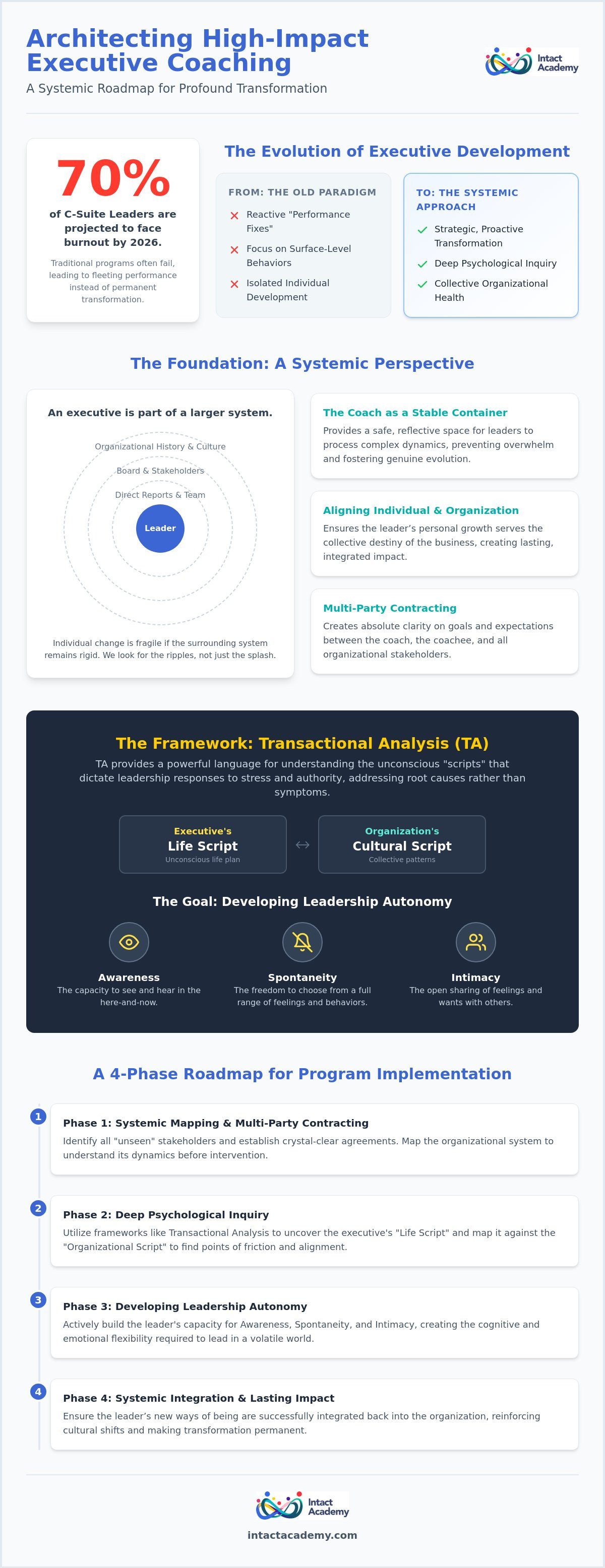
A Step-by-Step Roadmap for Program Implementation
Moving from theoretical frameworks to practical application requires a deliberate and rhythmic approach. When designing an executive coaching program, the implementation roadmap acts as the anchor that prevents the initiative from drifting into vague or unmeasured territory. Each phase is designed to build upon the previous one, ensuring that the psychological work remains grounded in organizational needs. This structured flow creates a sense of safety and reliability, allowing the often-turbulent work of change to proceed with clarity.
- Phase 1: Diagnostic and Systemic Mapping: We begin by looking beyond the individual leader. This phase involves mapping the organizational field, identifying historical patterns, and understanding the cultural "scripts" currently in play. It is an "intake" that considers the whole system.
- Phase 2: The Contracting Phase: Building on our previous discussion of multi-party alignment, this phase formalization the administrative, professional, and psychological expectations. It ensures all parties are literally and figuratively on the same page.
- Phase 3: The Intervention: This is the heart of the journey, consisting of deep-dive coaching sessions. Regular mid-term reviews involving the sponsor ensure the systemic alignment remains intact and that behavioral shifts are manifesting in the workplace.
- Phase 4: Closure and Integration: We focus on a sustainable hand-over. The goal is to ensure the leader returns to their state of completeness, now equipped with the autonomy to lead effectively without the coach’s ongoing presence.
Selecting and Vetting Executive Coaches
The success of the program rests heavily on the caliber of the practitioners. For C-suite engagements, "Senior Practitioner" status is not merely a title; it is a signal of the coach’s ability to navigate high-stakes systemic complexity. When designing an executive coaching program for 2026, you should prioritize an executive coaching certification that emphasizes both psychological depth and systemic thinking. Matching a coach’s personality to an executive’s life script requires an intuitive yet structured vetting process. It's about finding a mentor who can challenge the leader’s unconscious patterns while providing the empathy needed for profound growth.
The Role of Supervision in Program Integrity
Integrity is maintained through constant reflection. Every high-impact program must include mandatory systemic supervision for the coaches involved. Supervision protects the coach from "Systemic Contagion," a phenomenon where the coach unconsciously absorbs the stress or dysfunctional patterns of the organization. By providing a reflective space for the coach, we ensure they remain a stable container for the executive. This professional reflection keeps the work ethical, objective, and deeply human. To ensure your leaders receive this level of mastery, we invite you to explore our Systemic Supervision services to safeguard your organizational transformation.
Achieving Mastery with Intact Academy’s Systemic Approach
Mastery in the field of leadership development is not a destination; it's a continuous process of refinement and deepening awareness. At Intact Academy, our core philosophy is anchored in the belief that true leadership emerges when an individual returns to a state of completeness and genuineness. When you are responsible for designing an executive coaching program, you aren't just selecting service providers. You're choosing the psychological guardians of your organization’s future. We believe that the most effective coaches are those who function as systemic architects, capable of seeing the intricate web of relationships and unconscious scripts that define a corporate culture.
Our approach to professional development for coaches moves beyond the transactional. It's a journey into the heart of human behavior, guided by the wisdom of global mentor Sari van Poelje. With decades of experience in the inner workings of diverse organizations, Sari provides a bridge between complex psychological theory and the pragmatic realities of the boardroom. The TA EMCC Senior Practitioner Academy is designed specifically for those who wish to lead these profound transformations, offering a rigorous path to professional authority and systemic impact in a complex 2026 landscape.
Our Systemic Training Framework
We utilize Transactional Analysis as our primary lens, providing a sophisticated language for organizational change that remains accessible to executives. This framework allows practitioners to move from observing surface behaviors to intervening at the level of the "Organizational Script." Our curriculum guides you toward EMCC accreditation, ensuring your practice meets the highest global standards for senior practitioners. You don't just learn a methodology; you join a global community of practitioners committed to creating a sustainable, human-centric impact in a world that often feels fragmented and overwhelmed.
Next Steps for Your Coaching Practice
The first step toward mastery is an honest appraisal of your current systems. We recommend conducting a thorough audit to identify systemic gaps where individual growth might be stifled by organizational rigidity. When designing an executive coaching program, you must ensure the environment is as ready for change as the leader is. Whether you're an internal HR leader or an independent consultant, our academy provides the expertise needed to redesign leadership culture from the ground up. If you're ready to elevate your practice and lead with quiet power, we invite you to Explore the TA EMCC Senior Practitioner Academy and begin your journey toward systemic mastery.
Reimagining Leadership Development for a Systemic Future
The transition from surface level behavioral fixes to profound leadership transformation requires a fundamental shift in how we perceive growth. We've explored how psychological architecture and multi party contracting create a stable container for change; by aligning individual scripts with organizational destiny, you ensure that every coaching hour resonates through the entire system. When you're designing an executive coaching program for the complexities of 2026, you deserve a framework that honors both human depth and professional pragmatism.
Intact Academy provides this bridge through EMCC and ICF accredited programs that have empowered a global community of participants from over 14 countries. Founded by international expert Sari van Poelje, our academy offers the tools to move beyond transactional training into the realm of systemic mastery. Master the Art of Systemic Program Design at Intact Academy. Embrace the courage to look inward and the wisdom to act systemically; your commitment to leadership wholeness is the catalyst for a more genuine and flourishing organizational future.
Frequently Asked Questions
What is the ideal duration for an executive coaching program?
The ideal duration for an executive coaching program typically spans six to twelve months. This timeframe provides the necessary space for deep psychological integration and sustainable behavioral change. While shorter engagements might address immediate crises, a longer arc allows the leader to test new ways of being within the actual pressure of their role. It ensures that shifts aren't just temporary adaptations but permanent evolutions.
How do you handle confidentiality in a three-way contract?
Confidentiality is managed by establishing clear boundaries between process and content. While the specific details of a session remain private, the coach can share high level progress or systemic themes with the organization. This protocol is established during the initial three way meeting. It ensures that the executive feels safe enough to be vulnerable while the organization receives the accountability it needs for its investment.
What is the difference between executive coaching and leadership training?
Executive coaching focuses on an individual's unique psychological landscape and their search for internal solutions. Leadership training is generally a content driven, group based approach that teaches standardized skills. Coaching acts as a "stable container" for personal transformation, whereas training provides the external tools. When designing an executive coaching program, it's vital to recognize that coaching addresses the "who" while training addresses the "how."
How does Transactional Analysis help in coaching senior leaders?
Transactional Analysis provides a precise language for understanding the hidden dynamics of leadership. It helps senior leaders identify their "ego states" and "life scripts," allowing them to step out of reactive patterns and into an "Integrating Adult" state. This awareness leads to more grounded decision making and healthier systemic interactions. It transforms the boardroom from a place of psychological games into a space of authentic transactions.
What qualifications should I look for in an executive coach?
How do you measure the success of a systemic coaching intervention?
Success is measured through a blend of qualitative cultural shifts and quantitative business impact. Companies often report a median ROI of 700% on their investment in executive coaching, with 86% recouping their initial costs. We look for improvements in team engagement, 360 degree feedback scores, and the leader's ability to navigate organizational turbulence. These indicators show that the individual growth has successfully rippled through the entire system.
Can executive coaching be done effectively online?
Virtual delivery is highly effective and often preferred, with over 80% of coaches and clients favoring online sessions as of 2026. Data shows that 98.3% of coaches adopted virtual platforms between 2019 and 2021. This model allows for greater flexibility and access to global expertise. It doesn't diminish the "holding space" but rather creates a focused, digital environment that supports deep reflection and systemic mapping.
What are the most common pitfalls in designing a coaching program?
The most frequent pitfall is treating coaching as a remedial "fix" for a single leader rather than a systemic intervention. When designing an executive coaching program, organizations often fail by ignoring the psychological contract or excluding key stakeholders from the contracting phase. Without alignment between the executive’s goals and the company’s destiny, the program remains a surface level perk rather than a catalyst for profound human and organizational transformation.


