

Why do the same organizational conflicts and glass ceilings seem to follow you from one role to the next, regardless of the company name on your contract? It's a disorienting experience to feel like a seasoned professional in your conscious mind while your career trajectory seems governed by an invisible, repetitive hand. You aren't alone in this sense of professional deja vu. Many leaders find themselves hitting the same walls of self-sabotage or imposter syndrome, despite their clear intelligence and hard-earned expertise. Understanding script analysis for career development is the first step in breaking these cycles and reclaiming your professional narrative.
We often believe we're making rational, independent choices, yet we're frequently operating from a deeply ingrained psychological blueprint formed long ago. This article explores how to surface the unconscious patterns that dictate how you lead, how you follow, and how you succeed. You'll discover the origins of your professional blind spots and learn practical tools to shift from a "losing" script into a "winning" one. By the end, you'll have a roadmap for reclaiming your autonomy and stepping into a more authentic, empowered version of your professional self.
Key Takeaways
- Recognize how your early life decisions form an unconscious "Career Script" that influences your professional trajectory and interpersonal dynamics today.
- Leverage script analysis for career development to expose the hidden "Drivers" and "Injunctions" that may be sabotaging your growth at the threshold of promotion.
- Evaluate your current path against the "Winner" and "Non-Winner" archetypes to ensure your hard work leads to genuine satisfaction rather than just staying even.
- Discover a five-step methodology for identifying professional "Games" and rewriting your internal narrative to achieve greater autonomy and leadership authenticity.
- Connect psychological depth with professional mastery by understanding how systemic frameworks can elevate your coaching practice to international accreditation standards.
What is Script Analysis in Transactional Analysis?
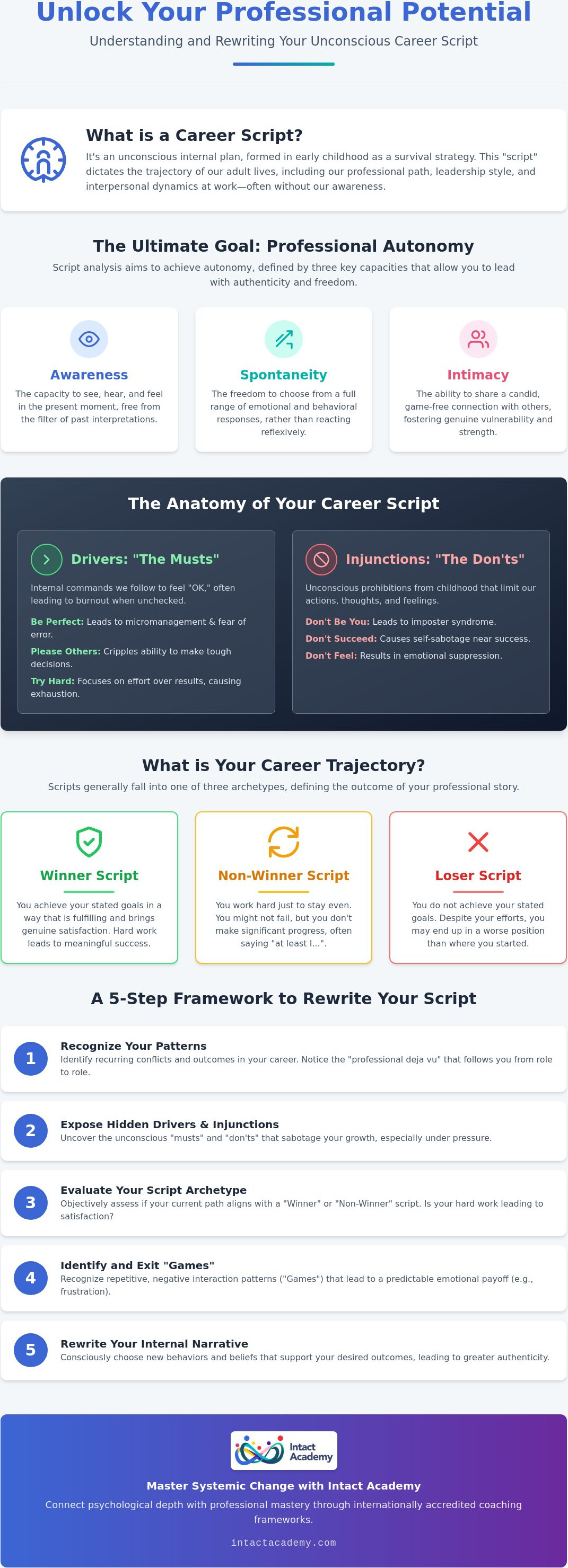
In the context of psychological growth, a script is not a document written for actors on a stage. Instead, it represents an unconscious internal plan, formulated in the early years of childhood as a survival strategy and a way to make sense of the world. Within the framework of Script analysis, we examine how these early narratives dictate the trajectory of our adult lives. While a film industry analyst might evaluate a screenplay for commercial viability, a systemic script analyst evaluates the life story you're currently living for its level of psychological freedom. Using script analysis for career development allows us to see that your professional path is rarely a series of random events; it's a structured performance based on a play you wrote before you even understood the rules of the corporate world.
The ultimate objective of this work is the attainment of autonomy. In Transactional Analysis, autonomy is defined by three distinct capacities:
- Awareness: The capacity to see, hear, feel, and taste things as pure sensory data, rather than through the filter of past interpretations.
- Spontaneity: The freedom to choose from a full range of emotional and behavioral responses, rather than reacting from a fixed, historical position.
- Intimacy: The ability to share a candid, game-free connection with others, allowing for genuine vulnerability and strength in leadership.
The Origins of the Life Script
Our professional protocol begins long before our first interview. It's shaped by parental injunctions, which are non-verbal messages about what we shouldn't do, and attributions, which are the labels others placed upon us. For instance, a child told they're "the responsible one" might grow into an executive who cannot delegate. Understanding what is transactional analysis provides the foundational language to decode these early messages. These childhood decisions aren't wrong; however, they often become outdated in an adult organizational context.
Why Career Development Requires Script Analysis
Traditional professional development often focuses on surface-level skills like time management or public speaking. While useful, these interventions fail to address recurring behavioral rackets; those habitual, unpleasant feelings we use to justify our script. If you find yourself constantly overwhelmed regardless of your workload, a time-management course won't help if your script demands you "Try Hard" to feel worthy. Script analysis for career development acts as a diagnostic tool for the soul of your career, mapping the subterranean currents that pull you toward either flourishing or frustration.
The Anatomy of a Career Script: Drivers and Injunctions
While technical expertise is often cited as the primary engine of success, the architecture of a professional life is frequently built upon unconscious foundations. Using script analysis for career development reveals that we operate under a set of "Drivers" and "Injunctions" that act as an invisible operating system. These are the internal rules we follow to feel "OK" in the eyes of our internalised parental figures. When these rules remain unexamined, they create a glass ceiling from the inside out, limiting our growth far more effectively than any external corporate policy could.
The "Script Payoff" is the predictable emotional outcome we unconsciously seek at the end of a project or a job. For some, it's the familiar sting of exhaustion; for others, it's the quiet resentment of being overlooked. This emotional destination is rarely accidental. It is the culmination of a sequence of choices driven by early psychological programming. Academic research in transactional analysis for career counselling highlights how these patterns are central to professional identity, often overriding rational career strategy.
Recognising Your Professional Drivers
Drivers are the functional demands we place on ourselves to maintain a sense of worthiness. The "Be Perfect" driver often manifests as chronic micromanagement and a paralyzing fear of error, ultimately leading to burnout. Conversely, the "Please Others" driver can cripple a leader's ability to make difficult, necessary decisions for fear of conflict. The "Hurry Up," "Try Hard," and "Be Strong" drivers each carry their own costs, from constant agitation to professional isolation. In high-stress meetings, notice your physical reactions. Are you rushing your speech? Are you tensing your muscles to appear invulnerable? These are the physical markers of your primary driver in action.
The Invisible Barriers: Career Injunctions
Injunctions are the restrictive "don'ts" that limit our professional range. "Don't Succeed" often appears as a sudden lapse in judgment or a bout of self-sabotage just as a major milestone approaches. "Don't Be You" forces a loss of authenticity in corporate environments, as professionals adopt a persona they believe the organization demands. These deep-seated barriers are why traditional training often fails; you cannot skill your way out of a script that forbids success. Understanding these dynamics is a cornerstone of professional development for coaches who wish to facilitate true transformation in their clients. Reflecting on these patterns is the first step toward reclaiming your professional life, a journey often supported through systemic supervision.
Identifying Your Pattern: Winner, Non-Winner, or Loser Scripts
When we apply script analysis for career development, we categorize professional outcomes into three distinct archetypes: winners, non-winners, and losers. These labels aren't moral judgments or assessments of your inherent worth. Instead, they describe the psychological destination of your Transactional Analysis life script. A "Winner" is someone who achieves their self-defined objectives with a sense of grace and internal satisfaction. They don't just hit the target; they find meaning in the process. A "Non-Winner," often termed a banal script, involves working incredibly hard just to stay at the baseline. It's the story of the professional who says, "At least I didn't fail," while feeling like they're on a treadmill that never stops. The "Loser" or tragic script is marked by predictable failure or catastrophic burnout, where despite high effort, the individual consistently ends up in a state of professional or emotional bankruptcy.
The Banal Script in Corporate Life
Corporate environments are fertile ground for banal scripts that keep potential leaders in a state of perpetual stagnation. The "Never-Ending" script drives professionals who feel they can never truly retire or rest; there's always one more project, one more year, or one more goal before they can permit themselves peace. Then there's the "Always" script, where an individual finds themselves repeating the same interpersonal mistake or organizational conflict in every new company they join. Perhaps most common is the "Until" script. This is the narrative of "I can't be happy until I reach the C-suite" or "I'll be authentic once I have tenure." These patterns keep the professional in a state of perpetual "not quite there," preventing any real sense of arrival or completion.
Shifting Toward a Winning Narrative
How to Rewrite Your Career Script: A 5-Step Framework
Rewriting a professional narrative is not a matter of sheer willpower; it is a methodical process of psychological restructuring. When we engage in script analysis for career development, we move through five distinct phases that transform unconscious compulsion into conscious choice. This journey begins with Awareness, where you map the recurring psychological "Games" you play at work and the predictable emotional "payoffs" they yield. Once these patterns are visible, you move to Analysis, tracing these behaviors back to the childhood decisions and parental injunctions that originally necessitated them. Only after understanding the "why" can you proceed to the "how" of professional evolution.
The Power of Permission
Step three is Permission. This is perhaps the most critical phase because willpower alone cannot override a script. You must give yourself the internal okay to act against your early programming. For example, a leader with a "Don't Be Important" injunction needs the internal permission: "It is okay to be successful and visible." A coach plays a vital role here, providing what we call Potency and Protection. They offer the psychological weight to challenge the old script and a safe space to explore the vulnerability that comes with new behavior. Without this systemic support, the old script often wins through sheer familiarity.
Redecision in the Workplace
The fourth step, Redecision, involves making a firm Adult commitment to a new professional behavior in real-time. This isn't a vague intention; it's a specific, actionable choice made during a high-stakes meeting or a difficult negotiation. Using script analysis for career development in this way allows you to catch the old impulse and choose a response that aligns with your current goals. However, be prepared for "Script Backlash." When you change your pattern, colleagues who were part of your old "Game" may unconsciously try to pull you back into your previous role. This is why Reinforcement, the fifth step, is essential. Building a systemic container through coaching ensures you have the support to maintain your new path. Individual redecisions have a ripple effect, often leading organizational change by shifting the psychological climate of the entire team. To begin this transformation and anchor your new professional script, explore our Executive Coaching programs.
Mastering Systemic Change with Intact Academy
The journey from identifying a professional script to mastering its transformation requires more than just insight; it demands a structured environment of excellence and a community of practice. At Intact Academy, we bridge the gap between psychological depth and organizational effectiveness. Our TA EMCC Senior Practitioner academy is designed for those who wish to go beyond surface-level coaching into the realm of profound human and systemic change. We integrate the profound insights of script analysis for career development with the rigorous standards of the EMCC and ICF, ensuring that your evolution is both personally significant and professionally accredited.
This methodology is rooted in the pioneering work of Sari van Poelje, who has been a leader in applying agile Transactional Analysis to complex organizational systems. Her approach ensures that the work of script analysis remains dynamic, relevant, and highly effective in fast-paced corporate environments. To sustain this level of awareness, we emphasize the role of Systemic Supervision. This practice provides the essential mirror for leaders and coaches, ensuring they remain in their Adult ego state and avoid being pulled back into the unconscious "Games" of the past.
Pathways to Professional Mastery
Our curriculum offers diverse pathways for those committed to flourishing, including the TA EMCC Senior Practitioner and TA EMCC Senior Team Coach Academy. The unique "Intact" approach focuses on moving from mere professional skill to a state of personal wholeness. We believe that the effectiveness of a coach or leader is directly tied to their own level of script awareness. This philosophy has resonated globally; we have trained professionals from over 14 countries, creating a rich tapestry of cultural and organizational perspectives. Our programs don't simply add tools to your kit. They transform the person who holds them.
Join a Global Community of Change Agents
Whether you join our immersive online sessions or participate in our in-person training in Utrecht, you become part of a global movement dedicated to integrity and depth. Earning an internationally recognized TA certification signifies a commitment to the highest standards of the profession. It marks your transition from being a character in an old narrative to becoming an author of systemic health. We invite you to explore our upcoming Academy intakes and transform your professional script. The courage to change your own story is the first step in helping others change theirs.
Stepping Into Your Authentic Professional Future
Your career trajectory isn't fixed by past decisions or organizational constraints; it's a living narrative that you have the power to rewrite. By engaging with script analysis for career development, you move beyond the repetitive cycles of the "Non-Winner" or "Loser" scripts and step into a state of true professional autonomy. This transformation isn't about simply acquiring more technical skills. It's about returning to a sense of wholeness and genuineness that allows you to lead with clarity, empathy, and lasting impact.
If you're ready to deepen your understanding of these systemic patterns and achieve international accreditation, we invite you to join our community of global change agents. Our programs are led by global expert Sari van Poelje and attract participants from over 14 countries. You'll benefit from EMCC and ICF Accredited Programs that bridge the gap between psychological depth and business pragmatism. Take the next step in your evolution and apply for the TA EMCC Senior Practitioner academy today. Reclaiming your professional script is the most significant investment you'll ever make in your future flourishing.
Frequently Asked Questions
Is script analysis the same as career coaching?
Script analysis is a specialized diagnostic method used within high-level coaching, rather than a synonym for the coaching process itself. While standard career coaching often addresses surface-level goals like skill acquisition or networking, script analysis for career development uncovers the unconscious psychological blueprints that dictate long-term professional patterns. It moves the conversation from what you're doing to why you're doing it. This depth allows for a level of transformation that behavioral coaching alone rarely achieves.
How long does it take to change a professional script?
The timeline for script transformation varies based on the complexity of the early decisions involved. Initial awareness of a pattern can occur rapidly, but the process of redecision and reinforcement typically unfolds over several months of consistent work. Sustainable change requires practice in real-world scenarios to anchor new behaviors. Working within a systemic container, such as an accredited coaching program, provides the stability needed for this evolution to take hold permanently.
Can I perform script analysis on myself, or do I need a coach?
You can begin the work of identifying your professional drivers independently, but rewriting a script usually requires a trained professional. Our internal injunctions are designed to be invisible to us as a form of psychological protection. A coach provides the necessary external perspective and potency to challenge these deep-seated rules. This partnership creates a safe space where you can experiment with new ways of being without triggering your old survival mechanisms.
What are the most common career scripts in executive leadership?
Executive leaders often operate under the "Hurry Up" or "Be Perfect" drivers. These manifest as a relentless pace or an inability to delegate, creating a "Never-Ending" script where rest is never permitted. Another frequent pattern is the "Until" script, where satisfaction is perpetually delayed until a certain milestone is reached. Identifying these archetypes is the first step toward reclaiming professional autonomy and finding genuine satisfaction in leadership.
How does Transactional Analysis differ from traditional organizational psychology?
Transactional Analysis offers a systemic view of human interaction that goes beyond traditional behavioral assessments. While traditional organizational psychology might measure engagement or personality traits, TA examines the ego states and transactions between individuals. It provides a practical framework for understanding how childhood scripts influence corporate culture. This approach makes complex interpersonal dynamics manageable and actionable through structured methodology and clear terminology.
Is script analysis relevant for team development or just individuals?
Script analysis is as vital for team development as it is for individuals. Organizations often develop a "collective script" or a shared set of unconscious rules that dictate how conflict is handled or how success is celebrated. When a team understands its collective injunctions, it can break free from repetitive games and move toward more authentic collaboration. This systemic shift often leads to higher levels of psychological safety and productivity across the department.
What is the Redecision process in a business context?
In a business context, Redecision is the moment you consciously choose a new response over an old, scripted impulse. It is an Adult-state commitment to change a professional behavior, such as setting a boundary with a difficult client or choosing to lead with vulnerability. This isn't a vague resolution; it's a specific action taken in a high-stakes moment. Each redecision strengthens your new professional narrative and weakens the old, restrictive script.
How can I explain the value of script analysis to my HR department?
Focus on the link between psychological depth and organizational ROI. You can explain that script analysis for career development acts as a preventative measure against burnout and leadership stagnation. By addressing the root causes of recurring conflicts and self-sabotage, this work creates more resilient and authentic leaders. It moves beyond transactional training to foster deep, systemic growth that benefits the entire organizational culture and improves retention.


