

What if the resistance you feel when quoting your fee isn't a sign of overcharging, but a symptom of a systemic misalignment between your professional depth and your market positioning? It's a common struggle; many highly qualified practitioners find themselves undercharging for complex work or losing ground to competitors who offer surface-level solutions at lower price points. Mastering the process of setting executive coaching fees requires more than a simple calculation of hours spent. It demands a profound understanding of the value created within the organizational system and the courage to hold a boundary that reflects your level of accreditation and expertise.
You likely recognize that true transformation isn't a commodity, yet the pressure to justify your worth in a volatile 2026 market can feel overwhelming. This article will provide you with a clear rationale for premium pricing, helping you move past the 'imposter' narrative into a space of quiet professional confidence. We will examine how to align your fees with global standards and systemic impact, ensuring your pricing reflects the wholeness of the change you facilitate and the maturity of your practice.
Key Takeaways
- Uncover how your psychological 'Life Script' influences your professional worth, allowing you to move from an 'Adapted Child' state into a grounded 'Adult' stance during fee negotiations.
- Navigate the 2026 market with precision by setting executive coaching fees that reflect your accreditation level and the profound systemic impact of your work.
- Transition from transactional hourly rates to value-based pricing models that align your fees with the strategic milestones and long-term health of the organization.
- Utilize the three-way contract as a tool for transparency, creating a stable professional container where fees are presented with clarity and confidence.
- Learn how advanced training in Transactional Analysis empowers you to move from individual coaching toward senior team coaching roles with higher market value.
The Psychology of Pricing: Is Your 'Life Script' Setting Your Fees?
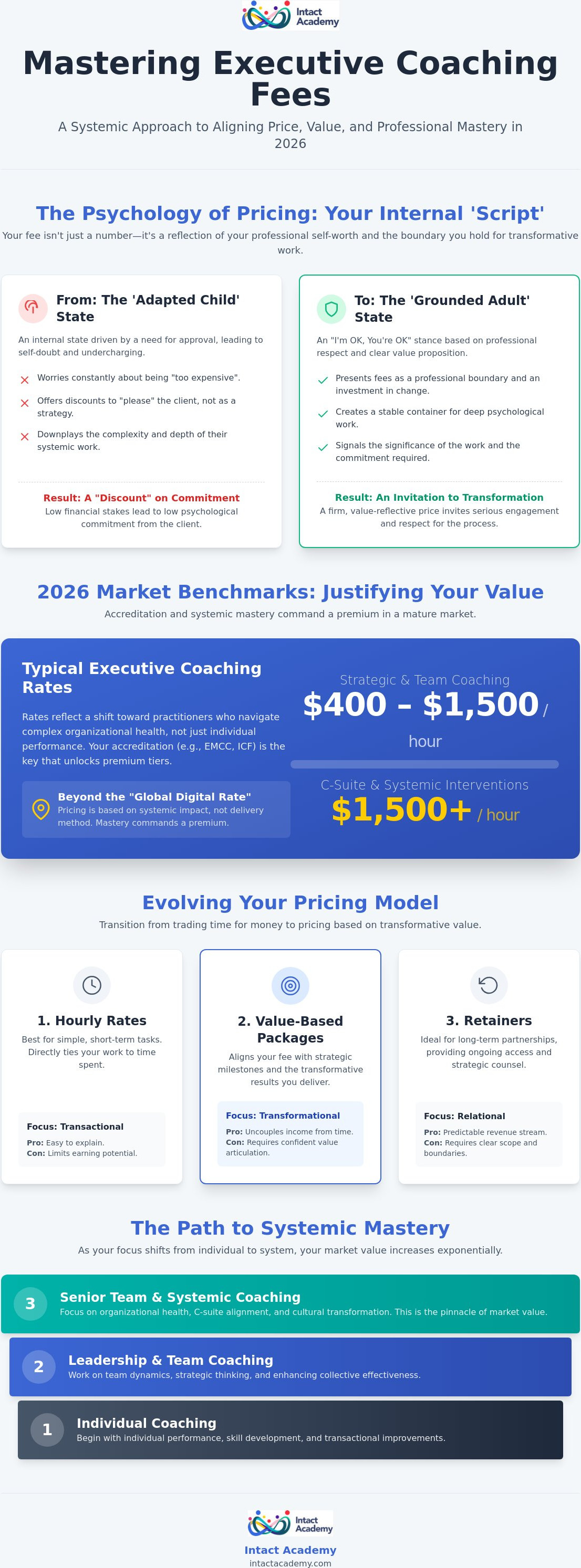
Setting executive coaching fees is an act of self-definition that begins long before you open a spreadsheet. It's a mirror reflecting your internal landscape. If you feel a tightening in your chest when stating your rate, you're likely encountering your "Pricing Script." This script isn't just about money; it's about your perceived right to occupy space and command value in a complex organizational system. It's a narrative built from early experiences that dictates how much you're allowed to receive in exchange for your mastery.
The process of setting executive coaching fees often triggers a shift in our internal ego states. When we worry about being "too expensive," we've likely slipped into the Adapted Child state, seeking the client's approval rather than their professional respect. A mature practice requires an Adult-to-Adult transaction. In this state, we recognize that our fee is a professional boundary. It protects the integrity of the work. Without this boundary, the coaching relationship becomes porous, and the deep psychological work required for transformation loses its necessary tension. You aren't just charging for time; you're creating a stable container for change.
Undercharging isn't a kindness. It's a "discount" on the client's commitment to change. When the financial stakes are low, the psychological stakes often follow. If the investment doesn't feel significant to the organization, the motivation to engage with difficult systemic truths often wanes. By holding a firm, value-reflective price, you're inviting the client into a serious developmental space. You're signaling that the work ahead is significant, and so is the commitment required to achieve it. Your fee is the first intervention in their growth process.
Identifying Your Internal Barriers
Many coaches carry unconscious injunctions from childhood, such as "Don't be important" or "Don't succeed." These beliefs manifest as a persistent urge to offer price concessions or to downplay the complexity of systemic work. The trap of "Pleasing" the client through low fees is often a survival strategy from the past, not a professional strategy for the present. The Pricing Script is the unconscious framework governing a coach's financial boundaries. Recognizing these patterns is the first step toward reclaiming your professional value.
Moving to an Adult-to-Adult Pricing Model
Adopting an "I'm OK, You're OK" stance is vital for grounded fee discussions. It allows you to stop "asking for money" and start proposing an investment in transformation. Using Transactional Analysis helps you stay present during high-stakes negotiations, ensuring that you don't regress into a state of apology. You aren't just selling hours; you're facilitating a return to wholeness within an organization. This perspective shifts the conversation from cost to value, allowing for a more authentic connection with the client's needs.
Market Benchmarks vs. Professional Mastery in 2026
In 2026, the global market for high-level leadership development has matured into a tiered ecosystem where professional value is clearly delineated. While entry-level engagements might start lower, the benchmark for setting executive coaching fees at the strategic level now typically ranges from $400 to over $1,500 per hour. This isn't a random escalation; it reflects a shift in demand toward practitioners and firms like Simon Lead LLC that focus on enhancing leadership capabilities to navigate the complexities of hybrid work, AI integration, and systemic organizational health. For C-suite interventions, these rates often climb even higher, reflecting the immense weight of the decisions being influenced.
Accreditation serves as a vital signal in this crowded marketplace. Organizations increasingly look to EMCC and ICF standards to validate a coach's depth. A Senior Practitioner doesn't just offer advice; they provide a psychological safety net for the entire organization. This level of mastery allows you to move away from the "Global Digital Rate"—the standardized pricing for virtual sessions—and toward a premium that reflects your unique systemic impact. Mastery commands a premium. It always has. When you align your practice with these global standards, you're no longer competing on price; you're offering a specialized form of professional maturity that few can replicate.
The Value of Accreditation
Earning an advanced executive coaching certification is the most direct path to shifting your market positioning. It moves you from a generalist role into the realm of Senior Practitioner, where project-based fees become the norm. At this level, your work is often informed by a deep understanding of what is transactional analysis, allowing you to decode the complex scripts that drive executive behavior. This specialized knowledge is what justifies a higher fee tier. It provides the tools necessary for profound interventions that surface-level coaching simply cannot reach. If you're ready to deepen your impact, consider exploring the TA EMCC Senior Practitioner academy to align your skills with these premium market demands.
Justifying the Fee to Stakeholders
Justifying these fees to stakeholders requires a shift from talking about "hours" to talking about "outcomes." Research suggests that companies investing in executive coaching report a median ROI of 700%, a figure that makes the initial investment feel far more manageable. You must also highlight the "Cost of No Change." What does a dysfunctional leadership team cost a company in lost talent, stalled innovation, or cultural decay? By using systemic data to prove the value of long-term shifts, you provide the clarity that boards and HR directors need. You can find more insights on setting coaching fees that reflect this ROI-centric approach, ensuring your proposals are grounded in both psychological depth and business reality.
Comparing Fee Structures: Hourly, Value-Based, and Retainers
The mechanics of setting executive coaching fees require a deliberate choice between different commercial structures, each carrying its own psychological and systemic implications. While hourly rates offer a familiar starting point for many, they often fail to capture the full scope of a Senior Practitioner's impact. In a sophisticated 2026 market, your fee structure should mirror the depth of the container you're building. Whether you choose a transactional model or a value-based agreement, the structure itself becomes a part of the professional boundary you maintain with the organization.
Value-based pricing shifts the focus from your time to the client's transformation. This approach aligns your compensation with the specific milestones achieved by the leader or the team. It's a model supported by research on the value of executive coaching, which suggests that high-level interventions can produce significant shifts in organizational effectiveness. By linking your fees to these outcomes, you demonstrate a commitment to the client's success while honoring the intellectual and emotional labor involved in facilitating deep change.
Retainer models offer a different kind of stability. They provide the C-suite with "on-call" systemic support, allowing for a more fluid and responsive coaching relationship. This model is particularly effective for long-term engagements where the coach acts as a steadying presence through periods of volatility. When setting executive coaching fees for these roles, you aren't just pricing sessions; you're pricing access to a specialized level of professional maturity and systemic insight.
When to Use Which Model
Hourly rates remain useful for short-term, tactical coaching where the goals are narrow and skill-based. However, when your work involves leading organizational change, a value-based or retainer approach is more appropriate. These models allow for the "skin in the game" that complex systemic work requires. They ensure that the coach is viewed as a strategic partner rather than a mere vendor, facilitating a more authentic Adult-to-Adult relationship with the sponsoring organization.
Hidden Costs to Include in Your Fees
A comprehensive fee must account for the invisible labor that sustains a high-level practice. This includes the administration of assessment tools like 360-degree feedback or Hogan reports, as well as the time spent in shadow coaching and stakeholder interviews. Crucially, your pricing must also support your own professional development for coaches and systemic supervision. These aren't just overheads; they're the investments that keep your "instrument"—yourself—tuned to the highest professional standards.
The Art of the Contract: Communicating Fees with Clarity
The contract is more than a legal document; it's the architectural blueprint for the transformational space you're about to enter. When setting executive coaching fees, the clarity of your communication serves as the first real test of your professional boundaries. If you hesitate or apologize for your rate, you're inadvertently signaling a lack of confidence in the systemic impact you're promising to deliver. Transparency isn't just a business practice. It's a trust-builder that creates a secure container where deep, often-turbulent work can safely occur.
In high-level engagements, you're often managing a three-way contract between yourself, the coachee, and the sponsoring organization. Each party must have a clear understanding of the investment and the expected outcomes. Price resistance, when it arises, shouldn't be met with defensiveness. Instead, use it as a moment for systemic inquiry. Is the resistance about the number itself, or does it reflect a deeper organizational hesitation regarding the change process? By addressing these questions directly, you move the conversation from a transactional negotiation to a professional exploration of value and commitment.
Steps to a Seamless Fee Discussion
A structured approach ensures that the financial conversation remains grounded and Adult-to-Adult. Follow these three stages to maintain integrity:
- The Administrative Contract: Establish the fee structure, payment terms, and cancellation policies early in the discovery phase. This removes ambiguity before the emotional work begins.
- The Professional Contract: Explicitly link the fee to the specific goals and organizational milestones you've identified. This reinforces the ROI of the intervention.
- The Psychological Contract: Confirm the coachee's internal commitment to the work. A high fee often requires a high level of "psychological skin in the game," which is essential for lasting change.
Navigating Ethical Dilemmas in Pricing
Integrity is the bedrock of a senior practice. While you might be tempted to offer pro-bono work, consider its systemic impact. Does a free service undermine the coachee's perception of value or their commitment to the process? Often, a tiered pricing model for different sectors—such as non-profits or emerging startups—is a more ethically sound way to practice inclusion without devaluing your expertise. Avoid referral fees or kickbacks that could compromise your objectivity. Your fee should be a clean exchange for your mastery, free from hidden agendas that could cloud your systemic perspective. To master these complex dynamics and elevate your practice, consider joining the TA EMCC Senior Practitioner academy for advanced training in professional contracting.
Elevating Your Practice: From Transactional to Systemic Mastery
The journey toward professional mastery is rarely a linear climb. It's a series of deep internal shifts that alter how you perceive your role and your worth. When you move beyond the transactional nature of individual coaching, you begin to see the organizational system as a living, breathing entity. This transition from "Individual Coach" to "Senior Team Coach" is where the most significant value is created. By working with the collective dynamics of a leadership team, you address the root causes of systemic dysfunction rather than just the symptoms. This broader scope inherently changes the conversation around setting executive coaching fees, as your impact ripples through the entire culture of the organization.
The Path to Senior Practitioner Status
True evolution requires a methodology that integrates psychological depth with organizational agility. The Sari van Poelje methodology provides exactly this, offering a structured way to master systemic change. By engaging with the TA EMCC Senior Practitioner academy, you build the internal "Adult" capacity to hold high-level interventions without losing your footing. Investing in advanced accreditation isn't just an expense; it's a strategic move with a high ROI. It signals to the market that you operate at the intersection of human behavior and business strategy, a rare and highly valued position in 2026. Setting executive coaching fees at this level becomes a natural extension of your demonstrated mastery.
Conclusion: Your Fee as a Reflection of Your Impact
Your fee is the final word in the professional narrative you've built. It links your psychological depth to your professional pragmatism, serving as a clear indicator of the transformation you're capable of facilitating. We invite you to find the courage to set fees that honor the intelligence of your clients and the complexity of the work you do. Aligning your pricing with your mastery isn't an act of ego; it's an act of professional honesty. It ensures that the exchange remains clean, transparent, and focused on the profound human transformation that lies at the heart of your practice.
If you're ready to join a global community of practitioners committed to this level of depth, we encourage you to join our upcoming intake for the TA EMCC Senior Practitioner academy. Together, we can elevate the standards of our profession and ensure that your practice reflects the wholeness and genuineness that modern leadership demands.
Reclaiming Your Professional Worth Through Systemic Mastery
Your fee is more than a simple number; it's a statement of your professional maturity and a testament to the depth of your practice. By addressing your internal 'Pricing Script' and aligning your practice with global benchmarks, you move from a transactional mindset into one of systemic mastery. Setting executive coaching fees becomes an act of integrity rather than a negotiation of worth. It allows you to hold a stable container for the profound organizational transformations your clients require. When you value your own contribution, you invite your clients to do the same.
True value is found at the intersection of psychological insight and business pragmatism. When you ground your practice in accredited standards and systemic methodology, you provide the safety and results that modern leadership demands. You don't have to navigate this evolution alone. Join a global community of practitioners from over 14 countries who are redefining the boundaries of leadership development through insight and structured change.
Deepen your impact and master systemic coaching at the Intact Academy. Our EMCC and ICF accredited programs, led by Sari van Poelje, provide the structured methodology you need to thrive in a complex market. Step into your power and honor the intelligence of the systems you serve.
Frequently Asked Questions
What is the average hourly rate for executive coaching in 2026?
In 2026, average hourly rates span a wide spectrum based on the leader's seniority and the coach's expertise. Managerial coaching typically ranges from $150 to $400 per hour, while director-level engagements often command between $300 and $600. For C-suite and CEO interventions, fees can reach between $800 and $3,500 or more per hour. These figures reflect the significant systemic responsibility and the potential organizational impact involved at the highest levels of leadership.
Should I publish my coaching fees on my website?
High-level systemic coaching is rarely a commodity, so publishing fixed fees can sometimes undermine the bespoke nature of the work. While transparency is vital, it's often more effective to discuss pricing during the initial discovery phase after the scope is understood. This allows you to align the investment with the specific organizational milestones and the depth of the psychological contract required. Providing a price range can be a helpful middle ground for establishing early trust without sacrificing flexibility.
How do I transition from hourly rates to value-based pricing?
Transitioning requires a fundamental shift from selling your time to selling measurable organizational outcomes. Start by identifying the strategic goals the client seeks to achieve, such as successful culture shifts or improved executive retention. By linking your fee to these results, you demonstrate that you have 'skin in the game' and move the conversation toward the long-term return on investment. This model honors the intellectual and emotional labor required for deep, systemic change.
What is the difference between a Junior and a Senior Practitioner fee?
Senior Practitioners command higher fees because their work addresses deep systemic patterns rather than just surface-level behaviors. A junior coach might focus on tactical skills or individual performance, but a Senior Practitioner facilitates transformation across entire leadership teams. This higher tier reflects a greater level of professional maturity and advanced accreditation. It signals to the market that the practitioner can hold a stable container for the most complex organizational challenges.
Can I charge extra for assessments and psychometric testing?
Yes, it's standard professional practice to charge separately for psychometric tools and 360-degree feedback assessments. These instruments involve direct costs from providers and require additional time for administration and interpretation. Clearly outlining these as separate line items in your proposal ensures transparency and prevents the administrative contract from becoming a point of friction. It also reinforces the value of the specialized data these tools provide to the coaching process.
How do I handle a client who says my coaching fees are too high?
Treat this feedback as a moment for systemic inquiry rather than a prompt for defensiveness. Ask the client to explore the 'cost of no change' for the organization if the leadership dynamics remain as they are. This shifts the focus from the price of the service to the value of the transformation. If the resistance persists, it may indicate a lack of readiness for the deep work required, which is a vital insight for the psychological contract.
Is it ethical to charge different rates for different clients?
It's both ethical and common to use tiered pricing models for different sectors, such as non-profits, startups, or global corporations. This practice allows you to maintain professional integrity while ensuring your work remains accessible to a diverse range of organizations. The key is to be consistent in your rationale and ensure that the fee always reflects the complexity of the system you're entering. Integrity lies in the transparency of your exchange, not in a one-size-fits-all price.
How often should I review and increase my executive coaching fees?
Review your fee structure annually or whenever you achieve a significant milestone in professional mastery. Setting executive coaching fees should be a reflective process that accounts for your ongoing investment in supervision and advanced accreditation. As your capacity for facilitating deep, systemic change grows, your pricing should evolve to mirror that increased value. Regular reviews ensure your practice remains sustainable and aligned with the current 2026 market benchmarks.


