

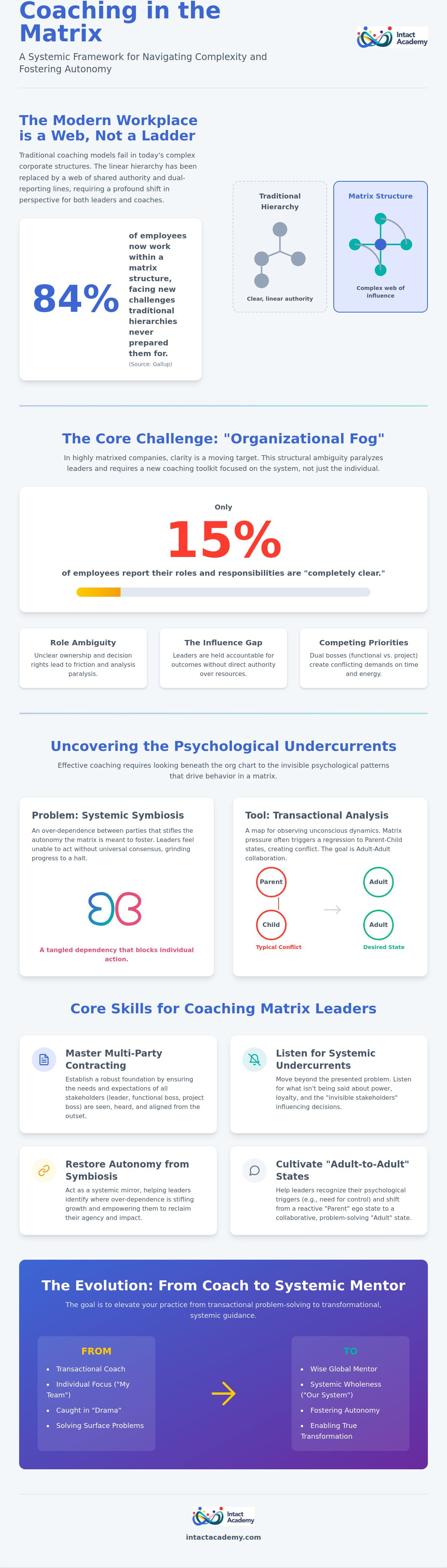
What if the political maneuvering and conflicting priorities you encounter in your coaching sessions aren't signs of individual failure, but the natural pulse of a system designed for tension? With 84% of employees now working within some form of a matrix structure according to Gallup, the traditional hierarchy has dissolved into a complex web of dual-reporting lines and shared authority. You've likely felt the weight of the "organizational fog" alongside your clients, witnessing how role ambiguity and competing bosses can paralyze even the most seasoned leaders. It's a landscape that feels increasingly brittle and incomprehensible, requiring more than just standard management tactics to navigate effectively.
We understand that coaching in this environment requires a profound shift in perspective. To facilitate true transformation, you must develop specific skills for coaching in a matrix organization that honor both the individual's growth and the systemic reality they inhabit. This article provides a sophisticated framework for mastering multi-party contracts and managing the delicate psychological dynamics of influence without authority. We will explore how to move teams from the exhaustion of "drama" toward a state of systemic autonomy, offering you the insight needed to act as a wise, grounding presence in a turbulent corporate world.
Key Takeaways
- Learn to identify systemic symbiosis, where over-dependence stifles individual growth, and discover how to restore autonomy within complex organizational webs.
- Develop the essential skills for coaching in a matrix organization by using Transactional Analysis to map ego states and navigate the friction between functional and project-based demands.
- Establish a robust foundation for every engagement through multi-party contracting, ensuring that the needs of all stakeholders are seen, heard, and aligned.
- Refine your ability to influence without formal authority by mastering the art of psychological recognition and listening for the systemic undercurrents that drive decision-making.
- Move beyond surface-level intervention by integrating systemic supervision into your practice, evolving from a transactional coach into a wise global mentor.
The Matrix Challenge: Why Traditional Coaching Often Fails
Traditional coaching models often rely on a linear understanding of cause and effect. They assume that if a leader refines their individual behavior, the environment will naturally respond in kind. However, Matrix management introduces a level of complexity that renders this individualistic approach insufficient. In a system where authority is diffused across functional and project lines, the path to success isn't a straight climb up a ladder; it's a delicate dance of horizontal influence. When we coach the leader in isolation, we ignore the systemic gravity that pulls at every decision they make.
This environment frequently produces what we call "organizational fog." Research indicates that in highly matrixed companies, only 15% of employees report that their roles and responsibilities are "completely clear." This ambiguity isn't a temporary glitch; it's a structural feature. For the coach, this means clarity is a moving target. Developing the specific skills for coaching in a matrix organization requires moving beyond the individual's performance to understanding the systemic undercurrents that shape their executive identity. Without this broader perspective, coaching sessions can become mere venting spaces rather than catalysts for transformation.
The Reality of Responsibility Without Authority
The most profound struggle in a matrix is the "influence gap." Leaders are frequently held accountable for outcomes but lack direct authority over the people or resources required to deliver them. This structural tension often triggers a psychological regression. When authority feels threatened, leaders may default to "Parent" ego states, becoming overly controlling or critically demanding as a way to manage their own anxiety. This shift directly impacts psychological safety. Teams caught in this crossfire often retreat into survival mode, stifling the very innovation the matrix was designed to foster. The coach's role is to help the leader recognize these triggers and return to an "Adult" state of shared problem-solving.
From Hierarchy to Holism: A Systemic Shift
To coach effectively, we must stop viewing the matrix as a rigid reporting chart and start seeing it as a living system. The coach acts as a systemic mirror, reflecting the invisible patterns and "invisible" stakeholders that influence the client's world. This shift is essential for those leading organizational change through a psychological lens. It's about moving from a focus on "my team" to "our system." By helping leaders see the symbiosis inherent in their dual-reporting lines, we empower them to move from a place of fragmentation toward a state of systemic wholeness and genuine impact.
The Psychology of the Matrix: Ego States and Systemic Symbiosis
To navigate the matrix effectively, we must look beneath the surface of the reporting lines to the invisible psychological threads that bind its participants. Systemic Symbiosis occurs when two or more parties in a matrix become over-dependent, effectively stifling the very autonomy the structure is meant to encourage. This often manifests as a leader feeling unable to act without the explicit approval of every stakeholder, or a team waiting for a consensus that never arrives. Transactional Analysis is a tool for mapping unconscious organizational patterns, offering a lens through which we can observe these hidden dynamics without judgment.
A leader's "Life Script," the unconscious narrative formed in early development, profoundly influences their ability to share power and tolerate ambiguity. If a leader’s script is rooted in a need for total control to feel safe, the horizontal influence required by the matrix will feel like a fundamental threat to their executive identity. Refining the skills for coaching in a matrix organization means helping leaders recognize when their past scripts are interfering with their present systemic needs, allowing them to choose a more genuine and effective response.
Adult-to-Adult Transactions in Dual-Reporting
Dual-reporting lines often trigger a regression into Parent-Child dynamics. A functional manager might act as a "Critical Parent," dictating terms, while the project manager slips into an "Adapted Child" state, complying with resentment or passive-resistance. True executive presence emerges when both parties maintain an "Adult" state during resource negotiations. This psychological grounding allows for a focus on data and shared goals rather than emotional reactivity, turning a potential conflict into a collaborative inquiry. It's about staying present and resource-oriented even when the system feels fragmented.
Breaking Symbiotic Patterns in Cross-Functional Teams
In cross-functional teams, "Rescuing" is a common trap that undermines performance. A leader might take on a peer's responsibility to avoid conflict, inadvertently creating a dependency that prevents the team from functioning at its full potential. Autonomy is the essential antidote to matrix-induced helplessness. Understanding what is transactional analysis provides the language for these shifts, enabling teams to move from the exhaustion of drama to the vitality of productive collaboration. For those seeking to master these depths, exploring the TA EMCC Senior Practitioner academy offers a path toward systemic mastery and professional completeness.
Mastering the Art of Multi-Party Contracting
In the fluid environment of a matrix, the traditional two-party coaching agreement is a fragile illusion. When a leader reports to both a functional head and a project lead, their priorities are often in direct competition. To coach effectively, you must move beyond the dyad and embrace the "Three-Cornered Contract." This framework ensures the organization is not an invisible observer but an active participant with clear, negotiated expectations. Developing the skills for coaching in a matrix organization means becoming an architect of these multi-layered agreements, ensuring that every stakeholder's voice is integrated into the work from the outset.
The first step in this process is identifying the "invisible" stakeholders. These are the individuals who may not be in the coaching room but whose influence dictates the client’s success. Once identified, you must align three distinct levels of contracting to ensure systemic integrity. The administrative contract covers the logistics of time and fees; the professional contract defines tangible goals and success metrics; and the psychological contract uncovers the unspoken expectations and emotional commitments. Without this alignment, you may find yourself navigating a "Secret Contract." This is a hidden agenda where the organization might expect a behavioral change the client hasn't agreed to, or where a manager uses the coach to deliver difficult feedback they're avoiding themselves.
Managing Conflicting Loyalties and Priorities
Matrix leaders often feel torn between competing truths. A functional manager may demand long-term skill development, while a project lead insists on immediate delivery. Your role is to help the client hold these multiple realities simultaneously without losing their sense of self. By facilitating three-way alignment meetings, you create a space for Adult-to-Adult dialogue where priorities can be negotiated openly. This transparency reduces the organizational fog and builds a foundation of shared responsibility, allowing the leader to move from a state of conflict to one of systemic contribution.
Contracting for Resilience and Change
In an environment of constant structural shifts, a contract is never static. It must be a living document that evolves alongside the organization. When reporting lines change mid-engagement, the coach must initiate a formal re-contracting process to maintain professional boundaries. This level of systemic agility is a hallmark of professional maturity. It aligns closely with the competencies explored in the TA Foundation Year, where practitioners learn to maintain a stable professional container amidst the turbulence of organizational change. By establishing these boundaries, you provide the client with a sense of safety and reliability that is often missing in the wider matrix.
Core Skills for Coaching Matrix Leaders
Mastering the skills for coaching in a matrix organization requires a shift from managing tasks to managing the psychological energy of the system. In an environment where formal power is fragmented, influence becomes the primary currency. This isn't about manipulation; it's about the art of psychological "stroking," which is providing the recognition that individuals need to feel valued within a complex web of competing demands. When a leader recognizes a peer's contribution without needing a formal reporting line to do so, they build the social capital necessary to move projects forward even when authority is absent.
Advanced listening in this context means hearing the systemic undercurrents. It's the ability to perceive the unspoken tensions between departments or the historical anxieties of the organization that manifest in a single client's hesitation. By reflecting these patterns, the coach helps the leader develop an "Agile Transactional Analysis," allowing them to pivot their communication strategies as rapidly as the organizational structure shifts. This level of awareness transforms the coach into a grounding force, helping the leader stay centered amidst the organizational fog.
The Winners Triangle: A Strategy for Matrix Conflict
The high-pressure environment of dual-reporting often traps teams in the Drama Triangle, where individuals rotate between the roles of Persecutor, Rescuer, and Victim. To move toward a state of professional completeness, coaches must guide leaders toward the Winners Triangle. This shift requires conscious behavioral changes:
- Replacing Persecution with Assertion: Leaders learn to ask for what they need clearly and directly without blaming others for systemic delays.
- Replacing Rescuing with Caring: This involves supporting a peer or team member without over-functioning or taking on their responsibilities, which preserves everyone's autonomy.
- Replacing Victimhood with Vulnerability: Admitting challenges or resource limitations builds trust and invites collaborative problem-solving rather than defensive posturing.
Coaching for Political Savvy with Integrity
Political Savvy is the ability to navigate systems without losing one's genuineness. It involves mapping the "Social Level," which is the explicit agenda of a matrix meeting, against the "Psychological Level," which contains the underlying power plays and emotional subtexts. Helping a leader maintain an "OK-OK" position, a state where they value both themselves and their counterparts, ensures they can negotiate high-stakes outcomes without compromising their integrity. By understanding these levels, leaders can influence the system effectively while remaining true to their core values. To deepen your ability to guide leaders through these systemic complexities, consider enrolling in the TA EMCC Senior Practitioner academy, where these frameworks become practical tools for professional mastery.
Elevating Your Practice: From Coach to Systemic Mentor
The evolution of a coach within a complex organization is not merely a matter of accumulating more tools. It is a profound shift in identity. Moving from the transactional to the systemic requires a commitment to one's own development that mirrors the complexity of the matrix itself. To truly master the skills for coaching in a matrix organization, one must embrace a journey toward executive coaching certification. This path isn't just about a credential; it's about integrating Transactional Analysis mastery with the rigorous EMCC Senior Practitioner requirements to ensure you can hold the space for leaders navigating profound fragmentation.
Systemic supervision becomes essential in this landscape. It provides the necessary container for the coach to process the organizational fog they inevitably absorb. Without this reflective space, the coach risks becoming entangled in the very symbiotic patterns they aim to dissolve. By returning to a state of wholeness and genuineness, you offer your clients a mirror of stability in an otherwise turbulent system. This presence allows you to guide others not through force, but through the quiet power of insight and structured methodology.
The Role of Systemic Team Coaching
Becoming a Wise Global Mentor
The philosophy of Sari van Poelje emphasizes that professional mastery is inseparable from personal evolution. To be a wise global mentor, one must have the courage to look inward before taking outward action. It's about moving beyond transactional skills toward a state of systemic wisdom where you don't just solve problems, but help the system evolve. We invite you to join the Intact Academy community of senior practitioners. Together, we move beyond the surface of business coaching into the realm of profound human transformation, helping leaders return to their most genuine selves within the complexity of the modern matrix.
Step Into Systemic Mastery
Navigating the modern organization requires a shift from viewing leadership as a solo endeavor to seeing it as a systemic dance. You've explored how to dissolve the organizational fog by mastering ego states and breaking symbiotic patterns. By moving from the Drama Triangle toward the Winners Triangle, you empower your clients to reclaim their autonomy and influence. These skills for coaching in a matrix organization are the foundation for a practice that doesn't just solve problems but facilitates profound human transformation and professional completeness.
Your journey toward becoming a wise global mentor continues through structured methodology and deep reflective practice. Our community, spanning over 14 countries, offers the stability needed to master these complexities under the guidance of world-renowned expert Sari van Poelje. We invite you to deepen your impact with our TA EMCC Senior Practitioner Academy, where our EMCC and ICF accredited programs provide the intellectual rigor and psychological depth required for senior-level mastery. Step into a space where your professional growth aligns with systemic excellence. You have the courage to change; we provide the stable container for that evolution.
Frequently Asked Questions
What are the most important skills for coaching in a matrix organization?
The most vital skills for coaching in a matrix organization include systemic awareness and the capacity for horizontal influence. A coach must guide leaders to move beyond hierarchical control and instead build alliances across functional boundaries. This requires advanced listening to perceive the hidden undercurrents of the system and the psychological flexibility to adapt as reporting lines shift. It's about helping the client navigate a web of shared authority with grace and strategic insight.
How do I handle a coaching contract with two different managers?
Transparency is your primary tool when managing dual-reporting lines. You must bring both managers into a shared alignment meeting to establish a collective understanding of success metrics and boundaries. This proactive approach prevents the coach from being caught in the middle of conflicting priorities. It ensures that the administrative, professional, and psychological contracts are fully synchronized across all parties, creating a stable foundation for the coaching work to flourish.
What is the 'Three-Cornered Contract' in Transactional Analysis?
This framework explicitly includes the organization as an active third party in the coaching agreement. It moves the engagement from a private dyad to a systemic partnership where the sponsor, coach, and client agree on shared goals. This structure protects the coach from hidden agendas and provides a secure container for the work within a fragmented system. It ensures that the organization's needs are visible and negotiated alongside the individual's growth.
How can a coach help a leader who has no direct authority?
A coach helps these leaders master the art of influence through psychological recognition and the building of social capital. By using "stroking" to value others' contributions, leaders can inspire collaboration without the need for formal power. We focus on moving from a "Parent" state of demanding to an "Adult" state of shared inquiry. This shift is essential for leading effectively in decentralized structures where influence is the primary currency of success.
Why is systemic team coaching better for matrix organizations?
Systemic coaching addresses the connective tissue between various nodes of the matrix rather than focusing on the individual in isolation. Since matrix challenges are inherently structural and relational, coaching the whole team allows for the resolution of symbiotic dependencies that stifle progress. This approach fosters collective autonomy and improves decision-making speed. It's particularly effective in environments where roles are frequently ambiguous and require high levels of cross-functional cooperation.
What is the difference between the Drama Triangle and the Winners Triangle?
The Drama Triangle is a regressive cycle of Persecutor, Rescuer, and Victim roles that drains organizational energy and creates resentment. The Winners Triangle offers a path to professional maturity by replacing these roles with Assertion, Caring, and Vulnerability. This shift allows leaders to ask for what they need clearly and support others without over-functioning. It creates a healthier psychological environment where team members can take responsibility for their own success and growth.
How do I deal with conflicting priorities in a matrix coaching engagement?
You deal with these by facilitating a formal re-contracting process whenever organizational shifts occur. It's the coach's role to help the client hold multiple, often competing truths without becoming paralyzed by the tension. By mapping stakeholder power and interest, you guide the leader to negotiate priority conflicts from a grounded, Adult-to-Adult position. This methodology ensures the client remains focused on systemic contribution rather than falling into survival-driven anxiety.
Can Transactional Analysis be used for organizational change?
Transactional Analysis provides a sophisticated language for mapping unconscious patterns and "Life Scripts" that exist at the organizational level. It allows practitioners to diagnose systemic symbiosis and design interventions that promote genuine autonomy across the entire system. By addressing the psychological roots of resistance, TA facilitates sustainable change. This moves beyond surface-level process adjustments toward a profound cultural transformation that honors both human needs and business objectives.


