

What if the most precarious moment in your supervisory practice isn't when you break a rule, but when you follow one too rigidly at the expense of the human system? When you encounter ethical dilemmas in coaching supervision, the Global Code of Ethics provides the necessary boundaries, yet it rarely illuminates the shadows where conflicting stakeholder interests collide. You might find yourself caught between a coach's vulnerability and an organization's demand for data, feeling the weight of your professional reputation pressing against your chest.
It's natural to feel isolated or even anxious when the "right" path isn't clearly marked in a manual. We recognize that true professional maturity isn't about simple compliance; it's about developing the psychological depth to hold these systemic tensions with integrity. This guide will show you how to move beyond rigid checklists by using Transactional Analysis and systemic frameworks to transform ethical friction into a catalyst for growth. We'll explore a structured way to process complex grey areas with confidence, ensuring your decisions are both defensible and deeply insightful.
Key Takeaways
- Distinguish between simple compliance and true ethical dilemmas by identifying the underlying conflict between competing, yet valid, professional principles.
- Discover how Transactional Analysis and your personal Life Script provide a map for navigating ethical dilemmas in coaching supervision with psychological depth.
- Gain insight into "parallel processes" to understand how organizational shadows and unspoken systemic rules manifest within the coaching relationship.
- Master a structured framework for ethical maturity that uses an Ego State Audit to move from reactive anxiety to Adult-centered decision-making.
- Transition from professional rigidity to systemic integrity by aligning your practice with a philosophy of wholeness and completeness.
Beyond the Code: Why Ethical Dilemmas Require Reflective Supervision
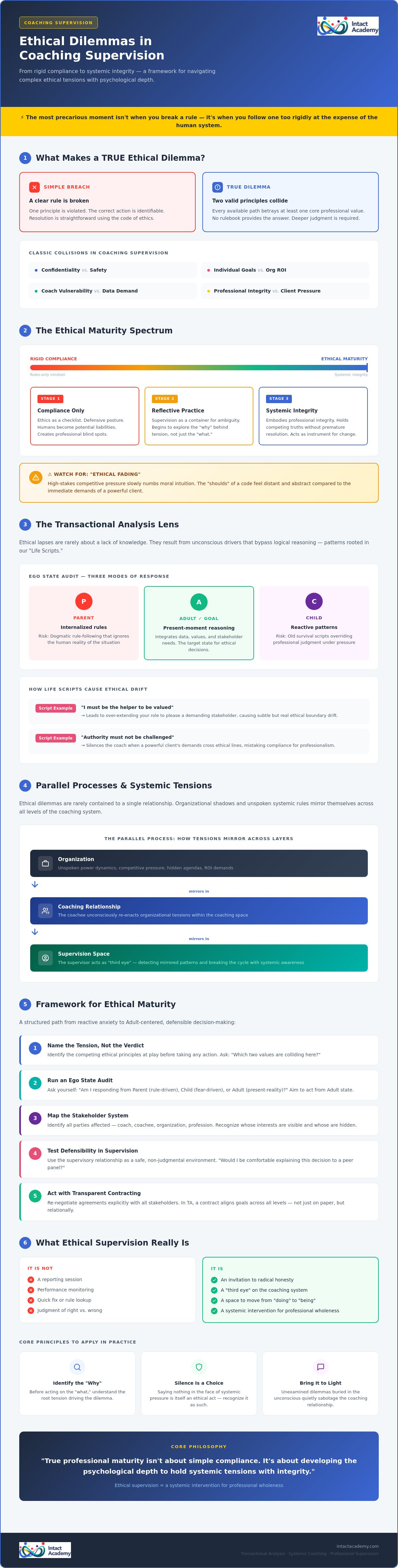
Have you ever felt the cold weight of a decision where every available path seemed to betray a core professional value? This is the essence of a true dilemma. Unlike a simple breach of conduct, an ethical dilemma represents a collision between two or more valid ethical principles. It is the friction between confidentiality and safety, or the tension between individual coaching goals and organizational ROI. In these moments, ethical dilemmas in coaching supervision function as signals, inviting us to look beneath the surface of our practice.
Relying solely on a "compliance-only" mindset often leads to a dangerous professional rigidity. When we treat ethics as a checklist, we inadvertently create blind spots. We stop seeing the human being in front of us and start seeing a potential liability. This defensive posture limits our effectiveness and prevents the deep, transformative work that executive coaching demands. True growth requires a transition toward "Ethical Maturity," a developmental journey where a coach moves from following rules to embodying professional integrity. Supervision serves as the stable container necessary to hold this ambiguity without rushing to a premature or shallow resolution.
The Limitations of Professional Codes of Ethics
While the ICF or EMCC Global Code of Ethics provide vital scaffolding, they are frameworks rather than exhaustive rulebooks. They cannot account for every nuance of a high-pressure corporate environment. Professional ethics in a systemic context often involve a delicate "duty of care" that stretches across multiple stakeholders. You might face "ethical fading," a psychological phenomenon where the competitive pressure of a high-stakes contract slowly numbs your moral intuition. In these instances, the "shoulds" of a code can feel distant and abstract compared to the immediate demands of a powerful client.
Supervision as a Space for Radical Honesty
Supervision is not a reporting session; it's an invitation to radical honesty. It allows you to step out of the "doing" and into the "being," offering a reflective space where the supervisor acts as a "third eye" on the coaching system. This external perspective helps you identify where your own needs or fears might be distorting your ethical judgment. By bringing ethical dilemmas in coaching supervision into the light, we ensure they don't remain buried in the unconscious, where they can quietly sabotage the coaching relationship. We define ethical supervision as a systemic intervention for professional wholeness, ensuring that the coach remains a clear and effective instrument for change.
- Identify the "why" behind the tension before acting on the "what."
- Recognize that silence in the face of systemic pressure is often an ethical choice in itself.
- Use the supervisory relationship to test the defensibility of your decisions in a safe, non-judgmental environment.
The Transactional Analysis Lens: Mapping Unconscious Drivers in Ethical Conflict
To understand why we falter at the edges of our professional boundaries, we must look beyond the surface of the conflict. Transactional Analysis (TA) offers a precise map for diagnosing the "why" behind the tension. By exploring what is transactional analysis in a systemic context, we see that ethical lapses are rarely about a lack of knowledge. Instead, they are often the result of unconscious drivers that bypass our logical reasoning. When ethical dilemmas in coaching supervision arise, they frequently signal a moment where our professional persona has been eclipsed by an older, more reactive part of the self.
Our "Life Scripts"—the unconscious plans we created in childhood to survive and flourish—exert a silent influence on how we respond to authority and conflict today. If your script dictates that you must be "the helper" to be valued, you may find yourself over-extending your role to please a demanding stakeholder. This internal pressure can lead to subtle ethical drift. Professional integrity begins with the clarity of "Contracting." In TA, a contract is not just a legal document; it's a multi-layered agreement that aligns the goals of the coach, the client, and the organization. A robust contract serves as the primary tool for preventing the psychological "blurring" that leads to boundary violations.
Ego States and the Ethical "Hook"
Ethical risks often emerge when we move out of our "Adult" ego state. A coach operating from an "Adapted Child" state might feel silenced by a powerful executive, finding it impossible to challenge behavior that contradicts the coaching agreement. Conversely, the "Parent" ego state can lead to "rescuing" behaviors, where the coach takes over-responsibility for the client's success. This shift creates a framework for ethical maturity that requires constant self-observation. Maintaining an Adult-to-Adult contract is the only way to ensure the coaching remains a developmental partnership rather than a co-dependent struggle. For those seeking to deepen this level of self-mastery, our TA EMCC Senior Supervisor academy provides the rigorous training needed to hold these ego states in balance.
Psychological Games in the Coaching Room
In the high-stakes environment of corporate coaching, it's easy to get pulled into "Psychological Games." These are repetitive sequences of transactions that end in a predictable "payoff" of negative emotion. The game of "I’m Only Trying to Help" is a classic example where a coach crosses ethical boundaries by offering unsolicited advice or working harder than the client. This dynamic often plays out within the Drama Triangle, where the coach, client, and sponsor rotate through the roles of Persecutor, Rescuer, and Victim.
- The Rescuer: The coach who steps in to "save" the client from organizational pressure, effectively hiding performance issues.
- The Persecutor: The corporate sponsor who uses the coach as a tool for "fixing" or exiting an employee without due process.
- The Victim: The client who uses the coaching space to complain about the system without taking accountability for change.
Imagine a scenario where a HR Director asks you for "informal feedback" on a high-potential leader you are coaching. If you haven't contracted for this transparency, providing that information is an ethical breach. However, if you feel a "pull" to stay in the Director's good graces to secure future work, you've been hooked into a game. Supervision allows you to step back, recognize the payoff you're seeking, and return to a position of systemic integrity.
Parallel Processes and Systemic Tensions: When the Dilemma Is Not Yours Alone
Sometimes the tension you feel in a session isn't yours to carry. It's a reflection of the organizational field itself. In our work, we often encounter "Parallel Process," a phenomenon where the unconscious dynamics of the client's system are mirrored in the relationship between the coach and the supervisor. When ethical dilemmas in coaching supervision occur, they are frequently symptoms of these larger systemic ripples. If a coach feels a sudden, inexplicable urge to withhold information or bypass a boundary, they may be unconsciously enacting the "shadows" or unspoken rules of the company they are working within.
To navigate these turbulent waters, we employ the 7-eyed model of supervision. This framework allows us to move beyond the individual coach-client dyad and look at "Eye 6"—the wider context. By examining how the organizational culture "infects" the coaching relationship, we can distinguish between a personal ethical lapse and a systemic pressure. This is particularly vital in team coaching, where the ethical framework must expand to hold the collective needs of the group alongside the requirements of the corporate sponsor.
The Multi-Client Dilemma in Organizational Systems
One of the most persistent challenges in executive work is the question: "Who is the client?" While the individual leader sits in the chair, the organization pays the invoice. This dual loyalty creates a fertile ground for ethical tension. We advocate for radical transparency through "three-way" or "four-way" contracting sessions at the start of any engagement. Without these clear agreements, a coach can easily be caught in a crossfire between a CEO's strategic vision and an HR Director's developmental agenda. Integrity in this space requires the courage to name these conflicting loyalties before they become professional traps.
Detecting Systemic Mirroring
A skilled supervisor can often "feel" the client's organization during a session. This occurs through projective identification, where the coach unknowingly takes on the feelings or behaviors that the client cannot process. If a coach describes feeling "paralyzed" by a decision, it's often because the organization itself is in a state of paralysis. Recognizing this mirroring is the first step toward resolving the dilemma. To help you discern the source of your tension, consider this brief systemic audit:
- Is it Personal? Does this dilemma trigger a specific part of my Life Script or a past professional trauma?
- Is it Professional? Is there a clear directive in the EMCC or ICF code that I am struggling to apply?
- Is it Systemic? Am I feeling a pressure that matches the "unspoken rules" or culture of the client's company?
By identifying the origin of the conflict, you can move from a state of reactive anxiety to one of Adult-centered clarity. You aren't just a rule-follower; you're a systemic guardian, ensuring that the work remains a vehicle for genuine transformation rather than a reflection of organizational dysfunction.
A Framework for Ethical Maturity: From Compliance to Systemic Integrity
When you move beyond simple rule-following, you enter the territory of ethical maturity. This isn't a destination but a continuous developmental process. To resolve ethical dilemmas in coaching supervision, we need a methodology that honors the complexity of the human and organizational systems involved. We propose a five-step framework designed to move you from reactive anxiety to Adult-centered clarity.
- Step 1: Name the tension. Identify the specific clash between the internal "should" and the external "is." What ethical principle feels at risk? Naming the friction is the first act of integrity.
- Step 2: Ego State Audit. Use Transactional Analysis to look inward. Are you responding from a Controlling Parent seeking to enforce a rule, or perhaps an Adapted Child trying to avoid conflict? A return to the Adult ego state allows for objective observation.
- Step 3: Stakeholder Mapping. Visualize the "unseen actors" in the room. This includes the sponsor, the HR department, and even the ghosts of past organizational failures. Who else has a stake in this decision?
- Step 4: Systemic Inquiry. Ask what this dilemma is trying to tell us about the organization. Often, the coach is being asked to carry a secret or a burden that the system itself cannot face.
- Step 5: Provisional Action. Determine the most "OK-OK" way forward. This action must respect the dignity and autonomy of all parties while maintaining professional boundaries.
Navigating the "Grey Zones" of 2026
The landscape of 2026 brings new challenges that existing codes are only beginning to address. We see a rise in complex questions regarding AI in coaching, particularly around data privacy and the transparency of algorithmic interventions. Additionally, coaching in a world of "permanent crisis" requires us to hold space for climate anxiety and systemic instability without losing our professional footing. Ethical maturity demands the capacity to stay with the trouble, resisting the urge to resolve the tension prematurely through a shallow, rule-based response. It's about maintaining your presence in the face of the unknown.
The Role of the EMCC Senior Supervisor
Handling these multi-layered frameworks requires a high level of professional mastery. This is why advanced accreditation, such as the TA EMCC Senior Supervisor academy, is vital. A Senior Supervisor doesn't just provide answers; they act as a guardian for the profession at large, ensuring that ethical dilemmas in coaching supervision are treated as opportunities for systemic clearing. As you weigh your next decision, ask yourself: "Does this choice move me closer to or further from wholeness?" If you're ready to deepen your ethical capacity, join our next academy cohort to master these systemic tools.
Cultivating Wholeness: Professional Supervision at Intact Academy
At Intact Academy, we believe that professional mastery is not merely the accumulation of skills, but a journey toward wholeness. Our core philosophy centers on returning to a state of completeness and genuineness, where the practitioner is no longer fragmented by the pressures of the corporate system. When you face ethical dilemmas in coaching supervision, you aren't just looking for a technical solution; you're seeking to realign with your own integrity. Our approach provides the methodology to do exactly that, blending the precision of Transactional Analysis with the expansive lens of systemic theory.
Led by Sari van Poelje, a global expert in systemic change, the Academy serves as a bridge between profound psychological insight and organizational reality. Sari’s personal insights and proprietary frameworks permeate our curriculum, ensuring that the work remains grounded in decades of experience across diverse cultures and industries. We provide a stable container for the often-turbulent work of change, allowing you to process complex systemic issues through structured methodology and deep reflection.
Our Supervision Academies
The TA EMCC Senior Supervisor academy stands apart by focusing on the intersection of human behavior and business strategy. It isn't just for those who wish to supervise; it's for organizational consultants and team coaches who recognize that systemic supervision is the ultimate tool for navigating ethical dilemmas in coaching supervision. Our training is designed for a sophisticated global audience, offering programs both online and in-person in Utrecht. We help you move beyond surface-level training into a space where the connection between individual growth and organizational success is clearly mapped and actionable.
Join a Global Community of Mastery
Transformation is rarely a solitary endeavor. Our academies foster a rich community of practice where peer learning is as vital as the theoretical curriculum itself. By investing in your own supervision, you ensure a sustainable transformation that radiates outward to your clients and their organizations. This commitment to depth is what distinguishes a transactional provider from a transformative mentor. It's a choice to value integrity, depth, and the courage to change. We invite you to explore our upcoming TA EMCC Senior Supervisor Academy and Masterclasses and begin your own return to professional completeness.
- Engage with EMCC and ICF accredited programs that set the global standard for excellence.
- Develop the psychological depth to hold systemic tensions with quiet power and empathy.
- Join a network of global citizens committed to flourishing at the intersection of business and behavior.
Advancing Toward Systemic Integrity and Professional Wholeness
Moving from the safety of a code to the complexity of a system is the hallmark of a mature practitioner. We've explored how ethical dilemmas in coaching supervision aren't merely problems to be solved; they are systemic signals to be decoded through Transactional Analysis and reflective inquiry. By recognizing parallel processes and auditing our own ego states, we transform tension into a catalyst for profound human and organizational evolution.
This journey toward wholeness requires a community of peers and mentors who honor the depth of your work. As an EMCC Global Quality Award (EQA) provider, Intact Academy offers a global faculty of Transactional Analysis experts dedicated to your growth. Our programs are specifically designed for those at the Senior Practitioner and Master levels who seek to lead with quiet power and unwavering integrity.
Deepen your systemic impact at the TA EMCC Senior Supervisor Academy and step into a space where your professional maturity can truly flourish. The courage to look inward is the first step toward changing the systems around you.
Frequently Asked Questions
What is the most common ethical dilemma in coaching supervision?
The most frequent challenge involves conflicting loyalties between the individual coachee and the organizational sponsor. This often manifests as a tension between the coachee's right to confidentiality and the sponsor's demand for progress data or performance insights. It's a systemic friction where the coach feels pulled between two valid sets of expectations, requiring precise contracting to manage these complex grey areas with professional integrity.
How does Transactional Analysis help in resolving ethical conflicts?
Transactional Analysis (TA) identifies the unconscious ego states and psychological games that drive professional drift. By mapping whether a practitioner is responding from a "Parent" state of over-responsibility or an "Adapted Child" state of conflict avoidance, TA allows for a return to Adult-to-Adult clarity. This depth helps diagnose ethical dilemmas in coaching supervision by addressing the internal drivers rather than just the external rules.
Why should a senior coach still have a supervisor for ethics?
Senior practitioners are often more susceptible to "ethical fading," where long-term familiarity with corporate systems numbs their moral intuition. Supervision provides a vital "third eye" to uncover blind spots that years of experience might otherwise obscure. Even at the Master level, a supervisor acts as a guardian for professional wholeness, ensuring the coach remains a clear instrument for change rather than becoming absorbed by organizational shadows.
What is the difference between an ethical dilemma and a boundary violation?
An ethical dilemma is a conflict between two valid but competing professional principles where no single "right" answer exists in the code. A boundary violation, however, is a direct breach of established standards, such as a conflict of interest or a breach of confidentiality. While violations require immediate corrective action, dilemmas require deep reflective practice to navigate the nuanced layers of systemic integrity and stakeholder interests.
How do I bring an ethical dilemma to my supervision session?
Start by naming the specific internal "should" that is clashing with the external "is" in your current practice. Describe the physical or emotional tension you feel, as this often points toward the systemic origin of the conflict. Presenting the case through an audit of your own ego states and the "unseen" stakeholders involved allows the supervisor to help you map the systemic forces rather than simply seeking a checklist solution.
Can a supervisor report a coach for an ethical breach?
A supervisor has a professional duty of care that may include reporting a serious breach if the coach refuses to take corrective action. However, the supervisory space is primarily a stable container for growth and radical honesty. Reporting is a last resort, typically reserved for situations involving significant harm or illegal activity. Most ethical dilemmas in coaching supervision are resolved through dialogue and the development of systemic maturity.
What is the role of the "Parallel Process" in ethical decision-making?
Parallel Process occurs when the unconscious dynamics of the client's organization are mirrored within the supervision session itself. If you feel an inexplicable pressure to "rescue" or "fix" during supervision, it often reflects the organizational culture of the client system. Recognizing this mirroring is essential for ethical clarity, as it helps you distinguish between your own professional struggle and the systemic pressure "infecting" the coaching relationship.
How do I handle ethical dilemmas in team coaching vs. individual coaching?
Team coaching requires an expanded framework to manage the collective needs of a group alongside the corporate sponsor's agenda. Unlike individual work, where the focus is a single dyad, team interventions involve navigating complex sub-groups and unspoken systemic rules. Ethical maturity in this context means being radically transparent about multi-way contracting and maintaining a perspective that honors the health of the entire team system over any single individual's interests.


