

Why do the most meticulously planned corporate restructures often collapse under the weight of irrational resistance and repetitive cultural inertia? It is a common struggle; research indicates that 70% of change initiatives fail to achieve their goals, often because the human element remains unaddressed. Utilizing transactional analysis for organizational change offers a way to look beneath the surface of these systemic frustrations to find the hidden psychological scripts that truly drive behavior.
You have likely felt the exhaustion of leading a team that seems stuck in a Parent-Child dynamic, where every strategic directive is met with a quiet but firm refusal to evolve. It is grounding to realize that this resistance is rarely a lack of intelligence; instead, it is often a protective mechanism of the organizational system. This article promises to provide you with the tools to map these unconscious patterns and shift your leadership culture toward a more mature, Adult-Adult state. We will explore the framework of ego states, the power of script analysis, and a structured methodology for achieving sustainable, systemic transformation that honors the wholeness of every individual involved.
Key Takeaways
- Distinguish between surface-level process shifts and the deep psychological scripts that determine whether a change initiative truly takes root.
- Master the architecture of interaction by utilizing transactional analysis for organizational change to foster Adult-Adult dynamics within your leadership teams.
- Uncover the "Organizational Script," identifying how historical founder myths and early successes continue to shape the unconscious life of your culture today.
- Learn to recognize and interrupt the "Drama Triangle" and repetitive workplace games that perpetuate resistance and drain systemic energy.
- Explore the path toward becoming a systemic change agent, moving beyond surface-level interventions toward the profound professional wholeness offered by specialized academies.
Beyond Surface-Level Shifts: Why Organizational Change Requires Psychological Depth
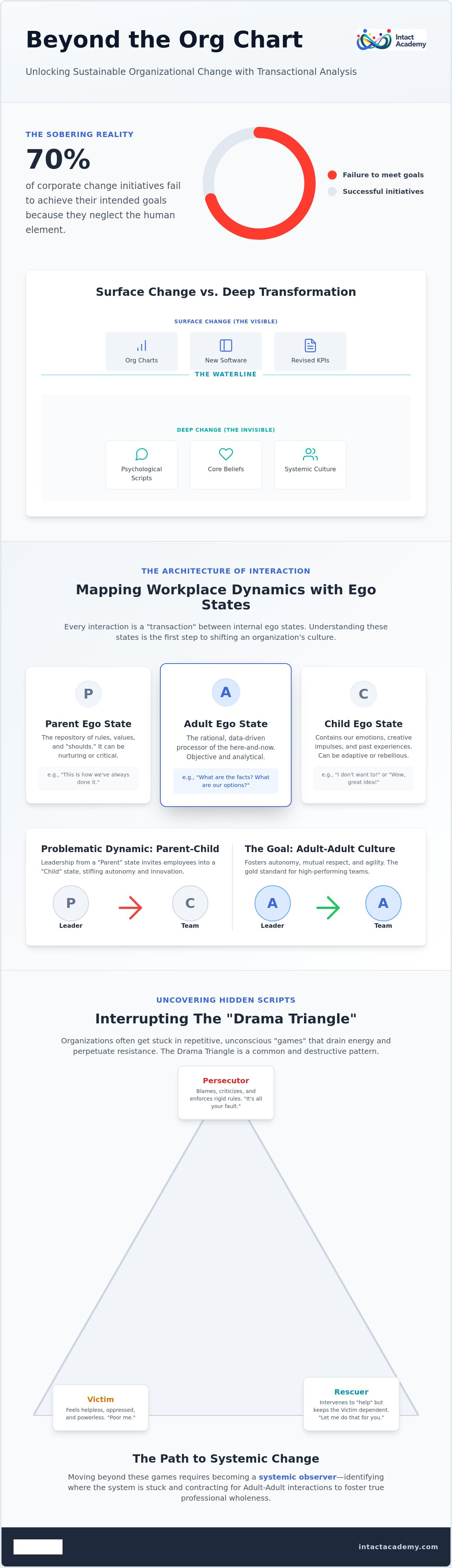
Most change efforts focus on the visible: the org charts, the software, and the revised KPIs. Yet, these are merely the surface. True transformation requires a profound understanding of the invisible undercurrents that dictate how people actually work together. Transactional analysis serves as a robust social psychology that illuminates these depths. It provides a framework for organizational health by examining how individuals communicate and how those communications aggregate into a systemic culture.
When we contrast "surface change" with "deep change", we see the difference between changing a tool and changing a belief. A process change might tell people what to do, but it doesn't address the underlying script that tells them why they do it. Using transactional analysis for organizational change means looking at the whole system rather than just its constituent parts. It's the recognition that the whole is always greater than the sum of its parts; a change in one area inevitably ripples through the entire organism. This systemic view shifts the focus from fixing individuals to understanding the relationships that define the system.
The Limits of Traditional Change Management
Statistics consistently show that approximately 70% of change initiatives fail to meet their intended goals. This happens because traditional models often treat organizations like rational machines. They assume that if you provide a logical reason for change, people will follow. This ignores the "human element," the emotional and psychological realities that drive resistance. By leading organizational change through a psychological lens, we acknowledge that people aren't just cogs. They're individuals with complex internal worlds who respond to change based on their perceived safety and autonomy.
The Systemic TA Perspective
To understand a system, one must view it as a living organism with its own unique history and lineage. TA provides the map for these unconscious undercurrents of culture. If you've ever wondered what is transactional analysis in a professional context, think of it as a tool for the "systemic observer." The change agent's role isn't just to direct action. Instead, they must observe the patterns of interaction to identify where the system is stuck. This allows for transactional analysis for organizational change to move beyond surface-level symptoms and address the core dynamics that either foster or inhibit sustainable growth. It's a move from mere management to true systemic mastery.
The Architecture of Interaction: Ego States and Transactions in the Workplace
To understand the systemic health of an organization, we must first look at the invisible architecture of its daily interactions. Every email, every board meeting, and every water-cooler chat is composed of "transactions" between internal ego states. In a professional setting, these states function as distinct systems of thought and feeling. The Parent ego state acts as the repository of rules and "shoulds," the Adult functions as the data-driven processor of the here-and-now, and the Child contains the emotional responses and creative impulses of our past. When we apply transactional analysis for organizational change, our goal is to move toward an Adult-Adult culture.
This dynamic is the gold standard for high-performing teams because it fosters autonomy and mutual respect. Building An 'Adult' Workplace Environment is not merely a management preference; it's a systemic necessity for agility. When leadership habitually operates from a "Parent" state, they inadvertently invite employees into a "Child" state of dependency or rebellion, stifling the very innovation they claim to seek. This creates a cycle of "Complementary" transactions that, while predictable, are often stagnant. To break this, we must learn to identify and shift these underlying patterns.
Recognizing Ego States in Leadership
Leadership styles often mirror Parent ego states. A "Controlling Parent" leader may micro-manage through criticism, while a "Nurturing Parent" leader might "rescue" teams by over-protecting them from accountability. Both styles, though different in tone, prevent employees from stepping into their own Adult capacity. In times of crisis, you might notice "Adapted Child" behavior in resistant teams, characterized by over-compliance that masks a hidden resentment. To invite the Adult state in stakeholders, leaders must provide clear data and ask reflective questions that require objective analysis rather than emotional reaction.
Productive vs. Non-Productive Transactions
The cost of "ulterior transactions" in a change initiative is staggering. These are interactions where the real message is hidden beneath the surface, such as a manager agreeing to a strategy shift while signaling skepticism through sarcasm. This duality creates systemic confusion. To resolve this, you can use the technique of "crossing" a transaction. If a colleague speaks to you from a place of "Critical Parent," don't respond from "Child." Instead, stay in "Adult." By refusing to engage in the expected pattern, you invite them to return to a rational, productive space. You can begin this journey of systemic mastery by exploring how these PAC dynamics shape your current culture.
Uncovering the Organizational Script: Mapping the Unconscious Patterns of Culture
Every organization operates according to a hidden blueprint. While the board might focus on the official five-year plan, there is often a more powerful, unconscious narrative running beneath the surface. In the study of transactional analysis for organizational change, we call this the "Organizational Script." It is the collective life plan of the company, often written during its founding years and reinforced by every subsequent success or failure. This script dictates what is possible, what is forbidden, and ultimately, whether the system is destined to flourish or stagnate.
Founder myths are the primary architects of this DNA. If a company was born from a "rebel" spirit that defied industry norms, it may unconsciously sabotage its own attempts at professionalization decades later. The "Life Scripts" of key leaders also play a critical role. When an executive's personal script for success aligns with the organizational script, the system feels harmonious. However, if a leader carries a script of "never enough," the organization may find itself in a perpetual state of burnout, regardless of its actual market position. Recognizing these patterns is the first step toward reclaiming systemic agency.
A "losing script" is often visible in firms that experience repetitive failures despite having the right resources. You might see a company that consistently hires brilliant talent only to see them leave within eighteen months. This is rarely a coincidence. It is often the result of an unconscious systemic plan that prioritizes safety or tradition over the very growth it claims to want. By utilizing transactional analysis for organizational change, we can bring these scripts into the light, transforming them from invisible shackles into conscious choices.
Diagnosing Cultural Narratives
To uncover the hidden rules of your culture, you must ask reflective questions. What happens to the "whistleblowers" in this system? What is the unspoken penalty for a mistake? These inquiries often reveal "don't" injunctions, such as "Don't be successful" or "Don't be different." These injunctions act as psychological brakes on transformation. Organizational trauma, such as a previous hostile takeover or a massive layoff, can also bake "Don't Trust" into the corporate DNA, making future change efforts feel threatening to the system's survival.
Rewriting the Script for Future Success
Moving from a "Defensive Script" to a "Growth Script" requires more than a new mission statement. It requires the leader to act as a permission-giver. The system needs permission to succeed in new ways, to let go of the founder's shadow, and to evolve beyond its historical limitations. Sari van Poelje uses script analysis to facilitate systemic organizational change by helping leaders identify where their past narratives are blocking their future potential. This process isn't about erasing history; it's about integrating it so the organization can move toward professional wholeness with clarity and intent.
Practical Interventions: Breaking Psychological Games and Contracting for Success
Transformation often stalls not because the strategy is flawed, but because the system is caught in repetitive, non-productive patterns. In the study of transactional analysis for organizational change, these patterns are identified as "Psychological Games." These are not merely annoying habits. They are structured sequences of transactions that lead to a predictable, negative payoff, reinforcing an individual's or a team's limiting script. By recognizing these games, a change agent can move from being a reactive participant to a systemic observer who restores professional flow.
The "Drama Triangle" is perhaps the most pervasive framework for understanding these dynamics. In this triangle, stakeholders rotate through three roles: the Persecutor, who blames others for failure; the Rescuer, who offers help that disempowers; and the Victim, who feels overwhelmed and incapable. During a corporate restructure, leaders often fall into the "Rescuer" trap. By taking over responsibility for their employees' adaptation, they inadvertently treat them as "Victims." This prevents the team from moving into an Adult state of accountability, leading to systemic failure and emotional burnout for the leader. True transformation requires breaking this cycle and returning to a state of professional wholeness.
Identifying and Stopping Workplace Games
To stop a game, you must first understand its payoff. For example, in the game of "Yes, But," a team member asks for advice only to reject every suggestion offered. The payoff isn't a solution; it's the hidden satisfaction of proving that the "Parent" figure cannot help them. You can step out of this triangle by using your Adult state to name the dynamic without shaming the individual. Instead of offering more advice, try a reflective inquiry: "I notice that every solution we've discussed has a significant barrier. What would it take for you to feel empowered to solve this?" This shift crosses the transaction and invites the other person back into a rational, problem-solving space.
The Power of the Multi-Cornered Contract
The primary TA tool for maintaining clarity is "Contracting." This goes far beyond a legal document. A robust contract for change operates on three distinct levels: administrative (time and fees), professional (tasks and goals), and psychological (unspoken expectations and fears). In complex systems, we use a multi-cornered contract to ensure alignment between the Sponsor, the Change Agent, and the Target of the change. This clarity prevents scope creep and ensures that everyone is working toward the same outcome with full transparency. To deepen your ability to navigate these complex human systems, consider exploring our organizational change programs designed for systemic mastery.
Mastering Systemic Change: Professional Training with Intact Academy
The transition from a transactional coach to a systemic change agent represents a profound evolution in professional identity. It's a journey that moves beyond the simple acquisition of tools toward the cultivation of a specific way of being. When you employ transactional analysis for organizational change, you aren't just applying a methodology; you're stepping into a role that requires deep psychological insight and systemic awareness. This mastery allows you to hold the complexity of an entire organization while remaining grounded in your own Adult state, even when the system around you is in flux.
Central to this development is the TA EMCC Senior Practitioner Academy. This program isn't a mere collection of modules. It's a transformative experience that has shaped change makers from over 14 countries, creating a global community of practitioners who value depth over speed. Here, the focus remains on professional wholeness, ensuring that as you learn to map the scripts of others, you also gain clarity on your own. Systemic supervision acts as the vital anchor in this process. It provides the reflective space necessary to maintain neutrality and potency when navigating the often-turbulent waters of corporate restructuring.
The Intact Academy Approach to Wholeness
Our methodology blends rigorous psychological depth with practical, professional pragmatism. By pursuing an executive coaching certification through this systemic lens, you learn to see the invisible threads that bind a culture together. The academy is led by Sari van Poelje, whose decades of experience in global systemic change provide a bridge between complex theory and executive reality. Applications are now being accepted for the 2026 intake, offering a rare opportunity to join a global cohort dedicated to profound human and organizational flourishing.
Why Accreditation Matters for Change Consultants
In a global market often saturated with surface-level training, the value of recognized accreditation cannot be overstated. Our programs carry the weight of recognition from the EMCC, ICF, and EATA. This ensures your expertise is grounded in international standards of excellence, providing a sense of safety and reliability to the organizations you serve. Moving beyond "weekend workshops" allows for the deep-dive professional development required to handle high-stakes conflicts and entrenched cultural scripts. If you're ready to move from transactional interventions to true systemic impact, the path of transactional analysis for organizational change offers the stability and insight you need to lead others toward their own state of completeness. For those seeking high-impact professional growth through specialized academy memberships and mastery series, click here.
Embracing the Path to Systemic Mastery
True transformation isn't found in a new set of rules or a revised org chart. Instead, it's found in the courage to look beneath the surface. By understanding the architecture of ego states and the hidden scripts that govern cultural behavior, you can move your organization from repetitive resistance toward authentic growth. Utilizing transactional analysis for organizational change allows you to navigate these human complexities with precision and empathy. It ensures that every shift you lead is both sustainable and deeply resonant with the people involved. To further support this evolution, Culture Of Belonging Global INC. provides a framework for building a culture where every individual feels recognized and valued.
If you're ready to evolve from a transactional practitioner into a systemic change agent, we invite you to join our global community. Led by Sari van Poelje, our programs provide EMCC Senior Practitioner Level Accreditation and connect you with experienced peers from over 14 countries. This is your opportunity to move beyond surface-level coaching and achieve professional wholeness. Explore our TA EMCC Senior Practitioner Academy and begin your journey today. The capacity for profound change is already within your system; it only requires the right map to uncover it.
Frequently Asked Questions
What is Transactional Analysis (TA) in an organizational context?
In an organizational context, TA is a social psychology used to understand the invisible undercurrents of communication and culture. It provides a structured methodology to analyze how individuals interact and how these interactions shape the systemic health of the whole. By focusing on the "transactions" between people, it allows leaders to identify where energy is blocked and how to restore a state of professional wholeness across the system.
How does TA differ from traditional change management models like Kotter or ADKAR?
While models like Kotter or ADKAR focus on the linear stages of process and adoption, TA addresses the psychological depth of human systems. Traditional models are often mechanical, treating people as rational actors. TA recognizes that 70% of change efforts fail due to the "human element." It provides a map for the unconscious scripts and ego states that either support or sabotage even the most logical strategic directives.
Can TA help reduce active resistance to change in teams?
Yes, utilizing transactional analysis for organizational change directly addresses the root causes of resistance. Resistance is often a protective mechanism of the organizational script or an "Adapted Child" response to "Parenting" leadership. By recognizing these patterns and shifting to Adult-Adult transactions, leaders can invite teams into a space of autonomy and accountability. This reduces the friction caused by hidden psychological "don't" injunctions that often block progress.
What are "Ego States" and why do they matter for leaders?
Ego states are coherent systems of thought and feeling categorized as Parent, Adult, and Child. For leaders, these matter because they dictate the quality of every workplace interaction. If a leader habitually operates from a "Critical Parent" state, they inadvertently force their team into a "Child" state of dependency or rebellion. Mastering these states allows a leader to remain in an objective "Adult" stance, fostering a culture of mutual respect and high performance.
How can I identify an "Organizational Script" in my company?
Identifying an organizational script requires looking at the repetitive patterns and founder myths that define your company's life plan. You can start by asking what the unspoken rules are for success and failure. If your company consistently experiences the same types of setbacks despite different strategies, you're likely seeing a script in action. These unconscious blueprints are often baked into the corporate DNA during the company's earliest successes or traumas.
What is the "Drama Triangle" and how does it affect workplace productivity?
The Drama Triangle consists of three psychological roles: Persecutor, Rescuer, and Victim. It affects productivity by trapping teams in repetitive "games" that drain emotional energy and distract from professional goals. When a manager "rescues" a team member, they prevent that individual from taking responsibility. This cycle creates systemic dependency and resentment, which ultimately stalls innovation and leads to the burnout often seen in stagnant or declining organizations.
Is Transactional Analysis training suitable for C-suite executives?
TA training is exceptionally well-suited for C-suite executives who must navigate high-stakes conflicts and systemic complexity. It moves beyond surface-level business coaching into the realm of profound human transformation and professional wholeness. For top-tier leaders, transactional analysis for organizational change provides the tools to manage their own ego states while observing the broader systemic scripts. This allows for more grounded, authoritative leadership in an increasingly volatile global business environment.
How long does it take to see results from a TA-based intervention?
The timeline for results varies depending on the depth of the intervention. You can often see immediate shifts in communication quality by simply "crossing" a non-productive transaction or moving into an Adult state during a meeting. However, rewriting an entire organizational script or shifting a long-standing culture is a more deliberate process. It requires steady, methodical work over several months to ensure that behavioral changes take root throughout the entire human system.


