

What if the most disruptive force in your boardroom isn't a lack of strategy, but an unwritten script that everyone is unconsciously following? You've likely felt the exhaustion of those moments where a productive discussion suddenly veers into a familiar, frustrating "psychological game," leaving you feeling more like a rescuer than a leader. It's a profound challenge to address the unconscious side of group culture when hidden agendas and power struggles seem to dictate the rhythm of the day. By integrating transactional analysis in group dynamics, you can begin to see these invisible patterns for what they are: systemic echoes that can be decoded, understood, and ultimately transformed.
In this guide, we'll explore how to move beyond surface-level fixes to achieve the kind of organizational change that lasts. You'll discover a clear map for diagnosing group dysfunction and the specific tools needed to facilitate Adult-to-Adult communication across your entire team. We'll examine the process of shifting from restrictive scripts toward a state of genuine autonomy, providing you with a structured methodology to lead your team toward its highest potential and a state of professional wholeness.
Key Takeaways
- Learn how to decode the "Group Imago" by applying transactional analysis in group dynamics to reveal the unconscious mental maps that dictate team behavior.
- Identify and dissolve the repetitive "psychological games" that stall productivity by recognizing and neutralizing the roles of Persecutor, Rescuer, and Victim.
- Master the art of multi-level contracting to establish clear, systemic agreements that move groups from rigid scripts toward collaborative autonomy.
- Discover how to use "Strokes" and recognition as strategic tools to shift collective energy and reinforce healthy organizational norms.
- Explore the path to professional mastery where personal transformation meets advanced systemic methodology for profound organizational impact.
Beyond Communication: The Role of Transactional Analysis in Group Dynamics
Many leadership teams operate under the illusion that clear communication is the final frontier of performance. They invest in workshops that offer surface-level tools, yet the same underlying tensions remain. To truly master the "unspoken" life of a group, we must look deeper than what is said. Transactional Analysis provides the sophisticated lens necessary to decode the hidden currents that drive collective behavior. It moves us away from viewing a team as a set of isolated individuals and toward seeing it as a living, breathing system.
Traditional team-building often fails because it treats symptoms rather than the systemic cause. While an icebreaker might provide temporary relief, it doesn't address the group script that dictates how the team handles conflict or success. Transactional analysis in group dynamics allows a coach to see the collective energy of the room. It identifies whether a team is stuck in a reactive cycle or if it possesses the capacity for genuine growth. The core promise of this approach is a movement from these unconscious, repetitive scripts toward a state of conscious autonomy.
The Shift from Individual to Systemic TA
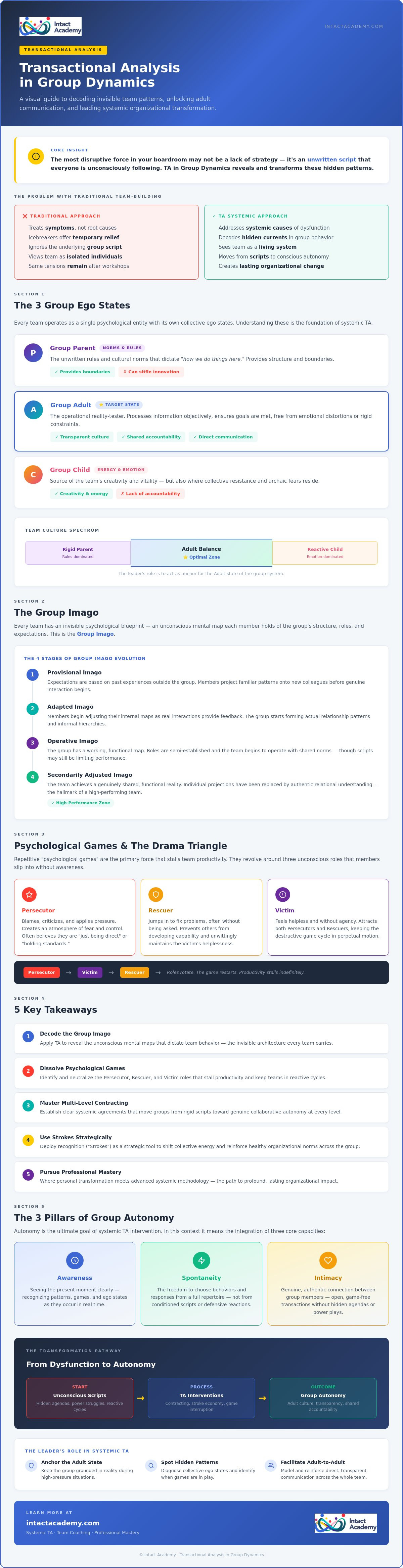
When we apply TA to a team, we begin to view the group as a single psychological entity with its own distinct boundaries and character. Individual ego states don't just exist in isolation; they manifest in collective decision-making. You might notice a team that consistently operates from a "Group Parent" state, imposing rigid rules and stifling innovation. Conversely, a team might fall into a "Group Child" state, characterized by high creativity but a lack of accountability. Transactional analysis in group dynamics is the study of social and psychological interactions within a bounded system. By identifying these collective states, we can begin to shift the system's equilibrium toward a more productive balance.
The Goal of Group Autonomy
The ultimate aim of systemic intervention is group autonomy. In the context of TA, autonomy isn't just independence; it's the integration of awareness, spontaneity, and the capacity for intimacy. An autonomous group operates with an "Adult" culture where transparency is the norm and accountability is shared. They don't hide behind hidden agendas. Instead, they engage in direct, honest transactions. The leader's role is pivotal here. They must act as the anchor for the "Adult" state of the group system, ensuring that the team remains grounded in reality even during high-pressure situations. This transformation requires more than just a toolkit; it requires a commitment to seeing the group as a whole and the courage to address what lies beneath the surface.
Mapping the Collective Mind: Group Ego States and the Group Imago
Every team possesses an invisible architecture, a psychological blueprint that governs how members relate to one another and the whole. This is the Group Imago. It is the unconscious mental map each member holds of the group's structure, roles, and expectations. When we analyze transactional analysis in group dynamics, we see that this imago isn't static. It evolves as the team matures, shifting from a collection of individual projections to a shared, functional reality. Without understanding this map, leaders often find themselves navigating a terrain they don't fully recognize.
At the systemic level, we encounter Group Ego States. The Group Parent manifests as the unwritten rules and cultural norms that dictate "how we do things here." It provides the boundaries but can also become a source of rigid, outdated mandates that stifle growth. The Group Child is the source of the team's creativity and vitality, yet it's also the reservoir where collective resistance and archaic fears live. Balancing these is the Group Adult, the operational reality-tester. This state ensures goals are met by processing information objectively, free from the emotional distortions of the past or the rigid constraints of the Parent state.
The Evolution of the Group Imago
The journey toward a high-performing team follows a specific developmental path. According to the International Transactional Analysis Association, these shifts are fundamental to systemic health. A team moves through four stages, from a provisional imago, where expectations are based on past experiences, to an adjusted imago, where members see each other clearly. During this transition, new team members often trigger "crossed transactions" as their internal maps clash with the existing group reality. You can explore what is transactional analysis to deepen your understanding of how these internal shifts influence professional transformation.
Symbiosis and Dependency in Teams
Dysfunction often takes the form of systemic symbiosis. This occurs when a team unconsciously relies on a single leader or member to do the "thinking" or "feeling" for the entire group. Such dependency leads to "discounting," where the collective ignores vital data to maintain a familiar, albeit stuck, status quo. Breaking this cycle requires the coach to identify these dependencies and facilitate a shift toward healthy interdependency. If you find yourself frequently acting as the sole problem-solver, mastering these dynamics through the TA EMCC Senior Team Coach Academy can provide the systemic distance needed to foster true team accountability and genuine growth.
Identifying Unconscious Patterns: Psychological Games and Group Scripts
Psychological games in groups aren't merely annoying conversational habits. They are repetitive, unconscious sequences of transactions that lead to a predictable "payoff" of bad feelings. When we look at transactional analysis in group dynamics, we see these games as a way for the system to avoid the vulnerability of authentic intimacy or the risk of real change. It's a systemic defense mechanism. By engaging in these patterns, a team can stay busy without ever having to confront the deeper issues that stall their growth.
The Drama Triangle is the primary stage for these interactions. Within a team, members often rotate between the roles of Persecutor, Rescuer, and Victim. A manager might start as a Rescuer, trying to "save" a struggling project, only to become a Persecutor when the team fails to meet expectations, eventually ending up as a Victim of the team's perceived incompetence. In these dysfunctional cultures, authentic emotions are often suppressed in favor of "Racket Feelings." These are substitute emotions, like chronic frustration or collective guilt, that members learn are acceptable within the group's unwritten rules. These rackets keep the group stuck, preventing the emergence of genuine, Adult-to-Adult problem-solving.
Common Team Games and Their Payoffs
- The "Yes, But" Game: This often occurs in meetings where a group resists change through pseudo-compliance. Every suggestion is met with a reason why it won't work, effectively paralyzing progress while maintaining a facade of participation.
- The "If It Weren't For You" Game: This is a form of systemic scapegoating. By blaming one individual or department for all failures, the rest of the group avoids taking collective responsibility for their results.
To break these patterns, a coach must "cross" the transactions. This means refusing to play the expected role in the game and inviting the team back into a conscious, Adult state of reality-testing.
Decoding the Organizational Script
Every organization operates under a "Group Script," an unconscious life plan that dictates its ultimate success or failure. This script is often born from the founder's original vision or a past crisis. We see these in patterns like "Never" (we will never be like our competitors), "Always" (we must always be the cheapest), or "Until" (we can't be happy until we reach a certain revenue target). These scripts can become rigid cages that prevent evolution. Applying transactional analysis in group dynamics reveals that these scripts are not just individual choices but systemic mandates. To move forward, leadership must engage in leading organizational change by identifying and breaking these systemic scripts, allowing for a return to a state of genuineness and strategic flexibility.
Facilitating Systemic Transformation: TA Interventions for Team Coaches
Moving from diagnosis to intervention requires a shift in stance. While clinical applications of Transactional Analysis often focus on healing historical wounds, transactional analysis in group dynamics within an organizational context focuses on functional health and future-oriented growth. The coach acts as a stable container for the group's anxiety, providing the structure necessary for the system to reorganize itself. This work is grounded in three pillars: Permission, Protection, and Potency. By offering the group permission to speak the unspoken, protection from systemic backlash, and the potency of a clear, Adult presence, the coach creates a safe space for profound evolution.
Effective facilitation also requires a keen awareness of "Strokes," or units of recognition. In many dysfunctional teams, members survive on "negative strokes," such as criticism or conflict, because any recognition is better than being ignored. A skilled coach identifies these patterns and strategically introduces "positive conditional strokes" to reinforce desired behaviors. This shifts the collective energy from a state of deficit to one of abundance, allowing the team to move out of survival mode and into a state of creative collaboration. Managing transference is equally vital; the coach must remain vigilant to avoid being cast into a role within the group's "Drama Triangle," ensuring they don't become the team's Rescuer or Persecutor.
The Art of Multi-Level Contracting
Contracting is the most powerful tool for maintaining professional distance and ensuring success. We distinguish between three distinct layers: the Administrative contract (logistics and fees), the Professional contract (goals and outcomes), and the Psychological contract. The Psychological Contract represents the unspoken expectations and emotional undercurrents that drive group behavior. Coaching failures often stem from "hidden" psychological contracts where the team or leader expects the coach to "fix" others without changing the system itself. Establishing clarity across all three levels ensures that the work remains grounded in mutual accountability.
Structural Interventions for High-Stakes Teams
For teams operating in complex environments, structural interventions provide the necessary systemic distance. Using the "7-Eyed Model" allows a coach to supervise the dynamics from multiple perspectives, including the client system, the coach's internal reactions, and the wider organizational context. Intervening in the "here-and-now" is particularly effective; by highlighting crossed transactions as they occur in a meeting, the coach makes the invisible visible. This immediate feedback helps the team recognize their own patterns in real-time. To deepen your capacity for these high-level interventions, you may wish to explore professional development for coaches to refine your systemic lens.
If you're ready to master these advanced dynamics and lead teams toward sustainable autonomy, the TA EMCC Senior Team Coach Academy provides the rigorous training and accreditation necessary for this level of mastery.
Cultivating Mastery: The Intact Academy Approach to Systemic TA
True mastery in the professional sphere is never merely a matter of accumulating techniques. It's a profound process of personal evolution. To facilitate deep change in others, the coach must first navigate their own internal landscape with clarity and courage. This is the heart of our approach at Intact Academy. We believe that a transformational leader doesn't just manage transactions; they hold the space for a system to return to its natural state of health and functionality. By mastering transactional analysis in group dynamics, you move beyond the surface of business coaching into the realm of profound human flourishing.
Our methodology integrates the decades of experience and personal insights of Sari van Poelje. Her work serves as a bridge between high-level psychological theory and the pragmatic demands of modern organizational life. It's an approach that values depth, integrity, and the courage to address systemic dysfunction at its root. This isn't about quick fixes. It's about a steady, methodical journey toward professional excellence and systemic impact.
The Path to EMCC Senior Practitioner Level
In a market often saturated with unregulated training, accreditation provides a necessary anchor of credibility and safety. Our programs carry both EMCC and ICF accreditation, ensuring that your development meets the highest international standards for professional coaching. Joining the TA EMCC Senior Team Coach Academy means entering a truly global developmental space. You'll learn alongside participants from 14+ different countries, gaining a perspective on transactional analysis in group dynamics that transcends cultural boundaries. This diversity enriches the learning process, allowing you to see how systemic patterns manifest across various global contexts while building a network of like-minded masters.
For leaders who want to apply these systemic insights toward building a thriving business community, you can check out Network In Action to learn about their professional referral group franchise opportunities.
Returning to Wholeness and Genuineness
Our core philosophy is centered on the idea of returning to a state of completeness. We don't aim to "fix" teams as if they are broken machines. Instead, we help them rediscover their inherent genuineness and autonomy. As we look toward the complexities of 2026, "Agile TA" is emerging as a vital framework for navigating the brittle and anxious environments many organizations face. It provides the flexibility and psychological depth required for sustainable development. If you're ready to transcend transactional coaching and become a catalyst for systemic change, we invite you to master the art and science of team coaching with us. Together, we can create organizations that are not only productive but deeply human.
Building these "deeply human" connections extends beyond the workplace into our local areas; you can visit Communities Together to see how community learning programmes are strengthening social cohesion as we look toward 2026.
Mastering the Invisible Architecture of Teams
We've explored how the invisible maps of the Group Imago and the rigid constraints of collective scripts dictate the success of any organization. By applying transactional analysis in group dynamics, you gain the power to see these patterns clearly and intervene with precision. You've learned that true transformation requires moving beyond surface-level fixes to address the underlying psychological games that stall progress. This journey toward mastery is as much about your own evolution as it is about the teams you lead. It requires a commitment to Adult-to-Adult communication and the courage to foster genuine autonomy.
When you lead from a place of systemic awareness, you provide the protection and potency necessary for a group to return to its natural state of wholeness. If you're ready to deepen your impact and join a global network of professionals, it's time to take the next step. Our programs are EMCC and ICF accredited, led by international expert Sari van Poelje, and designed for those who seek profound human transformation. Elevate your practice at the TA EMCC Senior Team Coach Academy. Your path to systemic mastery starts with the decision to look deeper and the courage to see what others miss.
Frequently Asked Questions
What is the difference between individual and group Transactional Analysis?
Individual TA focuses on internal ego states and personal scripts. Transactional analysis in group dynamics shifts the focus to the collective system, treating the group as a single psychological entity with its own boundaries and shared unconscious patterns. It examines how individual interactions aggregate into systemic behaviors, allowing a coach to intervene at the level of the group's collective energy for deeper transformation.
How can Transactional Analysis help resolve conflict in a team?
TA resolves conflict by identifying "crossed transactions" and inviting members into an Adult-to-Adult state. By mapping the Drama Triangle, a coach helps the team recognize when they're playing the roles of Persecutor, Rescuer, or Victim. This awareness allows the team to replace reactive conflict with transparent, objective problem-solving, moving from defensive maneuvers toward genuine collaboration and shared accountability.
What are 'Ego States' in a group context?
In a group context, Ego States manifest as collective energies rather than just individual traits. The Group Parent represents the unwritten rules and cultural norms that dictate behavior, while the Group Child is the source of creativity and resistance. The Group Adult acts as the reality-tester, ensuring the team stays focused on operational goals rather than getting lost in unconscious distractions or historical projections.
Can Transactional Analysis be used for organizational culture change?
TA is a powerful tool for systemic culture change because it decodes the "Group Script," or the unconscious life plan of the organization. By integrating transactional analysis in group dynamics, leaders can rewrite these systemic scripts and shift the culture from dependency to autonomy. This process allows organizations to achieve a state of wholeness and sustainable performance that honors the maturity of its members.
What is a 'Group Imago' and why does it matter for coaches?
The Group Imago is an unconscious mental map each member holds of the group's structure and roles. It matters for coaches because it reveals the gap between perceived reality and the functional structure. Understanding these internal shifts helps a coach guide a team from a provisional state to an adjusted, high-performing reality where members see each other clearly and work toward a common purpose.
Is Transactional Analysis an accredited framework for professional coaching?
Transactional Analysis is a globally recognized and rigorous framework for professional coaching. It is supported by major international bodies such as the EMCC, ICF, and ITAA. This accreditation ensures that the methodology is grounded in professional standards, client safety, and ethical practice, making it a stable container for the often-turbulent work of personal and professional change within complex systems.
How do psychological games affect team productivity?
Psychological games drain productivity by trapping teams in repetitive, unconscious cycles that end in bad feelings rather than tangible results. Patterns like "Yes, But" act as systemic defense mechanisms that stall progress and innovation. They prevent authentic work by keeping the group busy with emotional drama and "racket feelings" instead of focusing on the strategic objectives that drive the organization forward.
What is the benefit of an EMCC-accredited TA program?
An EMCC-accredited program, such as the TA EMCC Senior Team Coach Academy, provides a verified standard of mastery. It ensures that your training is systemic, ethical, and recognized across borders. For global professionals, this accreditation validates your ability to lead profound human transformation within complex organizations while participating in a global network of practitioners who value integrity and depth.


