

What if the most influential person in your coaching session isn't actually in the room? You likely recognize that subtle frustration when a client remains trapped in repetitive patterns, or when the invisible weight of an organizational culture pulls them back into old scripts. It's difficult to navigate complex, multi-stakeholder contracts when you're only seeing the individual's perspective. This feeling of being stuck is often a signal that you're missing the wider field. Through the practice of systemic supervision, you'll learn to map these unseen dynamics, transforming your work from a simple dialogue into a profound exploration of organizational systems.
You know that true professional mastery requires a blend of psychological depth and practical methodology. In this masterclass, we'll examine how to decode parallel processes and address the cultural scripts that cause 70% of organizational change initiatives to fail. We'll provide the tools you need to handle complex dynamics with a sense of quiet power and clarity. This journey not only sharpens your clinical insight but also prepares you for the rigorous standards of EMCC or ICF accreditation. It's time to move beyond surface-level interventions and embrace the art of systemic mastery.
Key Takeaways
- Discover how to look beyond the coach-client dyad to perceive the invisible organizational field that influences every professional interaction.
- Master the 7-Eyed Model as a structured framework for navigating the complex interplay between internal psychology and external systemic dynamics.
- Transition from linear problem-solving to systemic supervision, allowing you to identify what an organization is attempting to resolve through the coaching relationship.
- Integrate Transactional Analysis and systemic mapping to reveal the hidden scripts and patterns that dictate client outcomes and organizational culture.
- Prepare for EMCC Senior Supervisor accreditation by aligning your practice with advanced methodologies that honor both human depth and professional pragmatism.
What is Systemic Supervision? Beyond the Coach-Client Dyad
In traditional developmental models, the focus remains tightly fixed on the coach and the client. We look at the coach's competence, the client's goals, and the immediate interaction between them. Systemic supervision invites a radical expansion of this view. It's the practice of holding the client, the coach, and the wider organizational system in a single, unified awareness. While many practitioners are familiar with the foundations of Clinical Supervision, the systemic approach moves beyond individual skill to explore the invisible threads of the organizational field.
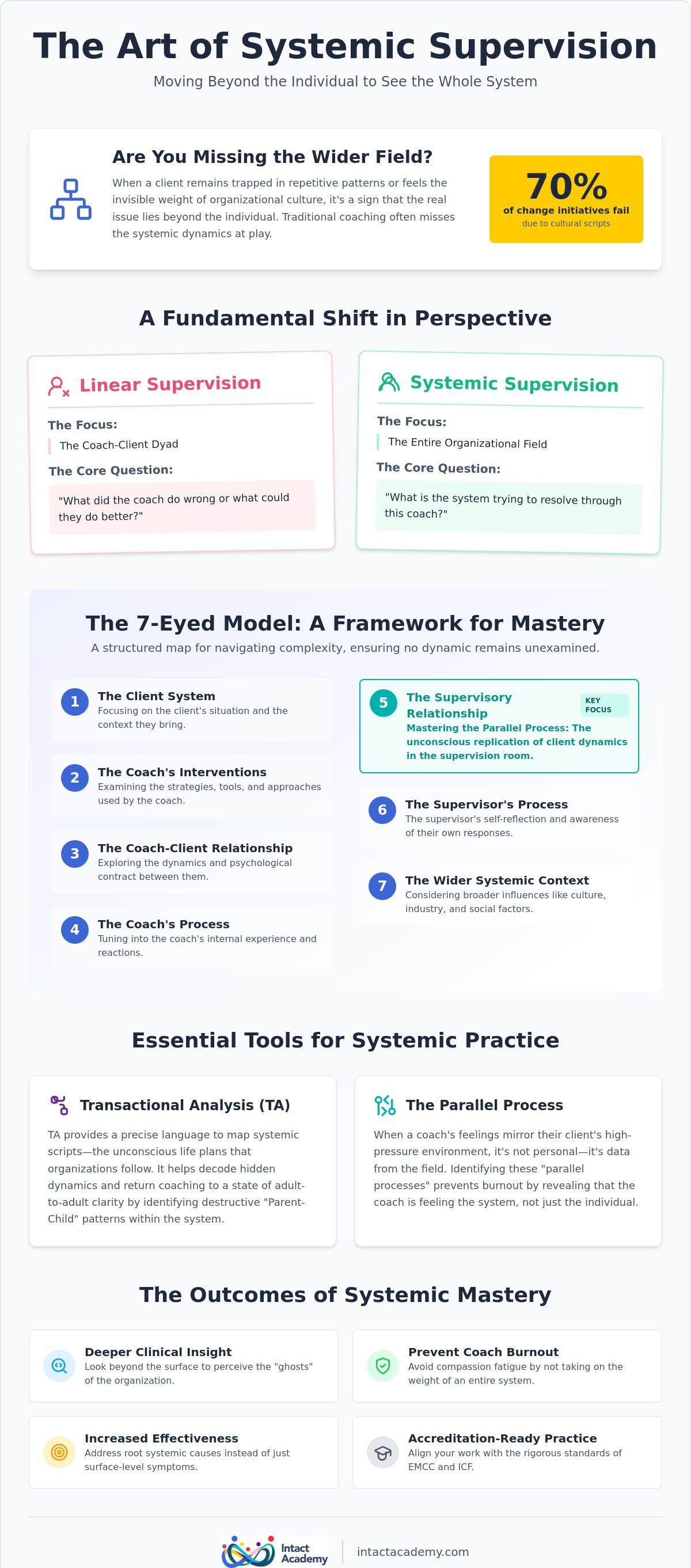
Linear supervision asks, "What did the coach do?" Systemic supervision asks, "What is the system trying to resolve through this coach?" This shift requires a state of wholeness in the supervisor. It's not enough to be a technician; one must be a grounded presence capable of sensing the living entity of the organization. This "field" often speaks through the coaching relationship, manifesting as subtle tensions, sudden blocks, or repetitive patterns that don't belong to the individuals involved.
The Shift from Individual to Field Awareness
Traditional supervision often misses the "ghosts" of an organization. These are the unwritten rules, historical traumas, and cultural shadows that dictate behavior long after the original events have passed. As a systemic supervisor, you function as a sensory organ for the client's wider system. You notice when the coach feels an unexplained heaviness or an urgent need to "save" the client. These feelings are rarely personal. They're often data points from the field. By identifying these parallel processes, systemic awareness prevents the coach burnout and compassion fatigue that occur when we take on the weight of a system we haven't yet mapped.
Transactional Analysis and the Systemic Lens
To navigate these complex dynamics, we need a precise language. This is why understanding what is transactional analysis becomes essential for the modern supervisor. TA provides the tools to map systemic scripts, the unconscious life plans that organizations follow just as individuals do. For instance, a rigid organizational "parent" state can suffocate a coaching contract, forcing the coach into a rebellious "child" role without them even realizing it. By using TA as a systemic lens, we can decode these scripts and return the coaching relationship to a state of adult-to-adult clarity and effectiveness.
The 7-Eyed Model: A Framework for Systemic Mastery
To navigate the complexity of organizational life, a supervisor needs more than intuition; they require a robust map. The 7-Eyed Model, developed by Peter Hawkins and Nick Smith, serves as the essential backbone for systemic supervision. It invites us to move beyond the narrow focus of what is happening to the client and instead look at what is happening between the various layers of the system. This framework organizes the supervisor's attention into seven distinct perspectives, ensuring that no hidden dynamic remains unexamined.
The first three "eyes" are inner-facing, centering on the coaching dyad itself. We observe the client's narrative, the specific interventions the coach employs, and the psychological contract between them. While many practitioners remain within these initial boundaries, a master of the craft knows that the real leverage for change often lies in the outer-facing eyes. While the roots of this work often draw from Systemic Family Therapy Supervision, applying these lenses to the corporate world requires a unique blend of psychological depth and professional pragmatism. The supervisor must fluidly dance between these perspectives to identify where the system is stuck.
Eye 5: Mastering the Parallel Process
The parallel process is the unconscious replication of client system dynamics within the supervision room. You might notice it when a coach, usually calm and methodical, begins to speak with a frantic urgency that mirrors their client's high-pressure environment. If you find yourself, as the supervisor, feeling an uncharacteristic need to "fix" the coach, you've likely caught a reflection of the client's organizational culture. By turning the parallel process from a blind spot into a diagnostic tool, we can reveal the systemic pressures that the coach has unknowingly absorbed.
Eye 7: Bringing the Organization into the Room
The final eye focuses on the wider system, mapping the stakeholders who aren't physically present but whose influence is palpable. This includes the "Sponsor" who holds the budget, the HR partners who defined the success metrics, and the industry-wide scripts that dictate what is considered "acceptable" behavior. We look for the cultural Parent states that might be suppressing innovation or the historical industry traumas that still shape current decision-making. Developing this level of sight is a core focus of the TA EMCC Senior Supervisor academy, where we train practitioners to see the whole field rather than just the individual players. It's through this expansive view that we help coaches move from transactional support to truly transformative systemic intervention.
Systemic vs. Linear Supervision: Choosing the Right Path
Linear supervision operates like a microscope, focusing intently on the coach's technique, the client's immediate goals, and the specific interventions used during a session. It asks, "What did the coach do correctly?" and seeks to refine the practitioner's individual skill set. While this foundational approach is necessary for early-stage development, it often falls short in the high-stakes environment of executive leadership. It treats the coaching encounter as an isolated event rather than a ripple in a much larger pond. In contrast, systemic supervision functions more like a wide-angle lens, asking, "What is the system trying to resolve through this coach?" It recognizes that the coach is not just an observer but an active participant in the client's organizational field.
The evolution of professional development for coaches signifies a shift toward this more mature, systemic awareness. Without this lens, there is a significant risk of "collusion" in the supervision room. Collusion occurs when the supervisor unknowingly accepts the coach's narrative as the absolute truth, thereby reinforcing the same biases and blind spots that exist within the client's organization. If the coach is frustrated by a client's lack of progress, a linear supervisor might suggest new techniques. A systemic supervisor, however, explores whether that frustration is actually a reflection of the organization's own resistance to change. This prevents the supervisor from becoming an accidental accomplice to the system's status quo.
When Linear Supervision Fails the Executive Coach
In high-complexity environments, skill-based feedback reaches a ceiling. You might deliver "perfect" coaching, yet find your interventions are consistently rejected by the system. This often happens because the organization is "sick," and its internal scripts are designed to maintain current dysfunctions at all costs. A linear approach misses these "ghosts" in the room, leaving the coach feeling inadequate or exhausted. Systemic supervision empowers the supervisor to act as a protector of the coaching contract, ensuring the work doesn't get swallowed by the hidden agendas of the wider organizational field.
The ROI of a Systemic Approach
The return on investment for a systemic approach is found in the sustainability of change. While linear methods might produce temporary behavioral shifts, systemic work targets the underlying structures that dictate long-term outcomes. This depth of work significantly increases the coach's value to the organization, as they become capable of facilitating profound transformation rather than just surface-level adjustments. Aligning with EMCC Senior Practitioner standards for 2026 requires this level of mastery. It’s about moving beyond doing coaching to becoming a grounded, systemic presence that fosters genuine organizational health.
Practical Integration: How to Work Systemically
Moving from the theoretical frameworks of systemic supervision into the live heat of a session requires a deliberate shift in how we contract and observe. Effective integration begins the moment you define the boundaries of the work with corporate clients. Unlike traditional models, systemic contracting explicitly includes the "third" in the room: the organization itself. You aren't just supervising the coach's skill; you're supervising the coach's relationship with the organizational field. This means establishing a clear understanding that the supervisor may challenge the coach on how they are being recruited into the system's hidden agendas and unvoiced scripts.
A vital component of this practical work is the cultivation of the "Internal Supervisor," often referred to as the eighth eye. This is the part of you that monitors your own reactions, biases, and movements while you are engaged with the coach. To maintain a stance that is both neutral and deeply involved, you must learn to observe your own internal process without being swept away by it. If you're ready to deepen this internal capacity and master these complex dynamics, the TA EMCC Senior Supervisor academy provides the structured mentoring necessary for such profound professional evolution.
Mapping the Organizational Script
We use Transactional Analysis (TA) to map the "organizational script," identifying the unconscious life plans that govern how a business operates. For example, some organizations operate under a "Don't Succeed" script, where innovation is subtly sabotaged to protect a familiar, though painful, status quo. Consider a coach working with a struggling department who finds themselves taking on a "Rescuer" role. In systemic mapping, we see this isn't just a personal quirk of the coach. Instead, the department's script has recruited the coach to play a role in a repetitive psychological game, effectively preventing the department from taking its own Adult responsibility for change.
Refining Your Systemic Presence
Mastery through the TA EMCC Senior Supervisor Academy
The transition from a skilled practitioner to a senior supervisor is a journey from delivering interventions to becoming a systemic architect. It requires a shift in identity, moving from the "doing" of coaching to the "being" of a grounded, authoritative presence. At Intact Academy, we bridge the gap between high-level theoretical frameworks and direct, actionable directives. Our methodology combines the psychological precision of Transactional Analysis with a pragmatic focus on organizational health. This ensures that you don't just learn about systems; you learn how to move within them to foster genuine flourishing and professional wholeness.
The academy is led by Sari van Poelje, a global expert who has spent decades navigating the inner workings of diverse organizations across more than 14 countries. Her mentorship serves as a vital bridge between the complexity of systemic theory and the reality of executive practice. In this environment, systemic supervision is taught as an embodied wisdom, where your personal growth is inextricably linked to your professional efficacy. You'll learn to hold the space for others with a sense of quiet power, helping them return to a state of completeness and genuineness in their own work.
The Path to Senior Supervision Accreditation
The curriculum of the TA EMCC Senior Supervisor academy is meticulously designed to support the rigorous requirements of EMCC accreditation for the 2026 cohort and beyond. It offers a balanced rhythm of theory, supervised practice, and deep personal transformation. You aren't just joining a training program; you're entering a global network of systemic change agents. This international cohort provides a stable container for deep learning, allowing ideas to resonate across different cultural and industry contexts. It's a space where you can test your insights, refine your internal supervisor, and align your practice with the highest global standards of the profession.
Your Next Step Toward Systemic Wholeness
Deciding to advance your practice is a commitment to excellence and a desire for greater systemic impact. You might ask yourself if you're ready to hold the weight of complex organizational fields or if you're prepared to challenge the hidden scripts that stifle growth. This path is the logical next step for those who have mastered the Senior Practitioner level and wish to lead the next generation of coaches and consultants. We value the integrity of the process, the depth of the inquiry, and the courage required for genuine change. We invite you to explore the TA EMCC Senior Supervisor academy to begin your journey toward systemic mastery and professional wholeness.
Embracing the Architecture of Systemic Change
Mastering the art of systemic supervision is more than a professional upgrade. It's a commitment to seeing the world in its full complexity. By moving beyond linear skill-building and embracing the hidden organizational scripts revealed through the 7-Eyed Model, you stop being a mere witness to client struggles. You become a catalyst for profound human and organizational transformation. You've learned that the "ghosts" in the room are actually data points, and that your own somatic awareness is a key tool for navigating these unseen fields.
This level of insight requires a stable container for growth. Our EMCC Senior Supervisor Accredited Program offers exactly that. Led by international TA expert Sari van Poelje, this academy brings together participants from over 14 countries to share in a journey of deep learning and professional pragmatism. It's time to align your practice with the highest global standards and reclaim your sense of wholeness. Elevate your practice at the TA EMCC Senior Supervisor Academy and join a community dedicated to the flourishing of individuals and systems alike. You have the vision to see the field; now, gain the mastery to lead within it.
Frequently Asked Questions
What is the difference between coaching supervision and systemic supervision?
Systemic supervision expands the focus beyond the coach-client dyad. It explicitly includes the entire organizational field. While standard coaching supervision might center on the coach's technique, the systemic approach investigates how the wider culture and stakeholder scripts influence the work. It treats the organization as a living entity that participates in every session. This broader perspective ensures that interventions are both effective and sustainable.
Do I need to be an expert in Transactional Analysis to use systemic supervision?
You don't need to be a Transactional Analysis expert to begin this work. While TA provides a precise language for mapping scripts and ego states, this approach is about developing a specific type of awareness. At Intact Academy, we integrate TA principles into the learning process, making these deep psychological concepts accessible and actionable. You'll naturally acquire the tools to decode systemic patterns as you deepen your practice.
How does systemic supervision help with ethical dilemmas in coaching?
Many ethical dilemmas in executive coaching arise from the unseen pressures of the organizational system. By mapping these dynamics, you gain the clarity needed to honor your professional integrity while navigating complex multi-stakeholder contracts. It provides a stable container to examine whose agenda you're truly serving in the moment, while Unashamedly Ethical NPC offers consultancy to help organizations integrate moral values and integrity into their corporate culture.
Is systemic supervision recognized by the EMCC and ICF?
Yes, systemic supervision is fully recognized and highly valued by both the EMCC and the ICF. It's a prerequisite for practitioners seeking Senior Practitioner or Master level accreditation. Our TA EMCC Senior Supervisor academy is specifically designed to meet these rigorous global standards. This ensures that your training is both psychologically profound and professionally accredited for your career advancement. It's a vital step for any serious practitioner.
Can systemic supervision be conducted in a group setting?
Group settings are exceptionally effective for this work because they allow for the use of organizational constellations. In a group, other participants can represent different elements of the client's system, such as the sponsor, the culture, or even the industry's history. This collective mapping provides the supervisee with diverse perspectives and somatic data that would be impossible to access in a one-on-one session. It's a rich, collaborative experience.
How often should an executive coach seek systemic supervision?
Most executive coaches find that meeting once a month or every four to six coaching sessions provides the necessary distance to remain effective. This regular rhythm prevents you from becoming enmeshed in the client's organizational scripts. If you're handling high-complexity contracts or significant organizational change, you might require more frequent sessions to maintain your clarity and prevent professional burnout. Consistency is key to long-term mastery.
What is the 7-Eyed Model of supervision and how is it used?
The 7-Eyed Model is a comprehensive framework that directs the supervisor's attention across seven distinct perspectives. These range from the client's internal world and the coach's interventions to the parallel processes and the wider organizational system. By dancing between these eyes, a supervisor can identify the specific leverage point where change is most likely to occur. It serves as the backbone of professional systemic mastery and clinical depth.
How does the parallel process manifest in a supervision session?
It manifests as an unconscious replication of the client's system within the supervision relationship. For example, if a client feels suffocated by a rigid hierarchy, the coach might start acting in a restricted way during their session. The supervisor uses their own internal reactions to these shifts as diagnostic data. This helps the coach see what they've unknowingly absorbed from the field. It's a powerful tool for clarity and disentanglement.


