

What if the difference between a competent coach and a master practitioner isn't just the number of hours logged, but the psychological depth of the container you inhabit? In a global market that reached over 122,000 practitioners by 2026, the search for EMCC accredited coaching programs often feels like navigating a dense fog of acronyms like EQA, EIA, and ITCA. You likely recognize that a mere certificate isn't enough to handle the complex, systemic tensions of modern leadership. You're looking for more than a "cookie-cutter" curriculum; you're seeking a path that honors the maturity of your experience and your desire for genuine impact.
It's understandable to feel overwhelmed by the technical requirements or the fear of investing in shallow training that misses the human core. This guide clarifies the 2026 EMCC standards, providing a clear roadmap to Senior Practitioner or Team Coach status while showing you how to integrate advanced frameworks like Transactional Analysis. We'll examine the specific pathways to professional mastery, ensuring you find a program that offers profound human transformation and the systemic insight required to thrive at the highest levels of organizational change.
Key Takeaways
- Understand why EMCC standards in 2026 have shifted toward systemic awareness, requiring coaches to move beyond individual performance into the heart of organizational complexity.
- Navigate the four levels of accreditation and recognize why the Senior Practitioner level is the vital gateway for those seeking to master executive and systemic coaching.
- Discover how Transactional Analysis provides the psychological depth needed to master EMCC competencies, using frameworks like Ego States to facilitate profound human transformation.
- Learn the five critical criteria for evaluating EMCC accredited coaching programs to ensure your training offers a stable container for professional evolution rather than just a certificate.
- Identify the right developmental path for your practice, whether you're specializing in individual mastery or organizational systems through dedicated Senior Practitioner and Team Coach academies.
What Are EMCC Accredited Coaching Programs and Why Do They Matter?
The European Mentoring and Coaching Council (EMCC) operates as a global steward for professional coaching, establishing the ethical and competency frameworks that define master-level practice. By July 2026, the coaching industry has evolved beyond the pursuit of simple behavioral changes. Organizations now demand evidence-based interventions and systemic awareness. They want to know that a coach can hold the complexity of a changing world without losing their grounding or their integrity. This shift makes the choice of training more than a logistical decision; it's a declaration of your professional depth.
Choosing from various EMCC accredited coaching programs is the first step in a larger developmental arc. These programs carry the European Quality Award (EQA), which signifies that the training provider has met rigorous standards of psychological depth and pedagogical integrity. For the practitioner, this isn't just about learning a few techniques. It's about entering a stable container where you can develop the reflective practice required for long-term mastery. This accreditation is often preferred by European and international organizations because it prioritizes psychological safety and a holistic view of the individual within the system.
The Value of the EMCC Global Quality Award (EQA)
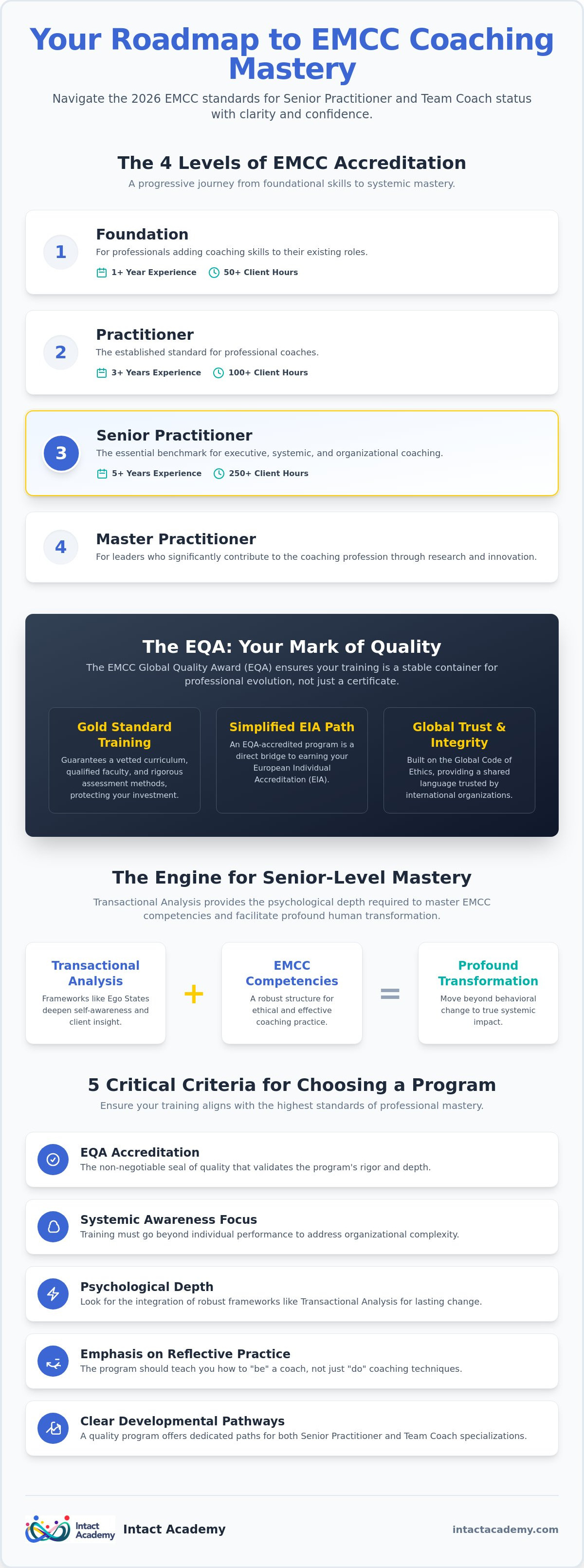
An EQA-accredited program serves as a vital bridge for your career. It simplifies your journey toward Individual Accreditation (EIA) because the EMCC has already vetted the curriculum, the faculty, and the assessment methods. This gold standard of training protects you as a student. It ensures you aren't investing in a shallow, "cookie-cutter" course but rather a deep, rigorous exploration of human behavior. The Global Code of Ethics remains the backbone here, providing a shared language of integrity that global organizations trust. When a program holds an EQA, it means the provider has demonstrated that their methodology is both theoretically sound and practically effective.
Individual vs. Programme Accreditation: Clearing the Confusion
Confusion often arises between the training you attend and the title you eventually hold. You enroll in an EQA program to eventually earn your EIA. While many start at the Practitioner level, top-tier consultants and executive coaches increasingly target the Senior Practitioner status. This level requires at least five years of experience and 250+ client hours, marking the threshold where coaching moves from transactional delivery to systemic transformation. Top-tier EMCC accredited coaching programs focus heavily on reflective practice. This isn't just "thinking about a session"; it's a methodical, supervised process of looking inward to understand how your own internal system interacts with the client’s system. It's the difference between "doing" coaching and "being" a coach who facilitates profound human change.
The 4 Levels of EMCC Accreditation: A Roadmap to Senior Practitioner
The journey through EMCC accredited coaching programs isn't a linear climb, but a deepening of one's professional container. The EMCC framework is designed to mirror the practitioner's internal growth, moving from basic competency to systemic mastery. By July 2026, these levels have become the industry's primary language for quality and ethical reliability. Each stage demands more than just time; it requires a qualitative shift in how you perceive the relationship between the individual and the wider organization.
- Foundation: Designed for those adding coaching to their existing roles, requiring one year of experience and 50 client hours.
- Practitioner: The standard for professional coaches, focusing on three years of practice and 100 contact hours.
- Senior Practitioner: The threshold for executive work, requiring five years of experience and 250+ hours.
- Master Practitioner: Reserved for those who contribute to the profession through research, innovation, and leadership.
For those seeking to work at the highest levels of organizational change, the Senior Practitioner level is the essential benchmark. It signals to stakeholders that you've moved beyond surface-level problem solving. At this stage, Transactional Analysis provides many useful theories to decode the unconscious scripts that often stall organizational progress. It's about developing the "quiet power" to hold space for transformation in high-pressure environments.
Requirements for the Senior Practitioner Level
Reaching this level in 2026 requires a documented portfolio showing at least 250 contact hours with 20 different clients. You must demonstrate five years of active practice and a commitment to consistent supervision. The EMCC now recommends one hour of supervision for every 35 hours of coaching to prevent burnout and maintain psychological safety. Senior Practitioner status represents the ability to work with complex organizational dynamics, moving beyond individual performance into the realm of cultural and systemic shifts. If you're ready to deepen your psychological container, exploring a TA-based Senior Practitioner academy can provide the necessary rigour.
The Specialized Path: Individual Team Coaching Accreditation (ITCA)
Team coaching is a distinct discipline that focuses on the collective entity rather than the individuals within it. It requires a different set of competencies, specifically the ability to manage group dynamics and systemic interference. The Individual Team Coaching Accreditation (ITCA) is the global standard for this work, often preceded by a Team Coaching Quality Award (TCQA) from your training provider. The TA EMCC Senior Team Coach Academy is specifically designed to meet these 2026 standards, helping you move from managing meetings to facilitating profound systemic evolution.
Transactional Analysis: The Engine for Senior-Level Mastery
Accreditation provides the necessary structure, but psychological depth provides the lasting impact. Many EMCC accredited coaching programs focus on the "how" of coaching, yet true mastery requires an understanding of the "why" behind human behavior. Transactional Analysis (TA) serves as a sophisticated psychological engine that allows a Senior Practitioner to see beneath the surface of organizational dialogue. While surface-level models might offer quick fixes, TA addresses the Life Scripts and Ego States that drive long-term behavior. This alignment with the EMCC competency of "Self-Development" is precise; it requires the coach to understand their own internal system before they can hope to influence another's.
Sari van Poelje has pioneered the application of "Agile TA" within organizational settings, moving the framework from the clinical room to the boardroom. This approach acknowledges that organizations are living systems with their own unconscious patterns and defense mechanisms. By integrating TA into your practice, you gain a structured methodology for managing the often-turbulent work of professional change. It isn't just about solving a problem; it's about facilitating a state of wholeness that distinguishes a master from a technician. Choosing between EMCC accredited coaching programs shouldn't just be a search for a title, but a search for the depth required to handle these complex human dynamics.
Mapping Ego States in Executive Coaching
Navigating C-suite resistance requires more than rapport; it requires an understanding of Parent-Adult-Child dynamics. When a leader retreats into a defensive "Parent" state or a compliant "Child" state, a master coach uses TA to invite them back into an "Adult" awareness. This shift moves the conversation from a transactional exchange of tasks to a transformational exploration of leadership identity. To understand these foundations further, you can explore What Is Transactional Analysis? as a guide for your own evolution. It's here that the work of transformation truly begins.
Systemic Change through TA and EMCC Standards
Organizational change initiatives often fail because they address the symptoms rather than the systemic psychological roots. The EMCC Global Accreditation standards emphasize the importance of "Contracting," a competency where TA excels through its focus on multi-party agreements. In complex systems, the coach must manage the expectations of the individual, the sponsor, and the organization simultaneously. TA provides the ethical clarity needed to navigate these overlapping interests without losing professional integrity. TA acts as a vital tool for returning to a state of completeness and genuineness, allowing both coach and client to operate from their most authentic selves.
Choosing the Right EMCC Program: 5 Critical Evaluation Criteria
Selecting from various EMCC accredited coaching programs requires a discerning eye for more than just the logo on the certificate. It’s an investment in your professional identity and your capacity to hold the weight of human transformation. To move from transactional delivery to systemic mastery, you must evaluate the vessel that will contain your learning. This choice determines whether you’ll gain a set of superficial techniques or a profound psychological framework for change.
First, examine the faculty. Are they active practitioners who have seen the inner workings of global organizations, or are they mere theorists? Sari van Poelje, for instance, brings decades of experience in systemic change to her teaching, bridging the gap between theory and executive reality. Second, evaluate the depth. Does the curriculum offer a collection of "tools" or a comprehensive psychological system? Mastery requires an integrated framework to navigate unconscious patterns. Third, check the global reach. A program should support international certification and honor diverse cultural contexts. Finally, assess the supervision and the community. High-quality supervision should be a core thread of the curriculum, and learning alongside peers from over 14 countries provides a rich, systemic perspective that a local cohort cannot match.
The Role of Supervision in Accredited Training
Supervision is the stable container for the often-turbulent work of change. The EMCC mandates it for individual accreditation because it’s the primary tool for maintaining ethical clarity and psychological safety. However, there’s a vast difference between basic administrative supervision and a systemic model. A systemic approach looks at the interplay between the coach, the client, and the organizational field. Finding a program that integrates Professional Supervision and Consultancy ensures you’re not just logging hours, but evolving through reflective practice.
Boutique Academy vs. Large Training Factory
Large training factories often prioritize transactional skill-building, moving students through a standardized process. In contrast, a boutique academy led by a wise global mentor offers a space for profound human transformation. Here, the focus is on a "wholeness" philosophy, where the goal is returning to a state of completeness and genuineness. When your cohort includes practitioners from 14+ countries, every session becomes a lesson in systemic diversity. This international richness is essential for anyone operating in today's global business environment. If you're seeking a path to psychological and professional depth, explore the academies at Intact Academy.
Advancing Your Practice with Intact Academy's EMCC Programs
Choosing to deepen your practice is an act of professional courage. It’s a commitment to moving beyond superficial techniques and entering a state of genuine mastery. At Intact Academy, our EMCC accredited coaching programs are designed to provide the stable container required for this level of growth. Whether you're seeking individual mastery or looking to influence entire organizational systems, our academies offer a unique synthesis of Transactional Analysis and systemic change. Led by global expert Sari van Poelje, these programs are available both in Utrecht and online, catering to a sophisticated audience from over 14 countries.
The TA EMCC Senior Practitioner academy stands as the premier choice for those seeking psychological depth in their executive work. It isn't just about learning to coach; it's about learning to hold the complexity of the human experience within a high-pressure business context. For those whose work focuses on the collective, the TA EMCC Senior Team Coach Academy provides the systemic tools necessary to facilitate organizational evolution. Finally, for the seasoned coach ready to guide the next generation, the TA EMCC Senior Supervisor academy offers a rigorous path to becoming a mentor who can hold the supervisor's container with integrity and wisdom.
The Intact Academy Learning Journey
Our sessions follow a rhythmic, balanced approach that mirrors the process of deep learning itself. We don't rush the reader or the student; instead, we allow ideas to resonate before moving to the next concept. This flow creates a sense of safety and reliability, suggesting that the academy provides a stable container for the often-turbulent work of personal change. By bridging the gap between high-level theoretical frameworks and punchy, actionable directives, we ensure that profound psychological concepts remain accessible. Our "Agile TA" framework makes complex systemic issues feel manageable, allowing you to return to a state of completeness and genuineness in your professional life.
Next Steps: Enrollment and Professional Transformation
Joining our upcoming 2026 cohorts means entering a global community of master practitioners. This isn't just a training course; it's a lifelong professional evolution. The impact of this work extends far beyond the certificate, influencing every transaction and every system you touch. When you learn alongside peers from diverse cultural backgrounds, you develop the global citizenship required for modern leadership. If you're ready to elevate your practice from transactional delivery to profound systemic impact, it's time to take the next step. Explore our EMCC Senior Practitioner Academy and begin your journey toward mastery.
Your Path to Systemic Mastery in 2026
Professional evolution requires more than the accumulation of hours; it demands a deepening of your internal psychological container. By choosing the right path among EMCC accredited coaching programs, you transition from a technician of behavior to a master of systemic change. We've explored how Transactional Analysis provides the depth to navigate complex organizational dynamics and how rigorous supervision ensures your practice remains ethical, stable, and profoundly human. This journey is about returning to a state of wholeness, allowing you to hold space for others with quiet power and clarity.
Intact Academy provides the stable environment needed for this level of transformation. Led by Sari van Poelje, TSTA-O, our academies are backed by over 10 years of systemic coaching excellence and hold accreditations from both EMCC Global and the ICF. If you're ready to elevate your practice and join a global community of practitioners, we invite you to take the next step. Discover the TA EMCC Senior Practitioner Academy at Intact Academy and begin your journey toward professional mastery. The courage to look inward is the foundation for every outward success you facilitate.
Frequently Asked Questions
Is EMCC accreditation better than ICF?
Neither is objectively superior; instead, they reflect different professional philosophies. The ICF often focuses on observable competencies and a quantitative measure of hours, while the EMCC emphasizes reflective maturity and the quality of supervision. In 2026, many executive coaches choose EMCC accredited coaching programs because they prioritize the systemic and psychological depth required for complex organizational change.
Can I get EMCC accredited if I already have an ICF credential?
Yes, you can use your existing ICF training hours to apply for an EMCC Individual Accreditation (EIA) through the portfolio route. The EMCC recognizes the value of diverse training backgrounds—including those from professional education centers like HEG Fin Academy—provided you can demonstrate the required reflective practice and meet their specific supervision standards. This allows you to bridge the gap between different coaching traditions while building a more comprehensive professional identity.
How much does an EMCC accredited coaching program cost?
While the cost of training programs depends on the provider's depth and faculty expertise, the EMCC's own accreditation fees are fixed. As of May 2026, the Individual Accreditation (EIA) fee for a Senior Practitioner is €245, while the Practitioner level is €205. These fees are separate from the tuition of the academy and the annual membership fee, which was €90 in several chapters as of mid-2026.
What is the difference between EQA and EIA in EMCC?
EQA refers to the accreditation of the training program, while EIA is the credential awarded to the individual coach. When you graduate from EMCC accredited coaching programs that hold a European Quality Award (EQA), you gain access to a simplified, fast-track application for your individual EIA. The EQA ensures the provider meets global standards, while the EIA validates your personal competence and experience.
How long does it take to become an EMCC Senior Practitioner?
Reaching the Senior Practitioner level requires at least five years of active practice and a minimum of 250 client contact hours. This duration ensures that you've moved beyond basic behavioral coaching into the realm of systemic mastery. It's a journey that honors the time needed for psychological integration and the development of a stable professional container capable of handling high-level organizational tensions.
What happens if I don't meet the client hours for EMCC accreditation?
If you haven't yet reached the 250-hour threshold for Senior Practitioner, you can apply at the Practitioner or Foundation level and upgrade your accreditation as your experience grows. The EMCC framework is designed to mirror your actual professional evolution. It allows you to build your portfolio over time, ensuring your accreditation always reflects your current level of maturity and practice.
Is Transactional Analysis required for EMCC accreditation?
Transactional Analysis (TA) isn't a mandatory requirement, but it's an exceptionally powerful framework for meeting the EMCC’s standards for self-development and systemic awareness. TA provides the specialized terminology and psychological depth needed to decode complex human transactions. Many senior-level practitioners find that TA offers the intellectual rigor necessary to move from transactional coaching to profound human transformation.
Can I attend Intact Academy programs online from outside the Netherlands?
Yes, Intact Academy provides both online and in-person sessions to accommodate a global audience of practitioners from over 14 countries. This virtual accessibility ensures you can engage in deep systemic learning and peer reflection regardless of your location. Our online environments are carefully structured to maintain the same psychological safety and depth as our in-person sessions in Utrecht.


