

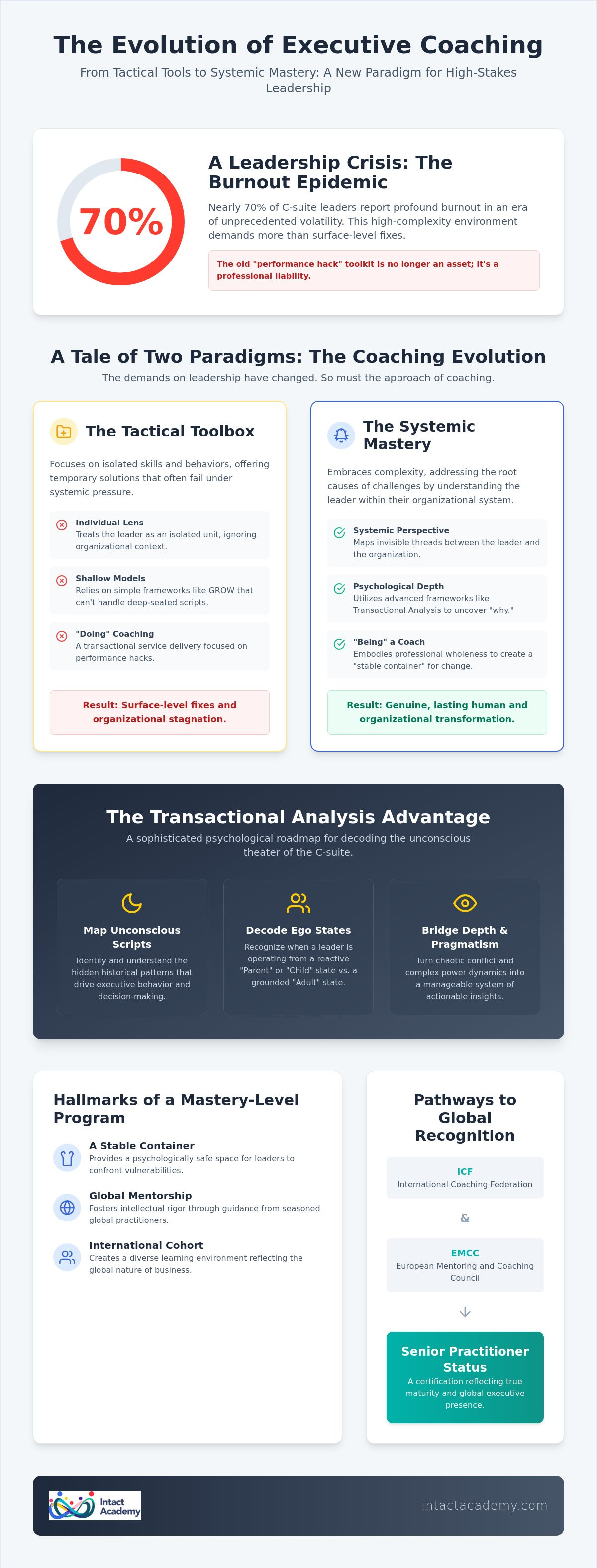
The era of the tactical coach is fading; in a landscape where nearly 70% of C-suite leaders are navigating profound burnout, a simple toolkit of performance hacks is no longer a professional asset, it's a liability. You've likely felt that standard models are too shallow for the intricate complexities of modern leadership. There's a growing gap between simply holding a credential and possessing the psychological depth required to facilitate genuine, systemic organizational change.
This guide illuminates the path toward an executive coaching certification that transcends mere transactions. It offers a stable container for you to master the art and science of human behavior, moving beyond surface-level fixes to achieve profound impact. We'll explore the critical distinctions between ICF and EMCC accreditations, the transformative power of Transactional Analysis, and how to secure a Senior Practitioner status that reflects your true maturity and global executive presence.
Key Takeaways
- Understand why traditional coaching toolboxes fail in complex environments and how to embrace a systemic perspective that honors organizational depth.
- Gain a sophisticated roadmap for interpreting C-suite power dynamics by utilizing Transactional Analysis to map unconscious leadership scripts.
- Evaluate the global weight of ICF and EMCC pathways to ensure your executive coaching certification reflects the Senior Practitioner level of professional mastery.
- Discover the necessity of a global mentor and an international cohort in fostering the intellectual rigor required for high-stakes executive change.
- Learn to transcend transactional service delivery, moving toward a state of professional wholeness that facilitates genuine and lasting human transformation.
Beyond the Surface: Why Executive Coaching Certification Requires Systemic Depth
Acquiring an executive coaching certification is often viewed as a final destination, a professional gold seal to be displayed on a profile. In the current landscape of 2026, this perspective is dangerously incomplete. True mastery is not found in the credential itself, but in the shift of professional identity that the right training facilitates. It is the movement from being a person who "does" coaching to becoming a person who "is" a coach, capable of holding space for the profound human and organizational transformations required at the highest levels of leadership.
The executive environment has reached a point of unprecedented volatility. With nearly 70% of C-suite leaders reporting significant burnout, the demand for coaches who can navigate high-complexity, high-stakes scenarios has never been greater. To understand the evolution of this field, one can look at the historical development of Business and executive coaching, which has moved steadily away from mere skill-building toward developmental depth. When a leader is drowning in systemic pressure, they don't need a cheerleader with a checklist; they need a partner who understands the underlying psychological and organizational architecture that keeps them stuck.
The Shift from Individual Performance to Systemic Impact
Traditional coaching often treats the leader as an isolated individual. It focuses on personal habits, time management, or communication styles while ignoring the "unseen" organizational forces that dictate behavior. This individualistic lens is a blind spot. Sustainable transformation requires a systemic perspective that acknowledges how a leader is both shaped by and a shaper of their environment. Systemic coaching is the art of mapping the invisible threads between the leader and the organization. Without this lens, coaching interventions remain surface-level, failing to address the root causes of systemic tension and organizational stagnation.
Why 'Tactical' Coaching Models Are No Longer Sufficient
Standard tactical models, such as GROW, are useful for simple goal-setting, but they frequently crumble when confronted with deep-seated personality scripts or complex power dynamics. These "toolbox" approaches lack the capacity to hold the turbulent emotions and systemic complexities of the C-suite. High-level executive coaching certification must instead provide a "stable container"—a psychologically safe space where leaders can confront their own vulnerabilities and the unconscious scripts that drive their decisions. This requires a level of professional wholeness from the coach that cannot be found in a manual. It is developed through rigorous, reflective practice and a deep understanding of human systems, ensuring that the coach remains grounded even when the organizational environment is in chaos.
The Transactional Analysis Advantage: Mapping the Unconscious in the C-Suite
The boardroom is rarely a space of pure logic; it is more often a theater of unconscious patterns and historical echoes. While many foundational programs, such as NYU's Certificate in Executive Coaching, provide essential business frameworks, achieving true mastery requires a more sophisticated psychological lens. Transactional Analysis (TA) offers this architecture. It provides a precise roadmap for navigating the hidden dynamics that drive executive behavior, turning what looks like chaotic conflict into a manageable system of insights.
By integrating TA into your executive coaching certification journey, you gain the ability to see beneath the surface of professional interactions. You begin to understand why certain leaders thrive under pressure while others revert to self-sabotaging behaviors. This approach moves beyond the "what" of leadership into the "why," creating a bridge between psychological depth and the professional pragmatism required in global corporate settings. It is here that the coach becomes a true partner in the leader's evolution.
Decoding Ego States and Executive Presence
Leadership presence is often compromised by reactive internal states. When an executive operates from a "Critical Parent" or "Adapted Child" ego state, their decision-making becomes clouded by past scripts rather than present reality. They may become overly controlling or unnecessarily defensive, eroding the trust of their teams. A high-level executive coaching certification rooted in TA trains you to help leaders return to their "Adult" state, the place where clarity, empathy, and presence reside. This shift is the essence of authentic leadership. To understand the full scope of this modality, explore What Is Transactional Analysis? A Systemic Guide to Professional Transformation.
Addressing Life Scripts and Organizational Culture
Every leader carries a "Life Script," an unconscious plan formed early in life that dictates how they handle success, power, and conflict. These scripts don't just affect individuals; they coalesce into a collective organizational culture that often resists top-down change initiatives. A coach trained in Transactional Analysis can observe the subtle shifts in tone and posture that signal a 'psychological game' is beginning, allowing them to intervene before a power struggle derails a critical boardroom meeting. This ability to spot the "script" of a culture allows for interventions that are both surgical and sustainable.
By mastering these psychological frameworks, you ensure that your coaching practice provides a stable container for the often-turbulent work of executive change. If you're ready to move beyond tactical advice and facilitate genuine transformation, the TA EMCC Senior Practitioner academy offers the systemic depth required to lead at this level.
Navigating Accreditation: ICF vs. EMCC Senior Practitioner Pathways
Choosing the right executive coaching certification often feels like standing at a professional crossroads. On one side, the International Coaching Federation (ICF) offers a robust, competency-based framework that is widely recognized across the globe. Programs like NYU's ICF-accredited executive coaching program exemplify this path, emphasizing observable skills and the quantitative accumulation of coaching hours. On the other side, the European Mentoring and Coaching Council (EMCC) prioritizes reflective practice and the psychological maturity of the coach. For those operating in the high-stakes environment of global leadership, the EMCC Senior Practitioner level often proves to be the more relevant target, as it demands a capacity for systemic awareness that goes beyond simple performance metrics.
A core competency shared by both bodies is 'Contracting for Change'. This is not merely a legal or financial agreement; it is a psychological pact. In the context of 2026, where organizational volatility is the norm, the ability to contract effectively with both the individual leader and the wider organization is vital. It ensures that the coaching work remains grounded in Adult-to-Adult dynamics, preventing the coach from being pulled into the system's unconscious games. Intact Academy’s programs are meticulously designed to satisfy the rigorous requirements of both the ICF and the EMCC, providing a dual path to mastery.
Understanding the EMCC Senior Practitioner Standard
The standard for an EMCC Senior Practitioner is distinguished by its focus on the 'internal supervisor'. While some pathways measure mastery by the number of hours logged, the EMCC assesses your ability to reflect on your own process and the systemic impact of your work. This level of executive coaching certification signals that you don't just apply tools; you manage the complex, often contradictory forces within an organization. It's about developing a state of professional wholeness, a concept explored in our guide on Professional Development for Coaches: A Systemic Guide to Mastery in 2026.
Aligning Accreditation with Your Professional Evolution
Your decision should align with your professional evolution and the needs of your target clientele. If you're working with C-suite leaders in complex, international systems, the EMCC's emphasis on supervision is indispensable. As of 2026, the EMCC recommends one hour of supervision for every 35 hours of coaching, a standard that ensures you remain a stable container for your clients. This commitment to ethical standards and continuous development is what separates a transactional coach from a systemic practitioner. Whether you seek the global reach of the ICF or the reflective depth of the EMCC, the goal is to move toward a state of genuine mastery.
Evaluating Program Quality: From Tactical Coaching to Systemic Mastery
Identifying a high-quality executive coaching certification requires looking far beyond the syllabus. You must examine the community and the lineage of the teaching. Mastery is rarely achieved in isolation; it is forged in the presence of a global mentor and a cohort of peers who challenge your internal biases. In 2026, the most effective programs are those that foster a sense of global citizenship. For instance, the current Intact Academy cohort brings together practitioners from over 14 countries. This diversity isn't just a statistic. It is a crucible for learning how systemic forces operate across different cultural scripts, ensuring your practice is as comfortable in an international executive setting as it is in a developmental one.
Most programs fail because they offer "fast-track" solutions that lack the long-term integration necessary for true human transformation. Short-term workshops often prioritize evidence-based principles but neglect the ongoing reflective practice required to master them. To move from tactical coaching to systemic mastery, a program must balance theoretical rigour with a methodical rhythm of learning. It should not rush you. Instead, it should build a narrative arc that moves from identifying core human struggles to presenting systemic solutions, allowing ideas to resonate before you take outward action.
The Critical Role of Systemic Supervision
Systemic supervision is the "missing link" in many standard certifications. It acts as the "coach of the coach," providing a reflective space to examine the psychological undercurrents of your work. Without this stable container, even the most skilled coach can fall prey to "parallel processes," where they unconsciously mirror the very dysfunction they are hired to resolve. This practice is a vital safeguard against professional burnout and an essential component of ethical standards. It ensures you remain a clear, neutral observer of the organizational system. For a detailed roadmap of how this integrates into your professional path, see our comprehensive guide on Executive Coaching Certification: A Guide to Mastery and Systemic Impact in 2026.
Theoretical Rigour vs. Professional Pragmatism
A program must offer more than just high-level theory; it must be actionable in the high-stakes environment of the C-suite. The "art" of change lies in the mastery of "Contracting," using it as both a psychological pact and a robust business tool to navigate power dynamics. This balance is what we call professional pragmatism. At Intact Academy, we bridge the gap between deep psychological insight and the demands of the modern business world. By integrating the wisdom of a global mentor like Sari van Poelje with "agile Transactional Analysis," we ensure that profound concepts remain accessible without losing their intellectual rigor.
If you're ready to transcend surface-level training and embrace a path of profound professional change, we invite you to explore the TA EMCC Senior Practitioner academy and join a global community dedicated to systemic excellence.
The Intact Academy Path: Your Journey to Senior Practitioner Certification
The search for a truly transformative executive coaching certification often leads to a realization that professional growth cannot be separated from personal evolution, a principle also central to the NLP training provided by Toby and Kate McCartney. At Intact Academy, we provide the stable container necessary for this dual journey. Our TA EMCC Senior Practitioner academy is designed for those who seek to move beyond the ego-driven desire for mere titles. It is a path for practitioners who wish to achieve systemic mastery, led by international expert Sari van Poelje and a team of seasoned professionals who have navigated the inner workings of global organizations for decades.
Entering this academy means joining a vibrant community of global citizens. With participants currently representing over 14 countries, the learning environment is rich with diverse perspectives and cultural scripts. This international cohort ensures that your development as a coach is grounded in a global reality, preparing you to handle the systemic tensions that define modern leadership. You aren't just learning a method; you are participating in a collective movement toward professional wholeness and organizational flourishing.
The TA EMCC Senior Practitioner Academy Experience
The curriculum is a methodical progression from the fundamentals of Transactional Analysis to the complexities of systemic team coaching and organizational change. It is rigorous yet accessible, ensuring that profound psychological concepts remain actionable in your daily practice. We believe that deep learning requires both digital flexibility and physical presence. The format reflects this, blending the intellectual depth of online modules with the emotional weight of in-person connection in Utrecht. The ultimate outcome is not just a certificate to hang on a wall. It is a sustainable transformation of your professional impact, allowing you to hold space for others with a new level of quiet power and insight.
Bridging Individual Growth and Organizational Excellence
True excellence in the C-suite is rarely about acquiring more skills; it is about returning to a state of genuineness. Our academy supports coaches in facilitating this profound human transformation within themselves and their clients. When a leader moves from reactive ego states to a place of completeness, the entire organization feels the shift. This alignment between individual growth and systemic success is the hallmark of our approach. We invite you to step away from transactional coaching models and embrace a path that honors your maturity and intelligence. Explore the TA EMCC Senior Practitioner academy and start your journey to mastery, where you will find the tools, the mentorship, and the community needed to facilitate lasting change.
Embracing the Path to Systemic Mastery
The journey toward professional wholeness requires a departure from surface-level tactics and an entry into the deep, often turbulent waters of systemic change. True impact in the C-suite isn't found in a checklist; it's found in your ability to hold a stable container for human transformation. By integrating Transactional Analysis with a systemic lens, you move beyond the role of a facilitator and become a catalyst for organizational excellence. Securing a high-level executive coaching certification is the first step in this evolution, signaling your commitment to the intellectual rigor and psychological maturity that the year 2026 demands.
Led by internationally recognized TA expert Sari van Poelje, our programs provide a bridge between theoretical depth and professional pragmatism. You'll join a global cohort of practitioners from over 14 countries, all working within a framework accredited by both the EMCC and ICF. This is your invitation to return to a state of genuineness and to lead others toward their own completeness. We invite you to enroll in the TA EMCC Senior Practitioner academy to deepen your impact and facilitate sustainable transformation. Your evolution as a coach is the key to the flourishing of the systems you serve.
Frequently Asked Questions
What is the difference between executive coaching and leadership coaching?
Executive coaching focuses on the C-suite and senior leaders within the context of organizational systems and high-stakes decision-making. Leadership coaching is broader, often focusing on individual skill development for managers at various levels. While leadership coaching builds competencies, executive coaching navigates the complex interplay between personal psychology and systemic organizational forces. It requires a deeper understanding of power dynamics and the collective scripts that drive corporate culture.
Is an ICF or EMCC certification better for executive coaching in 2026?
The choice depends on your professional focus; ICF is often preferred for global corporate recognition and competency-based standards, while EMCC is highly valued for its emphasis on reflective practice and supervision. In 2026, many senior practitioners seek dual accreditation to cover both bases. The EMCC Senior Practitioner level specifically signals a mastery of systemic complexity, making it an excellent path for those working with executive-level organizational dynamics.
How long does it take to get a Senior Practitioner executive coaching certification?
Achieving a Senior Practitioner level typically requires a minimum of five years of active practice and 250 client contact hours, according to 2026 EMCC standards. The training programs themselves vary, but a comprehensive executive coaching certification at this level often spans nine months to a year. This timeframe allows for the deep integration of psychological frameworks and the completion of the required supervision hours to ensure professional maturity.
Do I need a background in psychology to succeed in a TA-based coaching program?
No, a formal degree in psychology isn't required to master Transactional Analysis (TA) for coaching. While the framework has clinical roots, our programs translate these concepts into a pragmatic, business-oriented language. We provide the necessary psychological foundations within the curriculum, allowing professionals from diverse business backgrounds to develop the depth needed to map unconscious organizational scripts effectively and facilitate profound human transformation.
Can I get an executive coaching certification online?
Yes, many high-quality programs offer robust online pathways that combine live sessions with digital learning modules. In 2026, the best online certifications prioritize interactive, peer-to-peer learning to mirror the complexities of global business. For example, Intact Academy blends online intellectual depth with optional in-person connection, ensuring that the convenience of digital access doesn't compromise the emotional weight or the "stable container" required for deep professional learning.
What are the core competencies for an EMCC Senior Practitioner?
The core competencies center on professional development, reflective practice, and the ability to manage complex systemic interventions. A Senior Practitioner must demonstrate they can work with multiple stakeholders and navigate the "invisible threads" within an organization. Unlike entry-level tracks, this accreditation focuses on the coach's psychological maturity and their commitment to consistent supervision as a safeguard for ethical practice and the prevention of professional burnout.
How does Transactional Analysis improve executive presence?
Transactional Analysis improves executive presence by helping leaders identify and move out of reactive "Parent" or "Child" ego states. By returning to an "Adult" state, a leader gains clarity, emotional regulation, and the ability to communicate with genuine authority. This psychological groundedness creates a stable container for their team, allowing the executive to remain influential and calm even during periods of high organizational volatility or systemic pressure. To see how these principles of presence and authority are cultivated in high-performing men, check out Undaunted Man.
What is the ROI of an accredited executive coaching certification for my career?
The ROI is reflected in both increased earning potential and professional credibility; ICF-credentialed coaches reported earning 20-40% more per session than non-credentialed peers in 2026. Beyond the financial gains, an accredited executive coaching certification provides the systemic depth required to handle high-stakes C-suite contracts. It transforms your professional identity, moving you from a tactical advisor to a trusted partner who can facilitate genuine and lasting organizational change.


