

What if the repetitive friction you encounter with your most challenging clients isn't a failure of technique, but a silent echo of the organization's deepest, unaddressed scripts? You likely recognize the frustration of feeling stuck in a loop where traditional coaching tools seem to graze the surface without ever reaching the core. It's exhausting to manage high-stakes politics when the underlying unconscious dynamics remain invisible. This is where transactional analysis supervision becomes essential, acting as a systemic microscope that reveals the hidden patterns governing human interaction.
In this guide, you'll discover how to move beyond surface-level interventions to uncover deep systemic patterns and elevate your professional impact. We'll explore the mastery of parallel processes and the journey toward accreditation as an EMCC Senior Supervisor. By the end, you'll understand how to cultivate greater self-awareness as a practitioner, ensuring your work fosters genuine transformation rather than just temporary relief. We'll look at the specific methodologies that turn complex systemic issues into manageable insights for professional mastery in 2026.
Key Takeaways
- Learn how to move beyond surface-level observations to achieve a meta-perspective on your professional relationships and client interactions.
- Master the practical application of the Mazzetti Operational Model and Berne’s supervisory operations to sharpen your diagnostic precision as a practitioner.
- Understand how to utilize transactional analysis supervision as a systemic filter to identify and resolve parallel processes where client drama enters the supervision room.
- Navigate the complexities of the "Three-Cornered Contract" to maintain ethical maturity and clear psychological boundaries within organizational systems.
- Explore the path toward becoming a Senior Supervisor through an EMCC-accredited academy that bridges deep psychological theory with global professional standards.
What is Transactional Analysis Supervision? Beyond the Surface
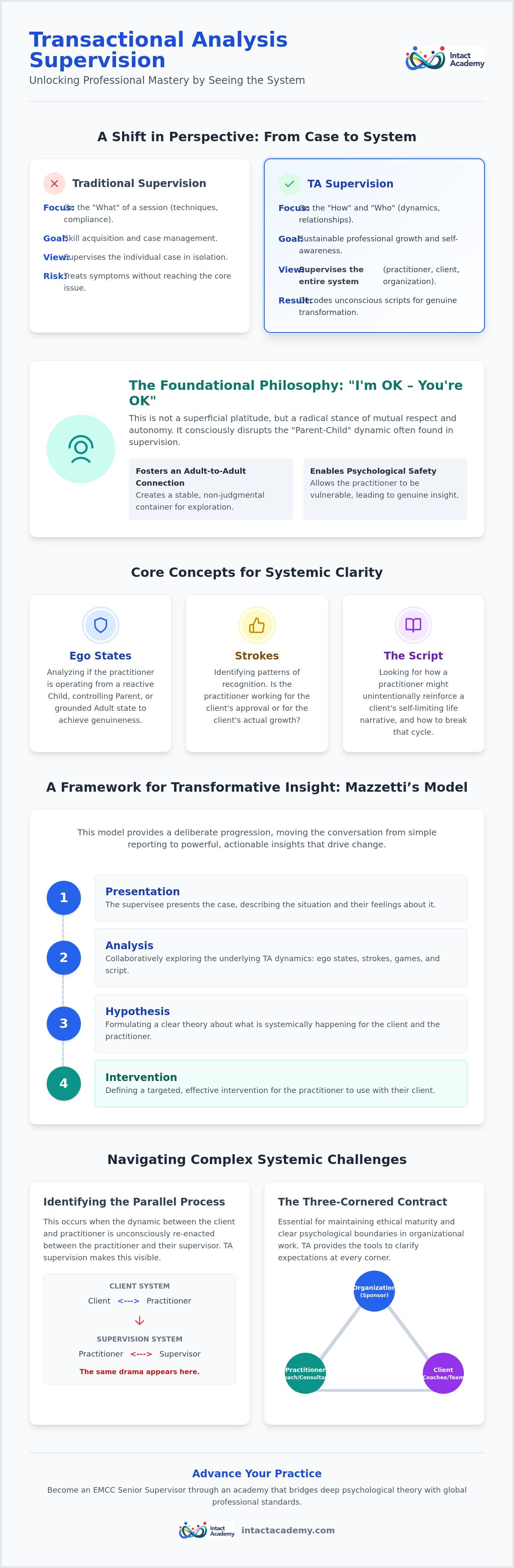
Traditional supervision often focuses on the "what" of a coaching session, reviewing techniques and checking for compliance. In contrast, transactional analysis supervision invites a deeper inquiry into the "how" and the "who." It's a collaborative process of reflection where the supervisor and supervisee explore the intricate psychological architecture of professional relationships. To understand the roots of this approach, one might ask, What is Transactional Analysis? At its core, it's a theory of personality and social dynamics that allows us to see beyond the immediate problem presented by a client.
While standard coaching supervision might prioritize skill acquisition, the TA approach offers a unique meta-perspective. It shifts the focus from "supervising the case" to "supervising the system." This means we don't just look at the client's struggle; we look at how that struggle is mirrored in the coach's response and how both are influenced by the wider organizational culture. Transactional analysis supervision is a systemic intervention that decodes the unconscious scripts and relational patterns occurring between the practitioner, the client, and the broader environment to foster sustainable professional growth.
The Philosophy of I’m OK – You’re OK in Supervision
The foundation of this work is the "I’m OK – You’re OK" position. This isn't a superficial platitude. It's a radical stance of mutual respect and autonomy. In many supervisory settings, an unconscious "Parent-Child" dynamic can emerge, where the supervisor provides the "correct" answers and the supervisee seeks approval. The TA model consciously disrupts this. By maintaining an Adult-to-Adult connection, the supervisor creates a stable container where the practitioner feels safe enough to be vulnerable. This psychological safety is the prerequisite for genuine insight. When we remove the fear of judgment, we open the door to true professional maturity.
Key TA Concepts Applied to the Supervisory Relationship
We use specific frameworks to illuminate the supervisor-supervisee-client triad and ensure the practitioner remains grounded. These concepts provide a map for the often-turbulent work of organizational change.
- Ego States: We analyze whether the practitioner is operating from a reactive Child state or a controlling Parent state when faced with high-stakes client politics. This awareness allows for a return to a state of completeness and genuineness.
- Strokes: Recognition is the unit of social action. We identify the patterns of "strokes" or recognition within a system. Is the practitioner working for the client's approval or for the client's growth?
- The Script: We look for "script" reinforcements where the practitioner might be unintentionally playing into the client's self-limiting narrative.
Understanding these dynamics prevents the practitioner from becoming entangled in the client's drama. Instead of reacting to surface-level noise, you learn to respond to the systemic reality with quiet power and clarity.
The Core Models of Transactional Analysis Supervision
Mastery in any discipline requires more than just intuition; it demands a robust structural framework that can hold the weight of complex human dynamics. In the context of transactional analysis supervision, we rely on established models to move from subjective observation to systemic clarity. These frameworks don't just categorize behavior. They provide a roadmap for the supervisor to navigate the subtle shifts in energy and communication that occur when three or more parties are involved in a professional contract. By grounding our work in the standards of the International Transactional Analysis Association, we ensure that our insights remain both ethically sound and theoretically rigorous.
Mazzetti’s Operational Model in Action
The Mazzetti model is a cornerstone for practitioners who want to move beyond mere storytelling. It outlines a deliberate progression through four distinct stages: presentation, analysis, hypothesis, and intervention. Too often, supervision sessions stall in the reporting phase, where the coach simply recounts what the client said. Mazzetti’s model forces a shift into transformative insight.
Consider a coach who feels blocked by a high-level executive who constantly deflects feedback. In the presentation stage, the coach describes the executive's evasive maneuvers. Moving to analysis, the supervisor helps the coach identify the "game" being played. They form a hypothesis: perhaps the coach is unconsciously stepping into a "Rescuer" role, which invites the executive to remain a "Victim" of their own busy schedule. The intervention then focuses on how the coach can return to an Adult ego state to break the cycle. This structured approach turns a frustrating impasse into a profound learning moment for the practitioner.
Berne’s Legacy in Modern Supervision
Eric Berne’s original "supervisory operations" remain remarkably relevant for the challenges of 2026. He categorized the work into specific actions: confrontation, explanation, and illustration. These aren't just techniques; they are ways of engaging the supervisee’s Adult ego state to maintain clear professional boundaries. To fully grasp these dynamics, it helps to revisit the core question of what is transactional analysis and how its systemic application differs from individual coaching.
In modern practice, we also integrate the Clarkson 7-step checklist to evaluate progress. This ensures that the supervision doesn't just feel good, but actually does good. We examine the relationship between the supervisor and supervisee, the interventions used with the client, and the wider organizational context. This systemic lens is what distinguishes transactional analysis supervision from more surface-level coaching oversight. It provides a stable container for the often-turbulent work of organizational change. If you're ready to deepen your own practice, exploring the curriculum of a TA EMCC Senior Supervisor academy can provide the necessary rigour to move toward senior-level accreditation.
Navigating Parallel Processes: The Systemic Lens of TA Supervision
What if the subtle tension you feel during a supervision session isn't actually yours? In transactional analysis supervision, we view the supervisor as a systemic antenna, tuned to the frequencies of the client's environment. This phenomenon, known as parallel process, occurs when the unconscious drama of the client's organization is imported into the supervision room. The supervisor might suddenly feel the same pressure to perform or the same sense of helplessness that the coach experiences with their client. By recognizing these mirrors, we stop being victims of the system and start becoming its observers.
The 7 eyed model of supervision becomes significantly more potent when viewed through a TA filter. We don't just look at the coach-client relationship; we analyze the ego states active in every "eye" of the model. Are the organizational stakeholders operating from a "Critical Parent" position? Is the coach responding from an "Adapted Child" state? By applying a rigorous operational model for TA supervision, we can map these invisible threads. This allows the practitioner to return to a state of Adult clarity, ensuring they don't become an unwitting pawn in the client’s internal politics.
Spotting Psychological Games in the System
In high-stakes corporate environments, psychological games are the default mode of communication. We often see the Karpman Drama Triangle play out, where clients rotate between the roles of Persecutor, Rescuer, and Victim. A coach might enter supervision feeling a desperate need to "save" a failing leader, unconsciously stepping into the Rescuer role. The supervisor's job is to identify this shift early. By "crossing the transaction"—responding from an Adult ego state when the supervisee invites a Parent or Child response—we break the repetitive cycle. This move restores the practitioner’s autonomy and protects the integrity of the coaching contract.
Script Analysis for Organizations
Every organization has a script, a pre-conscious plan for how things "should" go, which often mirrors the individual life scripts of its founders. When a coach feels stuck, it's frequently because they've bumped into a corporate script that forbids change or transparency. Transactional analysis supervision helps you remain script-free by distinguishing your personal history from the client’s systemic baggage. Parallel process acts as a diagnostic tool by revealing how the client's unconscious relational patterns are being reenacted in the present moment between the supervisor and practitioner. This insight is what allows for sustainable transformation rather than mere surface-level adjustments.
Ethical Maturity and Contracting in TA Supervision
Ethics in our profession is often reduced to a dry checklist of "dos and don'ts." In transactional analysis supervision, we view ethical maturity as a living, breathing commitment to integrity and systemic awareness. It's the capacity to hold multiple, often conflicting, perspectives without losing one’s grounding. This process begins with the contract. While a standard agreement covers fees and frequency, a TA-informed contract dives into the unwritten expectations. We call this the psychological contract. It's here that we address the hidden hopes and fears that, if left unexamined, can sabotage even the most brilliant coaching engagement.
For the practitioner, professional "Imposter Syndrome" is rarely about a lack of skill. Instead, it's often a script-driven response to high-stakes environments. Through transactional analysis supervision, we facilitate script re-decisions. This allows the coach to move from a place of "trying to prove" to a place of "being present." It's a profound shift that transforms the coach's presence from one of anxious activity to one of quiet, authoritative power. This level of depth is what distinguishes a senior practitioner from a technician.
The Art of Multi-Party Contracting
The "Three-Cornered Contract" is the essential architecture of organizational work. It involves the supervisor, the coach, and the sponsoring organization. Managing the tension between confidentiality and the organization’s need for reporting requires a high degree of transparency. We use TA to clarify these expectations before the supervision ever begins. This ensures that the coach isn't caught in a "loyalty bind" between their client and the person paying the bill. Clear contracting is the first step in professional development for coaches, providing the safety needed for deep work.
Supervision as a Container for Professional Integrity
Coaches working at the executive level often face immense pressure to deliver immediate results. This can lead to "blind spots" where the coach unconsciously adopts the frantic energy of the system. Transactional analysis supervision acts as a stable container, offering the "Permissions" necessary for resilience. You need permission to not have all the answers. You need permission to challenge the status quo. These permissions are vital when leading organizational change effectively. Without this reflective space, the coach risks becoming another cog in the client’s repetitive machine.
If you're ready to elevate your practice and navigate these complex ethical landscapes with mastery, consider joining our next cohort at the TA EMCC Senior Supervisor academy to begin your journey toward senior accreditation.
Advancing Your Practice: The TA EMCC Senior Supervisor Academy
Transitioning from a practitioner to a supervisor is more than a career move; it's an evolution of your professional identity. While many programs offer general oversight, choosing a specialized path in transactional analysis supervision ensures that your practice is anchored in a profound understanding of human and systemic change. At Intact Academy, we don't just teach models. We provide a stable container for the turbulent work of professional change, allowing you to return to a state of completeness and genuineness as you guide others through their own developmental thresholds.
The learning journey is led by Sari van Poelje, an international expert who masterfully integrates TA with systemic coaching and organizational agile transformation. Her approach bridges the gap between high-level psychological frameworks and the pragmatic demands of modern business. By joining this academy, you aren't just gaining a diploma. You're entering a space where the art and science of transformation meet, guided by a mentor who has seen the inner workings of countless global organizations.
The Path to Senior Supervisor Mastery
The curriculum for the 2026 cohort is designed for experienced coaches and consultants who seek the highest level of professional recognition. This isn't a surface-level training. It requires a commitment to 60 hours of client supervision work, 10 hours of group supervision, and 15 hours of peer supervision, all supported by seven intensive workshop days. Upcoming dates for this transformative experience include October 7 to 10, 2026, in Poznan and October 14 to 17, 2026, in Zwolle. These sessions provide the intellectual rigor and emotional grounding necessary to hold space for others.
Learning alongside peers from over 14 countries, you'll cultivate a "Global Citizen" perspective. This diversity of thought is essential for navigating the complex, cross-border organizational scripts found in the current market. The program leads to a Diploma in Supervision and provides the direct path to apply for the prestigious EMCC ESIA senior supervisor accreditation. This credential signals your mastery to a global audience, distinguishing you as a leader at the intersection of behavior and business.
Joining a Community of Systemic Experts
Achieving the status of an EMCC Senior Supervisor places you in a unique position of influence. It's a role that requires not just knowledge, but the courage to facilitate deep, sustainable change. Our academy serves as your stable container, ensuring you have the support and supervision needed as you step into this new level of authority. We focus on the process of becoming, ensuring that your growth as a supervisor mirrors the growth you facilitate in your supervisees.
If you're ready to move beyond transactional coaching and embrace the depth of systemic mastery, the next step is clear. Explore the TA EMCC Senior Supervisor Academy at Intact Academy and discover how to elevate your professional impact for 2026 and beyond.
Elevating Your Impact Through Systemic Mastery
Professional mastery in 2026 requires more than technical proficiency; it demands a return to a state of completeness and the courage to look beneath the surface of organizational scripts. We've explored how transactional analysis supervision provides the meta-perspective necessary to decode complex human dynamics and resolve the parallel processes that often stall progress. By grounding your practice in the "I’m OK – You’re OK" philosophy and mastering multi-party contracting, you protect your professional integrity while fostering sustainable transformation for your clients.
The journey toward becoming a Senior Supervisor is a process of deep learning and evolution. It's an invitation to join a global community of practitioners committed to the art and science of change. Led by international expert Sari van Poelje and accredited by both the EMCC and ICF, our academy offers a stable container for your growth. You'll learn alongside peers from over 14 countries, gaining the insights needed to navigate high-stakes politics with quiet power. Are you ready to move beyond the visible to the systemic?
Take the next step in your professional evolution. Join the TA EMCC Senior Supervisor Academy and achieve the international recognition your expertise deserves. Your path to professional wholeness and systemic impact starts here.
Frequently Asked Questions
What is the primary difference between TA supervision and regular coaching supervision?
Transactional analysis supervision focuses on the unconscious dynamics and systemic scripts that drive behavior, whereas regular coaching supervision often stays at the level of skill acquisition and goal alignment. It uses specific frameworks like Ego States and Games to decode relational patterns. This depth allows practitioners to address the root causes of professional friction rather than just managing surface symptoms.
How does Transactional Analysis help with "parallel processes" in coaching?
Transactional Analysis treats the parallel process as a diagnostic mirror where the client's organizational drama is reenacted within the supervision room. By identifying these mirrors, the supervisor acts as a systemic antenna. This awareness prevents the coach from being pulled into the client's script, allowing them to remain grounded and objective during high-stakes interventions.
Can I use TA supervision if I am not a trained Transactional Analyst?
You don't need to be a certified analyst to benefit from transactional analysis supervision. The models are designed to be accessible and immediately applicable to any practitioner working within complex systems. While the theory is deep, the practical tools like the Drama Triangle or Ego States provide a clear language for understanding professional relationships that any experienced coach can use.
Is the TA EMCC Senior Supervisor Academy recognized internationally?
The academy is fully accredited by the European Mentoring and Coaching Council (EMCC) and recognized by the International Coaching Federation (ICF). This ensures that your certification carries weight across global markets. Participants from over 14 countries have joined our cohorts, reflecting a truly international community of systemic experts committed to the highest standards of professional mastery.
How often should a professional coach seek TA-based supervision?
Professional standards typically suggest one hour of supervision for every 15 to 20 hours of coaching practice. For those working in high-stakes organizational change, monthly sessions are common to maintain ethical maturity and systemic clarity. Regularity is key because it provides a stable container for the ongoing work of self-reflection and professional evolution.
What are "Supervisory Operations" in the context of Transactional Analysis?
Supervisory operations are specific interventions categorized by Eric Berne to engage the supervisee's Adult ego state. These include confrontation, explanation, and illustration. Unlike casual feedback, these operations are deliberate moves designed to break through blind spots and invite the practitioner into a deeper level of insight regarding their client's unconscious patterns and systemic entanglements.
How does TA supervision address organizational culture and scripts?
TA supervision links individual life scripts to the broader corporate "Organizational Script" that dictates how a company responds to change. By analyzing these scripts, we can identify why certain coaching interventions meet resistance. This systemic lens helps coaches remain script-free, ensuring they don't unintentionally reinforce the very cultural patterns the organization is trying to transform.
What qualifications do I need to join a TA supervision academy?
Applicants should be experienced coaches, consultants, or leaders who have a solid foundation in professional practice and a desire to move into a supervisory role. While a background in psychology is helpful, it's not a prerequisite for entry. The academy focuses on developing your capacity to hold complex systemic containers and achieving senior-level accreditation through the EMCC.


