

What if the reason your coaching interventions feel like temporary band-aids isn't a lack of effort, but a lack of systemic depth? You've likely experienced those moments where a client remains stuck despite your best tools, or where group dynamics feel like an impenetrable web of unspoken scripts. It's a common plateau for high-level professionals who sense that something deeper is at play. Understanding the benefits of TA practitioner certification allows you to move beyond these surface-level obstacles. By integrating Transactional Analysis into your practice, you transition from a transactional fixer to a systemic transformer who understands the intricate architecture of human behavior.
I've seen how this shift from doing to being creates a stable container for genuine change. In this guide, you'll discover how a formal certification provides the psychological frameworks needed to map unconscious patterns while securing global credibility through EMCC Senior Practitioner status. We'll examine how this path leads to greater professional impact, the ability to lead complex organizational evolution, and the internal grounding required to facilitate lasting growth in others. This is your roadmap to mastering the systemic tools that define professional excellence in 2026.
Key Takeaways
- Move beyond transactional "to-do" lists by identifying the unconscious scripts that drive behavior and create sustainable change at a psychological level.
- Navigate the certification landscape to understand how the benefits of TA practitioner certification translate into global accreditation and EMCC Senior Practitioner status.
- Enhance your diagnostic precision to "read the room" and address complex systemic issues that typically stall organizational progress.
- Learn to integrate "Agile TA" into modern business settings, bridging the gap between classical theory and the high-velocity demands of the current corporate landscape.
- Map your professional evolution from foundational training to systemic mastery, ensuring your interventions provide a stable container for human flourishing.
Beyond the Surface: Why Professional Coaching Demands Psychological Depth
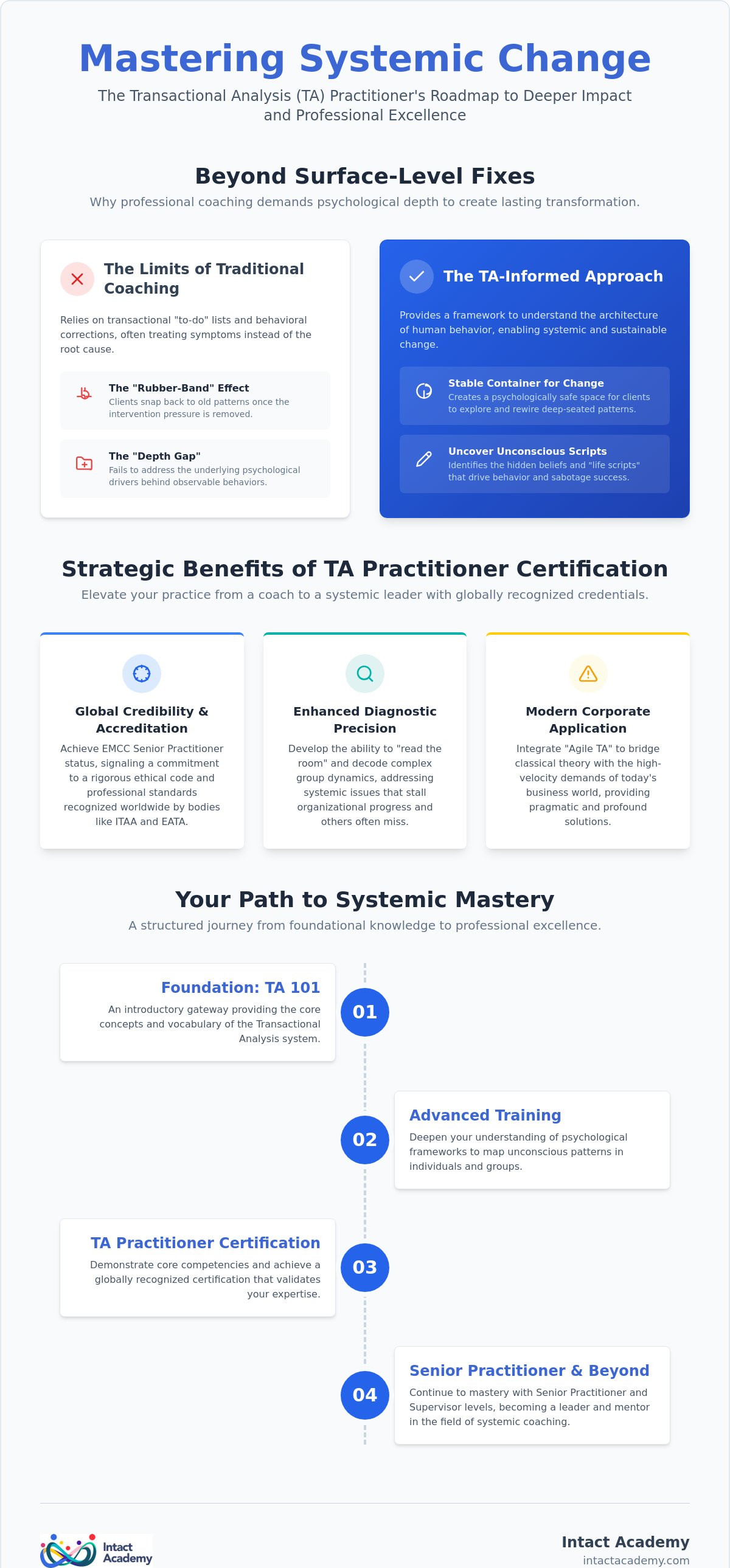
In 2026, the corporate environment has become a complex web of rapid technological shifts and intricate human dynamics. Leaders and organizations no longer find value in transactional "to-do" lists or surface-level behavioral corrections. These methods fail because they treat the symptoms of organizational friction rather than the source. When a coach only addresses what is visible, they often trigger a "rubber-band" effect, where individuals and teams snap back to old, unproductive patterns the moment the pressure of an intervention is removed. True transformation requires a move toward systemic depth, where we look beneath the surface to find the actual drivers of human interaction.
The role of the professional coach is evolving from a mere advice-giver to a wise global mentor. This evolution demands a shift from fixing people to facilitating a deeper awareness of the systems they inhabit. One of the primary benefits of TA practitioner certification is that it provides the intellectual rigor and emotional grounding needed to hold this space. It transforms the coaching relationship into a stable container, allowing clients to explore turbulent organizational waters without losing their sense of direction or safety.
The Limits of Traditional Executive Coaching
Traditional coaching often hits a ceiling when it encounters deeply ingrained habits. While setting goals and tracking progress is useful, these actions don't address why a leader might unconsciously sabotage their own success or why a team might resist a necessary change. Without psychological depth, coaching remains a series of polite conversations that bypass the core issues. Psychological safety is not just a buzzword; it's a systemic requirement for high performance that can only be built when the coach understands the hidden scripts at play. The depth gap is the distance between observable behavior and underlying psychological drivers.
Transactional Analysis as a Professional North Star
To bridge this gap, we need a framework that is both pragmatic and profound. Originally developed by Eric Berne, Transactional Analysis offers a clear map of the human psyche and how it interacts within a social system. It's a tool for those who believe that individual wholeness is the prerequisite for organizational flourishing. By learning what is transactional analysis, you gain the ability to decode the complex culture of any company, seeing the scripts and games that others miss. This mastery allows you to act with precision, ensuring that the benefits of TA practitioner certification manifest as tangible, lasting results for your clients and your career.
What is a TA Practitioner? Clarifying the Certification Landscape
There's a common point of confusion in professional development circles that we must address immediately. In many search results, the acronym "TAP" often refers to a teaching assistant in a primary school setting. For the high-level coach or organizational consultant, however, becoming a TA Practitioner describes a far more profound journey. It's the pursuit of mastery in Transactional Analysis, a psychological framework that allows you to decode human interaction with surgical precision. One of the primary benefits of TA practitioner certification is this clarity of identity; it signals to the market that you operate with a level of psychological depth that goes far beyond standard coaching techniques.
The path to certification isn't a single event but a methodical hierarchy of mastery. It begins with the TA 101, an introductory gateway that provides the basic vocabulary of the system. From there, practitioners move through advanced training toward Senior Practitioner and eventually Supervisor levels. This journey is governed by global bodies such as the International Transactional Analysis Association (ITAA) and the European Association for Transactional Analysis (EATA). These organizations ensure that your credentials carry weight across borders, reflecting a commitment to professional supervision and a rigorous ethical code that protects both the practitioner and the client.
The Core Competencies of a TA Practitioner
A certified practitioner masters the use of the three Ego States, Parent, Adult, and Child, within a professional context. They don't just teach these concepts; they embody them. This mastery allows a coach to remain in their "Adult" state even when a client or a team is gripped by reactive "Parent" or "Child" dynamics. Another essential skill is "contracting" for change. In TA, a contract isn't just a legal document. It's a multi-layered psychological agreement that ensures all parties are aligned on the goals and the depth of the work. Practitioners also learn to identify "life scripts," the unconscious blueprints that dictate how leaders show up in times of crisis or transition.
Accreditation Levels and Global Standards
Navigating the path to a high-level executive coaching certification requires an understanding of how TA integrates with broader industry standards. In 2026, the EMCC Senior Practitioner status has become the benchmark for global coaching excellence. This accreditation proves you've logged the necessary hours of practice and, more importantly, that you engage in regular systemic supervision. This supervision acts as a mirror, helping you stay aware of your own biases and scripts while you guide others through theirs. If you're ready to deepen your impact, exploring the TA EMCC Senior Practitioner academy is a logical next step toward this professional North Star.
The Strategic Benefits of TA Practitioner Certification
Mastery in Transactional Analysis transforms your presence in the executive suite. It provides a diagnostic lens that allows you to see what others merely feel. One of the key benefits of TA practitioner certification is the immediate enhancement of your diagnostic power. You don't just observe a meeting; you map the unconscious scripts and psychological games playing out in real-time. This ability to "read the room" with surgical precision allows for interventions that are both timely and profound, moving the needle where surface-level coaching fails.
This specialized training provides several strategic advantages for the modern practitioner:
- Real-time Script Mapping: The ability to identify repetitive, unproductive patterns as they happen during a session.
- Structural Clarity: Using ego-state models to explain complex interpersonal friction in simple, actionable terms.
- Contracting Precision: Creating multi-layered agreements that prevent "mission creep" and ensure psychological safety.
For senior consultants, TA certification acts as a credibility multiplier that signals a rare level of psychological sophistication. It opens doors to high-stakes C-suite engagements because leaders recognize the value of a practitioner who can navigate the complexities of human nature with a structured, evidence-based methodology. This professional authority is backed by an ethical robustness that is built into the TA framework. When faced with the murky ethical dilemmas common in global organizations, the TA practitioner relies on a clear system of boundaries to maintain integrity and safety for all parties involved.
The Competitive Edge in a Saturated Market
The coaching market is increasingly crowded, making it difficult for even experienced professionals to stand out. Moving beyond the generic "certified coach" label to become a "psychologically informed practitioner" creates a distinct market position. This shift allows you to secure higher-value, long-term organizational consultancy contracts that demand more than just goal-setting. Clients in 2026 seek partners who understand the intersection of professional coaching and psychological depth, ensuring that the work leads to genuine, lasting wholeness rather than temporary fixes.
Mastering High-Stakes Interventions
In the heat of organizational crisis, such as a merger or a major redesign, the ability to resolve "psychological games" is invaluable. These games often stall productivity and breed resentment, yet they remain invisible to those without specialized training. By applying systemic TA tools, you facilitate change that respects the underlying human needs of the organization. This level of mastery is not a destination but a continuous process of professional development for coaches. As you guide others toward their authentic selves, you continue your own journey toward a state of completeness and genuineness—a path where Paramount Shift can help facilitate the profound personal transformation and emotional well-being required to embody the very change you lead.
Systemic Impact: Applying TA to Teams and Organizations
The true power of Transactional Analysis reveals itself when we move from the individual to the collective. In organizational life, we often encounter "cultural ruts," which are patterns of behavior that feel inevitable but are actually shared scripts. One of the profound benefits of TA practitioner certification is the ability to diagnose these organizational scripts before they lead to systemic failure. Instead of viewing a team's dysfunction as a series of isolated personality clashes, the TA practitioner sees the underlying structure of the system. Understanding the benefits of TA practitioner certification is essential for anyone looking to bridge the gap between individual coaching and systemic organizational health.
This perspective is vital for the application of "Agile TA." Modern businesses move too fast for month-long diagnostic phases that yield little actionable insight. By adapting classical theory for high-velocity environments, practitioners can identify the "ego state" of an entire department. Is the culture stuck in a "Critical Parent" mode, where blame and rigidity stifle innovation? Or has it regressed into a "Rebellious Child" state, resisting all forms of leadership? Identifying these states allows for a more precise and rapid intervention.
Mapping the Unconscious in Corporate Culture
Shared scripts create the invisible boundaries of what is possible within a company. When a coach is leading organizational change, they must look beyond the official strategy documents to find the "shadow" organization. Shifting a culture from a punitive, Parent-driven environment to an Adult-Adult organizational state requires more than a memo. It requires a systemic intervention that addresses the psychological needs of the team. By modeling Adult behavior and inviting others into that space, the practitioner helps the team rewrite its collective story, fostering a sense of shared responsibility and maturity.
Facilitating Sustainable Transformation
Interventions informed by TA result in significantly lower resistance to change. This happens because the practitioner addresses the "existential hungers" of the employees, particularly the need for recognition, or "strokes." In a system where people feel seen and valued, the threat of change is minimized. The ROI of TA-based team coaching is evidenced by the measurable reduction in turnover and the substantial lowering of conflict-related costs within the organization. When you integrate TA with systemic team coaching, you create high-performing units that are resilient and self-aware. If you are ready to master these dynamics, the TA EMCC Senior Team Coach Academy provides the specialized training needed to lead these profound transitions.
Your Path to Mastery: The Intact Academy Journey
Choosing a path for professional growth is a reflective act. It requires a match between your internal aspirations and the external structure of the program you select. At Intact Academy, the journey toward systemic mastery is designed as a deliberate evolution rather than a series of disconnected workshops. One of the enduring benefits of TA practitioner certification through our academy is the integration of high-level theory with the lived experience of organizational life. You aren't just earning a credential; you're entering a stable container where your professional identity can be reshaped and refined.
The Intact Academy difference lies in the synthesis of psychological depth and global expertise. Learning from Sari van Poelje and our international team provides a bridge between classical Transactional Analysis and the contemporary needs of the corporate world. Our programs offer the flexibility of online learning to accommodate a global schedule, yet we remain committed to the power of deep, in-person intensive sessions. These intensives are where the most profound work happens, allowing you to practice systemic interventions in a safe, supervised environment before applying them to your clients.
The Academy Experience: More Than Just Training
Deep learning requires a space that is both challenging and supportive. We provide this "stable container" to ensure that you can explore complex systemic issues without feeling overwhelmed. You'll join a community of practice that includes professionals from more than 14 countries, offering a rich tapestry of cultural perspectives and peer learning opportunities. This global networking is a vital component of the experience, as it prepares you to work in the diverse, interconnected environments of 2026. The TA Foundation Year serves as the essential first step on this path, setting a rigorous stage for those who eventually seek senior-level certification.
Next Steps for Your Professional Evolution
The transition from a traditional coach to a systemic practitioner is a significant milestone. It marks the moment you decide to stop fixing and start transforming. As you prepare for this shift, consider how the benefits of TA practitioner certification will amplify your influence within organizations. Achieving EMCC Senior Practitioner status is the final step in this stage of your journey, granting you the international accreditation that modern leaders respect. If you're ready to move beyond surface-level interventions and embrace a more profound way of working, now is the time to act. We invite you to join the Intact Academy and begin your journey to mastery, where your professional flourishing becomes a catalyst for organizational change.
Embracing the Evolution of Your Professional Presence
The journey to systemic mastery isn't merely about adding another credential to your profile. It's about fundamentally altering how you perceive and interact with the human systems around you. By moving beyond surface-level interventions, you've learned to address the unconscious scripts and organizational ruts that hinder true progress. One of the primary benefits of TA practitioner certification is the internal shift from being an expert who provides answers to a mentor who facilitates deep, sustainable growth. This path ensures you're equipped with the diagnostic precision and ethical grounding required for the most complex C-suite challenges.
You're invited to join an international community of practice that values integrity and wholeness. Led by global expert Sari van Poelje, our academy provides EMCC Senior Practitioner Level Accreditation and connects you with peers from over 14 countries worldwide. This is your opportunity to step into a role of quiet power and global citizenship. We're here to provide the stable container for that transformation.
Master the art of systemic change, Explore our TA EMCC Senior Practitioner Academy
Your professional evolution is a process of becoming more of who you already are, and you can find further inspiration for this journey of conscious creation at reading.becomeyourcreator.com. We look forward to supporting your next steps toward mastery and professional flourishing.
Frequently Asked Questions
What is the difference between a TA Practitioner and a Certified Transactional Analyst (CTA)?
A TA Practitioner focuses on the systemic application of Transactional Analysis in professional settings like coaching or consultancy. In contrast; the Certified Transactional Analyst (CTA) is a comprehensive global qualification requiring years of specialized study and a final examination. While both value depth, the practitioner path often aligns more directly with EMCC standards for those working in corporate environments who don't seek clinical status.
How long does it take to get a TA practitioner certification?
Achieving this certification typically requires a commitment of one to two years. It begins with a foundation year to build theoretical grounding, followed by specialized training for practitioner status. This timeframe allows for the integration of concepts and the accumulation of supervised practice hours necessary for global accreditation. It's a steady, methodical process that ensures you don't just learn the theory but embody the methodology.
Is TA certification recognized by the EMCC or ICF?
Yes, our programs are specifically designed to meet the rigorous standards of both the EMCC and the ICF. One of the key benefits of TA practitioner certification is the dual recognition it offers. You can achieve EMCC Senior Practitioner status while also earning ICF Continuing Coach Education (CCE) units. This ensures your credentials carry significant weight in the global marketplace and meet the expectations of sophisticated corporate clients.
Can I apply Transactional Analysis to corporate coaching, or is it just for therapy?
Transactional Analysis is exceptionally powerful in corporate settings and is not limited to therapeutic environments. While it has roots in psychology, its application in organizations focuses on communication, team dynamics, and leadership scripts. It provides a pragmatic framework for resolving conflict and increasing productivity. Intact Academy specializes in this non-clinical application, helping you use TA to lead profound organizational transformation and systemic change.
What are the prerequisites for joining a TA practitioner program?
The primary prerequisite is the TA 101, which provides the foundational vocabulary of the system. Most participants also bring several years of experience in coaching, human resources, or leadership. This background ensures you have a professional context in which to apply the systemic tools. We look for individuals who are ready to move beyond surface-level techniques and are committed to their own professional and personal evolution.
How does TA certification improve my ROI as an organizational consultant?
Certification improves your ROI by enabling you to handle complex, high-value engagements that generic coaches cannot. Practitioners with recognized certifications can command fees 25% to 40% higher than their non-certified peers according to 2025 industry data. By reducing organizational conflict and turnover through systemic interventions, you provide measurable value to your clients. This diagnostic precision leads to longer-term consultancy contracts and a stronger reputation in the executive market.
Do I need a background in psychology to become a TA practitioner?
You don't need a formal degree in psychology to become a successful TA practitioner. The certification process is designed to provide you with the specialized psychological frameworks required for systemic mastery. While an interest in human behavior is essential, the program builds your expertise from the ground up. We focus on making complex psychological concepts accessible and actionable within a professional and pragmatic organizational context.
What is the role of supervision in the TA certification process?
Supervision is the cornerstone of the certification process, acting as a mirror for your professional practice. It provides a safe, stable container where you can explore your own blind spots and psychological scripts. Regular systemic supervision ensures that you maintain the highest ethical standards while deepening your diagnostic precision. This ongoing reflective practice is a requirement for maintaining EMCC status and ensures the quality of your interventions.


