

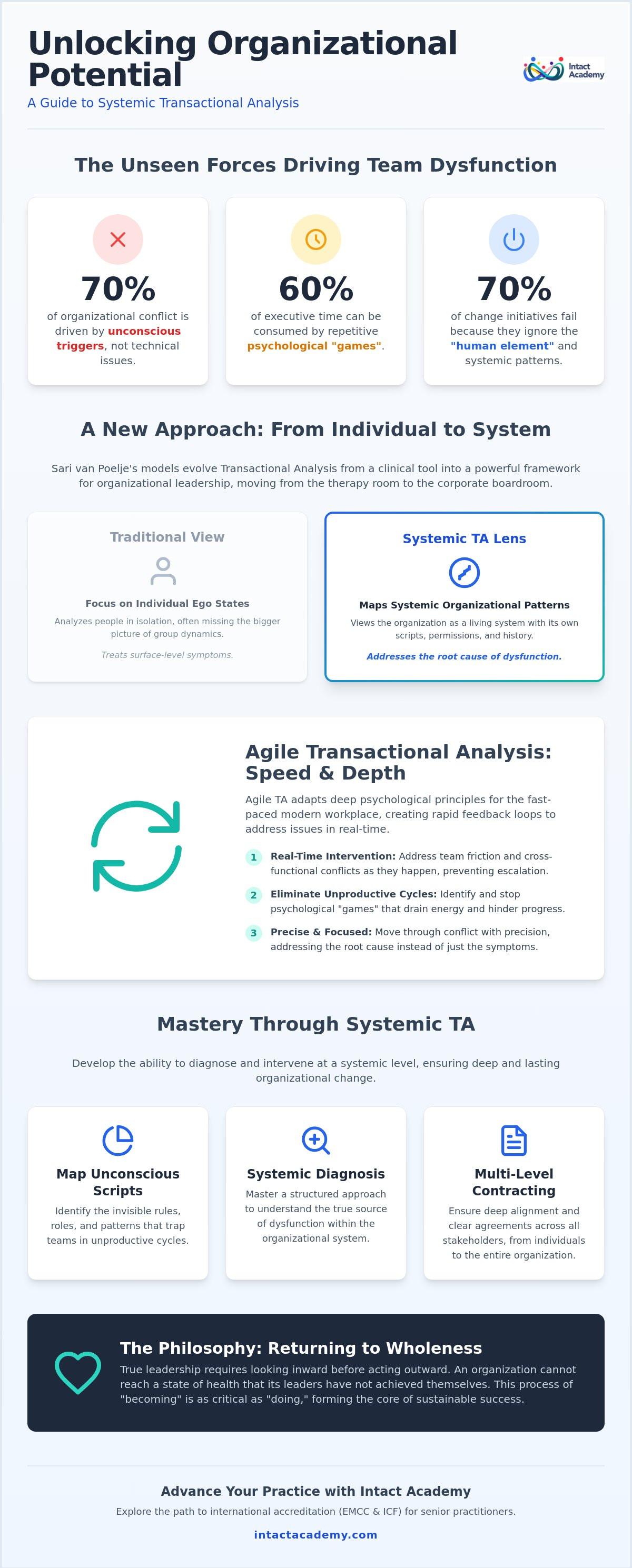
Did you know that up to 70% of organizational conflict is driven by unconscious triggers rather than technical disagreements? It's a sobering reality for leaders who find themselves trapped in repetitive cycles of friction that no amount of traditional management training seems to resolve. You likely recognize the exhaustion of treating surface-level symptoms while the deeper, systemic roots of team dysfunction remain untouched. It's time to look beneath the visible structure to the psychological architecture that actually governs behavior. By mastering the Sari van Poelje transactional analysis models, you can bridge the gap between deep psychology and high-performance organizational change.
In this guide, you'll learn how these innovative frameworks allow you to map organizational scripts and identify the psychological "games" that consume up to 60% of executive time. We'll explore the principles of Agile TA and demonstrate how a structured, systemic approach can transform turbulent environments into spaces of clarity and genuine connection. We'll also preview the path toward professional accreditation through the Intact Academy, ensuring you have the tools to lead your organization back to a state of wholeness and sustainable growth.
Key Takeaways
- Understand the transition from individual ego states to systemic organizational patterns, moving TA from the clinical room into the corporate boardroom.
- Discover how to implement Sari van Poelje transactional analysis models through an Agile lens to create rapid feedback loops and improve professional communication.
- Gain the ability to identify unconscious organizational scripts and the specific roles that often trap teams in unproductive cycles.
- Master a structured approach for systemic diagnosis and multi-level contracting to ensure deep alignment across all organizational stakeholders.
- Explore the path toward international accreditation through EMCC and ICF programs designed for senior practitioners at the Intact Academy.
The Evolution of Transactional Analysis: Sari van Poelje’s Systemic Lens
Transactional Analysis began as a revolutionary method for understanding the individual soul, yet its potential extends far beyond the therapist's couch. Sari van Poelje has spent decades moving these concepts from the clinical therapy room into the global corporate boardroom. This transition represents a vital shift in how we perceive leadership. While traditional models often focus on surface-level behaviors, the Sari van Poelje transactional analysis models delve into the unconscious currents that dictate how teams actually function. It's a move from analyzing individual ego states in isolation to observing systemic organizational patterns that repeat across decades and departments.
Many leaders struggle because their change initiatives ignore the "human element." Research indicates that 70% of change efforts fail for this very reason. When a team is stuck, it's rarely a lack of technical skill that holds them back; it's the invisible psychological architecture of the group. By looking through a systemic lens, we see that an organization isn't just a collection of people. It's a living system with its own scripts, permissions, and prohibitions. Recognizing these patterns is the first step toward the "Intact" philosophy, which is the process of returning a system to a state of completeness and genuineness. For leaders who wish to apply these systemic principles to nature-aligned, regenerative growth, you can learn more about Jannine Barron and her work as a business strategist and mentor.
Bridging Psychology and Professional Pragmatism
Sari van Poelje’s work honors the foundations laid by Eric Berne, the creator of Transactional Analysis, while integrating modern systemic theory. This integration creates a sophisticated framework where complex psychological issues become manageable through structured methodology. Mastery in this field requires a calm and authoritative presence. It's the voice of a wise global mentor who understands that profound human transformation and professional pragmatism aren't mutually exclusive. By applying these models, consultants can move beyond the frantic energy of typical business coaching, offering instead a reflective space where deep learning can take root.
The Core Philosophy of Professional Transformation
True mastery requires the courage to look inward before taking outward action. The connection between individual growth and sustainable organizational success is absolute; a leader cannot lead a team to a place of health they haven't reached themselves. This is why the Intact Academy focuses on the process of "becoming" as much as the process of "doing." For those seeking to understand the foundational mechanics of this approach, exploring what is transactional analysis provides the necessary clarity. Through this systemic guide, professionals learn that returning to wholeness is not just a personal goal but a business necessity. It's the only way to ensure that the Sari van Poelje transactional analysis models translate into lasting, impactful change within the organization.
Agile Transactional Analysis: Adapting TA for the Modern Organization
The modern business environment demands a speed that often feels at odds with deep psychological work. However, the Sari van Poelje transactional analysis models prove that depth doesn't have to sacrifice pace. Agile Transactional Analysis is the bridge. It takes the core principles of TA and applies them to the rapid feedback loops required in high-stakes corporate settings. Instead of spending months in diagnosis, Agile TA allows for real-time intervention. It enables team coaches to address friction in cross-functional collaborations as it happens, ensuring that the human "operating system" is as responsive as the business strategy itself.
Speed in an organization is often hindered by what we call psychological "games." Research suggests that as much as 60% of executive time can be consumed by these repetitive, unproductive patterns. By facilitating both speed and depth simultaneously, Agile TA strips away these layers of interference. It allows teams to move through conflict with a level of precision that traditional leadership models simply can't match. When we address the root cause of a dynamic in the moment, we stop the cycle of recurring issues that drain collective energy.
The Intact Model of Communication
Moving beyond surface-level transactions is essential for systemic alignment. In many organizations, what's said and what's felt are miles apart. This gap is where efficiency dies. By using the Agile Transactional Analysis framework, leaders can ensure their communication intent matches the organizational impact. This requires a mastery of parallelisms; it's the art of ensuring that vertical leadership goals align with horizontal team dynamics. Agile TA is a framework for adaptive leadership that prioritizes psychological safety and systemic clarity to facilitate rapid organizational evolution.
Transactional Analysis in Agile Teams
In high-pressure project environments, the "Adult" ego state is often the first casualty. When deadlines loom, it's easy for individuals to slip into "Critical Parent" or "Adapted Child" modes, which immediately stalls progress. Mastery of the Sari van Poelje transactional analysis models helps teams stay grounded in their Adult state, even during intense sprints. This is achieved through multi-level contracting. By setting clear psychological and professional boundaries early, teams gain the freedom to pivot without losing their systemic integrity. This is precisely what Sari van Poelje teaches: the ability to change direction while keeping the core human system intact. If you're seeking to bring this level of mastery to your own practice, exploring the Systemic Team Coaching Mastery path offers the depth required for such a transformation.
Mapping Unconscious Patterns: The Systemic Organizational Model
Every organization carries an invisible narrative that dictates its future. This "unconscious life story," or organizational script, often forms during the company's founding or in response to a significant crisis. It acts as a hidden blueprint, guiding decisions, shaping culture, and occasionally sabotaging growth. By utilizing the Sari van Poelje transactional analysis models, practitioners can map these invisible structures with surgical precision. This process allows leaders to see why certain problems persist despite repeated attempts to fix them; it reveals the systemic roots of stagnation.
One of the most pervasive patterns in dysfunctional leadership is the Drama Triangle. Within this framework, team members and leaders often slip into the roles of Victim, Rescuer, or Persecutor. A leader might become a Rescuer, taking on responsibilities that belong to their team, which inadvertently turns the team into a collective Victim. Eventually, frustration builds, and the leader may pivot to the Persecutor role, blaming the team for their lack of initiative. This cycle creates a state of symbiosis where teams become over-dependent on a single leader, effectively paralyzing the organization's capacity for independent thought and innovation.
Uncovering the Corporate Life Script
Rewriting a corporate script is the most profound way of leading organizational change. It requires identifying the "unspoken rules" that block innovation, such as a hidden prohibition against challenging authority or a systemic fear of failure. These patterns frequently emerge as "rebound" dynamics after mergers or major restructuring, where the old script attempts to reassert itself in the new environment. The Sari van Poelje transactional analysis models provide the diagnostic tools needed to identify these scripts before they derail strategic objectives. When we bring these unconscious patterns into the light, we give the organization the permission it needs to evolve.
The Systemic Team Coaching Framework
Effective change doesn't happen by coaching individuals in isolation; it happens by coaching the "whole system." Systemic team coaching looks at the energy and productivity of the entire group as a single entity. Using techniques like systemic constellations, coaches can visualize the hidden loyalties and exclusions that drain team morale. This approach is particularly vital in the C-suite, where high-pressure dynamics can easily trigger primitive psychological defenses. By applying Transactional Analysis at this systemic level, we create a container of psychological safety. This allows the leadership team to move from defensive posturing to a state of genuine collaboration, ensuring that the entire organizational system remains healthy and intact.
From Theory to Impact: Applying Sari van Poelje Transactional Analysis Models
Moving from a conceptual understanding to tangible organizational impact requires a disciplined, four-step application process. The Sari van Poelje transactional analysis models provide a precise roadmap for this journey, ensuring that interventions aren't just temporary fixes but catalysts for permanent evolution. This process begins with the courage to look at the system as it truly is, rather than how it appears on an organizational chart. By following a structured methodology, practitioners can navigate the turbulent waters of corporate change with a sense of quiet power and systemic clarity.
- Step 1: Systemic Diagnosis. We begin by analyzing the ego state patterns of the leadership team. We ask: is the executive board operating primarily from a Controlling Parent state, and how does this trigger Adapted Child responses in the middle management?
- Step 2: Multi-level Contracting. This involves establishing clear, transparent agreements between the coach, the leader, the team, and the organization. Without alignment at every level, even the best-intentioned change efforts will eventually stall.
- Step 3: Neutralizing Psychological Games. We identify the repetitive "games" that drain up to 60% of executive time. By bringing these to conscious awareness, we strip them of their power and redirect that energy toward productive goals.
- Step 4: Systemic Interventions. We facilitate a "return to wholeness" by addressing the exclusions or script prohibitions that prevent the organization from reaching its full potential.
Developing Executive Presence through TA
Authoritative leadership is not about dominance; it's about the ability to maintain an Adult-Adult transaction under pressure. When a leader masters the Parent, Adult, and Child states, they gain the flexibility to be nurturing, decisive, or creative as the situation demands. We use reflective inquiry to deepen this self-awareness, asking leaders to consider which ego state they default to during conflict. By practicing Adult-Adult transactions, executives can manage disagreements without triggering the defensive responses that lead to the Drama Triangle. This presence creates a stable container for the team, allowing them to focus on innovation rather than self-protection. For leaders who find that the stress of maintaining this equilibrium becomes overwhelming, professional support from specialists like Amandine Baptista can help address underlying anxiety and restore personal balance.
Coaching for Sustainable Transformation
Transactional fixes often fail because they treat symptoms while ignoring the systemic cause. A systemic intervention, however, shifts the entire field of the organization. This level of mastery requires a commitment to continuous learning and reflection. For those dedicated to this path, professional development for coaches is essential to move beyond surface-level techniques. By engaging in systemic supervision, practitioners ensure their long-term impact remains grounded in integrity and depth. If you're ready to integrate these Sari van Poelje transactional analysis models into your own practice, exploring the TA EMCC Senior Practitioner academy is the next logical step in your professional evolution.
Advancing Your Practice with the Intact Academy
Mastering the Sari van Poelje transactional analysis models is not a destination; it's a continuous process of evolution. To move from understanding these frameworks to embodying them in high-stakes environments, you need a structured path of professional development. The Intact Academy serves as this developmental home. It offers a space where experienced coaches and consultants can refine their craft through a systemic lens, moving beyond surface-level techniques into the realm of profound human transformation. By joining this academy, you step into a lineage of practitioners dedicated to the flourishing of both individuals and organizations.
The journey often begins with the TA Foundation Year. This program is designed as a systemic journey to professional mastery and wholeness. It ensures that your own growth keeps pace with your technical skill, providing a stable container for the often-turbulent work of change. Here, theoretical depth is balanced with rigorous professional supervision, allowing you to integrate complex concepts into your daily practice. For those looking ahead, the executive coaching certification grounded in TA offers a clear path to mastery and systemic impact in 2026. These programs are not merely about acquiring knowledge. They are about achieving Senior Practitioner level accreditation through the EMCC, a mark of distinction that signals your expertise to a global audience.
The Path to EMCC Senior Practitioner Level
Achieving a senior level of practice requires more than just hours logged; it requires a shift in how you hold space for a system. The academy provides a curriculum that satisfies the requirements of the EMCC, ICF, and EATA, ensuring your credentials are recognized internationally. This accreditation reflects a commitment to the highest standards of professional ethics and systemic insight. By combining theoretical rigor with real-world application, you learn to navigate the unconscious dynamics of the C-suite with confidence and empathy. It is a process of becoming a wise global mentor, capable of guiding others through the complexities of organizational life.
Global Mentorship and Systemic Mastery
Learning directly from Sari van Poelje and her team of experts provides a unique opportunity to bridge the gap between abstract theory and professional pragmatism. You join a global community of systemic change agents, connected by a shared commitment to integrity and depth. Whether through online modules or in-person training, the academy supports international participants in their quest for systemic mastery. For those who have already reached a high level of expertise, the TA EMCC Senior Supervisor Academy offers the next stage of development. As of July 2026, applications are being accepted for the 2026 intake, and a specialized masterclass for experienced coaches is scheduled to deepen your mastery of Sari van Poelje transactional analysis models. This is your opportunity to move beyond the transactional and return to a state of completeness and genuineness in your professional life.
Embracing the Path to Systemic Wholeness
Transitioning from understanding to mastery requires more than just theoretical knowledge; it demands a commitment to the "Intact" philosophy of returning to genuineness. We've explored how the Sari van Poelje transactional analysis models offer a precise lens for identifying organizational scripts and neutralizing the psychological games that drain collective energy. By shifting your focus from individual transactions to systemic patterns, you move beyond surface-level fixes toward sustainable transformation. You gain the ability to foster an environment where Adult-Adult transactions become the norm rather than the exception.
This journey of professional evolution is best undertaken within a community of like-minded experts. Led by international expert Sari van Poelje, Intact Academy brings together participants from over 14 countries to master these profound tools. Whether you seek to refine your executive presence or lead complex organizational change, our programs offer the depth and rigor you need. Explore our EMCC-accredited Transactional Analysis programs at Intact Academy to join a global movement of change agents accredited by both the EMCC and ICF.
True mastery is a process of becoming. It takes courage to look inward and integrity to lead others toward wholeness, but the result is an organization that's as healthy as it's high-performing. Your evolution starts with a single step toward systemic clarity.
Frequently Asked Questions
What is Agile Transactional Analysis as taught by Sari van Poelje?
Agile Transactional Analysis is a framework designed to meet the demands of fast-paced corporate environments by facilitating rapid feedback and real-time psychological intervention. It adapts traditional TA concepts to support speed and depth simultaneously, ensuring that team dynamics remain responsive to business shifts. This approach allows leaders to identify and resolve communication friction as it occurs, rather than waiting for formal reviews or retrospective analysis.
How do Transactional Analysis models apply to organizational change?
Sari van Poelje transactional analysis models apply to organizational change by revealing the unconscious patterns that typically derail 70% of change initiatives. These models provide a structured methodology for diagnosing systemic resistance and aligning stakeholder intent across all levels. By addressing the psychological architecture of the group, leaders can ensure that structural changes are supported by healthy human dynamics rather than being sabotaged by hidden fears.
What are 'Organizational Scripts' in the context of systemic TA?
Organizational Scripts are the unconscious life stories that dictate a company's future based on its founding experiences or past traumas. These scripts act as hidden blueprints, creating unspoken rules that can either support or sabotage innovation. Systemic TA allows practitioners to map these narratives and consciously rewrite them. This process gives the organization the permission it needs to evolve beyond its historical limitations and reach a state of wholeness.
Can Transactional Analysis be used for team coaching and leadership development?
Transactional Analysis is highly effective for team coaching and leadership development because it provides concrete tools for managing ego states and professional boundaries. It helps leaders maintain an Adult-Adult transaction even under extreme pressure, preventing the destructive roles of the Drama Triangle. This methodology fosters psychological safety in the C-suite, allowing for genuine collaboration and high-performance decision-making that isn't hindered by unconscious power struggles.
What is the 'Intact' philosophy in professional coaching?
The "Intact" philosophy centers on the idea of returning an individual or organization to a state of completeness and genuineness. It suggests that systemic issues often arise when a part of the system is excluded or suppressed, leading to dysfunction. Professional coaching through this lens focuses on restoring wholeness. It creates a stable container where complex systemic issues feel manageable, allowing the organization to flourish without the weight of unresolved psychological baggage.
How do I become an EMCC-accredited Senior Practitioner through Intact Academy?
To become an EMCC-accredited Senior Practitioner, you can enroll in the specialized academies offered at Intact Academy. The path typically begins with the TA Foundation Year, followed by advanced training in the TA EMCC Senior Practitioner Academy. This process combines theoretical depth with rigorous professional supervision and assessment. It ensures you meet the high international standards required for systemic mastery and global citizenship in the coaching profession.
What is the difference between clinical TA and organizational TA?
Clinical TA focuses on psychological healing and individual therapy within a medical or developmental context. Organizational TA, however, applies these same psychological principles to the systems, hierarchies, and dynamics of the professional world. It shifts the focus from personal pathology to systemic health and leadership effectiveness. The goal is to optimize group performance by understanding the psychological transactions that occur within business structures and executive teams.
Who is Sari van Poelje and what is her role in modern Transactional Analysis?
Sari van Poelje is the founder of Intact Academy and a globally recognized expert in Systemic Transactional Analysis. With decades of experience in executive coaching and organizational change, she has developed proprietary Sari van Poelje transactional analysis models like Agile TA. Her work bridges the gap between deep psychology and business pragmatism. She serves as a wise mentor to change agents worldwide, helping them navigate the inner workings of complex systems.


