

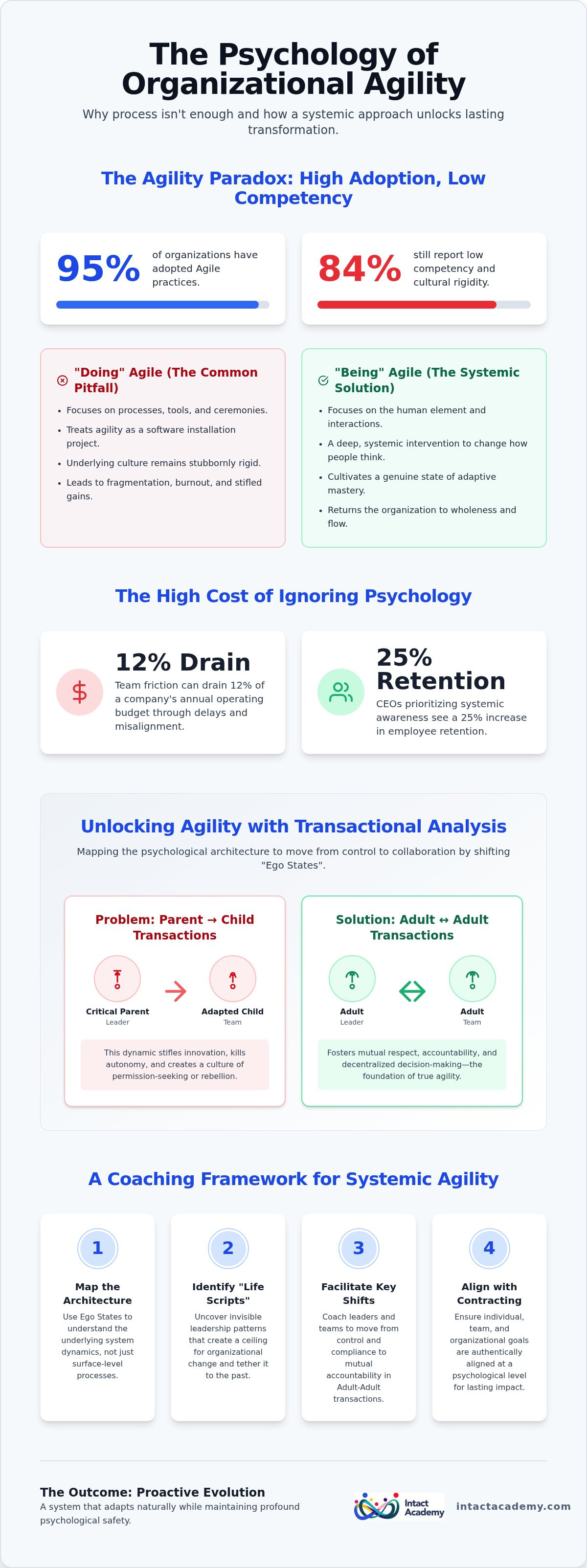
What if the persistent resistance to your latest transformation isn't a lack of process, but an unconscious script protecting the status quo? You've likely experienced the frustration of installing new frameworks only to watch cultural rigidity and burnout stifle every gain. Effective organizational agility coaching acknowledges that while nearly 95% of organizations have adopted Agile practices, 84% still report low competency levels because they focus on "doing" rather than "being." We agree that true change requires more than a methodology; it requires a systemic intervention that honors the human element.
You deserve a path that moves beyond surface-level ceremonies to cultivate deep, adaptive mastery. In this guide, we promise to reveal how Transactional Analysis can unblock the psychological scripts that cause fragmentation and exhaustion. We'll preview a framework for mapping ego states in the boardroom, interrupting the psychological games that stall innovation, and ultimately returning your organization to a state of wholeness and proactive evolution. By looking inward before taking outward action, you can build a system that adapts naturally to market shifts while maintaining profound psychological safety.
Key Takeaways
- Understand why effective organizational agility coaching shifts the focus from superficial process implementation to deep systemic intervention.
- Map the psychological architecture of your organization using Ego States to foster the Adult-Adult transactions necessary for autonomous decision-making.
- Identify how the invisible Life Scripts of leadership create a ceiling for change, keeping the organization tethered to rigid, historical patterns.
- Apply a multi-level contracting framework to ensure that individual, team, and organizational goals are authentically aligned for lasting transformation.
- Discover a path to mastery through the TA EMCC Senior Practitioner academy, where profound human insight meets professional pragmatism.
Beyond the Buzzwords: What is Organizational Agility Coaching?
Most organizations approach agility as an installation project, focusing on ceremonies and software while the underlying culture remains stubbornly rigid. True organizational agility coaching is not a process implementation; it is a systemic intervention that addresses the very fabric of how a collective thinks and interacts. This evolution is a prerequisite for broader Business Agility, moving from localized efficiency to enterprise-wide responsiveness. At its core, we define organizational agility coaching as the facilitation of a system's capacity to return to wholeness while adapting to change.
Coaching serves as the essential bridge between high-level leadership vision and daily operational reality. Without this systemic support, the most ambitious strategic pivots often crumble against the invisible walls of departmental silos and historical habits. By focusing on the system rather than just the individual, coaches help organizations transition from a fragmented state to one of integrated flow. It's about moving beyond tools to cultivate a genuine cultural state of being.
The Evolution from Individual to Systemic Agility
While individual mindset coaching has its place, it is insufficient for enterprise-wide transformation. The coach must act as a systemic observer and catalyst, identifying the parallel processes where team-level behaviors mirror leadership dynamics. This awareness allows for interventions that ripple across the entire structure, ensuring that individual growth directly fuels organizational success. For those seeking to lead this change, the TA EMCC Senior Practitioner academy provides the necessary depth to navigate these complex human systems without getting lost in the transactional noise.
The Business Case for a Psychologically Grounded Approach
The financial implications of cultural rigidity are stark. Team friction can drain 12% of a company's annual operating budget, creating a silent tax on every initiative through delay and misalignment. By prioritizing systemic awareness, organizations can reduce this friction and foster a culture of resilience. A 2022 survey of 500 CEOs revealed that those who prioritize systemic awareness saw a 25% increase in employee retention. A psychologically grounded approach moves the system from reactive survival to proactive evolution, creating a space where market shifts are seen as opportunities for growth rather than threats to be managed.
The Psychological Architecture of an Agile Organization
To build a truly responsive system, we must look at the psychological architecture that supports it. Using Transactional Analysis (TA), we can map the "Ego States" of a corporation to understand why certain behaviors persist despite new process implementations. Real organizational agility coaching focuses on moving the system into an "Adult-Adult" transaction. This is the only sustainable mode for decentralizing decision-making; it replaces the hierarchy of control with a network of accountability. When leaders and teams operate from this grounded state, they bypass the "Psychological Games" that typically stall innovation. Before any tactical shift begins, we must focus on "Contracting for Change." This process ensures every stakeholder is aligned at a psychological level rather than just a procedural one, creating a stable container for the turbulence of transformation.
Ego States in the Boardroom: Facilitating Adult-Adult Cultures
Parental leadership styles, while often well-intentioned, inadvertently stifle the "Creative Child" energy required for breakthrough innovation. When a leader acts as a Critical Parent, teams retreat into a compliant or rebellious Adapted Child state. This dynamic kills autonomy and creates a culture of permission-seeking. Coaches must intervene by inviting leaders back into their Adult ego state, especially during high-stakes pivots where the urge to control is highest. You can explore our guide on what is transactional analysis to understand these dynamics more deeply. By fostering this maturity, you are essentially building an agile culture through coaching that relies on mutual respect rather than institutional fear.
Uncovering the Organizational Script
An organizational script acts as a powerful, unconscious life plan for the system. It dictates the limits of agility by enforcing "Don't" injunctions that were often formed during the company's founding years or through past failures. Common corporate scripts include "Don't be successful," which manifests as self-sabotage when reaching a certain scale, or "Don't change," which appears as an obsessive clinging to legacy identity despite market shifts. Through organizational agility coaching, we can identify these scripts and perform "re-scripting" interventions. This involves challenging the historical narrative to allow for new, flexible behaviors. It's a process of returning the organization to its state of completeness and genuineness. If you're ready to deepen your impact, consider how the TA EMCC Senior Practitioner academy can equip you with these systemic tools.
Why Traditional Change Initiatives Fail: The Rigidity of Corporate Scripts
Systems often exhibit a striking paradox: they fight to remain the same even when the status quo is demonstrably painful. This resistance isn't a failure of logic, but a result of organizational homeostasis. In this context, organizational agility coaching moves beyond typical consulting by identifying the "invisible ceiling" created by the Life Scripts of founders and key leaders. If a leader’s internal narrative unconsciously prioritizes control over collaboration, the entire organization will sabotage agile efforts to stay in alignment with that script. Without addressing these deep-seated psychological patterns, new frameworks are simply painted over old, rigid structures.
Failure also stems from "Discounting," a psychological mechanism where teams ignore significant data, such as burnout or market shifts, until they become crises. This avoidance serves as a defense against the perceived threat of change. Effectively leading organizational change requires addressing the human element of mergers and acquisitions, where conflicting corporate scripts often create a toxic paralysis that no amount of process mapping can solve. By bringing these unconscious patterns into the light, we create the possibility for genuine movement.
The Systemic Resistance to Agility
Organizations function like living organisms that seek balance. When a top-down mandate is forced upon a system, it doesn't create compliance; it triggers psychological rebellion. The system perceives the change as an attack on its identity and retreats into familiar, defensive behaviors. The coach’s role here is to hold a "Stable Container." This means providing a safe, consistent space where the turbulence of un-scripting old habits can occur without the system collapsing into chaos. It's a process of slowing down to eventually move much faster.
From Rigidity to Resilience: Breaking the Cycle
Breaking the cycle of stagnation demands systemic restructuring rather than surface-level behavioral fixes. By integrating Sari van Poelje’s insights on mastering systemic change, coaches can look past technical resistance to the underlying emotional needs of the collective. For example, a tech firm recently struggled with fragmented teams despite perfect Scrum metrics. By diagnosing their script as "Don't be close," the intervention shifted from process training to relational contracting. This shift didn't just improve velocity; it returned the organization to a state of wholeness where teams finally felt safe enough to innovate proactively.
Facilitating the Shift: A Coaching Framework for Systemic Agility
To move from understanding to action, we require a methodology that respects the system's complexity. A structured framework for organizational agility coaching ensures that transformation isn't just a series of workshops, but a permanent shift in the collective consciousness. This journey begins with Systemic Diagnosis. We map the current organizational script and the dominant ego states that dictate daily interactions. Once the current state is clear, we move to Multi-Level Contracting. This step is vital; it aligns individual aspirations with team objectives and overarching organizational goals. Without this alignment, the system will continue to pull in conflicting directions.
The third step is Intervention. Here, we use TA tools to interrupt the psychological games identified earlier, inviting participants back into Adult-to-Adult problem-solving. This is followed by Integration, where we embed these new agile behaviors into the systemic structure through ongoing supervision. Finally, we focus on Evaluation, measuring concrete shifts in psychological safety and the organization's adaptive capacity to meet market shifts. This methodical approach creates a stable container where deep learning can occur without triggering the system's defensive rejection.
Systemic Team Coaching for Agile Execution
Teams are the engine room of agility. For coaches, choosing the right team coaching course is vital to master high-stakes facilitation without getting hooked by the system's existing patterns. By applying systemic awareness, you can move a group from a collection of individuals to a high-performing team that self-regulates and innovates. This level of mastery allows the coach to remain a neutral catalyst rather than a participant in the team's friction. It's about fostering an environment where wholeness and professional pragmatism coexist.
The Role of Supervision in Agility Coaching
Mastery in organizational agility coaching requires the coach to have their own stable container. Systemic supervision is essential to remain objective and avoid becoming an unconscious part of the organizational game. Using tools like the 7-Eyed Model, coaches can look at the organization through the lens of their coaching relationship, identifying parallel processes that might otherwise go unnoticed. This reflective practice ensures that your interventions remain clean, ethical, and profoundly effective. If you're ready to elevate your practice to this level of systemic depth, explore the professional development pathways at Intact Academy today.
Cultivating Mastery: The Intact Academy Approach to Agility
Intact Academy exists at the intersection of human depth and business results. We believe that true organizational agility coaching requires more than just process knowledge; it demands a profound understanding of the human systems that drive performance. Our approach bridges the gap between psychological insight and pragmatic outcomes, allowing consultants to navigate the often-turbulent waters of systemic change with grace and precision. By joining our academies, you enter a global community of practitioners who are dedicated to returning organizations to a state of completeness and genuineness. This isn't just about efficiency; it's about the flourishing of every individual within the system.
Our curriculum is designed for those who have seen the limitations of surface-level frameworks and seek a more stable container for their work. Led by global expert Sari van Poelje, we provide a pathway to master the complexities of human behavior in a corporate context. Whether you are facilitating a massive strategic pivot or resolving deep-seated cultural rigidity, our methodology provides the intellectual rigor and empathetic grounding necessary for success. We move beyond the frantic energy of typical business training, opting instead for a reflective and inviting style that honors your maturity as a leader.
Professional Development for the Modern Agility Coach
In 2026, the demand for coaches who can manage enterprise-wide complexity is higher than ever. Effective professional development for coaches must move beyond basic competencies to include systemic and Transactional Analysis training. Our programs are EMCC and ICF accredited, offering a clear path to achieve the EMCC Senior Practitioner level. This designation signifies your ability to intervene at the highest levels of an organization with calm authority. Our wholeness-based philosophy ensures that you don't just fix isolated problems; you facilitate the evolution of the entire system, helping it adapt naturally to market shifts while maintaining psychological safety.
Next Steps on Your Journey to Mastery
The path to becoming a master in organizational agility coaching is a deliberate process of deep learning. We invite you to explore the TA EMCC Senior Team Coach Academy, which focuses specifically on the dynamics of systemic agility within groups. Our upcoming academy dates and flexible online training options allow you to integrate this learning into your professional life without rushing the process. You'll learn to apply Transactional Analysis directly to your current organizational change projects, turning theory into immediate impact. This is your invitation to move beyond transactional coaching and into the realm of profound human transformation. Discover our TA EMCC Senior Practitioner academy and elevate your impact.
Stepping into the Future of Systemic Agility
True transformation begins when we stop treating organizations as machines and start honoring them as complex human systems. We've explored how the deep architecture of ego states and corporate scripts dictates the success of any agile initiative. By moving beyond surface-level frameworks, you can facilitate a return to wholeness that allows for natural, fluid adaptation. This shift requires a commitment to looking beneath the surface of behavior to the unconscious patterns that hold a collective in place. It's about moving from reactive survival to proactive evolution.
Effective organizational agility coaching is the bridge between these profound psychological insights and lasting business results. With training delivered across 14+ countries and programs holding the prestigious EMCC Senior Practitioner Accreditation, Intact Academy provides the psychologically grounded TA methodology you need to lead this change. Explore our TA EMCC Senior Practitioner academy and master systemic change.
You possess the capacity to transform not just how a business functions, but how its people flourish. The journey to mastery is a steady, rewarding evolution of both the self and the system. We invite you to step into this space of quiet power and lead your organization toward its most genuine potential.
Frequently Asked Questions
What is the difference between Agile coaching and organizational agility coaching?
Agile coaching typically focuses on team-level frameworks like Scrum or Kanban to improve delivery speed. Organizational agility coaching addresses the entire system's capacity to adapt. It moves beyond process implementation to look at the psychological architecture and cultural scripts that either enable or block responsiveness. While an Agile coach might fix a team's velocity, an organizational agility coach facilitates the system's return to wholeness and enterprise-wide flow.
How does Transactional Analysis help with organizational agility?
Transactional Analysis (TA) provides a clear map of the ego states and transactions that drive corporate behavior. By identifying Parent-Child dynamics that stifle innovation, coaches can invite leaders and teams into Adult-Adult problem-solving. This shift is essential for decentralized decision-making. TA helps unmask the unconscious games that stall progress, allowing the organization to move from rigid defensiveness to a more flexible, authentic state of being.
Can agility coaching work in highly regulated or traditional industries?
Yes, it's particularly effective in regulated sectors where rigidity is often a survival mechanism. In these environments, organizational agility coaching helps distinguish between necessary compliance and unnecessary psychological barriers. By addressing the underlying scripts that equate safety with total control, coaches can foster adaptive mastery without compromising regulatory integrity. This approach allows traditional firms to innovate within their constraints, creating a more resilient and responsive system.
What qualifications do I need to become an organizational agility coach?
A background in leadership or systemic consulting is foundational, but deep mastery requires accredited training. Programs such as the TA EMCC Senior Practitioner academy provide the psychological depth needed for systemic interventions. You should look for certifications recognized by global bodies like the EMCC or ICF. These qualifications ensure you have the intellectual rigor to manage complex human systems and the ethical grounding to facilitate profound transformation.
How long does a systemic organizational agility intervention typically take?
A systemic intervention is a deliberate process rather than a quick fix. While initial diagnosis and contracting might occur over several weeks, a full cultural shift usually takes six to eighteen months. The timeline depends on the complexity of the existing organizational script and the system's readiness for change. It's a methodical journey of un-scripting old habits and embedding new, agile behaviors through consistent coaching and supervision.
How do you measure the success of organizational agility coaching?
Success is measured through both operational metrics and psychological shifts. We look for increased flow metrics and business value realization alongside improved psychological safety scores. A 2022 survey showed CEOs prioritizing systemic awareness saw a 25% increase in employee retention. Reduced cost of team friction, which typically drains 12% of operating budgets, also serves as a key indicator. Ultimately, success is the system's ability to adapt naturally to market shifts.
What is the "Organizational Script" and why does it matter for agility?
The Organizational Script is an unconscious life plan for the system, often inherited from founders or past crises. It acts as an invisible ceiling, enforcing "Don't" injunctions like "Don't change" or "Don't be successful." These scripts matter because they override any new process or framework you try to install. Recognizing and re-scripting these patterns is the only way to achieve lasting agility and return the organization to its state of completeness.
How can I integrate TA into my existing coaching practice?
Integration begins with your own professional development and systemic supervision. You can start by applying TA concepts like Ego States and Contracting to your current executive or team sessions. Enrolling in a specialized program like the TA EMCC Senior Team Coach Academy provides the structured methodology to bridge theory and practice. This allows you to move from surface-level behavioral coaching to deep, systemic interventions that honor the maturity of your clients.


