

What if the conflict currently fracturing your team isn't a sign of failure, but a prerequisite for the very wholeness you seek? Most leaders feel a quiet sense of dread when a once-stable group begins to splinter. It's exhausting to watch superficial harmony dissolve into the emotional intensity of the "Storming" phase, especially when traditional team-building efforts fail to create lasting change. Understanding tuckman's stages of group development through a systemic lens reveals that these moments of regression are often necessary steps toward a deeper maturity and collective flow.
We believe that a team is more than a collection of skills; it's a living system governed by unconscious psychological contracts. This article provides a deep psychological understanding of group evolution by viewing the classic model through the lens of Transactional Analysis. You'll gain practical tools to facilitate teams through each stage, from the initial Forming in 1965 to the crucial addition of Adjourning in 1977. By mastering these undercurrents, you can move beyond surface-level fixes to facilitate sustainable transformation and reach a state of systemic wholeness. We will examine how to recognize the hidden scripts within your team and provide a roadmap for navigating the often-turbulent journey toward high performance.
Key Takeaways
- Decode the hidden psychological contracts within tuckman's stages of group development to move teams from superficial stability to profound, sustainable transformation.
- Learn to facilitate the Storming phase by recognizing how individual Life Scripts interact, turning potential dysfunction into a catalyst for creative tension.
- Explore why the Adjourning stage is critical for systemic health, ensuring that teams disband with closure to avoid the lingering impact of organizational ghosts.
- Transition from a skill-based approach to a systemic perspective that honors the process of becoming, allowing teams to achieve a state of genuine wholeness.
- Discover why the Performing stage is not a fixed destination but a dynamic state of systemic wholeness that requires constant, insightful facilitation to maintain.
Understanding Tuckman's Stages of Group Development in 2026
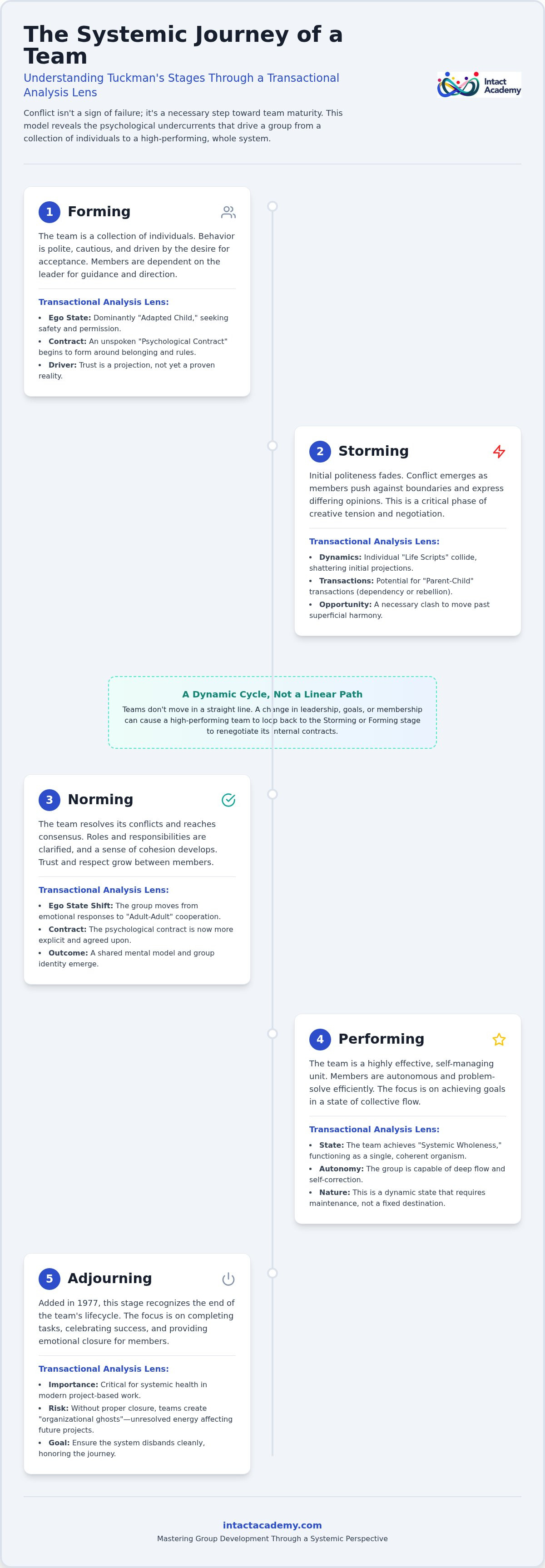
The framework of Tuckman's stages of group development remains the foundational architecture for understanding how people transform from a collection of individuals into a high-performing system. Even in 2026, where digital interfaces and agile sprints dominate the professional landscape, the fundamental human need for psychological safety and role clarity hasn't changed. Groups, much like individuals, possess a developmental arc that reflects their internal maturity and external effectiveness. This model provides a map for the five stages: Forming, Storming, Norming, Performing, and finally, Adjourning. Group Development is a systemic evolution of trust and task-competence.
The Evolution of the Model: From Four Stages to Five
While the original 1965 framework focused on the journey toward performance, the addition of Adjourning in 1977 by Bruce Tuckman and Mary Ann Jensen recognized the emotional complexity of endings. In our modern, project-based economy, teams dissolve as quickly as they form. Without a structured Adjourning phase, the system carries unresolved energy into the next venture. It's a mistake to view these stages as a simple linear progression. Teams don't just move from one to the next; they breathe and pulse. A sudden change in leadership or a shift in organizational strategy can cause a team to loop back to Storming or even Forming. These systemic shifts aren't failures of leadership but natural responses to environmental changes that require the group to re-negotiate its internal contracts.
Why Group Dynamics Matter for Professional Coaches
For the professional coach, these dynamics are the raw material of transformation. True mastery requires moving beyond surface-level facilitation to systemic intervention. You aren't just managing a meeting; you're acting as a container for the group's developmental energy. This requires a deep understanding of the human psyche. By linking these stages to the what is transactional analysis framework, coaches can identify the ego states and scripts that drive behavior during each phase. When a team is stuck in Storming, it's often because individual Life Scripts are clashing with the collective goal. A systemic coach doesn't just resolve the conflict; they help the group integrate these different perspectives to reach a state of completeness. Understanding tuckman's stages of group development allows you to predict these moments of tension and hold the space necessary for the team to evolve.
The Psychology of the Stages: A Transactional Analysis Lens
While many models describe what happens in a team, Transactional Analysis (TA) explains why it happens. Most mechanical interpretations of Tuckman's stages of group development overlook the unconscious architecture that governs human interaction. Every group begins by forming a "Psychological Contract." This is the unspoken set of expectations regarding belonging, safety, and recognition. In this early phase, the system is fragile because trust is often a projection rather than a proven reality. People are testing the waters, looking for cues on how to exist within the new collective.
As the team moves into Storming, these projections inevitably shatter. We see this phase not as a failure of leadership, but as a necessary clash of individual "Life Scripts." Each member brings their own unconscious life plan, formed in childhood, into the professional arena. When these scripts collide, the resulting friction creates the "storm." Norming represents the pivotal shift where the group moves from Parent-Child transactions, characterized by dependency or rebellion, into Adult-Adult cooperation. Finally, Performing is reached when the group attains systemic wholeness. It's a state of autonomy where the team functions as a single, coherent organism, capable of self-correction and deep flow.
Ego States in the Forming and Storming Phases
In the Forming stage, individuals often inhabit the "Adapted Child" ego state. They're looking for external permission and safety, often following rules or mirroring the leader to avoid rejection. However, as the group matures, the "Rebellious Child" or "Critical Parent" ego states frequently emerge to fuel the Storming phase. One member might criticize the process from a place of perceived superiority (Critical Parent), while another resists the structure to assert their individuality (Rebellious Child). A coach's primary task is to facilitate the transition to "Adult" ego states. By inviting members to observe their own reactions, you help them move from reactive patterns to conscious, Adult-level choices that allow for true Norming.
Contracting for Group Success
Effective facilitation relies on the TA concept of "The Three-Cornered Contract." This framework aligns the needs of the individual, the team leader, and the overarching organization. When you make these contracts explicit, you provide the team with a container strong enough to hold the intensity of the Storming phase. Explicit contracting reduces the duration of destructive conflict by clarifying boundaries and expectations before the pressure mounts. For those seeking to deepen their impact, exploring professional development for coaches can provide the advanced systemic tools needed to navigate these complex human undercurrents with grace and authority. This clarity ensures that the group doesn't just survive the storm, but uses it as a catalyst for genuine evolution.
Navigating the Storm: Why Conflict is Essential for Performance
The most frequent question leaders ask is whether it's possible to bypass the Storming phase of tuckman's stages of group development. There is a deep, human desire to maintain the polite harmony of the Forming stage, yet attempting to skip the storm is a systemic mistake. Without this period of friction, a team cannot achieve true intimacy or high performance. Instead, they risk falling into "Pseudo-Norming," a state where a facade of agreement masks unresolved tension and unspoken scripts. We must distinguish between destructive conflict, which targets the person, and creative tension, which interrogates the task and the system. Challenging the initial, often superficial leadership established during the Forming stage is a vital necessity. It marks the moment the group stops being a collection of followers and begins the work of becoming a co-creative entity. Storming is not a sign of failure, but a prerequisite for authentic Norming.
The Coach's Intervention During Storming
When a group enters the Storming phase of tuckman's stages of group development, the coach's primary duty is to remain firmly in the Adult ego state. It's easy to be pulled into a Critical Parent role to restore order or an Adapted Child role to avoid the group's rising heat. Your role is to act as a container for the group's developmental energy. You do this by highlighting "Injunctions," those unspoken, invisible rules that hold the team back. These might include scripts like "don't be important" or "don't disagree with the expert." By naming these patterns, you help the group move from competitive games, where members fight for status, to cooperative games, where they align for a shared purpose. This shift allows the group to integrate their differences rather than being divided by them.
Building Psychological Safety to Enable Norming
The transition to Norming requires a level of vulnerability that can only exist within a stable container. As a coach, you provide this safety by holding the group's collective aggression and anxiety without reacting defensively. This allows members to drop their professional masks and engage in honest dialogue. Psychological safety isn't about the absence of conflict; it's about the presence of a structure strong enough to handle the truth. If the container is too weak, the team will Pseudo-Norm, agreeing to superficial rules that they have no intention of following just to end the discomfort. Authentic Norming occurs when the system reorganizes itself around genuine trust and clear, Adult-level contracts. This process of becoming requires the courage to stay with the tension until it transforms into a new, more resilient form of collective wholeness.
Practical Guidance: Facilitating the Adjourning Phase
Adjourning is frequently the most neglected phase of tuckman's stages of group development in modern corporate culture. We live in an era of rapid transitions where the focus is almost exclusively on the next launch or the next sprint. However, failing to provide a structured ending creates "Organizational Ghosts." These are the unresolved tensions, unexpressed appreciations, and lingering frustrations that team members carry into their next systems. When a group entity is disbanded without closure, the psychological residue can haunt future collaborations, leading to a cycle of cynicism or a lack of commitment in new teams. Mourning the end of the group is not a sign of weakness; it is a systemic necessity that allows individuals to return to a state of wholeness before moving forward.
A 4-Step Process for Healthy Group Adjournment
Facilitating a healthy ending requires a deliberate, methodical approach. It begins with recognizing the end and acknowledging achievements. This is more than a superficial celebration; it is a deep validation of the collective journey. Second, the coach must help the group process "Systemic Residue." This involves clearing any remaining Adult-level conflicts or Child-level anxieties that were not fully resolved during the Performing stage. Third, ritualizing the departure is essential. Whether through a final reflective circle or a symbolic handover, rituals provide the psychological "stop" required for the brain to register completion. Finally, the team must integrate their lessons into the next leading organizational change initiative. This ensures that the wisdom gained is not lost but becomes a foundational asset for the organization's future. For those ready to master these complex transitions, our TA EMCC Senior Team Coach Academy offers the deep methodology required for high-stakes facilitation.
The Role of Supervision in Team Transitions
High-stakes group endings often trigger intense emotional responses, not only for the team but for the coach as well. This is why systemic supervision is critical during the Adjourning phase. Coaches frequently experience counter-transference, where their own personal history with endings and loss begins to color their professional interventions. You might find yourself wanting to rush the ending to avoid discomfort or lingering too long because of a personal attachment to the group's success. Supervision provides a stable container for you to process these internal movements. By engaging in systemic reflection, you maintain your professional mastery and ensure that you are holding the space for the team's needs rather than your own. This reflective practice is what distinguishes a transactional facilitator from a systemic expert who honors the full developmental arc of the human system.
Mastering Group Development with Intact Academy
Navigating the complex landscape of group dynamics requires more than a checklist or a surface-level understanding of tuckman's stages of group development. It demands a fundamental shift in professional identity. To move from a facilitator who simply manages tasks to a Senior Team Coach who facilitates profound transformation, you need a stable container for your own development. Our academy bridges the gap between psychological theory and organizational reality, offering a space where complex systemic issues feel manageable through insight and structured methodology. Our TA EMCC Senior Team Coach Academy is specifically designed for those who seek to master the unconscious undercurrents of the human system. Under the guidance of Sari van Poelje and our global faculty, you'll learn to apply Transactional Analysis to facilitate teams toward a state of systemic wholeness. This isn't just about business results; it's about returning to a state of completeness and genuineness within the professional sphere.
Accredited Pathways to Mastery
We offer programs that provide a rigorous path toward professional excellence through EMCC Senior Practitioner and Team Coach certifications. We understand that the modern professional requires flexibility without sacrificing intellectual or emotional depth. Our unique blend of online and in-person learning allows participants from across the globe to engage in deep, transformative work that resonates across borders. This systemic approach is the future of executive coaching certification. It moves beyond individual performance to consider the health and evolution of the entire organizational organism. By integrating these accredited frameworks, you gain the authority to lead high-stakes interventions that result in lasting, sustainable change rather than temporary, surface-level shifts.
Join a Global Community of Systemic Change Agents
Transformation doesn't happen in isolation. At Intact Academy, you join a vibrant community of professionals from over 14 countries. This diversity enriches the learning process, offering a truly global perspective on how tuckman's stages of group development manifest across different cultures and organizational structures. Your journey doesn't end with a single certificate. We provide ongoing support through systemic supervision and specialized masterclasses to ensure your professional mastery continues to evolve alongside the systems you facilitate. This is a lifelong commitment to your own wholeness as much as it is to the flourishing of the teams you serve. Deepen your impact by mastering the art and science of group development and join us in facilitating a more conscious, integrated professional world.
Facilitating the Path to Systemic Wholeness
Mastering group dynamics requires looking beneath the surface of behavior to the unconscious contracts that bind a team together. By applying Transactional Analysis to tuckman's stages of group development, you transform from a facilitator of tasks into a catalyst for profound human evolution. You've learned that the intensity of the storm is not a sign of failure, but a necessary bridge to the systemic wholeness of high performance. This work is both an art and a science; it requires the courage to stay present with tension until it resolves into a new state of being.
If you're ready to move beyond surface-level skills to achieve sustainable transformation, we invite you to enroll in our TA EMCC Senior Team Coach Academy to master systemic group dynamics. Our EMCC and ICF accredited programs, led by international expert Sari van Poelje, provide the stable container you need for this deep developmental work. Your commitment to wholeness is the compass that will guide your teams toward their highest potential.
Frequently Asked Questions
Can a group skip the Storming stage?
Skipping the Storming phase is a systemic impossibility if you desire high performance. While teams might suppress conflict to maintain a facade of harmony, this "Pseudo-Norming" prevents the group from negotiating the real psychological contracts necessary for depth. Conflict is the energy that breaks down individual Life Scripts to allow for a collective identity. Without it, the team remains a collection of individuals rather than a cohesive system.
How long does it take to reach the Performing stage?
There is no fixed timeline for a group to reach maturity. The duration depends on the complexity of the task, the emotional intelligence of the members, and the quality of the coaching container. Some teams might move through the early stages of tuckman's stages of group development in weeks, while others remain stuck in Storming for months. The key isn't speed, but the thoroughness of the psychological work done in each phase.
What happens if a new member joins the team during the Performing stage?
The entry of a new member fundamentally alters the system's boundaries, causing the team to loop back to the Forming stage. Even if the group was previously in a state of systemic wholeness, they must now re-negotiate roles and re-establish trust. This regression isn't a failure; it's a necessary recalibration. A systemic coach facilitates this by helping the group integrate the new member's script into the existing team culture.
Is Tuckman's model still relevant for remote or hybrid teams?
The model is perhaps more relevant now than it was in 1965. While the medium of interaction has changed, the underlying human needs for safety and recognition remain constant. Remote teams often struggle with the Forming phase due to a lack of physical cues, which can lead to prolonged, unspoken Storming. Coaches must be more intentional about creating digital containers that allow for the emotional intensity required to reach Norming.
What is the difference between Norming and Performing?
Norming is characterized by the establishment of Adult-Adult cooperation and agreed-upon rules, whereas Performing is a state of autonomous flow and systemic wholeness. In Norming, the team is still consciously following the structure they've built. In Performing, that structure becomes second nature. The group shifts from focusing on how they work together to focusing on the mission, with a level of trust that allows for rapid, intuitive self-correction.
How can a coach help a team that has regressed from Performing to Storming?
Regression is often triggered by an external systemic shift, such as a change in leadership or organizational strategy. A coach helps by naming the regression without judgment. By identifying the Injunctions or scripts that have resurfaced, you can guide the team back to an Adult ego state. This involves revisiting the psychological contract to see what needs updating to hold the current reality of the group's environment.
Why is the Adjourning stage important for organizational culture?
Adjourning, added to tuckman's stages of group development in 1977, provides the closure necessary to prevent Organizational Ghosts. When teams disband abruptly, unresolved tensions and unexpressed appreciations linger in the system. This systemic residue can negatively impact future teams. Proper adjournment allows members to mourn the group entity, integrate their learnings, and move into their next roles with a sense of personal and professional completeness.
Can a group be in two stages at once?
Human systems are rarely linear; they are dynamic and pulsing. A team might be Performing on a routine task while simultaneously Storming over a new, complex challenge. This duality reflects the complexity of the group's developmental arc. A systemic coach observes these different layers of maturity, helping the group maintain their Adult cooperation in one area while holding the space for the necessary conflict and growth in another.


