

What if the title on your office door has almost nothing to do with the actual influence you wield within your organization? In 2026, research reveals that 60% of employees report to a boss they consider toxic, a statistic that highlights a profound failure in how we traditionally understand authority. You might find yourself holding a senior position yet feeling strangely paralyzed by invisible resistance or the heavy weight of office politics. This is why coaching leaders on power dynamics is no longer optional for those who seek to lead with integrity. It's a journey into the subterranean psychological currents that dictate how energy and decisions truly flow through a system.
You already know that a formal hierarchy doesn't always translate to genuine movement, and you've likely felt the frustration of watching healthy initiatives wither in the face of unspoken scripts. This article promises to help you master these invisible currents by applying Transactional Analysis and systemic insights to your leadership practice. We'll examine a sophisticated psychological framework for understanding influence and provide you with practical tools to facilitate healthy dynamics. You'll discover how to move beyond surface level management into a state of systemic mastery where organizational change becomes a natural evolution rather than a constant struggle.
Key Takeaways
- Deepen your understanding of influence by distinguishing between formal authority and the psychological currents that truly drive systemic change.
- Utilize Transactional Analysis to decode how Ego States shape daily interactions and transform traditional reward power into meaningful recognition.
- Neutralize toxic office politics by identifying the psychological games and Drama Triangle roles that hinder collective progress.
- Develop a sophisticated competency in coaching leaders on power dynamics to facilitate healthy, transparent influence within high-performing teams.
- Integrate systemic theory with professional practice to master the art of organizational transformation while maintaining personal and professional integrity.
Redefining Power in Organisations: From Hierarchy to Systemic Influence
Power is often misunderstood as a static resource or a trophy to be won. In the sophisticated work of coaching leaders on power dynamics, we shift the focus from who holds power to how power moves through the collective. We define power as the capacity to influence the system and achieve sustainable transformation. It's not a personal possession; it's a systemic flow that requires both awareness and responsibility to channel effectively. To understand this, we must look beyond the formal org chart and explore various theories of social and political power that distinguish between the badge of office and the weight of one's presence.
Formal authority is a legitimate right granted by the organization, yet it's often hollow without psychological power. This internal influence is what allows a leader to move hearts and minds when the contract isn't enough. Systemic power is a neutral energy within the 2026 organizational landscape. It's neither inherently benevolent nor destructive; its impact is determined by the clarity and integrity of the leader who directs it. When we view power as a systemic energy, we stop blaming individuals and start observing the patterns that facilitate or block progress.
The Evolution of Authority in the 2026 Workplace
The traditional model of legitimate power is undergoing a profound shift as decentralized structures become the standard. In the 2026 workplace, the command-and-control approach has lost its efficacy. Leaders now find that expert power is rising in value, particularly as teams integrate complex AI systems into their daily workflows. Those who understand the technology's nuances gain a natural influence that transcends their job title. Referent power, built on trust and relational depth, has become the primary currency for modern leaders. It's the ability to lead because people want to follow you, not because they're required to. This relational grounding is a critical focus in coaching leaders on power dynamics, as it ensures authority is rooted in authenticity rather than just position.
Formal vs. Informal Power: The Invisible Org Chart
Every organization has two structures: the one printed on the website and the invisible network where decisions are actually made. Mapping the difference between who has the title and who has the influence is essential for any professional leading organizational change. Informal power networks can either accelerate a transformation or quietly stall it through passive resistance. In our transparent, modern organizations, informational power plays a vital role. It's no longer about hoarding data, but about the ability to synthesize and share insights that provide clarity to the system. When a leader masters the invisible org chart, they can align these informal currents with the organization's formal goals, creating a state of systemic wholeness.
The Psychology of Influence: Using Transactional Analysis to Map Power
To understand why organizational behavior often feels repetitive or stuck, we must look at the psychological bedrock of human interaction. Transactional Analysis (TA) provides a sophisticated framework for decoding workplace power dynamics, moving beyond surface-level management tactics into the unconscious drivers of influence. When coaching leaders on power dynamics, we analyze the specific Ego States from which individuals operate, as these internal structures determine whether power is used to build or to destroy. A leader’s Life Script dictates their relationship with authority, acting as an unconscious blueprint that guides every high-stakes decision and relational conflict.
The goal of any systemic intervention is to move toward an Adult-to-Adult power contract. This contract serves as the foundation for healthy organizations, ensuring that influence is based on shared reality, mutual respect, and clear objectives. Without this psychological grounding, even the most well-intentioned leaders can find themselves trapped in cycles of control and resistance. For those seeking to deepen their impact, exploring our advanced training can provide the necessary tools to navigate these complex human landscapes with precision.
Ego States and the Exercise of Authority
Power is rarely expressed as a neutral force; it's filtered through our internal psychological states. The Controlling Parent state manifests as coercive power, where authority is used to restrict, criticize, or micro-manage. This often triggers the Adapted Child state in employees, leading to a culture of either compliant "yes-people" or subtle, passive rebellion. In contrast, the Adult state facilitates power through negotiation, transparency, and shared goals. By operating from the Adult, leaders invite others to do the same, creating a space where navigating power dynamics in coaching becomes a collaborative process of alignment rather than a battle of wills.
Life Scripts and Leadership Authority
The way a CEO handles a boardroom challenge often mirrors decisions made long before they entered the corporate world. These early childhood decisions about power manifest in the C-suite as repeating patterns of behavior, often referred to as the Life Script. A toxic power holder frequently operates from an "I’m OK, You’re Not OK" position, viewing others as obstacles to be overcome or tools to be utilized. This defensive posture masks a deeper vulnerability but results in a fragmented, low-trust system. Transforming these leadership scripts requires more than a weekend workshop; it demands a commitment to professional development for coaches and practitioners who can facilitate deep, lasting change. By rewriting these internal narratives, leaders can shift from a script of domination to one of authentic, systemic contribution.
Sources of Power: Integrating Classic Models with Systemic Insight
Traditional models often treat power as a checklist of individual traits. When coaching leaders on power dynamics, we must view these bases as systemic properties that define the health of the entire organization. French and Raven's classic 5 Bases of Power take on new meaning when viewed through a systemic and psychological lens. They aren't just tools for control; they're indicators of how energy is distributed within a team.
Reward Power, for instance, is frequently reduced to financial incentives. From a Transactional Analysis perspective, it's actually about the distribution of strokes, which are units of human recognition. A leader who masters the flow of positive strokes creates a system of abundance; one who withholds them creates a starvation economy that breeds resentment. Conversely, Coercive Power carries a devastating long-term cost. In 2026, where 68.9% of workers report having experienced toxic environments, we see that coercion effectively destroys psychological safety. It might produce short-term compliance, but it kills the innovation and vulnerability required for deep growth. Expert Power, however, serves as a vital bridge to systemic mastery. It's not just about what you know; it's about how your expertise serves the collective evolution of the team.
Beyond French and Raven: The Systemic Sources
Power also emerges from sources that aren't tied to an individual's personality or title. These systemic sources include:
- Historical Power: The lingering influence of founders and the ghosts of past leaders whose decisions still dictate current behavior long after they've left.
- Resource Power: The ability to direct the flow of energy and attention within the system, which is often more influential than budget control.
- Network Power: The strength of systemic connections that allows information to bypass formal channels, revealing the true pathways of influence.
Understanding these sources is essential when coaching leaders on power dynamics, as it helps them navigate the invisible architecture of the organization rather than just the formal chart.
The Invisible Power of Organizational Culture
Culture acts as a collective script. It dictates who's allowed to speak, who's heard, and who's permitted to hold influence. To truly understand these hidden forces, we must ask what is transactional analysis and how it helps us uncover the unconscious contracts within a group. Referent Power plays a central role here. It's the power of being OK and inviting others into that same state of completeness and genuineness. By building high-trust, agile cultures, leaders can move away from coercive models and toward a system where influence is earned through integrity and systemic alignment.
Navigating Toxic Dynamics: Games, Scripts, and Systemic Health
When psychological safety erodes, the vacuum is quickly filled by unconscious maneuvers designed to grasp or maintain control. These patterns, known in Transactional Analysis as Psychological Games, are repetitive sequences of behavior with a hidden agenda and a predictable, negative payoff. In the context of coaching leaders on power dynamics, we identify these games not to assign blame, but to reveal the underlying systemic needs that aren't being met through direct communication. A culture where information is hoarded or where "Yes, But" responses dominate is a system in distress, signaling that power has become a tool for survival rather than a force for contribution.
Contracting is the antidote to toxic power struggles. It creates a transparent framework where expectations are explicit and hidden agendas have no room to flourish. Without clear contracts, organizations drift into a state of entropy where influence is wielded through manipulation rather than merit. If you're ready to master these interventions, you can join our TA EMCC Senior Practitioner academy to gain the tools for profound systemic transformation.
The Drama Triangle in the Workplace
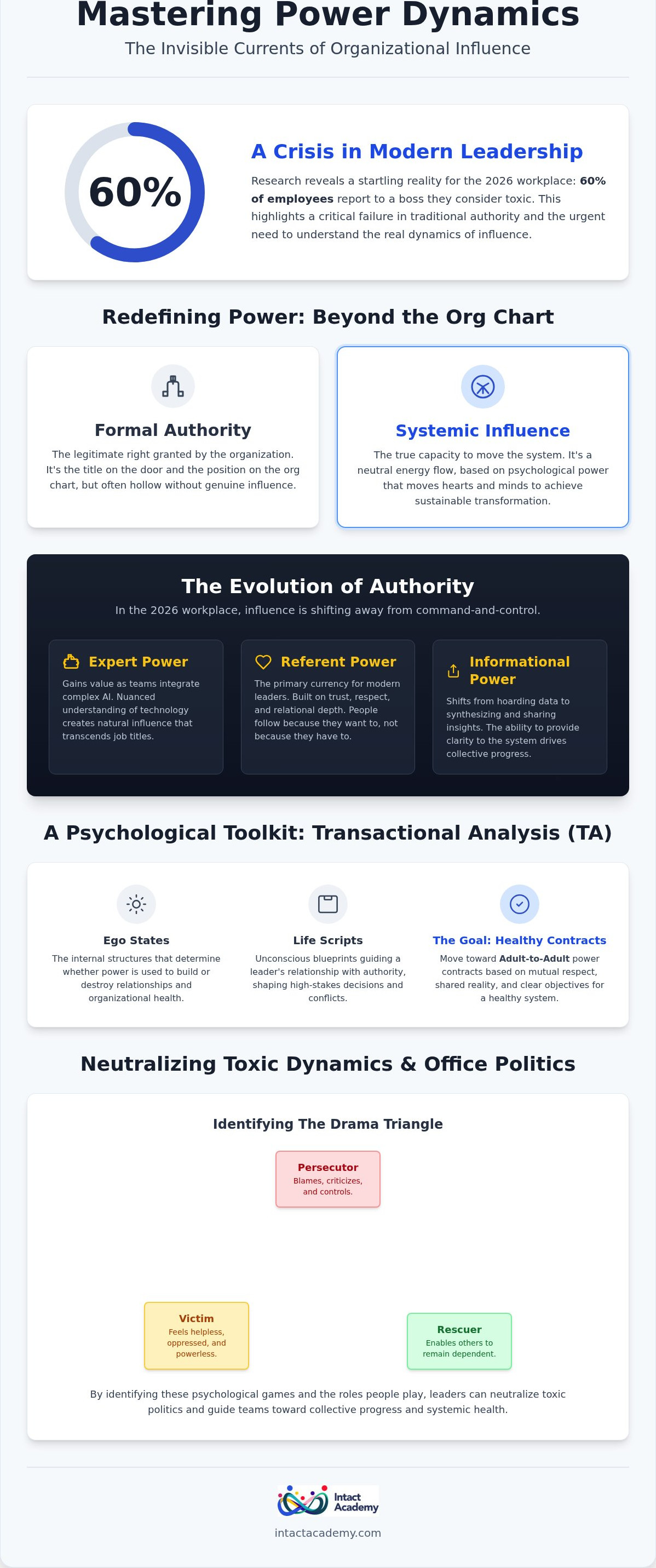
Power imbalances frequently manifest through the Drama Triangle, a model consisting of three roles: Persecutor, Rescuer, and Victim. Many leaders unknowingly get trapped in the Rescuer role, constantly solving problems for their team and inadvertently creating a Victim culture where employees feel powerless and dependent. This dynamic drains the system's energy and prevents true growth. To redistribute power healthily, we facilitate a shift to the Winner’s Triangle, where Rescuing becomes Potency, Persecution becomes Clarity, and Victimhood becomes Vulnerability. By applying Sari van Poelje’s insights, practitioners can break these dysfunctional cycles and return the system to a state of Adult-to-Adult autonomy.
Contracting for Healthy Power Dynamics
Effective leadership requires mastery over three levels of contracting: Administrative, Professional, and Psychological. The Administrative level covers the "what" and "when" of the work. The Professional level defines the "how" and the specific competencies required. However, it's at the Psychological level where the most significant power leaks occur. This level involves the unspoken expectations and emotional undercurrents of the relationship. When coaches facilitate power re-negotiations, they must bring these hidden psychological contracts into the light. You can spot systemic power leaks by looking for these indicators:
- Decisions are consistently made in informal corridors rather than official meetings.
- Information is treated as a private weapon rather than a shared resource.
- Leaders feel exhausted from "carrying" the emotional weight of their entire department.
- There's a recurring pattern of high turnover among high-potential employees.
By establishing clear, three-level contracts, you provide a stable container that prevents the games of power and influence from taking root. This clarity allows the team to focus their energy on the task at hand rather than the internal politics of the system.
Mastering Power Dynamics: Professional Development for Systemic Impact
Mastering the subterranean flows of influence is the final frontier for any professional who has already secured their place at the executive table. It's a high-level competency. It distinguishes a standard advisor from a truly transformative presence. In our work at Intact Academy, we've seen that coaching leaders on power dynamics requires more than a toolkit of techniques; it demands a shift in the coach's own way of being. You must move from merely doing coaching to becoming a systemic catalyst, someone who can witness the invisible scripts of an organization without being pulled into its games.
Our programs are designed to integrate Transactional Analysis (TA) with systemic theory to create this deep impact. By understanding the intersection of individual psychology and organizational structures, you learn to identify where the system is blocked and where it's ready to evolve. The TA EMCC Senior Practitioner academy serves as the path to this professional wholeness, offering a rigorous environment where theory meets the lived reality of leadership.
The Path to Senior Practitioner Mastery
Deepening your impact requires a commitment to a multi-dimensional perspective. By combining TA with systemic team coaching, you develop the ability to read a room not just as a collection of individuals, but as a living, breathing entity with its own history and future. The EMCC Senior Practitioner level stands as the global benchmark for excellence in this field, signaling a practitioner's ability to handle complex, high-stakes interventions with maturity and grace. To begin this transformation, many professionals find their grounding by joining the TA Foundation Year, which provides the essential psychological and systemic building blocks for long-term mastery.
Coaching with a Systemic Lens
In the face of turbulent change, a leader's greatest asset is a coach who can hold a stable container. This stability allows the client to explore their own relationship with authority and influence without the fear of systemic collapse. Developing the quiet power of a global mentor or systemic supervisor is a process of refinement, where you learn to lead through presence rather than force. It's about cultivating an internal Adult state that remains unshakeable, regardless of the organizational weather. If you're ready to elevate your practice, you can take the next step in your executive coaching certification, ensuring your work carries the weight of systemic mastery and genuine integrity.
Stepping Into Your Power as a Systemic Catalyst
The landscape of 2026 demands that we look beneath the surface of formal titles to the psychological currents that truly drive organizational movement. We've explored how Transactional Analysis and systemic theory transform our understanding of influence from a tool of control into a neutral energy for transformation. By mastering the art of coaching leaders on power dynamics, you move beyond resolving surface level conflicts to addressing the deep rooted scripts that dictate systemic health. You now have the framework to identify psychological games and replace them with clear, professional contracts that foster genuine autonomy.
The journey toward mastery is both an internal evolution and a professional milestone. It requires a stable container and a community of peers committed to the same level of depth and integrity. You don't have to navigate this complex terrain alone. You can deepen your systemic impact at Intact Academy through our EMCC and ICF accredited programs. Led by global expert Sari van Poelje, our global community of professional coaches provides the support needed for your transition toward professional wholeness. It's time to lead with the quiet power that only deep insight can provide.
Frequently Asked Questions
What are the 5 sources of power in an organisation?
The five primary sources of power are legitimate, reward, coercive, expert, and referent power. Legitimate power stems from a formal title, while reward and coercive power involve the ability to grant benefits or apply pressure. Expert power relies on specialized knowledge, and referent power is built on personal charisma and trust. In a systemic context, these sources don't exist in isolation; they're currents that define how energy and authority flow through the team.
How does Transactional Analysis explain power struggles at work?
Transactional Analysis views power struggles as the result of unconscious Psychological Games played between different Ego States. When a leader operates from a Controlling Parent state, they often invite an Adapted Child response from employees, leading to cycles of compliance or rebellion. These struggles are often fueled by early life scripts that dictate how an individual handles authority. Resolving them requires shifting to an Adult-to-Adult state where influence is based on shared reality and mutual respect.
What is the difference between formal and informal power?
Formal power is the authority granted by your position on the organizational chart; informal power is the influence you wield through relationships and expertise. While formal power allows you to sign contracts, informal power is what actually gets things done in the invisible org chart. This informal influence often resides with those who control the flow of information or possess high referent power. Mastering both is essential for anyone leading organizational change in 2026.
Can power in organisations be used ethically?
Dealing with coercive power requires you to maintain a stable Adult ego state while setting clear, professional boundaries. It's helpful to document interactions and seek support from informal power networks or systemic supervisors. When coaching leaders on power dynamics, we often highlight that coercion destroys psychological safety and innovation. If you're in a position to influence the manager, inviting them into a transparent contracting process can help shift the dynamic from pressure to collaboration.
What is the Drama Triangle in organizational power dynamics?
The Drama Triangle consists of three psychological roles: the Persecutor, the Rescuer, and the Victim. In toxic power dynamics, individuals rotate through these roles to maintain a sense of control or avoid responsibility. A manager might rescue a team by over-working, only to become a persecutor when they feel exhausted. Breaking this cycle requires moving to the Winner's Triangle, where leaders replace rescuing with genuine potency and persecution with clear, respectful boundaries.
How can I increase my referent power as a leader?
You increase your referent power by cultivating trust and operating from a state of genuineness. Referent power isn't about being liked; it's about being respected for your integrity and the consistency of your actions. It grows when you show vulnerability and invite others into an Adult-to-Adult relationship. By acting as a global mentor who values the growth of the collective, you become a person others want to follow, rather than someone they have to follow.
Why is contracting important for managing power in teams?
Contracting is vital because it makes the unspoken psychological expectations of a team explicit. By establishing clear administrative, professional, and psychological contracts, you eliminate the hidden agendas that fuel power struggles. This transparency provides a stable container for the work, ensuring that every team member knows how decisions are made and how influence is exercised. Effective contracting prevents the development of toxic games and keeps the focus on systemic mastery and shared success.


