

When global employee engagement dropped to 20% in 2025, it revealed a profound fracture in our traditional structures of authority. You might find that despite following every prescribed step in a standard model, your efforts are met with a systemic resistance that feels like a personal indictment. This friction often stems from a fundamental misunderstanding of leadership roles in organizational change. We frequently mistake a static job description for the living, breathing psychological contract that exists between a leader and their system. It's a heavy burden to carry the emotional labor of transformation when roles remain ambiguous, leading to burnout rather than the breakthrough you seek.
Key Takeaways
- Redefine leadership as a systemic interface; move beyond the limitations of static organisational charts to embrace the fluid reality of modern work.
- Leverage Transactional Analysis (TA) to decode how unconscious Role Scripts and Ego States drive repetitive patterns and resistance within your team.
- Navigate the systemic triad of Person, Role, and Function to identify and resolve the hidden collision points where personal identity interferes with professional impact.
- Implement a two-step framework for auditing and negotiating leadership roles in organizational change, transforming role ambiguity into a source of systemic clarity.
- Cultivate the advanced competencies required for sustainable transformation by moving from transactional coaching to deep systemic mastery within an accredited professional container.
Beyond the Org Chart: Redefining Leadership Roles in 2026
Traditional organisational charts are often static artifacts, relics of an industrial age that prioritized predictability over agility. In our contemporary, hybrid world, these rigid lines fail to capture the fluid reality of how work actually happens. We must redefine leadership roles in organizational change not as fixed boxes, but as systemic interfaces. A role is the vital point of contact where the needs of the organisation and the identity of the individual converge. It's a living space that requires constant negotiation and awareness.
Why do so many leaders feel ineffective despite having clear job descriptions? It's because a job description only lists functional tasks. It ignores the formal titles and the deeper psychological roles that individuals are often recruited to play unconsciously. When these layers collide, the resulting friction creates systemic resistance that no standard model can solve. Roles act as containers for the system’s collective expectations. They absorb the pressure of the organisation's goals and the anxieties of its people. If the container is ill-defined, the energy of the team leaks out into conflict and inefficiency.
The Evolution of Role Theory in Modern Systems
We've moved beyond the top-down structures of the past into a landscape of interconnected systemic networks. In this new space, roles are becoming increasingly fluid and dynamic, requiring leaders to navigate complex webs of influence rather than simple chains of command. The rise of remote work has further blurred these boundaries, making it essential to define roles with absolute precision to avoid collective burnout. An organisational role is the intersection of systemic purpose and individual action.
Why Role Clarity is the Foundation of Psychological Safety
Role ambiguity is a significant driver of stress and systemic friction, especially during large-scale transitions. When leaders don't know where their authority begins and ends, they often fall into psychological games or triangulation, which erodes trust across the entire system. Establishing clear boundaries is a fundamental requirement for leading organisational change effectively.
By anchoring roles in reality, we provide the safety needed for others to embrace organizational change management processes without fear. This clarity transforms a chaotic transition into a structured journey of becoming, allowing the leader to hold the space for others to grow. When we resolve the hidden costs of role ambiguity, we don't just improve performance; we protect the human spirit at the heart of the business.
The Psychology of Change: Role Scripts and Ego States
Leadership is rarely a purely rational exercise. It is an intricate dance of internalised patterns and systemic demands. To truly master leadership roles in organizational change, one must look beneath the surface of professional behavior into the psychological architecture of the leader. Transactional Analysis (TA) provides this essential depth, allowing us to see the organisation not just as a structure, but as a collection of interacting ego states and life scripts that influence every decision.
Every leader carries a "Life Script," a subconscious narrative formed early in life that often dictates how they respond to pressure. When we step into a professional position, this Life Script frequently transforms into a "Role Script." We might find ourselves repeating the same conflicts or successes regardless of the company culture. By understanding the Functions of a Change Leader through this lens, we can identify when we are acting from a place of historical habit rather than present-moment necessity. This awareness is the first step toward psychological maturity in leadership.
Within this framework, we interact from three primary ego states: Parent, Adult, and Child. In the midst of turbulent change, a leader might unconsciously slip into a "Parent" state, becoming overly critical or overly nurturing, or a "Child" state, reacting with compliance or rebellion. The goal is to remain in the "Adult" ego state, which is characterized by objective, here-and-now processing. When we fail to maintain this Adult position, we often fall into unconscious roles that stall progress:
- The Rescuer: Taking on more than 50% of the work, which inadvertently disempowers the team.
- The Rebel: Fighting against the system's requirements to protect a sense of individual autonomy.
- The Scapegoat: Unconsciously absorbing the system's collective anxiety and becoming the target for blame.
The Internalised Role: How We Inhabit Our Positions
There is often a significant gap between the role "given" by the organisation and the role "taken" by the individual. A leader might be given a mandate for innovation but, due to an internal script, takes on a role of cautious maintenance. Spotting when you or your colleagues are acting from an "Adapted Child" ego state, seeking approval rather than driving results, is vital for maintaining momentum. High-stakes executive leadership requires the courage to inhabit the role as it is needed now, not as our past dictates. For those seeking to master these dynamics, our Executive Coaching provides the systemic supervision necessary to navigate these complexities.
Psychological Contracts and Role Expectations
Beyond the formal job description lies the psychological contract: the unwritten rules and reciprocal expectations between the leader and the system. During organisational transitions, these unstated agreements are often the first things to break, leading to a sense of betrayal and resistance. Learning what is transactional analysis in a professional context allows you to re-contract these expectations explicitly. This process of "contracting for change" realigns the person with the system, ensuring that leadership roles in organizational change are anchored in mutual clarity and shared purpose.
Role, Person, and Function: Navigating the Systemic Triad
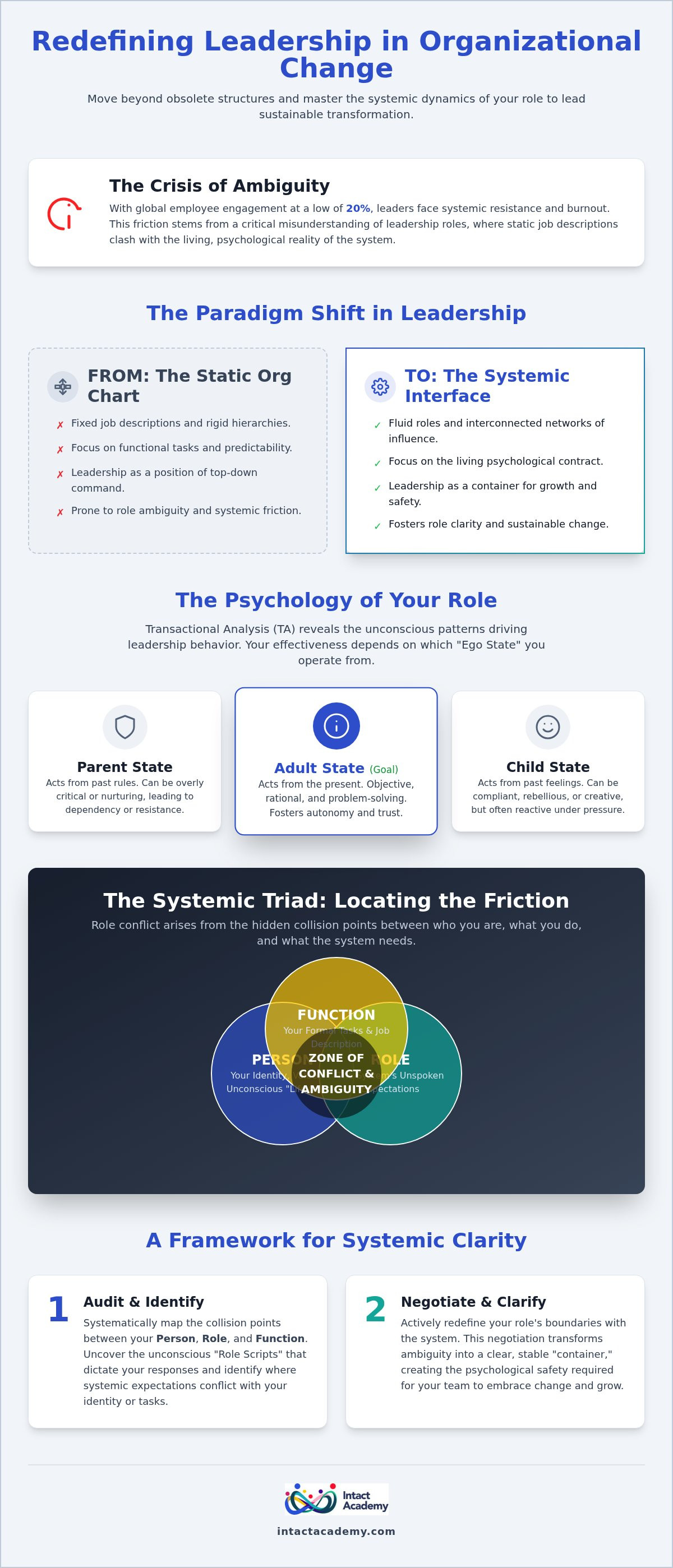
To navigate the complexities of leadership roles in organizational change, we must differentiate between the individual, the position, and the tasks at hand. This systemic triad consists of the Person (your identity and history), the Role (the psychological container provided by the system), and the Function (the specific tasks you perform). When these three elements are aligned, leadership feels fluid and impactful. However, when personal scripts interfere with professional functions, the resulting collision often leads to systemic stagnation and individual distress.
The key roles of a change leader require more than just technical proficiency; they demand a high degree of systemic differentiation. Systemic team coaching serves to identify imbalances in this triad, helping leaders recognise when they are carrying emotional weight that doesn't belong to their function. It's essential to practice "de-roling" at the end of each day, consciously stepping out of the professional container to maintain health and prevent the chronic exhaustion that leads to executive burnout.
Mapping the Intersections: A Diagnostic Tool
Understanding where the friction lies requires a precise diagnostic approach. You can evaluate your current standing by looking at the focus and typical conflicts of each pillar:
- The Person: Focuses on identity and history. Conflict arises when personal scripts override logic. Resolution requires self-awareness and systemic supervision.
- The Role: Focuses on the systemic container and projections. Conflict arises through role ambiguity or blame. Resolution requires clear contracting and boundary management.
- The Function: Focuses on tasks and performance. Conflict arises from task overlap or lack of resources. Resolution requires precise job definition and resource alignment.
To identify misalignment, ask yourself: Is this emotional reaction truly mine, or does it belong to the position? Are the expectations placed upon me realistic for my specific function? The "Person" can become "Role-locked" in a dysfunctional system when they can no longer distinguish their individual identity from the projections and failures inherent in their professional position.
The Leader as a Systemic Anchor
Leaders serve as anchors during periods of high uncertainty, defining the "container" that allows their teams to feel safe enough to innovate. Managing the boundaries between personal relationships and professional role requirements is a delicate art that prevents the system from becoming enmeshed. It's a process of constant evolution that requires maturity and the courage to remain objective. For those guiding others through these transitions, the necessity of professional development for coaches cannot be overstated. Mastering these dynamics ensures that you don't just survive the change, but you facilitate a return to a state of collective wholeness and effectiveness. Our Team Coaching programs provide the structured methodology to restore this vital systemic balance.
Resolving Role Conflict and Ambiguity: A Leadership Framework
Transitioning from theoretical understanding to practical application requires a structured approach to leadership roles in organizational change. When ambiguity persists, it isn't merely a failure of communication; it's often a sign of unresolved systemic tension. To restore clarity and momentum, we propose a five-step framework designed to align individual action with the organisation's core purpose.
- Step 1: Audit Formal vs. Informal Roles. Uncover the hidden power structures. Often, the person with the most influence isn't the one with the highest title, but the one who holds the system's "unspoken" history.
- Step 2: Facilitate Role Negotiation. Use systemic and TA tools to bring stakeholders together. This is a space for honest dialogue about what each role requires and what the individual can realistically provide.
- Step 3: Align with the Primary Task. Every role must be justified by its contribution to the system's ultimate goal. If a role doesn't serve the Primary Task, it becomes a source of friction.
- Step 4: Establish Adult-to-Adult Contracting. Move away from Parent-Child dynamics of "command and control." Create clear, reciprocal agreements where accountability is shared and boundaries are respected.
- Step 5: Implement Systemic Supervision. Monitor the health of these roles over time. Supervision provides a safe container to process the emotional weight of leadership and prevents roles from becoming distorted under pressure.
Our Organizational Change consultancy provides the expertise to guide your system through these intricate negotiations, ensuring that change is both sustainable and deeply human.
The Primary Task: The North Star of Organisational Roles
The Primary Task is the ultimate justification for any role within a system. It's the work the organisation must do to survive and flourish. During periods of upheaval, teams often fall into "anti-task" behaviours, engaging in psychological games or gossip to avoid the discomfort of change. These distractions are symptoms of a system that has lost sight of its North Star. Refocusing the team on their collective systemic purpose dissolves these games, allowing leadership roles in organizational change to regain their integrity and impact.
Handling Role Transitions During Organisational Change
Restructures and mergers often trigger a sense of profound psychological grief. Losing a familiar role can feel like losing a part of one's identity. It's vital for organisations to support leaders as they "re-author" their roles in a new systemic context. This isn't just about learning new tasks; it's about evolving one's professional identity. Sari van Poelje emphasizes that agile role adaptation is a core competency for the modern leader. By acknowledging the emotional weight of transition, we allow for a more genuine and complete return to effectiveness in the new structure.
Mastering Systemic Role Dynamics with Intact Academy
While understanding the theoretical underpinnings of role scripts and systemic triads is a vital first step, the actual enactment of these concepts in high-pressure environments requires a level of mastery that surface-level management training cannot provide. Traditional leadership development often focuses on tactical execution, yet it frequently ignores the deep-seated psychological currents that dictate how leadership roles in organizational change are truly inhabited. To facilitate profound human transformation, one must move beyond the "how-to" and enter the realm of systemic presence and awareness.
At Intact Academy, we bridge the gap between sophisticated psychological theory and professional pragmatism. Our programs, including the TA EMCC Senior Practitioner academy and the TA EMCC Senior Team Coach Academy, are designed for those who seek to lead with both intellectual rigor and emotional depth. By joining our global community, you become part of a network of practitioners from over 14 countries dedicated to the flourishing of individuals and systems alike. We provide the stable container needed to explore the often-turbulent work of systemic change, ensuring you emerge with the tools to resolve complex role conflicts and drive sustainable growth.
Accredited Paths to Professional Mastery
In the evolving landscape of 2026, professional accreditation serves as a benchmark for excellence and integrity. Our curriculum integrates Transactional Analysis (TA) and systemic theory with practical organisational leadership, allowing you to move from tactical coaching to deep systemic intervention in the C-suite. For those pursuing the EMCC Senior Practitioner level, we align our training with the rigorous requirement of 250 coaching hours and the necessity of quarterly supervision sessions. This focus on accreditation ensures that your impact as a change leader is grounded in globally recognised standards of competence and ethical practice.
Your Invitation to Transformation
We invite you to step into a space of profound professional evolution. Whether you join us at our physical location in Utrecht or through our global online platform, you will work directly with an international faculty of Transactional Analysis experts. This experience is not merely an educational journey; it's a process of becoming. You'll learn to navigate the intricacies of leadership roles in organizational change under the guidance of mentors who have seen the inner workings of countless global systems.
The path to leadership wholeness requires the courage to look inward before taking outward action. If you're ready to align your individual talent with the deepest needs of your organisation, we are here to support that transition. We invite you to explore our accredited programs and discover how a systemic perspective can redefine your professional legacy.
Embracing the Future of Systemic Leadership
The journey toward mastering leadership roles in organizational change is an invitation to move beyond the transactional and into the transformational. We've explored how roles act as systemic containers, absorbing the collective anxieties and aspirations of the organisation. By distinguishing between the person, the role, and the function, you protect your own well-being while providing the clarity your team needs to flourish. This alignment isn't a one-time event; it's a continuous process of negotiation and awareness that honors the complexity of human systems.
True change requires more than following a model. It demands the courage to inhabit your position with psychological maturity and systemic insight. As you refine your ability to navigate these dynamics, you become an anchor for your organisation, turning resistance into a catalyst for growth. If you're ready to deepen your impact and join a global community of practitioners from over 14 countries, we invite you to take the next step. Our EMCC and ICF accredited training, led by international expert Sari van Poelje, provides the structured methodology you need for professional mastery.
Master systemic role dynamics in our TA EMCC Senior Team Coach Academy.
Step forward with the confidence that your leadership is grounded in both depth and pragmatism.
Frequently Asked Questions
What is the difference between an organisational role and a job title?
A job title is a formal label on an organisational chart, while an organisational role is a psychological container for systemic expectations. Titles describe specific tasks and hierarchies. Roles describe the dynamic interface between the individual and the system. Understanding this distinction is crucial for effective leadership roles in organizational change. It allows leaders to manage the unwritten projections and emotional labor that a simple title often fails to capture.
How does role ambiguity affect employee performance and mental health during change?
Role ambiguity acts as a systemic stressor that erodes psychological safety and triggers defensive ego states. When boundaries are unclear, employees often experience chronic anxiety, which can lead to burnout and a significant drop in performance. This friction frequently results in anti-task behaviours, where energy is diverted from productive work into managing interpersonal conflict. Clear role definition provides the stability needed for individuals to remain in an Adult ego state.
Can Transactional Analysis be used to resolve team conflicts in a corporate setting?
Transactional Analysis (TA) is a powerful tool for decoding the unconscious scripts and psychological games that fuel corporate conflict. By identifying when team members are operating from Parent or Child ego states, leaders can facilitate a shift back to Adult-to-Adult communication. This methodology transforms conflict from a personal battle into a systemic inquiry. It allows teams to re-contract their professional relationships based on mutual respect and shared organisational objectives.
What are the most common leadership roles in agile organisational change?
In agile environments, leadership roles in organizational change shift from traditional command and control to functions like the Enabler, the Boundary Keeper, and the Systemic Anchor. These roles focus on maintaining the container for innovation rather than directing specific tasks. Leaders must navigate the fluidity of these positions, ensuring that while tasks change rapidly, the systemic purpose and psychological safety of the team remain intact through constant, explicit role negotiation.
How do I identify if a role conflict is systemic or personal?
A conflict is likely systemic if the same pattern of friction occurs regardless of who occupies the position. If multiple predecessors experienced similar challenges, the issue resides in the role's definition or its relationship to the wider system. Conversely, if the conflict stems from individual life scripts or historical patterns repeated across different organisations, it's likely personal. Systemic supervision is essential for leaders to differentiate these two layers and avoid taking systemic failures personally.
What is the "Primary Task" and how does it define a leadership role?
The Primary Task is the fundamental work an organisation must perform to survive and flourish within its environment. It serves as the ultimate justification for every role in the system. A leadership role is defined by its specific contribution to this task. Any behavior that deviates from it is considered anti-task. By anchoring roles in the Primary Task, leaders can dissolve psychological games and ensure all systemic energy is directed toward meaningful outcomes.
How can coaching supervision help me manage my professional role boundaries?
Systemic supervision provides a reflective space to process the emotional projections and role-locking that occur in high-pressure environments. It helps leaders de-role at the end of the day, preventing professional demands from bleeding into personal identity. By working with a supervisor, you can identify when you're unconsciously taking on roles like the Rescuer or the Scapegoat. This process allows you to return to a state of professional wholeness and objective clarity.
What accredited training is available for mastering systemic role dynamics?
Intact Academy offers several pathways for those seeking professional mastery. Our TA EMCC Senior Practitioner academy and TA EMCC Senior Team Coach Academy provide rigorous training that integrates Transactional Analysis with organisational leadership. These programs are EMCC and ICF accredited, ensuring that participants from over 14 countries meet the highest global standards for senior coaching. They equip you to handle the complex human dynamics inherent in large-scale systemic intervention.


