

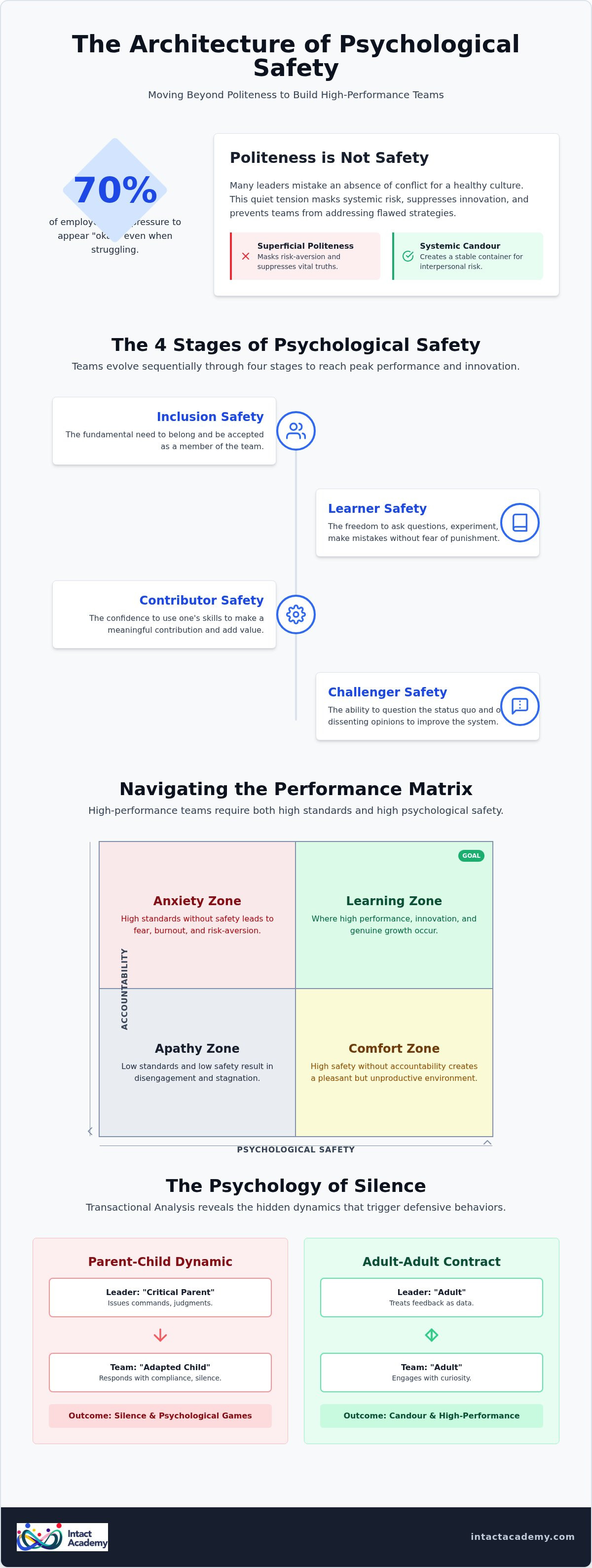
What if the polite silence in your boardroom isn't a sign of harmony, but a symptom of systemic risk? Many leaders mistake an absence of conflict for a healthy culture, yet 70% of employees report feeling pressure to appear "okay" even when they are struggling. You likely recognize the quiet tension when talented staff hold back their best ideas or avoid challenging a flawed strategy for fear of looking stupid. Building genuine psychological safety in teams requires moving beyond the veneer of workplace pleasantries. It demands a rigorous, systemic approach that addresses the underlying scripts and power dynamics that govern human interaction.
We understand that true transformation isn't found in a wellness app, but in the profound work of restructuring how people relate to one another. You'll discover how to move from a culture of risk-aversion to one of deep, systemic candour using Transactional Analysis and proven leadership frameworks. We will explore a diagnostic process to uncover why safety is missing and provide actionable steps to shift your team from fear to a state of high-performance flow. By establishing an Adult-Adult contract, you can finally align individual flourishing with the demands of organizational excellence.
Key Takeaways
- Distinguish between superficial politeness and the robust, systemic candour required to create a stable container for interpersonal risk.
- Master the use of Transactional Analysis ego states to identify when leadership patterns inadvertently trigger silence or defensive behaviors.
- Learn to navigate the Performance Matrix, moving your team out of the "Anxiety Zone" and into the high-growth "Learning Zone."
- Implement a practical roadmap for fostering psychological safety in teams through systemic audits and formal communication contracts.
- Understand the unique power of systemic team coaching to shift collective cultural patterns in real-time, far beyond the reach of individual training.
What is Psychological Safety in Teams? Defining the Systemic Foundation
Psychological safety is often misunderstood as a soft metric or a culture of perpetual agreement. In reality, it functions as a stable container that allows individuals to engage in interpersonal risk-taking without the paralyzing fear of retribution. When we speak about psychological safety in teams, we are describing a systemic property of the group rather than a collection of individual personality traits. It's not enough to hire brave people; the system itself must be designed to hold the weight of their honesty.
A critical distinction must be made between "being nice" and "being safe." Politeness frequently acts as a mask for risk-aversion, where the desire to avoid discomfort leads to the suppression of vital truths. True safety, however, embraces the truth. It creates a space where challenge is expected and dissent is seen as a contribution to the whole. This environment is established through clear contracting, where the team explicitly agrees on how they'll handle conflict, feedback, and failure before the pressure of a crisis arrives.
The Business Case: Why Silence is a Strategic Risk
The cost of silence is a tangible drain on organizational health, manifesting as missed innovations, unaddressed errors, and the slow erosion of talent. When employees feel they must self-censor, the organization loses the very intelligence it pays to employ. This lack of safety becomes a primary barrier when navigating systemic organizational change, as the anxiety of the unknown often triggers defensive silence. Investing in team coaching to build this safety isn't just a cultural initiative; it's the hidden engine of ROI that ensures strategies are actually executed rather than quietly undermined.
The 4 Stages of Psychological Safety
Teams typically evolve through four distinct stages of safety to reach peak performance:
- Inclusion Safety: The fundamental sense of belonging and acceptance.
- Learner Safety: The freedom to ask questions and make mistakes during the growth process.
- Contributor Safety: The confidence to use one's skills to add value without micro-management.
- Challenger Safety: The ability to question the status quo when you see a better way forward.
To help leaders in medium-sized enterprises navigate these developmental stages, you can explore First Line Manager Program by Inspired Leadership to build a more resilient and psychologically safe organizational culture.
These stages are sequential; a team can't effectively challenge a strategy if members don't first feel they belong. Challenger Safety represents the pinnacle of psychological safety in teams, where innovation occurs through the rigorous and healthy expression of dissent.
The Psychology of Silence: A Transactional Analysis Perspective
Silence in a meeting is rarely neutral. It's often a strategic withdrawal, a psychological shield used when the environment feels unpredictable. To truly understand psychological safety in teams, we must move beyond behavioral observation and examine the internal architecture of our interactions. Transactional Analysis (TA) provides a precise lens for this, categorizing our personality into three "Ego States": Parent, Adult, and Child. When a leader operates from a "Critical Parent" state, issuing commands or subtle judgments, they unconsciously invite team members into an "Adapted Child" state. In this state, the safest move is compliance or silence.
These dynamics often devolve into "Psychological Games," which are repetitive, unconscious patterns that substitute for genuine connection. You might recognize the "Yes, But" game, where a team member asks for help only to reject every suggestion, or "Look How Hard I Tried," where the focus shifts from results to the exhaustion of the effort. These games flourish where safety is low because they offer a way to interact without the risk of being truly seen. Understanding what is Transactional Analysis allows leaders to map these transactions and choose a different path.
Breaking the Parent-Child Dynamic
Shifting a team’s culture requires a deliberate move toward "Adult-Adult" transactions. In this space, feedback is treated as objective data rather than a personal attack. This transition is fueled by "strokes," or units of recognition. A safe environment is one where people receive enough positive recognition for their being and their doing that they don't need to play games to feel noticed. Research on the Power of Psychological Safety suggests that even in high-stakes environments, the ability to ask questions without fear is the primary driver of success.
Ask yourself: "Which ego state am I inviting from my team right now?" If you find yourself frustrated by their passivity, you may be over-functioning in a Parent role. Developing the awareness to step back into an Adult state is a core skill taught in our TA EMCC Senior Team Coach Academy, where leaders learn to foster autonomy rather than dependency.
Uncovering Team Scripts
Beyond individual transactions, every group develops a "Team Script." This is the collective unconscious blueprint of team behaviour, a set of unwritten rules about what is permissible. In some organizations, a "Don’t Speak" injunction prevents the reporting of errors, while a "Don’t Be Close" rule stifles the empathy needed for collaboration. Identifying these scripts is the first step toward rewriting the narrative of psychological safety in teams. When the script is made visible, it loses its power, allowing the team to return to a state of genuineness and high performance.
High Standards vs. High Safety: Navigating the Performance Matrix
A common misconception suggests that prioritizing psychological safety in teams requires a trade-off with high performance. This creates a false dichotomy that limits organizational potential. In reality, safety and standards are two axes of the same performance matrix. When standards are high but safety is low, teams enter the "Anxiety Zone." Here, the pressure to deliver without the permission to fail leads to burnout, hidden errors, and a culture of blame that stifles genuine innovation. Conversely, high safety without standards creates a "Comfort Zone" where stagnation takes root. The goal is the "Learning Zone," where high safety and high standards coexist, allowing for the rigorous pursuit of excellence within a supportive, transparent framework.
Understanding what is psychological safety in this context helps leaders realize that safety is the foundation of accountability, not its enemy. Maintaining this balance requires Systemic Supervision, a process where leaders reflect on the organizational dynamics they are creating. Developing the self-awareness to stay in the Learning Zone is a primary focus of our TA Foundation Year, which guides professionals through the psychological mastery needed to hold high standards without triggering systemic fear.
Accountability in a Safe Environment
Accountability in a safe system is redefined as a commitment to learning and growth. It's not about the fear of punishment, but the integrity of the "Clean Contract." These contracts establish clear boundaries and expectations, making it possible to address performance gaps through "Adult" confrontation. When a leader confronts a lack of performance as an objective problem to be solved together, they preserve the team’s dignity while maintaining the highest standards of excellence. This approach ensures that feedback is received as a tool for evolution rather than a threat to one's belonging.
The Role of Vulnerability in Executive Presence
A leader’s presence serves as the stable container for the team’s collective anxiety. To foster "Learner Safety," leaders must model vulnerability by admitting their own mistakes first. This isn't a sign of weakness; it's a demonstration of authority balanced with empathy. By showing that even the leader is a work in progress, the system relaxes into a state of genuine inquiry. Our executive coaching certification prepares leaders for this level of presence, teaching them to navigate the tension between holding power and remaining deeply human.
A Leader’s Roadmap: Practical Strategies to Foster Safety
Building psychological safety in teams isn't a one-time event; it's a rhythmic, systemic practice that requires both tactical precision and emotional depth. While the theoretical foundations of Transactional Analysis provide the "why," a leader needs a clear "how" to navigate the complexities of human interaction. Shifting a team's culture from a defensive crouch to a state of high-performance flow begins with small, deliberate interventions that signal a change in the systemic environment. By following a structured roadmap, you can begin to dismantle the unconscious barriers that keep your team silent.
- Conduct a Systemic Audit: Observe the "safety temperature" of your team. Do people challenge your ideas? Do they admit when they're overwhelmed? Identifying where silence is most prevalent is the first step toward intervention.
- Establish "Adult-Adult" Communication Contracts: Explicitly agree on how the team will handle feedback. Moving away from Parent-Child dynamics ensures that everyone takes responsibility for the quality of the dialogue.
- Replace "Blame Narratives" with "Learning Narratives": During debriefs, shift the focus from "Who made this mistake?" to "What did our system produce, and what can we learn?" This removes the threat to individual belonging.
- Implement Regular "Check-ins": Dedicate time to honour the human element. A simple, structured check-in at the start of meetings validates that team members are seen as whole people, not just units of production.
- Deepen Your Facilitation: To master these nuances, leaders and facilitators should seek professional development for coaches to refine their ability to catch and shift transactions in real-time.
Contracting for Candour
Genuine honesty doesn't happen by accident; it must be contracted. At the start of a project, ask the team: "How do we want to handle it when things go wrong?" or "What permissions do we need to give each other to be truly candid?" Using a Three-Cornered Contract is essential for systemic alignment. The Three-Cornered Contract is the alignment of expectations between the coach, the leader, and the team. This ensures that everyone is working toward the same goal of transparency without hidden agendas or conflicting loyalties.
Responding Productively to Failure
The leader’s reaction to a mistake is the single most powerful signal for future safety. If the reaction is one of judgment, the system will immediately revert to a defensive state. Leaders must distinguish between "Intelligent Failure," which occurs during the pursuit of innovation and provides valuable data, and "Preventable Failure," which stems from negligence. By celebrating intelligent failure as a necessary byproduct of growth, you reinforce the idea that risk-taking is a valued part of the team's identity. If you're ready to lead this transformation, consider joining our TA EMCC Senior Team Coach Academy to master the art of systemic intervention.
Scaling Safety: The Role of Systemic Team Coaching
Individual interventions, while valuable for personal growth, often fail to produce lasting organizational change because they ignore the gravitational pull of the collective system. When we address psychological safety in teams, we must look beyond the individual to the invisible web of relationships and unconscious contracts that define the group's behavior. A single courageous person cannot sustain a culture of candour if the system remains anchored in defensive scripts. This is where Systemic Team Coaching becomes indispensable. It moves beyond the classroom into the reality of the work itself, using "Live Action Coaching" to observe and intervene in real-time transactions.
By catching a "Critical Parent" interjection or a "Yes, But" game as it happens, the coach allows the team to see their own patterns reflected in a clear mirror. This immediate feedback loop is what enables a team to consciously choose a new way of relating, effectively rewriting their scripts in the moment. Sari van Poelje has pioneered the application of systemic Transactional Analysis to these dynamics, helping organizations move from rigid, fear-based structures to agile, safe environments. For those seeking to master these complex interventions, our TA EMCC Senior Team Coach Academy provides the rigorous methodological backbone required for high-stakes organizational work.
From Individual to Systemic Transformation
Evolving the system requires a fundamental shift in perspective. We must stop trying to "fix people" and start addressing the systemic imbalances that make silence a rational choice. This work demands that the coach operates as a "Supervised Practitioner," consistently reflecting on their own ego states to ensure they remain in a grounded, Adult position. Systemic mastery ensures that the safety created isn't a temporary peak in morale, but a sustainable foundation for long-term organizational health and wholeness. It's about creating a space where the collective intelligence of the group can finally flourish without the weight of unspoken injunctions.
Next Steps for Professional Coaches
Transitioning from a traditional facilitator to a Systemic Team Coach involves a journey of profound personal and professional transformation. Credibility in high-stakes executive environments often hinges on recognized standards, making EMCC accreditation a vital asset for those working at this level. This path requires more than just tools; it requires the capacity to hold a stable container for a team's collective anxiety during the turbulent process of change. True mastery begins with the courage to look beneath the surface of organizational life and address the human reality that lies there.
Cultivating the Systemic Container for Excellence
The journey toward high performance isn't paved with polite agreement, but with the courage to dismantle the unconscious scripts that keep talent silent. We've explored how psychological safety in teams is built upon a foundation of Adult-Adult contracting, where vulnerability is modeled from the top and failure is treated as essential data for evolution. By moving beyond surface-level interventions and addressing the systemic architecture of your organization, you create a stable container where innovation isn't just possible; it's inevitable.
True mastery of these dynamics requires a deep integration of Transactional Analysis and systemic methodology. Led by Sari van Poelje, TSTA-O, and holding the EMCC Global Quality Award accreditation, our programs offer a rigorous path for those committed to profound human and organizational transformation. We invite you to master the art of systemic safety in our TA EMCC Senior Team Coach Academy. Your commitment to looking beneath the surface is the first step toward returning your team to a state of wholeness and high performance. The path to systemic excellence is open to those ready to lead with depth and integrity.
Frequently Asked Questions
How is psychological safety different from trust?
Trust is a belief held by one person about another, while psychological safety in teams is a collective belief about the group's environment. Trust involves the relationship between two individuals, focusing on reliability and integrity. In contrast, psychological safety describes the systemic stable container where every member feels they can take interpersonal risks without fear of repercussion. It's the difference between trusting a colleague and feeling safe within the entire organizational system.
Can a team have too much psychological safety?
It's impossible to have too much safety, but it's common to have too little accountability. When a team feels safe but isn't held to high standards, they enter the "Comfort Zone," which leads to stagnation. True high performance requires both a stable container of safety and a rigorous commitment to excellence. Safety doesn't mean comfort; it means the ability to handle the discomfort of growth and honest challenge without systemic fear.
What are the first signs that a team lacks psychological safety?
The first signs often manifest as a heavy silence in meetings or the presence of repetitive "Psychological Games" like "Yes, But." You might notice that talented staff stop offering dissenting opinions or that errors are only discovered when they've become crises. When people feel they must self-censor to belong, the system has prioritized politeness over truth. This lack of candour is a primary indicator that the "safety temperature" has dropped.
How do I measure psychological safety in my team?
Measuring psychological safety in teams involves both quantitative surveys and qualitative observation. You can utilize established tools like Amy Edmondson’s seven-item scale to gather data on team perceptions. However, a systemic audit also looks at behavioral patterns: the frequency of questions asked, the speed at which mistakes are reported, and the distribution of airtime in meetings. These metrics reveal whether the team operates from an Adult state or a defensive Child state.
Does psychological safety mean I can’t fire underperformers?
Psychological safety actually makes addressing underperformance easier by establishing "Clean Contracts" and clear boundaries. Safety is not a shield against accountability; it's the environment that allows for honest, Adult-to-Adult conversations about performance gaps. When someone consistently fails to meet agreed-upon standards despite systemic support, ending the professional relationship is a necessary act of integrity for the health of the whole system. Safety ensures this process is respectful and transparent.
How long does it take to build psychological safety in a toxic team?
The leader's most critical role is to act as the "stable container" by modeling Learner Safety and vulnerability. How a leader reacts to their own mistakes and the failures of others serves as the primary signal for the entire system. By admitting their own errors first, they grant the team permission to be human. This shifts the team from a defensive posture into a state of inquiry, where growth and innovation become systemic norms.
How does Transactional Analysis help with psychological safety?
Transactional Analysis provides a sophisticated map for understanding the "unconscious scripts" that govern team behavior. By identifying Ego States, leaders can recognize when they've inadvertently triggered a Parent-Child dynamic that stifles contribution. TA allows teams to move beyond surface-level interactions, stopping "Psychological Games" and replacing them with genuine, Adult-Adult transactions. This methodology transforms complex systemic issues into manageable insights, fostering a culture of wholeness and profound human transformation.


