

What if the very metrics you rely on to define success are the silent architects of your team's eventual burnout? You likely recognize the hollow victory of hitting a quarterly target while the underlying culture feels fractured; the invisible friction of unresolved conflict slows every decision to a crawl. Measuring team performance in 2026 demands a shift from observing outward artifacts to understanding the deep psychological structures that hold a group together. It's a move from the transactional to the transformational.
We understand the exhaustion that comes when targets are met but human spirits are depleted. This article provides a path to move beyond superficial KPIs, teaching you to measure the systemic health and psychological maturity that drive sustainable excellence. We'll explore a holistic framework for performance that prioritizes psychological safety and long-term resilience. By looking inward at the team's functional architecture, you can ensure your people don't just reach the finish line, but flourish long after they've crossed it.
Key Takeaways
- Balance technical KPIs with the "soft architecture" of human relationships to ensure that your team's success is as durable as it is visible.
- Utilize Transactional Analysis to refine your approach to measuring team performance, identifying the specific Ego States that either fuel or frustrate collective decision-making.
- Integrate psychological safety into your balanced scorecard as a quantifiable indicator of systemic health and future productivity.
- Establish multi-level performance contracts that align administrative goals with the deeper professional and psychological needs of every team member.
- Transition from viewing performance as a static target to a continuous systemic process that requires ongoing diagnostic care and professional mastery.
What is Team Performance? Moving Beyond the Spreadsheet
Performance is often reduced to a series of numbers; a collection of outputs that satisfy the immediate demands of the market. However, a truly systemic view recognizes that performance is the synergy between technical output and systemic health. It is the collective ability to fulfill a contract while maintaining human wholeness. When we focus solely on the spreadsheet, we miss the vital signs of the organization. We see the result, but we remain blind to the cost at which it was achieved.
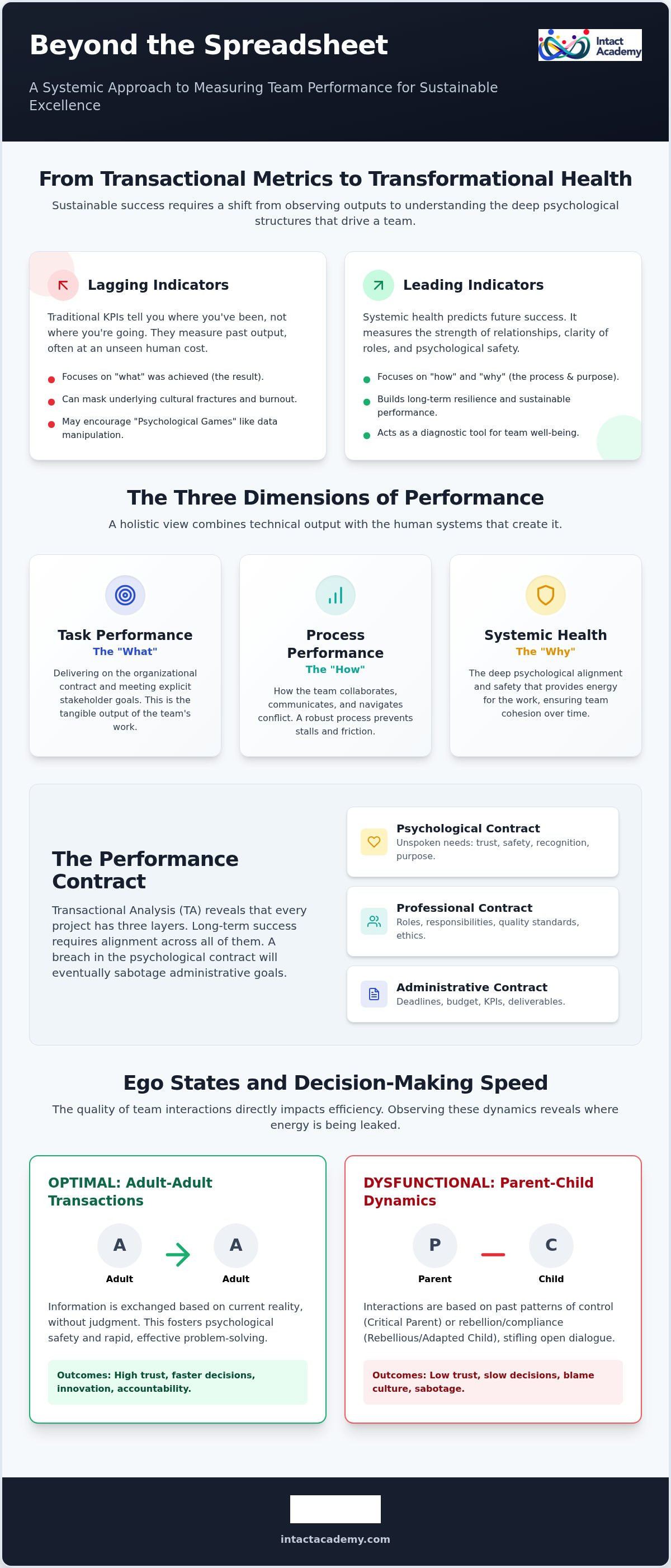
Traditional KPIs are lagging indicators; they tell you where you've been, not where you're going. Systemic health, conversely, is a leading indicator. It measures the strength of the relationships and the clarity of the roles that will determine next month's results. Effective leaders understand that measuring team performance requires looking at the "Soft Architecture," the trust and transparency that allow a group to weather a storm. Without this foundation, the "Hard Metrics" of productivity become brittle and unsustainable.
The Three Dimensions of Performance
- Task Performance: The "What." This involves delivering on the organizational contract and meeting the explicit goals set by stakeholders.
- Process Performance: The "How." This examines how the team collaborates, communicates, and navigates conflict. Many Team Effectiveness Models emphasize that without a robust process, even the most talented individuals will eventually stall.
- Systemic Health: The "Why." This is the deep psychological alignment and safety that provides the energy for the work, ensuring the team remains a cohesive unit rather than a collection of silos.
The Cost of Misaligned Metrics
If you only measure speed, you might miss the fact that your team is fracturing. "Hitting the numbers" can easily mask a failing organizational culture. When metrics are perceived as punitive or narrow, "Psychological Games" emerge. Team members may manipulate data or withhold information to protect themselves, creating a facade of success while the foundation rots. In 2026, the complexity of the global market demands that leaders prioritize long-term resilience over raw, unsustainable speed. Measuring team performance must therefore become a diagnostic tool for health, not just a yardstick for output.
A TA Framework for Measuring Team Performance
To understand the current of a team's productivity, we must look beneath the surface of their visible outputs. Transactional Analysis (TA) provides a sophisticated diagnostic lens for this purpose, moving beyond the "what" of results to the "how" of human interaction. When measuring team performance, we aren't just counting units of work; we are observing the quality of the transactions that produce them. TA allows us to see the invisible structure of a team, revealing whether they're operating from a place of reality-based problem solving or from outdated behavioral patterns.
The concept of "Contracting" is central to this systemic framework. Every project begins with a clear agreement that covers three distinct levels: the administrative, the professional, and the psychological. If a team hits their technical targets but feels resentful or exhausted, the psychological contract has likely been breached. Measuring the health of these agreements is a far more accurate predictor of long-term success than any quarterly report. It ensures that the team remains in a state of "Symbiosis-free" autonomy, where no one is over-functioning to compensate for another's lack of engagement.
Ego States and Decision-Making Speed
Efficiency is often a reflection of the Ego States present in the room. We look for "Adult-Adult" transactions, where information is exchanged without the weight of judgment or rebellion. When a team regresses into "Parent-Child" dynamics, decision-making speed plummets. A "Critical Parent" leader might stifle innovation by demanding perfection, while a "Rebellious Child" team might subtly sabotage new initiatives. Mapping these invisible structures helps us identify exactly where energy is being leaked and where psychological safety has been compromised.
Identifying Team Scripts and Performance Blocks
Teams often follow "Organizational Scripts," which are unconscious plans that dictate how the group responds to stress or success. You might notice a team that consistently fails just as they reach the finish line. This isn't usually a lack of skill; it's a systemic "Game" designed to maintain a familiar, albeit painful, status quo. Understanding what is transactional analysis is the first step in decoding these blocks. By recognizing these repetitive patterns, leaders can move from reactive firefighting to proactive transformation. If you're looking to deepen your diagnostic skills, exploring systemic team coaching can provide the methodology needed to break these scripts and restore collective vitality.
Quantitative vs. Qualitative: Designing a Balanced Scorecard
A spreadsheet can tell you that a team met its deadline, but it can't tell you if the members are on the verge of a collective collapse. Measuring team performance requires a more nuanced instrument; a balanced scorecard that reconciles quantitative output with qualitative health. We must move beyond the limitations of traditional Management by Objectives (MBOs) to find the "Systemic ROI" of our interventions. This means looking at the long-term resilience of the group and their ability to sustain high-level output without sacrificing their humanity. Through 360-degree systemic feedback, we invite a chorus of perspectives that reveal the team's true developmental stage and uncover leadership blind spots that data alone cannot reach.
Measuring Psychological Safety
Psychological safety is a quantifiable performance metric, not a soft luxury. We measure it through the frequency of healthy conflict and the team's ability to hold divergent views. By applying the Amy Edmondson framework alongside the TA concept of universal "OKness," we create a diagnostic for the team's internal security. This baseline of safety is essential for leading organizational change with grace. Without it, every new initiative is met with silent resistance or defensive posturing. When safety is high, the team's capacity for vulnerability becomes its greatest competitive advantage.
The Qualitative Performance Dashboard
The qualitative dashboard focuses on the indicators of "Flow" and "Relational Wealth." These aren't just buzzwords; they're the pillars of systemic excellence. When these indicators are strong, the team operates with a quiet power that feels effortless yet unstoppable.
- Boundary Clarity: Measuring how effectively the team manages its internal roles and external limits.
- Supervisory Quality: Assessing the level of developmental support and professional supervision team members provide to one another.
- Collective Alignment: Determining if the team's shared purpose is a living reality or merely a forgotten mission statement.
When we track these markers, we see the transition from a group of high-performing individuals to a high-performing system. This shift is the ultimate goal of measuring team performance in a complex, 2026 landscape. It requires the courage to look at what's difficult and the wisdom to value what's invisible. By prioritizing relational wealth, you ensure that the team's brilliance is not a flash in the pan but a steady, sustainable light.
The Performance Contract: A Step-by-Step Diagnostic
While task management software can track completion, it cannot address the underlying human agreements that dictate how work actually gets done. True mastery in measuring team performance begins with a robust diagnostic process centered on the concept of the performance contract. This is not a static document; it's a living agreement that aligns the team's external goals with their internal psychological needs. By following a structured diagnostic path, leaders can move from superficial tracking to deep systemic alignment.
- Step 1: Establishing the Multi-Level Contract. We define the administrative, professional, and psychological layers of the agreement to ensure total clarity.
- Step 2: Conducting a Systemic Audit. We observe the team in action to identify friction points and the prevailing Ego States that drive decision-making.
- Step 3: Defining Success Criteria. We establish metrics that value both technical output and the long-term well-being of every member.
- Step 4: Regular Clearance Meetings. We create a sanctioned space to address psychological games and script interference before they become permanent blocks.
- Step 5: Investing in Continuous Growth. We prioritize professional development for coaches to ensure these diagnostic processes remain sharp and effective.
The Three Levels of Contracting
Contracting is the bedrock of systemic health. We differentiate between the administrative level, which defines formal job descriptions and reporting lines; the professional level, which focuses on the specific tasks and measurable outputs; and the psychological level. This third level is where the "invisible" performance happens. It involves the unspoken expectations of support, recognition, and emotional safety. When measuring team performance, a failure in the psychological contract often predicts a future failure in professional output. If people feel their unspoken needs are ignored, they will eventually withdraw their creative energy.
Conducting the Systemic Audit
A systemic audit involves observing the team in their natural "Flow" without intervention. We look for "Discounting," a behavior where teams ignore symptoms of dysfunction, such as missed deadlines or rising tension, until they escalate into crises. Utilizing the methodology of Sari van Poelje, we track the movement of energy and the distribution of Ego States. This audit provides a clear map of where friction exists, allowing leaders to address the root cause rather than just the symptoms. To deepen your expertise in these systemic diagnostics, explore the specialized training at Intact Academy.
Sustaining Performance through Systemic Team Coaching
Performance isn't a static state you reach and then abandon. It's a continuous process of becoming; a rhythmic cycle of alignment, action, and reflection. When we view measuring team performance as a periodic chore, we miss the subtle shifts in systemic health that precede a crisis. Sustainable excellence requires constant maintenance through systemic team coaching and professional supervision. Supervision, in particular, acts as a vital "Mirror." It allows leaders and coaches to see the reflection of their own biases and the team's hidden performance blocks. Without this reflective space, even the most advanced metrics remain surface-level observations.
The 2026 organizational landscape demands consultants who possess more than just a toolkit of exercises. It requires a deep understanding of human systems. Enrolling in accredited team coaching courses is no longer optional for those seeking to drive genuine transformation. These programs provide the theoretical rigor and practical supervision necessary to navigate the complexities of modern team dynamics. By committing to this level of professional mastery, you ensure that your diagnostic approach remains both empathetic and precise.
The Coach as a Systemic Container
A systemic coach does more than facilitate meetings. They act as a container for the team's collective anxiety and ambition. When dynamics become turbulent, the coach holds the "Contract" we established earlier, ensuring the group remains anchored in their shared purpose. This isn't about "fixing the team" as if they were a broken machine. It's about empowering the system to find its own state of wholeness and functionality. This approach leads to sustainable transformation; a change that persists because the team has learned to self-regulate and maintain its own health.
Achieving Mastery and Accreditation
The journey toward professional mastery often leads to the EMCC Senior Practitioner level. This accreditation signifies a coach's ability to handle high-stakes systemic interventions and a sophisticated approach to measuring team performance. At the TA EMCC Senior Team Coach Academy, we focus on developing leaders who can see both the person and the system simultaneously. For those looking to expand their influence into the highest levels of leadership, an Executive Coaching Certification offers the path to deep systemic impact. In an era of rapid change, this depth of insight is the only true competitive advantage. It allows you to move beyond transactional coaching into the space of profound human flourishing.
Beyond the Metric: Cultivating Systemic Wholeness
The shift toward a systemic approach represents more than a change in methodology; it's a return to the fundamental truth that organizations are human systems first. By integrating Transactional Analysis and multi-level contracting, you move from merely observing results to actively nurturing the conditions that make those results inevitable. Measuring team performance in 2026 is an act of deep listening, requiring the courage to look at the invisible dynamics of ego states and psychological safety that traditional spreadsheets overlook. This journey toward systemic mastery is a commitment to both professional excellence and human flourishing.
If you're ready to deepen your impact, we invite you to master the art of systemic performance with the TA EMCC Senior Team Coach Academy. Our EMCC and ICF accredited programs, led by expert Sari van Poelje, connect you with an international community of professionals dedicated to sustainable transformation. Step into the role of a wise mentor and guide your teams toward a state of genuine completeness and enduring success.
Frequently Asked Questions
What is the difference between measuring individual and team performance?
Individual performance focuses on personal accountability and the completion of specific tasks, whereas team performance measures the synergy and systemic health of the collective. When you're measuring team performance, you're looking at how individual contributions coalesce into a whole that is greater than the sum of its parts. It's the difference between checking a single engine component and assessing the flight path of the entire aircraft. Individual metrics track output, while team metrics track the vitality of the system.
How does Transactional Analysis help in measuring team dynamics?
Transactional Analysis provides a structural map of the invisible architecture within a group. It allows you to identify whether transactions are happening in a productive Adult-Adult state or regressing into Parent-Child dynamics. By observing these ego states, you can diagnose where energy is being leaked and why decision-making has stalled. It moves the conversation from vague feelings to precise psychological data, allowing for a structured methodology that makes complex systemic issues manageable and actionable.
Can psychological safety be measured quantitatively?
You can quantify safety by tracking specific behavioral indicators over time. This includes the frequency of healthy conflict, the number of concerns raised without fear of retribution, and the rate of shared learning from mistakes. High-performing systems often use surveys based on the Amy Edmondson framework to assign a numerical value to trust. This data acts as a leading indicator for future productivity, ensuring that the human foundation of the team remains stable and reliable.
What are the signs of Systemic Burnout in a high-performing team?
Systemic burnout appears as a collective withdrawal of energy, even when technical targets are still being met. You'll notice a rise in psychological games, increased absenteeism, and a shift toward rigid, defensive communication. The team might hit their KPIs but at a cost of human wholeness and long-term resilience. It's a state where the system has lost its ability to self-regulate and is merely surviving on momentum rather than genuine vitality and engagement.
How often should a systemic performance audit be conducted?
A comprehensive systemic audit should ideally occur once or twice a year to ensure deep alignment. However, smaller clearance meetings should happen monthly to address minor script interferences before they escalate into crises. Think of it as a deep health checkup for the team's culture. Regular audits prevent the discounting of problems, allowing the group to maintain a state of continuous evolution and peak performance without the frantic energy of typical marketing-driven approaches.
What role does Contracting play in team performance?
Contracting is the bedrock of any successful systemic intervention. It clarifies the administrative, professional, and psychological expectations between all parties. Without a clear contract, the team operates in a vacuum of unspoken assumptions, which eventually leads to conflict and resentment. A robust contract ensures everyone is aligned on the what, the how, and the why. This creates a stable container for the work to flourish, honoring the intelligence and maturity of every team member.
Is it possible to measure the ROI of team coaching?
Measuring the ROI of coaching involves looking at both tangible outputs and the reduction of hidden systemic costs. You track improvements in decision-making speed, employee retention, and the successful navigation of organizational change. Organizations with well-managed remote and hybrid environments in 2026 report productivity improvements of 10% to 20% following systemic interventions. The true return is a more resilient, autonomous system that requires less reactive management and experiences profound human transformation.
How do ego states affect a team’s ability to hit KPIs?
Ego states directly influence the efficiency of every transaction within the team. If a group is stuck in a Critical Parent or Rebellious Child dynamic, energy is diverted away from the task and toward interpersonal drama. This regression increases error rates and slows down lead times. When measuring team performance, we look for the Adult state, where information is processed realistically. This allows the team to solve problems faster and hit technical KPIs with much less friction.


