

What if the most profound results of your coaching investment are the ones your current metrics are designed to ignore? You've likely sat in boardrooms where "soft skills" felt too ethereal to justify, or watched as a coachee’s initial breakthrough dissolved back into old habits within months. It's a common frustration for leaders who recognize that measuring coaching effectiveness requires more than a simple satisfaction survey. You understand that true change isn't just a temporary shift in mood. It's a fundamental reorganization of how a person relates to their professional system.
This article moves beyond the surface to offer a framework grounded in Transactional Analysis and systemic theory. We'll show you how to bridge the gap between individual psychological growth and the hard realities of organizational ROI. You'll learn to identify the subtle patterns that stall progress and replace them with a rigorous methodology for sustainable transformation. We'll explore how to align individual behavior with systemic health, ensuring that the journey toward completeness remains visible and vibrant long after the final session concludes.
Key Takeaways
- Treat coaching as a strategic systemic intervention that reshapes your entire organizational culture rather than just an individual perk.
- Discover a robust 5-step framework for measuring coaching effectiveness, ensuring individual breakthroughs translate into measurable business value.
- You'll learn to balance quantitative metrics like retention with qualitative indicators of psychological safety and systemic health.
- Use tripartite contracting to align individual goals with organizational needs, creating a shared and transparent map for success.
- Explore how systemic supervision provides the stable container required for tracking long-term transformation and maintaining professional rigor.
Beyond Anecdotes: Why Measuring Coaching Effectiveness is Critical in 2026
The perception of Coaching has undergone a radical transformation. It's no longer a luxury reserved for the elite few or a remedial tool for struggling managers. By 2026, it has matured into a vital systemic intervention. We define effectiveness as the intersection where individual psychological growth meets team synergy and organizational health. Traditional ROI models often fall short because they try to quantify the soul of transformation using only spreadsheets. They miss the human element. A wise mentor understands that measuring coaching effectiveness requires looking at the invisible threads connecting a leader's internal state to the external performance of their entire department.
True effectiveness isn't a static destination. It's a continuous process of becoming more aware and more aligned with the organizational system. When we look at impact through a systemic lens, we see how a single leader’s shift in perspective ripples through their team. This creates a culture where growth is expected and supported. By moving beyond anecdotal evidence, we provide the clarity needed to justify deep developmental work in a data-driven business environment.
The Cost of Non-Measurement in Organizational Change
Ignoring the metrics of change creates a vacuum where "phantom progress" thrives. You might see a leader adopt new phrases or attend more meetings, but if the underlying psychological scripts remain untouched, the old dysfunctional patterns will eventually resurface. This lack of rigor does more than just stall growth. It erodes stakeholder trust and puts future development budgets at risk. Without clear data, coaching looks like an expense rather than an investment in systemic resilience.
Setting the Stage with Psychological Contracting
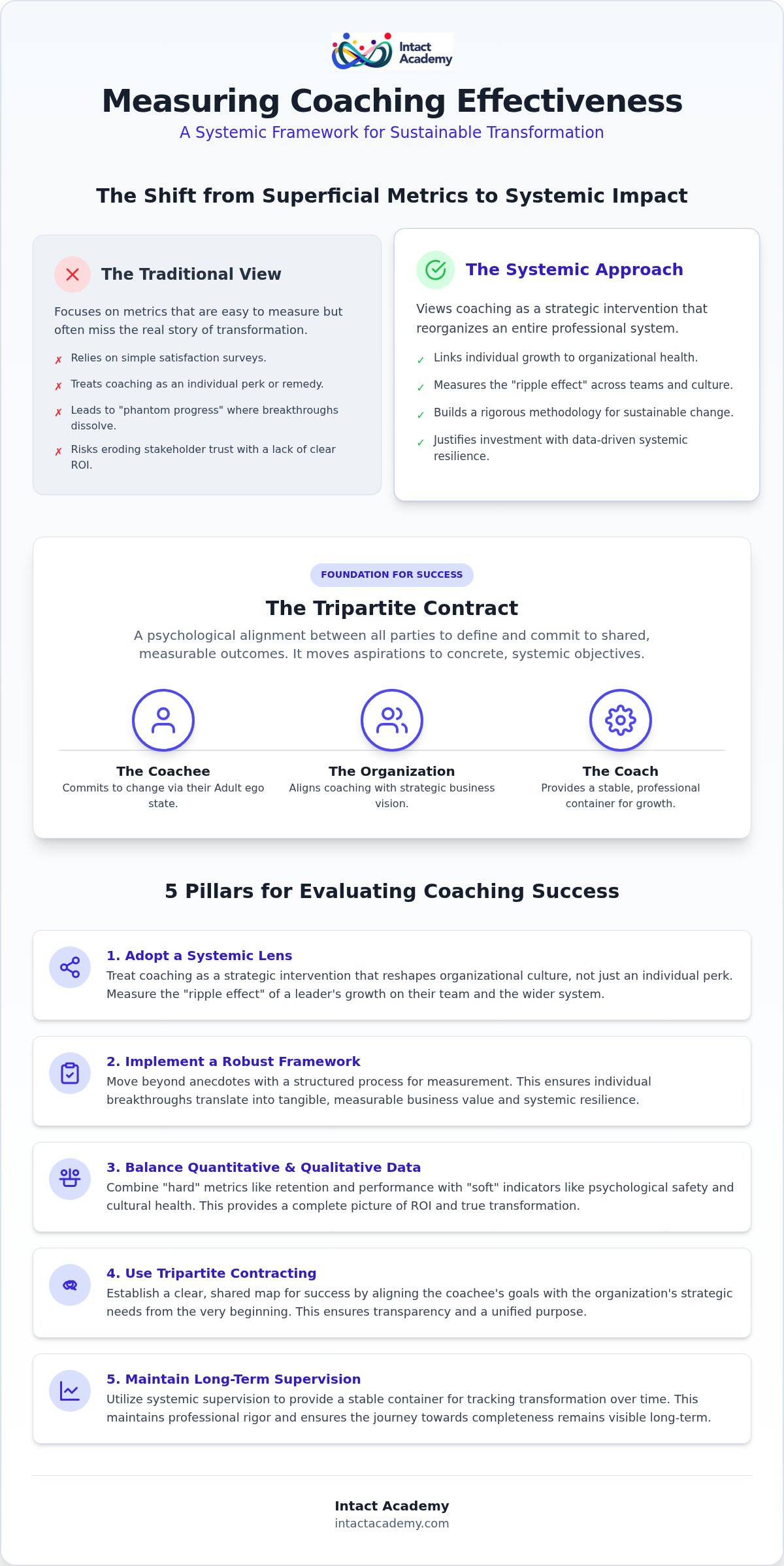
Sustainable impact begins long before the first session. It starts with the coaching contracting phase. This isn't just a legal agreement. It's a psychological alignment. We aim to engage the coachee’s Adult ego state, ensuring they're making a conscious, objective commitment to change that serves the company's strategic vision. Contracting for Effectiveness is a tripartite agreement between the coach, the coachee, and the organization that defines what success looks like for all parties.
When these three pillars are aligned, the coaching process gains a stable foundation. It moves the conversation from vague aspirations to concrete, systemic objectives that can be tracked and celebrated. This alignment ensures that every session contributes to the larger organizational goals, making the measurement of success a natural part of the developmental journey rather than an afterthought.
The Systemic Lens: Measuring Impact Across Organizational Scripts
The true power of coaching reveals itself not just in the coachee's private sessions, but in the hallways and meeting rooms where their influence resides. Moving from a dyadic model to a systemic one allows us to see how individual growth acts as a catalyst for collective evolution. This "ripple effect" is where measuring coaching effectiveness becomes a study of organizational health. We look for the reduction of unconscious psychological games and an increase in genuine autonomy. By understanding what is transactional analysis, we can map how a corporate culture moves from rigid, historical scripts to a state of dynamic, professional wholeness.
A systemic perspective acknowledges that no leader exists in a vacuum. When one person changes their behavior, the entire system must adjust to accommodate that new way of being. This adjustment can be measured through the lens of cultural scripts. We observe whether the organization is moving toward a narrative of growth and responsibility or remaining stuck in cycles of blame and stagnation. This deep-level mapping provides a much more accurate picture of coaching impact than surface-level performance reviews alone.
Mapping the Shift in Ego States
Professional maturity often hinges on the ego states we inhabit during conflict. We track the transition from restrictive Parent-Child dynamics, characterized by blame or dependency, toward Adult-Adult interactions. We also measure "strokes," or units of recognition, within the team environment. A healthy system shifts from negative, conditional strokes to positive, authentic recognition. In executive teams, we specifically measure the reduction of the "Drama Triangle." When leaders stop playing the roles of Victim, Rescuer, or Persecutor, the system regains its capacity for objective problem-solving and creative collaboration.
Evaluating Team Wholeness and Synergy
At the team level, success is measured by the capacity for leading organizational change with resilience. We evaluate how effectively a team communicates under high-stakes pressure. Does the dialogue remain clear, or does it collapse into coded messages and hidden agendas? While 70% of individuals report improved work performance following coaching, according to industry research, the systemic approach ensures this improvement isn't isolated. To effectively measure the effectiveness of coaching, we must observe these shifts in real-time. Systemic supervision serves as a vital tool here, providing an external perspective to verify that team-level outcomes are both sustainable and deep-seated.
This focus on the collective ensures that progress becomes woven into the very fabric of how the organization functions. If you are ready to explore these dynamics within your own leadership group, our Team Coaching programs provide the structured environment needed for this profound transformation.
Qualitative vs. Quantitative Metrics: Balancing ROI with Transformation
To truly capture the value of an engagement, we must look beyond the binary of success or failure. In 2026, measuring coaching effectiveness requires a balanced scorecard that honors both the spreadsheet and the human spirit. Hard metrics provide the grounding necessary for board reports; we see this in retention rates, promotion velocity, and the achievement of specific KPIs. Industry data suggests that companies investing in executive coaching see an average return of 5.7 to 7 times their initial investment. While 86% of companies report at least breaking even, these figures only describe the surface of a much deeper professional evolution.
Soft metrics like psychological safety scores and engagement levels offer a window into the organizational climate. However, the most compelling evidence often lies in the middle ground: the behavioral evidence of script change during high-pressure scenarios. We observe whether a leader defaults to defensive patterns or remains in an Adult ego state when the stakes are high. This shift represents a move from mere behavior modification to profound transformation. It's the difference between a temporary performance spike and a permanent increase in systemic capacity.
Designing Effective 360-Degree Feedback Loops
Standard surveys often miss the nuance of human interaction. By moving toward TA-informed behavioral observations, we can identify the unconscious patterns that dictate team dynamics. Stakeholder interviews should focus on identifying shifts in ego states and the reduction of psychological games. Establishing a clear pre and post evaluation window is essential. This allows us to track the evolution of the leader's impact over time, ensuring that the changes are not just temporary adaptations but permanent shifts in their way of being. We want to see if the coachee's growth is reflected in the increased autonomy of their direct reports.
Calculating the ROI of Sustained Wholeness
We can quantify the cost of workplace games by looking at the time lost to unproductive conflict and the subsequent impact on project timelines. When leaders operate from a state of wholeness, they foster Adult-Adult transactions that streamline decision-making and reduce friction. This directly links measuring coaching effectiveness to reduced burnout and increased organizational resilience. Systemic ROI is the value of sustainable cultural evolution. By valuing this evolution, we move from a transactional view of development to one that prioritizes long-term systemic health and the collective flourishing of the workforce.
A 5-Step Framework for Evaluating Coaching Success
To move beyond surface-level reviews, we must implement a sequence that honors the complexity of human systems. Measuring coaching effectiveness in 2026 requires a shift from transactional checklists to a developmental arc that tracks both internal shifts and external impact. This framework provides a stable container for the often-turbulent work of change, ensuring that every intervention is grounded in psychological rigor and professional pragmatism. We invite you to consider these five essential stages:
- Step 1: Systemic Diagnosis and Baseline Script Mapping. Before change can occur, we must understand the "as-is" state. We map the existing organizational scripts and individual ego states to create a clear starting point for the developmental journey.
- Step 2: Tripartite Contracting. Success is defined through a collaborative agreement between the coach, the coachee, and the organization. This ensures that personal growth remains aligned with strategic business objectives.
- Step 3: Ongoing Supervision. Throughout the engagement, we utilize supervision to monitor quality, ethics, and the coach's own presence. This acts as a safeguard against "phantom progress."
- Step 4: Mid-Point Review of Behavioral Indicators. We pause to evaluate shifts in ego states and the reduction of psychological games. This allows for course correction and ensures the work remains focused on deep transformation.
- Step 5: Final Systemic Impact Assessment and Integration. The final stage measures the ripple effect of the coaching, documenting how individual changes have translated into systemic cultural evolution.
The Role of Supervision in Measurement
The professional development for coaches is incomplete without the reflective space of supervision. A supervisor acts as a "third eye," providing an objective perspective on the effectiveness of the coaching contract. They help the coach identify blind spots and ensure that the measurement of progress remains unbiased and ethically sound. By measuring the coach's own growth and presence, supervision elevates the entire engagement, turning it into a model of professional excellence. If you seek to deepen your own practice through this rigorous lens, explore our offerings in Systemic Supervision.
Integrating Feedback into the Organizational System
Coaching insights should never exist in a vacuum; they must inform the broader culture. We create a "learning loop" where the psychological shifts observed during coaching are distilled into strategic narratives for board reports. This process turns individual growth into a catalyst for organizational change while ensuring the coachee remains the rightful owner of their personal developmental data. By reporting on systemic shifts rather than private details, we maintain trust while proving that measuring coaching effectiveness is a vital component of long-term business strategy.
Cultivating Mastery: How Intact Academy Integrates Measurement
The path to mastery is rarely a straight line; it's a deepening of one's capacity to hold the complexity of human systems while remaining anchored in professional rigor. At Intact Academy, the Sari van Poelje approach serves as a bridge between high-level psychological theory and the pragmatic demands of the boardroom. We believe that measuring coaching effectiveness isn't a task performed at the end of an engagement. Instead, it's a continuous, rhythmic process woven into the very fabric of the coaching relationship. Our academies teach coaches to listen for the subtle shifts in organizational scripts and to document the movement toward systemic wholeness from the very first interaction.
By integrating Transactional Analysis (TA) with systemic methodology, we move beyond the surface of behavior modification. We train our participants to observe the "process" as much as the "content," allowing them to identify the underlying drivers of organizational performance. This depth ensures that the impact of coaching is both visible to stakeholders and deeply felt by the individuals involved. It's about returning to a state of genuineness where individual growth and organizational success are no longer seen as competing interests but as two sides of the same coin.
Accreditation as a Benchmark for Effectiveness
In a world where coaching can sometimes feel ethereal, global accreditation provides the necessary grounding. We align our training with the highest standards, including the 2026 EMCC requirements for senior-level practitioners. Achieving EMCC Senior Practitioner status isn't just about hours logged; it's about demonstrating a sophisticated ability to manage complex systemic dynamics. Our TA EMCC Senior Team Coach Academy specifically prepares leaders to track team-level metrics that reflect true cultural evolution. These standards ensure that coaches can operate effectively in hybrid, global environments where the "ripple effect" of change must be documented across borders and digital interfaces. To find senior directors and finance leaders who thrive under such high standards of professional excellence, you can discover Inner Circle Agency.
We invite you to look inward and reflect on your current measurement practices. Are they merely surface-level surveys that capture a fleeting mood, or are they systemic assessments that reveal the health of your organizational culture? True mastery requires the courage to move beyond anecdotes and embrace a more rigorous, psychologically informed approach. If you're ready to join a community of practice dedicated to deep transformation and measurable impact, consider how our TA EMCC Senior Practitioner academy can elevate your professional presence.
For organizations seeking to align their leadership development with sustainable growth, we offer tailored Organizational Change consultancy. We help you turn the often-turbulent work of change into a structured journey toward excellence. Let's work together to ensure that your investment in human potential yields the profound, systemic results your vision deserves.
Advancing Toward Systemic Wholeness and Professional Rigor
The transition from anecdotal evidence to a rigorous framework for measuring coaching effectiveness represents a maturing of the coaching profession. By integrating Transactional Analysis with systemic methodology, you move beyond surface-level behavioral shifts into the realm of profound human and organizational transformation. We've explored how tripartite contracting and systemic supervision provide the stable container needed to track this evolution. This ensures that individual growth consistently serves the health of the entire system.
True mastery requires a commitment to both psychological depth and professional pragmatism. It's a process of becoming more aware, more aligned, and more effective in navigating the complex scripts that define modern leadership. Led by international TA expert Sari van Poelje, our programs have empowered participants from over 14 countries to lead with integrity and insight. Our EMCC and ICF accredited programs provide the intellectual rigor you need to succeed in a demanding global landscape.
Are you ready to elevate your practice and prove the deep value of your interventions? Deepen your impact with our TA EMCC Senior Practitioner academy and join a global community dedicated to excellence. The path to systemic wholeness is open to those with the courage to change.
Frequently Asked Questions
How do you measure the ROI of coaching for soft skills?
You measure ROI by linking specific behavioral shifts to organizational outcomes like retention or productivity. While 86% of companies report breaking even on their investment, industry data shows an average return of 5.7 to 7 times the initial cost. We focus on "Systemic ROI," which quantifies the value of reduced conflict and increased Adult-Adult transactions. This method ensures that measuring coaching effectiveness captures both financial gains and long-term cultural resilience.
What are the best KPIs for executive coaching effectiveness?
Effective KPIs include both quantitative data and qualitative indicators of professional wholeness. You should track retention rates and promotion velocity alongside psychological safety scores and 360-degree feedback. We also monitor the reduction of "psychological games" within executive teams. These diverse metrics provide a balanced scorecard for development. They ensure that individual performance improvements translate into broader team synergy and sustained organizational health.
Can you measure coaching success using 360-degree feedback?
Yes, 360-degree feedback is a powerful tool when it focuses on observable behavioral patterns rather than vague impressions. We use these loops to identify shifts in ego states and the frequency of positive recognition within the team. By comparing pre-coaching baselines with post-engagement results, you can see how a leader’s internal transformation affects their colleagues. This approach provides concrete evidence of how the coachee’s growth ripples through the entire system.
How often should coaching effectiveness be evaluated?
Evaluation should occur at multiple intervals to capture the full arc of transformation. We recommend a baseline diagnosis, a mid-point review of behavioral indicators, and a final systemic impact assessment. It's also vital to conduct a follow-up three to six months after the engagement ends. This ensures the change is sustainable. Regular evaluation helps maintain the "learning loop," allowing coaching insights to continuously inform and improve the broader organizational culture.
What is the difference between individual and systemic coaching measurement?
Individual measurement focuses on the coachee's personal goals and internal shifts, while systemic measurement tracks the "ripple effect" across the organization. Systemic evaluation looks at team synergy, reduced burnout, and cultural script changes. It acknowledges that a leader doesn't exist in a vacuum. By measuring coaching effectiveness at both levels, you ensure that individual growth supports the collective flourishing and strategic objectives of the entire business system.
How does Transactional Analysis help in measuring coaching impact?
Transactional Analysis provides a rigorous vocabulary for mapping internal and interpersonal shifts. We measure impact by tracking the transition from Parent-Child dynamics to Adult-Adult professional interactions. By identifying changes in "strokes" and the reduction of the Drama Triangle, we gain objective data on psychological growth. This methodology turns complex human behavior into a manageable framework for evaluation. It allows us to prove that deep psychological work leads to measurable professional results.
What role does a coaching supervisor play in measuring success?
A coaching supervisor acts as a "third eye," providing an objective perspective on the coaching contract's success. They ensure that the engagement remains ethically sound and focused on the agreed-upon systemic goals. Supervision measures the coach’s own presence and growth, which are critical factors in the engagement's overall impact. This reflective space provides a safeguard against "phantom progress." It ensures that the measurement of effectiveness remains unbiased and deeply grounded in professional mastery.
How do you ensure data privacy while measuring coaching outcomes?
Data privacy is maintained through clear tripartite contracting between the coach, coachee, and organization. We ensure the coachee remains the rightful owner of their personal developmental data. When reporting to the board, we focus on systemic shifts and strategic narratives rather than private session details. This approach protects individual vulnerability while providing the organization with the data it needs to justify the investment. It creates a safe container for profound personal and professional change.


