

What if the persistent friction within your leadership team isn't a lack of resources, but a systemic response to the psychological weight of change? In 2026, as US energy costs climb by 23.5% and inflation persists at 2.6%, leaders often find themselves trapped in a cycle of reactive firefighting. You likely recognize this chronic organizational noise, where the gap between executive vision and team execution feels increasingly insurmountable. To bridge this divide, you must move beyond tactical tasks and define clear strategic priorities for leadership that address the root causes of misalignment.
We agree that traditional management tools often fall short in the face of deep-seated human resistance. This article promises to show you how to align your internal psychological script with organizational strategy to define priorities that drive sustainable transformation. We'll preview a journey from tactical management to systemic mastery, exploring the Adult perspective and a five-step framework for establishing priorities that actually stick. This is the path toward returning to a state of completeness and genuine impact in a volatile world.
Key Takeaways
- Learn to distinguish tactical busyness from true strategic impact by operating from the Adult ego state, ensuring your focus remains on systemic levers rather than reactive tasks.
- Identify how personal "Drivers"—such as the urge to be perfect or the need to hurry—can subconsciously dictate your strategic priorities for leadership, creating invisible ceilings for growth.
- Understand the "Organizational Scripts" that cause teams to resist change and discover how professional contracting can align executive vision with team execution.
- Apply a five-step systemic framework to decontaminate your strategic vision from outdated influences, allowing for a clearer and more objective approach to organizational transformation.
- Transition from transactional management to systemic mastery by integrating Transactional Analysis and professional coaching principles into your daily leadership practice.
Beyond the To-Do List: Defining Strategic Priorities for Leadership in 2026
True strategic priorities for leadership aren't merely items on a high-level checklist; they are the systemic levers that determine whether an organization moves toward wholeness or fragmentation. In a year where global GDP growth is projected at a modest 3.2%, the margin for error in resource allocation is slim. Leaders often mistake tactical busyness for progress, yet this activity is frequently a defense mechanism against the deeper work of transformation. To achieve strategic impact, one must operate from the Adult ego state, observing the organizational system with objective clarity rather than reacting from impulsive or controlling patterns.
This shift requires an awareness of the Leadership Script, the unconscious set of past patterns and beliefs that dictate how a leader perceives urgency and value. If your script is built on a "Hurry Up" driver, you might prioritize speed over sustainability, inadvertently creating a culture of burnout. Moving from a linear mindset to a systemic one in 2026 means recognizing that every priority you set ripples through the entire organizational fabric. It's about seeing the connections between team well-being, economic volatility, and long-term viability.
The Difference Between Management Tasks and Leadership Priorities
Effective strategic planning rests on an Adult-to-Adult contract between the leader and the organization. When leadership becomes a series of management tasks, it often descends into a Parent trap, where top-down priority setting creates a culture of dependency and compliance rather than autonomy. This dynamic stifles the innovation needed to navigate 2026's economic pressures. Management is the art of doing things right; strategic leadership is the courage to choose the right things to do. By fostering Adult-to-Adult interactions, you empower your team to take ownership of the vision, transforming static goals into living movements. For organizations looking to cultivate this environment through specialized off-site programs, you can visit Aura Events to design high-end leadership retreats that foster deep systemic alignment.
Why Traditional Prioritization Frameworks Often Fail
While tools like the Eisenhower Matrix offer a basic logic for sorting tasks, they often fail in complex systemic environments because they ignore the underlying human element. They don't account for the Psychological Games that teams play to avoid the discomfort of change, such as "Yes, But" or "Look How Hard I'm Trying." These games act as invisible barriers to execution, keeping the organization stuck in a loop of unproductive urgency. To uncover these hidden obstacles, we must look toward Transactional Analysis as a diagnostic tool. Understanding these dynamics is essential for effective Strategic management, as it allows leaders to address root causes rather than just symptoms. Only by clearing these psychological blockages can a leader define priorities that drive genuine, sustainable transformation.
The Psychology of Focus: How Your Inner Script Shapes Your Strategy
Strategy is rarely the purely cognitive exercise that many business schools suggest. Instead, it's a reflection of the leader’s internal world. A leader's Life Script, an unconscious plan formed in early development, often creates an invisible ceiling for organizational growth. If your script dictates that you must struggle to be worthy, your strategic priorities for leadership will inevitably favor complex, high friction paths over simpler, more effective ones. Achieving autonomy in this context requires three psychological pillars: awareness of these patterns, the spontaneity to choose a new response, and the intimacy to connect authentically with your team. Without this internal work, even the most robust strategic plan will be sabotaged by the very person who created it.
Identifying Your Strategic Drivers
In Transactional Analysis, we identify Drivers as the internal pressures that push us to behave in specific, often counterproductive ways. For example, the Please Others driver often leads to a dilution of strategic priorities for leadership. A leader caught in this dynamic says yes to every stakeholder, resulting in a fractured vision and team over-commitment. Conversely, the Be Strong driver can result in a refusal to delegate strategic execution. This leader carries the weight of the organization alone, creating a bottleneck that prevents scaling.
Your calendar and checkbook serve as the ultimate truth tellers of your focus. When we examine a Blueprint For Leadership Strategic Priorities, it becomes clear that true strategy is found in resource allocation, not just intention. To test this, map your top three priorities against your primary psychological drivers. Are you pursuing a goal because it creates systemic value, or because your script demands you Be Perfect? Understanding this distinction is a core part of professional development for coaches and leaders alike.
Moving from Reaction to Proaction
Staying in the Adult ego state during high stakes meetings is the difference between leading a system and being consumed by it. When market volatility strikes, the Child ego state may panic, while the Parent ego state may become overly restrictive. Neither state allows for the objective analysis required to pivot effectively. Sari van Poelje emphasizes the use of agile TA to help leaders recognize these shifts in real time, allowing them to return to a grounded, Adult perspective before making critical decisions.
A leader’s greatest strategic asset is not their intellect, but their level of self-awareness. By cultivating this presence, you move from reacting to external crises to proactively shaping the future of your organization. If you're ready to deepen this mastery, exploring our TA EMCC Senior Practitioner academy provides the systemic tools necessary for profound professional transformation.
Systemic Alignment: Why Good Strategies Fail in Dysfunctional Cultures
Why do meticulously crafted strategies often gather dust in executive boardrooms? The answer usually lies within the "Organizational Script," the collective unconscious patterns that dictate how a company truly functions beneath its formal hierarchy. Even with a clear focus on the 5 Strategic Planning Priorities for 2026, a culture rooted in past failures or rigid hierarchies will instinctively resist new directions. This resistance often manifests as "Discounting," a psychological mechanism where teams minimize the importance of data or the viability of new goals to maintain a familiar status quo. In an era where US GDP growth is projected at a modest 2.1%, the cost of this internal friction is a luxury no leader can afford. Successfully strategic priorities for leadership require more than just a vision; they require a deep dive into the system's hidden architecture. This perspective is foundational for anyone leading organizational change with a focus on long-term sustainability.
The 3 Levels of Contracting for Strategic Success
To move beyond surface-level agreement, leaders must engage in a rigorous three-level contracting process with their teams. This ensures that every layer of the human system is aligned with the organizational goals. Without this clarity, priorities remain abstract concepts rather than actionable drivers.
- The Administrative Contract: This covers the "what" and "when." It defines clear goals, timelines, and the specific resources required to execute the strategy.
- The Professional Contract: This focuses on the "how." It outlines the competencies needed and the specific methods team members will use to work together toward the common vision.
- The Psychological Contract: This is the most critical and often ignored level. it addresses unspoken expectations, fears, and the underlying motivation that either fuels or sabotages the strategic priorities for leadership.
Uncovering the Systemic Roots of Resistance
When teams fail to execute, it's rarely a matter of simple laziness. Often, it's a result of "Symbiosis," a systemic dynamic where individuals surrender their autonomy to fit into a group pattern, preventing individual accountability. This leads to psychological "Games" at the executive level, where energy is spent on internal politics rather than external impact. To break these loops, leaders must use systemic team coaching to address the root causes of misalignment. Our TA Foundation Year provides the essential framework for leaders to recognize these patterns. By resolving these deep-seated systemic issues, you create a space where change isn't just a directive, but a natural evolution of the organization's growth.
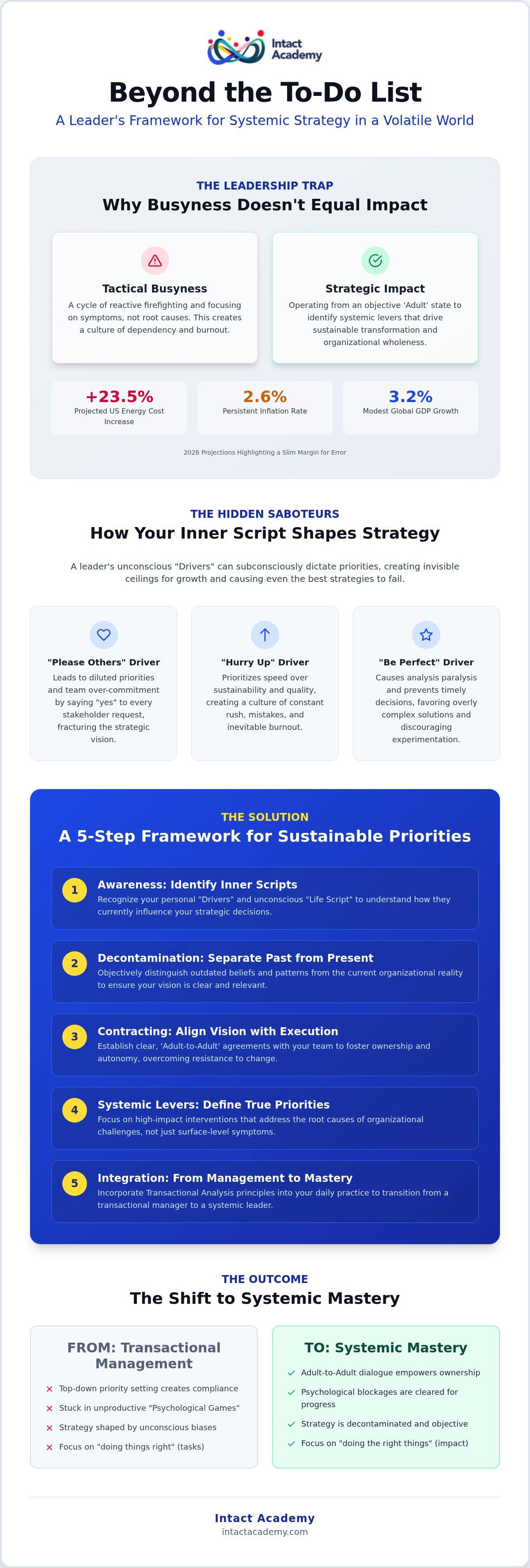
A 5-Step Framework for Establishing Sustainable Strategic Priorities
Establishing strategic priorities for leadership is not a mere exercise in logic; it's a process of systemic purification. Many executive teams fail not because they lack a plan, but because their vision is clouded by outdated psychological patterns. Moving beyond the "discipline" models of the past, this framework focuses on deep transformation. It ensures that every priority is grounded in the Adult ego state, free from the prejudices of the past or the reactive fears of the present. By following these five steps, you move from managing tasks to leading a thriving, autonomous system.
- Step 1: Diagnostic—Assess the current organizational script and identify which ego states are driving current decisions.
- Step 2: Decontamination—Clear the "Parent" and "Child" influences from the strategic vision to ensure objective clarity.
- Step 3: Redecision—Commit to new systemic patterns and strategic directions that honor the current reality.
- Step 4: Integration—Align the psychological contract with the business strategy to ensure team-wide buy-in.
- Step 5: Supervision—Maintain focus and resolve emerging systemic blocks through professional oversight.
Step 1 & 2: Diagnosis and Decontamination
Contamination in leadership thinking occurs when the Adult ego state is bypassed by the Parent’s rigid rules or the Child’s emotional needs. You can identify this when a strategy feels like a "Receptive Fantasy"—a goal that sounds inspiring but lacks a realistic path to execution. These fantasies often serve a leader's need for approval or a desire to avoid conflict rather than addressing systemic requirements. To clear this, you must distinguish between your "Real Priorities" and these psychological distractions.
Motivating a team through this shift requires a healthy "Stroke" economy. In Transactional Analysis, a stroke is a unit of recognition. If your organization only rewards "Hurry Up" behaviors, your team will prioritize speed over the strategic depth required for 2026. By consciously shifting what you recognize and reward, you begin to decontaminate the cultural environment, making space for more meaningful work.
Step 3, 4, & 5: Action and Sustainability
Sustainability is built on a culture of "OK-OK" transactions, where both the leader and the team operate from a position of mutual respect and accountability. This environment supports high-performance execution because it eliminates the need for defensive "Games." As the strategy is integrated, the psychological contract must be explicitly updated. This ensures that the unspoken expectations of the team are aligned with the new strategic direction, preventing the silent sabotage that often follows major shifts.
To maintain this alignment over time, professional supervision is essential. It acts as a systemic guardrail, preventing "Strategic Drift"—the slow, often unnoticed return to old, unproductive patterns. For senior leaders, obtaining an executive coaching certification provides the advanced tools needed to facilitate this process for others. If you're ready to master these systemic levers, consider joining our TA EMCC Senior Practitioner academy to bridge the gap between theory and transformational ROI.
Cultivating the Strategic Mindset: Mastery Through Transactional Analysis
The TA EMCC Senior Practitioner academy is designed for those who seek to refine their individual leadership impact through the lens of Transactional Analysis. It moves beyond generic coaching skills to provide a rigorous framework for understanding human behavior in business. You learn to recognize the subtle transactions that either build trust or create friction within your executive team. For those tasked with shifting the collective culture, the TA EMCC Senior Team Coach academy offers the tools to transform organizational dynamics from the inside out.
Holding an international accreditation from bodies like EMCC or ICF is no longer just a credential. In the current market, where 47% of organizations in a 2026 study cited scalability as the most important attribute in leadership development, these certifications signal a commitment to a standard of excellence that resonates globally. They provide a stable container for the often-turbulent work of organizational change. This systemic approach ensures that your leadership remains grounded even when facing energy cost increases of 23.5% or other external market shocks.
Your Next Step Toward Systemic Impact
True transformation requires more than attending a surface-level workshop. It requires a commitment to deep mastery and the courage to look inward before taking outward action. By joining our global community, you step into a space where complex systemic issues are managed through insight and structured methodology. You'll join participants from 14+ countries who are committed to their own flourishing and that of their organizations, moving beyond transactional management toward a more profound state of wholeness.
This is where you transition from being a participant in a system to becoming its wise mentor. You become someone who values integrity and has the courage to lead through ambiguity with a sense of quiet power. It's time to align your psychological depth with your organizational strategy to drive sustainable change. We invite you to explore our upcoming academies and masterclasses and take the first step toward a more profound systemic impact.
Embodying the Systemic Leader: Your Path to 2026 Mastery
True mastery in the coming years won't be defined by how much you do, but by the depth of your presence and the clarity of your systemic choices. You've seen how internal scripts and organizational patterns can sabotage even the most brilliant plans. By aligning your psychological depth with your business goals, you transform strategic priorities for leadership from mere tasks into powerful levers for sustainable growth. This journey requires moving beyond transactional management to embrace a more profound, systemic way of being.
If you're ready to lead with grounded power and join an international network of senior professionals from 14+ countries, it's time to deepen your expertise. Our EMCC and ICF accredited programs offer the specialized knowledge needed to master systemic organizational change. We invite you to Join the TA EMCC Senior Practitioner Academy for Leadership Mastery and begin your return to a state of completeness and genuine impact. The courage to change your script is the first step toward transforming your organization's future. You don't have to navigate this evolution alone.
Frequently Asked Questions
What are the top 3 strategic priorities for most leaders today?
The top three strategic priorities for leaders in 2026 involve integrating AI into decision making, navigating market volatility with adaptability, and prioritizing psychological safety. Data from a 2026 Harvard Business Impact study shows that 78% of leaders now leverage AI for strategic insights. Focusing on these areas allows organizations to remain resilient while fostering a culture where mental well-being and business outcomes coexist. This holistic approach ensures long term stability in an uncertain global economy.
How do I balance urgent tactical fires with long-term strategic priorities?
Balancing tactical fires with long term goals requires a deliberate shift into your Adult ego state. By stepping back from the immediate urgency of the Child ego state, you can assess whether a crisis is a systemic symptom or a random event. Effective leaders use clear contracting to empower their teams, ensuring that daily management tasks don't consume the space required for profound organizational transformation and high impact strategic work.
How does Transactional Analysis help in setting business strategy?
Transactional Analysis provides a diagnostic lens to uncover the unconscious Drivers and Scripts that influence your strategic priorities for leadership. By identifying whether you're acting from a need to Be Perfect or Please Others, you can decontaminate your decision making process. This psychological clarity ensures that your strategy is based on current organizational needs rather than outdated personal patterns, allowing for more authentic and effective leadership in complex environments.
What is the "Psychological Contract" and why does it matter for leadership?
The psychological contract consists of the unspoken expectations and emotional commitments between a leader and their team. While administrative contracts define goals and resources, the psychological layer determines whether people truly feel motivated to execute them. If this contract is neglected, it often leads to Discounting where priorities are ignored to maintain a familiar status quo. Addressing these hidden dynamics is essential for creating lasting alignment and systemic health.
Can systemic team coaching improve our execution of strategic goals?
Systemic team coaching directly improves execution by resolving the Psychological Games and Symbiosis that prevent individual accountability. Instead of focusing on surface level skills, this approach addresses the underlying patterns that cause teams to resist change. By fostering Adult to Adult interactions at the executive level, coaching creates a culture of mutual respect and high performance. This ensures that strategic goals move from being abstract visions to integrated organizational realities.
How do I know if my leadership script is hindering my organization’s growth?
You can identify script interference by observing repetitive patterns of organizational stuckness or your own chronic burnout. If you find yourself consistently managing reactive crises or diluted priorities, your internal script may be creating a ceiling for growth. Recognizing Drivers like Be Strong or Hurry Up is the first step toward redecision. Moving toward autonomy allows you to lead with more presence, spontaneity, and intimacy, benefiting the entire system.
What is the difference between a tactical leader and a strategic leader?
A tactical leader focuses on the administrative efficiency of doing things right, often trapped in the Parent ego state of top down control. In contrast, a strategic leader possesses the courage to choose the right things to do by focusing on systemic impact. This distinction is vital in 2026, as leaders must move beyond transactional management. Strategic leadership requires a higher level of self awareness to navigate ambiguity and drive sustainable transformation.
Why do most strategic change initiatives fail within the first six months?
Most initiatives fail because leaders focus on the administrative contract while ignoring the Organizational Script and psychological resistance. When teams feel their unspoken needs are being discounted, they subconsciously sabotage the strategic priorities for leadership to return to a state of familiar comfort. Success requires a five step framework that includes diagnosis and decontamination. Without addressing these systemic roots, even the most logical strategy will struggle to survive beyond its initial launch phase.


