

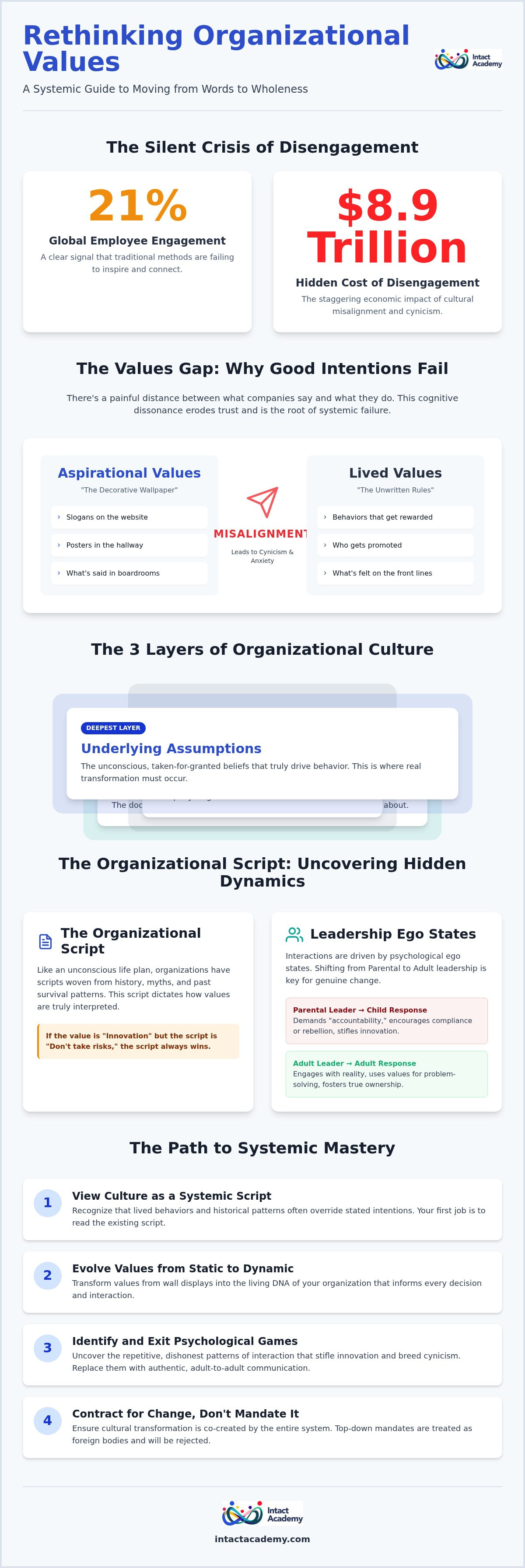
With global employee engagement stalling at just 21%, the hidden cost of cultural disengagement has quietly climbed to $8.9 trillion. You've likely noticed that traditional organizational values often function as little more than decorative wallpaper, failing to bridge the gap between what's said in the boardroom and what's felt on the front lines. This misalignment breeds a deep-seated cynicism that no amount of surface-level coaching can fix. It's a systemic failure, not a lack of intent.
We believe that true culture isn't a list of adjectives; it's the collective ego state of your company. This guide provides a sophisticated framework to move beyond superficial statements and address the underlying psychological scripts that dictate behavior. You'll discover how to facilitate profound human transformation by aligning leadership actions with systemic integrity. We'll examine the psychological drivers of performance and provide the precise tools needed to anchor your values in reality, ensuring your organization moves toward a state of genuine completeness and sustainable growth in 2026.
Key Takeaways
- Learn to view your culture as a systemic script where lived behaviors often override stated intentions.
- Discover how to evolve your organizational values from static wall displays into a dynamic DNA that informs every decision and interaction.
- Identify the psychological games and parental leadership styles that quietly stifle innovation and breed employee cynicism.
- Master the art of "Contracting for Change" to ensure that your cultural transformation is co-created by the entire system; don't rely on top-down mandates.
- Gain the tools to transition from surface-level interventions to systemic mastery, fostering a workplace culture defined by wholeness and genuine human connection.
What Are Organizational Values? Beyond the Surface Definition
Think of organizational values as the invisible DNA of your corporate system. They aren't merely slogans designed for a website; they're the fundamental coding that determines how your organization breathes, grows, and responds to crisis. While many view values as static principles, they're actually dynamic forces that shape the collective ego state of the company. When these values are authentic, they provide a sense of wholeness. When they're superficial, they create a systemic fracture that employees feel intuitively.
Most initiatives fail because they confuse the map with the territory. There's often a painful distance between "aspirational values", the idealized version of the firm, and "lived values", the behaviors rewarded in the shadows. This gap creates a psychological environment of high anxiety. If a company claims to value integrity but rewards aggressive, short-term gains, the resulting cognitive dissonance erodes the foundation of trust. Ensuring that your financial practices mirror your ethical standards is a vital step; firms like CTC Tax & Accounting provide the bookkeeping and CFO advisory necessary to maintain this level of operational transparency. For the human soul to flourish at work, it requires a predictable environment where stated intentions match observed reality.
The Three Layers of Organizational Culture
To understand why values often remain surface-level, we must look at the structural layers of organizational culture. First, we see Artifacts, which are the visible symbols, office layouts, and slogans. Beneath these lie Espoused Values, the documented beliefs that leaders talk about in meetings. However, the deepest layer consists of Underlying Assumptions. These are the unconscious, taken-for-granted beliefs that actually drive behavior. Lasting transformation only happens when we align what we say with these deep-seated assumptions.
The Role of Values in Strategy Execution
Strategic success depends on more than just market analysis; it requires a coherent internal compass. Values serve as a critical decision-making filter for leaders, helping them choose the right path when data is ambiguous. By establishing a shared ethical framework, you reduce the cognitive load on your teams. They don't have to guess how to act because the organizational values provide a clear directive. This alignment is also your strongest tool for talent retention. In an era where 85% of workers prioritize work-life balance and purpose, people stay where they feel their personal script resonates with the organizational mission.
A Systemic Perspective: Values as the Organizational Script
To truly understand organizational values, we must look beyond the present moment and into what we call the "Organizational Script". In Transactional Analysis, a script is an unconscious life plan. Organizations possess these scripts too. They're woven from founding myths, the legacy of past leaders, and historical patterns of survival that dictate how values are actually interpreted today. You might proclaim "innovation" as a core tenet, but if the underlying script is "don't take risks", your people will intuitively follow the unwritten rule every time. This hidden narrative often acts as a powerful anchor, holding the system in place even when leadership attempts to sail in a new direction.
This systemic script functions as a form of homeostasis. It's a mechanism that maintains stability, even when that stability is fundamentally dysfunctional. When you introduce new values without addressing this script, the system treats them as foreign bodies and rejects them. This is often why core values matter less than the behavioral reality; they cannot take root in soil that's already committed to a different story. True transformation requires us to rewrite the script at a systemic level rather than just polishing the surface.
Transactional Analysis in the Workplace
We see these scripts play out through individual ego states. A "Parental" leadership style might demand "accountability" but actually encourage a "Child" response of compliance or quiet rebellion. When leaders interact from an Adult ego state, they engage with the here-and-now reality, allowing organizational values to become tools for problem-solving rather than instruments of control. Without this Adult awareness, teams often fall into "Psychological Games", which are repetitive, dishonest patterns of interaction that serve to avoid responsibility while appearing to follow the company line. Transactional Analysis serves as a profound diagnostic tool for culture by revealing these hidden transactions and ego state misalignments before they derail your strategy.
The Systemic Balance of Values
Values function as the boundaries of your organizational system. They define what's "us" and what's "not us". However, boundaries only work when they're clear and mutually agreed upon. This is where the concept of "Contracting" becomes vital. It's the process of making the implicit explicit. By contracting for specific behaviors, you ensure that values are mutually understood across every level of the hierarchy. If you're looking to master this level of cultural alignment, our programs in organizational change provide the systemic depth required to uncover the gap between stated and lived values. Systemic coaching doesn't just ask what your values are; it asks what your system is trying to protect by ignoring them.
Why Values Often Fail: Misalignment and Psychological Games
Values fail when they exist in a vacuum of behavior. You've likely seen the "Value Gap" in action: a glossy mission statement on the wall that's flatly contradicted by the way leaders act in closed-door meetings. This misalignment isn't just a management oversight; it's a systemic fracture that invites deep cultural cynicism. When employees witness this discrepancy, they don't just lose motivation. They lose their sense of psychological safety. The system begins to operate on a double standard, where the stated organizational values are treated as a polite fiction while the real work happens through shadow scripts of power and survival.
This failure often stems from a "Parental" leadership style. When leaders dictate values from a position of authority without modeling them, they inadvertently cast their employees into a "Child" ego state. In this dynamic, innovation is stifled by a fear of stepping out of line, and accountability becomes a tool for blame rather than growth. The cost is staggering. With global engagement at record lows, the $8.9 trillion lost in productivity is frequently the price tag of a culture that has stopped believing in its own promises.
Common Pitfalls in Value Definition
Many organizations fall into the trap of adopting generic "table stakes" values. Principles like integrity, quality, or respect are essential, but they lack the differentiation needed to drive a unique culture. As Patrick Lencioni noted in Make Your Values Mean Something, values that don't cost you anything aren't really values. If your principles don't help you make difficult trade-offs or weed out high-performers who don't fit the culture, they're merely decorative. Without clear behavioral indicators, your team won't know what "innovation" actually looks like on a Tuesday morning. It remains an abstract concept rather than a practical guide for action.
Psychological Resistance to Cultural Change
People don't resist change itself; they resist the loss of the familiar. Even when old scripts are dysfunctional, they provide a predictable framework for survival. Moving toward new organizational values requires a high degree of systemic trust. If the environment feels threatening, individuals will retreat into defensive ego states, clinging to the status quo to maintain emotional equilibrium. Navigating this requires a sophisticated understanding of leading organizational change. You must address the underlying fear and facilitate a process where the new values feel like a path toward wholeness rather than an imposition from above. Only then can the system truly exhale and begin the work of transformation.
How to Implement Organizational Values Systemically
Implementing organizational values requires more than a launch event or a series of emails. It demands a fundamental redesign of how the system functions. We move from the abstract into the concrete through a deliberate, five-step process that ensures the new culture takes root in reality rather than just remaining on the lobby wall.
First, perform a systemic diagnosis. You must uncover the "living script" that currently dictates behavior. What are people actually doing when no one is watching? Second, engage in co-creation. This isn't a top-down mandate; it's a process of "Contracting for Change" where every level of the organization has a voice in defining the future. Third, focus on behavioral anchoring. You need to define specific, observable actions for every value. Fourth, ensure structural alignment. Your HR processes, reward systems, and daily rituals must support these values rather than penalize them. Finally, establish ongoing supervision. This provides a reflective space to bridge the inevitable gap between your intent and the system's actual impact.
The Power of Behavioral Indicators
Abstract nouns like "trust" or "excellence" are too vague to drive change. You must translate these into actionable verbs. What does trust look like in a conflict? How is excellence manifested in a failed project? By creating "Value Moments" in daily meetings and feedback loops, you make the invisible visible. Leaders who invest in professional development for coaches are better equipped to model these behaviors, transforming theoretical concepts into lived reality.
Integrating Values into the Employee Lifecycle
Your values must be embedded into the entire journey of an employee. This starts with values-based hiring. Instead of looking for "cultural fit", which often leads to homogeneity, look for "cultural contribution". How does this person help the system evolve toward its stated goals? Performance management must also shift. Evaluating "what" was achieved is only half the story; you must evaluate "how" it was achieved. If a high-performer reaches their targets by violating organizational values, the system must have the courage to address the misalignment.
The role of the Senior Team Coach is vital here. They act as the guardian of cultural momentum, ensuring that the work of transformation doesn't stall after the initial excitement fades. If you're ready to lead this level of deep change, our TA EMCC Senior Team Coach Academy provides the systemic methodology needed to master cultural transformation and create a state of genuine organizational wholeness.
Deepening Your Impact: Mastery in Cultural Transformation
As we look toward the horizon of 2026, the demands on leadership have shifted. Surface-level consulting and quick-fix workshops are no longer enough to sustain a healthy system. Organizations now require a depth of insight that can only come from systemic mastery. This isn't just about applying a new set of rules; it's about shifting the very foundation of how we perceive human interaction within a business context. To truly influence organizational values, you must move from the act of "doing" culture change to the state of "being" a change agent. This internal shift allows you to remain grounded even when the system's old scripts attempt to pull you back into dysfunctional patterns.
The Path to Systemic Mastery
Mastery requires a rigorous, psychologically grounded approach. Our TA EMCC Senior Team Coach Academy provides the framework needed to facilitate this level of deep change. The curriculum is built upon Sari van Poelje’s methodology, which bridges the gap between high-level theory and professional pragmatism. A unique pillar of this path is systemic supervision. It's a common trap for coaches to become unconsciously recruited into the very organizational script they aim to transform. Supervision provides the essential reflective space to ensure you don't become part of the problem you're trying to solve. It maintains the practitioner's clarity and integrity, allowing them to serve as a stable container for the system's evolution.
Next Steps for Organizational Leaders
Building authentic organizational values is an act of profound human transformation. It's about moving past the decorative artifacts of culture and addressing the underlying systemic scripts that define how people truly interact. By replacing psychological games with Adult-to-Adult transactions, you create an environment where integrity is lived rather than just discussed. We've seen that when values are systemically anchored in behavior, the resulting alignment drives both individual growth and sustainable organizational success.
The work of cultural evolution is demanding; it requires a stable container and a sophisticated methodology. Intact Academy supports this journey through EMCC and ICF accredited programs, drawing on expertise in Systemic Change and Transactional Analysis. Our global network of professionals from over 14 countries provides a rich space for deep learning and professional growth. We invite you to master the art of cultural transformation in our TA EMCC Senior Team Coach Academy. You have the opportunity to lead your organization toward a state of genuineness and flourishing. The courage to change begins with a single, systemic step.
Frequently Asked Questions
What is the difference between core values and organizational culture?
Core values represent the aspirational principles that guide decision-making, while culture is the actual sum of behaviors, rituals, and unwritten rules within the system. You can think of organizational values as the compass and culture as the terrain. While values provide the "why," the culture is the "how" it feels to work there every day. Misalignment occurs when the compass points north but the terrain forces everyone to walk south.
How many organizational values should a company have?
Most successful organizations thrive with three to five core organizational values. This range is narrow enough to remain memorable yet broad enough to encompass the systemic complexity of a global business. When a company attempts to juggle ten or more principles, they often become a list of generic "table stakes" that lack differentiation. Focusing on a few deeply resonant values allows for more precise behavioral anchoring and clearer filters for leadership.
Can organizational values change over time?
Values should remain stable but not static. As your organization evolves, the unwritten scripts that once served you may become obsolete. It's appropriate to review your principles during significant shifts, such as a merger or a pivot in strategy. However, frequent changes can breed cynicism. Instead of replacing them, consider evolving the behavioral indicators to reflect the maturity of the system. This ensures the culture remains authentic to its current reality.
How do you measure if employees are actually living the values?
Measurement requires moving from abstract nouns to observable behaviors. You can utilize 360-degree feedback and cultural audits to identify the "Value Gap" between stated intent and lived reality. If a high percentage of engagement is tied to direct managers, then observing managerial interactions is the most direct metric. Look for "Value Moments" in daily meetings. Are people rewarded for the behaviors your mission statement claims to prize, or is the shadow script winning?
What is a "systemic approach" to organizational values?
A systemic approach treats the organization as a living web of interconnections rather than a collection of separate parts. It acknowledges that values aren't just individual choices but are influenced by feedback loops, historical patterns, and unconscious scripts. Instead of just coaching one leader, we look at how the entire system's structure supports or stifles the desired culture. This perspective ensures that changes are sustainable and don't trigger the system's natural resistance to transformation.
How can Transactional Analysis help in defining company values?
Transactional Analysis provides a sophisticated diagnostic lens to move values from "Parental" mandates into "Adult" agreements. It helps identify when a company's culture is stuck in a compliant or rebellious "Child" ego state. By analyzing the transactions between teams, you can uncover the hidden psychological games that undermine your principles. This methodology allows you to rewrite the organizational script, ensuring that your values are co-created and anchored in genuine human connection and professional pragmatism.
What should I do if leadership behavior contradicts our stated values?
Contradictory leadership behavior is a signal of a systemic fracture that requires immediate, honest intervention. You must facilitate a process of "Contracting for Change" where the gap between words and actions is made explicit without triggering defensive ego states. If the "Parental" figures in the hierarchy don't model the values, the rest of the system will naturally follow their lead rather than the mission statement. Resolving this requires the courage to address the underlying script directly.
How do I align personal values with organizational values?
Alignment begins with deep self-reflection to understand your own life script and core principles. You must look for resonance between your personal drive for wholeness and the organization's systemic goals. If there's a fundamental mismatch, the resulting cognitive dissonance will eventually lead to burnout or disengagement. True alignment isn't about forced compliance; it's about finding a workplace where your personal evolution and the company's growth move in the same rhythmic and balanced direction.


