

Why does a coaching engagement that feels transformative in the quiet of a session often dissolve the moment your client returns to the boardroom? It’s a common frustration for even the most seasoned practitioners. You witness the same recurring cultural "games" and organizational politics, feeling the burnout of carrying a client’s systemic stress without a clear way to resolve it. This persistent struggle is exactly why systemic supervision has become an essential evolution for those working in high-stakes organizational fields; it allows you to see the invisible architecture that shapes every interaction.
You’ve likely realized that focusing on the individual is no longer enough when the collective forces are so much stronger. This guide promises to help you master the art of looking beyond the person to the patterns, enhancing your ability to facilitate sustainable change while securing your path toward Senior Supervisor accreditation. We’ll explore the transition from watching the players to understanding the stadium, covering the latest 2026 ICF and EMCC requirements. By integrating these profound insights, you'll provide a stable container for professional growth and help your clients return to a state of genuine completeness and impact.
Key Takeaways
- Learn how systemic supervision uncovers the invisible organizational field, allowing you to influence the collective patterns that dictate individual performance.
- Use Transactional Analysis as a precise diagnostic language to decode complex organizational cultures and move past recurring "games."
- Master the 7-Eyed Model and Systemic Constellations to visualize deep-seated blockages and facilitate more sustainable transformation for your clients.
- Protect your professional impact by identifying systemic stress before it leads to burnout or secondary trauma.
- Identify the developmental milestones required to transition from an executive coach to an accredited Senior Supervisor in a global market.
Defining Systemic Supervision: Seeing the Invisible Field
Systemic supervision is a collaborative inquiry that transcends the traditional boundaries of the coaching relationship. While case-based supervision often focuses on the coach's technique or the client's internal hurdles, this approach views the coaching engagement as a subset of a much larger organizational field. It acknowledges that the energy, tensions, and unspoken mandates of the client's company inevitably enter the coaching room. This perspective draws heavily from the principles of Systemic therapy, emphasizing that no individual exists in isolation; we are all nodes in a complex, interconnected web of influence.
One of the most profound phenomena in this work is the "Parallel Process." This occurs when the dynamics between the client and their organization are unconsciously replicated in the relationship between the coach and the client. A coach might feel suddenly overwhelmed or silenced, mirroring the client’s experience within their corporate culture. Recognizing these reflections allows the supervisor to diagnose systemic blockages that would otherwise remain invisible. By identifying these mirrors, systemic supervision provides a map for the coach to navigate the client's world without getting lost in it.
The Shift from Dyad to System
In 2026, the complexity of global markets and the rise of regenerative leadership mean that focusing solely on the coach-client dyad is insufficient. Every session includes a "third party" in the room: the organizational stakeholder who expects a return on investment and cultural evolution. Understanding this stakeholder's presence is vital. Without systemic awareness, a coach risks becoming a "colluder," unintentionally supporting the client’s existing script instead of challenging the patterns that keep the organization stuck. We must look at the whole stadium, not just the players on the field.
The Role of the Systemic Supervisor
The supervisor acts as a meta-observer of the organizational field. They don't just listen to the narrative; they sense the systemic ripple effects. This role requires a delicate balance of three core functions:
- Normative: Maintaining the ethical standards and professional boundaries of the practice.
- Formative: Developing the coach’s skills and theoretical understanding of systemic dynamics.
- Restorative: Providing a space to process the emotional weight of the client's organizational stress.
By holding these functions, the supervisor creates a safe container. This space allows the coach to step back from the turbulence of the client’s world and return to a state of clarity and professional wholeness. Through systemic supervision, the coach moves from being a reactive participant to a conscious catalyst for organizational transformation.
The Mechanics of Insight: Transactional Analysis in Supervision
Transactional Analysis (TA) serves as a precise diagnostic lens within systemic supervision. While other frameworks might describe the outward symptoms of organizational dysfunction, what is transactional analysis provides the robust vocabulary needed to understand the structural mechanics of human interaction. It allows us to map the invisible threads that bind a team together or, conversely, pull them apart. By treating the organization as a living entity with its own history and psychological needs, we move beyond surface-level coaching into the realm of profound systemic change.
Organizations often operate under "Systemic Scripts." These are unconscious, repetitive patterns of behavior that persist through generations of leadership, often outlasting the individuals who created them. These scripts dictate how a company handles failure, celebrates success, or suppresses dissent. To navigate these waters safely, systemic supervision emphasizes the importance of multi-level "Contracting." This isn't just a simple agreement on session times; it's a deep psychological alignment that ensures the goals of the coaching engagement aren't just serving the individual leader, but are also congruent with the long-term health of the wider organizational system.
Ego States and Organizational Roles
Mapping the Parent-Adult-Child dynamics within corporate hierarchies reveals why certain leaders feel perpetually stuck. A "Parental" organizational culture, characterized by high control and rigid rules, often triggers "Child" responses in executives, leading to either passive compliance or disruptive rebellion. Using Systems Perspectives in Supervision helps the coach recognize these ego-state shifts in real-time. By fostering the Adult ego state, a supervisor enables the coach to remain grounded and objective, helping the client decouple from these systemic pressures and lead with greater authenticity.
Uncovering Game Patterns in Teams
Executive teams frequently find themselves trapped in the "Drama Triangle," a cycle where members rotate through the roles of Persecutor, Rescuer, and Victim. Without a systemic lens, a coach might inadvertently step into the Rescuer role, attempting to "fix" the team and thereby becoming an unwitting participant in the game. Supervision acts as an essential circuit breaker. It provides the reflective space to identify these patterns and move the team toward "Intimacy," a state of authentic connection where professional masks are set aside for genuine collaboration. This shift is the hallmark of professional excellence, and you can explore more about this journey through what is transactional analysis and its profound systemic applications.
Frameworks for Mastery: The 7-Eyed Model and Constellations
To master systemic supervision, one must move beyond linear thinking. While Transactional Analysis helps us decode the specific scripts of human interaction, we require structural frameworks to map the "where" and "how" of broader systemic influence. These tools allow a supervisor to hold multiple perspectives simultaneously, ensuring that no facet of the organizational field remains hidden. By expanding the field of vision, we help coaches move from a narrow focus on individual performance to a profound understanding of the collective forces at play.
Navigating the 7-Eyed Model
The 7-Eyed Model serves as a comprehensive map for this exploration. It divides the supervisory focus into seven distinct perspectives, moving from the microscopic to the macroscopic. Eyes one through three focus on the dyadic interaction: the client’s world, the specific interventions the coach chooses, and the immediate relationship between them. Eyes four through six turn the gaze inward to examine the coach’s internal process, the dynamics within the supervisory relationship itself, and the supervisor’s own somatic responses. Finally, eye seven provides the ultimate systemic lens, accounting for the wider context of organizational culture, market pressures, and global shifts.
Visualizing Dynamics with Systemic Constellations
When verbal dialogue reaches its limit, systemic constellations provide a spatial representation of organizational blockages. By "mapping" the elements of a system, we can identify where energy is stuck or where the flow of leadership is interrupted. This work is often guided by the "Orders of Love" in organizations: the right to belong, the respect for chronological order, and the balance of giving and taking. In our increasingly digital world, supervisors can use virtual whiteboards or even simple physical objects on a desk to represent these dynamics. This allows the field to become visible even through a screen, revealing the hidden architecture of the leadership team.
Effective supervision also requires "Sensing the Field," which involves using your own physical and emotional responses as valid data. If you feel a sudden sense of exclusion or a heavy weight during a session, it often reflects a systemic reality that the coach has not yet named. To evaluate your systemic depth in any given session, consider this brief checklist:
- Are we discussing the client's stakeholders as active participants in this dynamic?
- Have I identified any parallel processes mirroring the organization's history?
- Am I aware of how current market volatility is impacting the coach's resilience?
- Is there a balance between the individual's growth and the organization's needs?
By holding these inquiries, you ensure the work remains grounded in the reality of the organizational system, fostering a state of completeness for both the coach and the client.
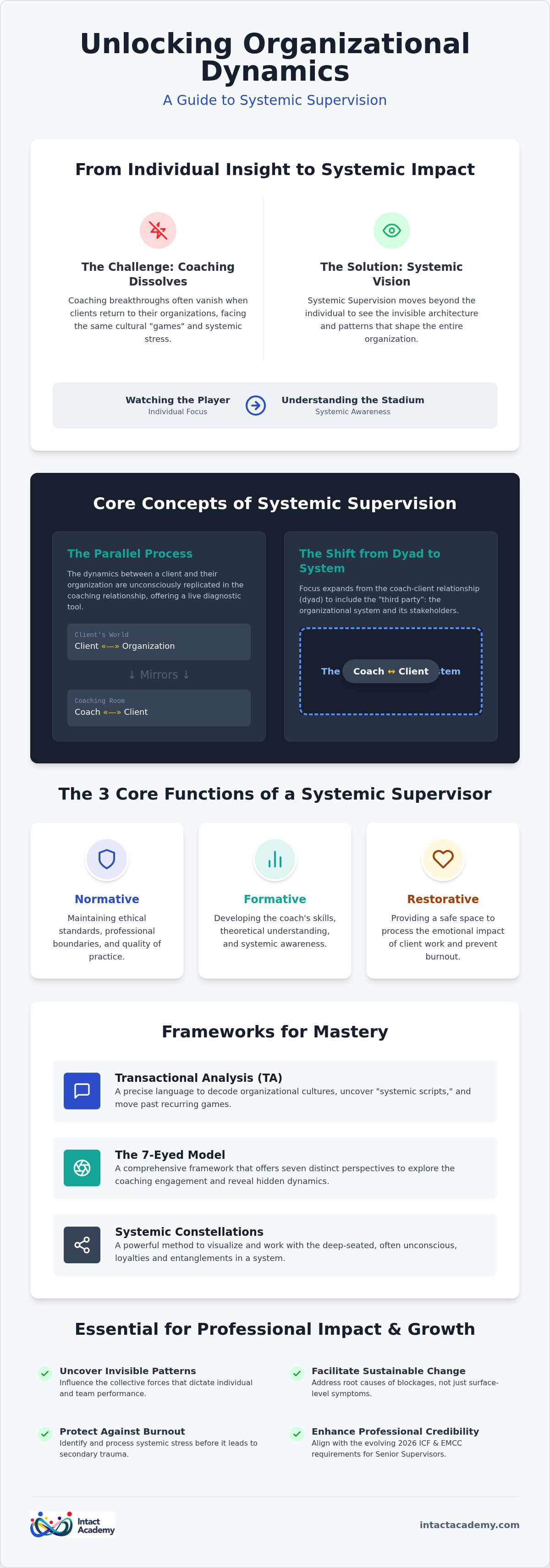
Why Systemic Supervision is Essential for Executive Impact
One of the most persistent misconceptions in the coaching industry is that supervision is merely "therapy for coaches." This view fundamentally misses the point of professional hygiene. In reality, systemic supervision is a rigorous discipline of excellence that ensures the coach remains a clear, objective instrument for change. Without this reflective space, a practitioner working in a toxic or high-pressure culture risks absorbing the "Secondary Trauma" of the organization. They become an emotional sponge for systemic stress, which eventually leads to burnout and a loss of professional potency.
When coaches engage in leading organizational change, the stakes are significantly higher. The coach must navigate not only the client’s resistance but also the collective psychological immune system of the entire company. Supervision provides the necessary distance to maintain ethical boundaries, especially when multiple stakeholders like HR, boards, and C-suite leaders have competing agendas. It is the steady anchor that prevents the coach from being swept away by the turbulent currents of corporate politics.
Preventing Systemic Collusion
Coaches often inadvertently become part of the very problem they were hired to solve. If an organization is characterized by a culture of avoidance, the coach might find themselves avoiding difficult conversations with the client. This is systemic collusion. Through systemic supervision, you gain a "Helicopter View" that allows you to see when you are being "triangulated." Triangulation occurs when a third party, such as an HR director, tries to use the coach to deliver a message they are too afraid to give themselves. Recognizing these traps is essential for maintaining integrity and impact.
ROI: The Business Case for Supervision
Supervision isn't a luxury; it is a key differentiator for those seeking high-value coaching contracts. Supervised coaches deliver faster and more sustainable results because they spend less time caught in the "games" of the organizational field. This level of mastery is a core component of a prestigious executive coaching certification. By demonstrating a commitment to ongoing systemic development, you signal to global organizations that you possess the depth to handle their most complex human challenges. To begin your journey toward this level of professional mastery, explore the opportunities at Intact Academy.
The Path to Becoming a Systemic Supervisor
The journey from an expert coach to a systemic supervisor isn't merely a change in title; it's a profound shift in identity. It requires a move from the active "doing" of coaching to the reflective "being" of supervision. This evolution demands that you expand your capacity to hold the complexity of the organizational field while remaining anchored in your own professional center. As you progress through these developmental stages, you transition from a practitioner of techniques to a master of systemic dynamics, learning to see the world through the lens of interconnectedness.
To achieve the "gold standard" EMCC Global Supervisor Accreditation (ESIA) in 2026, candidates must navigate a rigorous pathway. This includes holding an individual accreditation (EIA) at the Senior or Master Practitioner level and documenting a minimum of 120 hours of supervision practice with at least 10 different supervisees. This high bar ensures that the practice of systemic supervision remains a distinct and advanced discipline, separate from mentor coaching or peer support. It signals to the market that you possess the depth required to supervise coaches working at the highest levels of global leadership.
The TA EMCC Senior Supervisor academy
Our professional development for coaches pathway culminates in the TA EMCC Senior Supervisor academy. This curriculum moves methodically from the foundations of Transactional Analysis to the most advanced applications of systemic practice. You'll apply the insights of global expert Sari van Poelje to your own work, learning to sense the organizational field with precision. With participants from more than 14 countries, the academy offers a rich tapestry of international perspectives, allowing you to test your insights against a diverse range of corporate cultures and systemic challenges.
Final Reflection: Returning to Wholeness
At the heart of our work is the philosophy of returning to a state of completeness and genuineness. The world of organizational change is often turbulent; it can pull at the seams of a practitioner’s integrity and energy. Systemic supervision serves as a stable container that helps you stay "Intact" even when the systems you serve are in crisis. It's about more than professional hours or accreditation; it's about the courage to change and the commitment to human flourishing. We invite you to step into this next level of professional mastery and join a global community dedicated to the profound work of systemic transformation.
Elevate Your Practice to the Systemic Horizon
Mastering the invisible architecture of organizational life is the hallmark of the modern senior practitioner. By shifting your gaze from the individual to the wider field, you move beyond surface-level interventions and into the realm of sustainable transformation. You've explored how Transactional Analysis provides a precise language for corporate culture and how frameworks like the 7-Eyed Model allow you to navigate complex stakeholder dynamics with grace. This path of systemic supervision is not just about professional development; it's about the courage to remain grounded and "Intact" while facilitating deep change in a turbulent world.
If you're ready to transition into a role of global mentorship, we invite you to Apply for the TA EMCC Senior Supervisor Academy. Our programs are recognized by both the EMCC and ICF, led by world-renowned expert Sari van Poelje, and supported by a vibrant community representing over 14 countries. This is your opportunity to join a stable container for deep learning and professional evolution. Step into your next level of impact and help others return to a state of genuineness and professional wholeness. The journey toward mastery is steady and methodical, and it begins with your commitment to see the field in its entirety.
Frequently Asked Questions
What is the difference between coaching supervision and systemic supervision?
Coaching supervision often centers on the coach's technique or the client's internal state. In contrast, systemic supervision expands this focus to include the wider organizational field and its invisible mandates. It treats the coaching room as a microcosm of the client's corporate environment. By analyzing these broader forces, a supervisor helps the coach navigate complex politics and cultural scripts that usually remain hidden in standard case-based sessions.
Is systemic supervision only for team coaches, or can executive coaches benefit too?
Executive coaches benefit just as much as team coaches because no leader operates in a vacuum. Even in one-on-one sessions, the organization's collective energy and third party stakeholders are always present. Systemic awareness helps executive coaches identify when a leader is being triangulated or pressured by cultural expectations. This insight allows for more sustainable transformation, as the coach helps the leader influence the entire system through their individual actions.
How does Transactional Analysis (TA) fit into systemic supervision?
Transactional Analysis provides a precise diagnostic language for mapping systemic interactions. It moves beyond vague descriptions of culture by using concrete concepts like Ego States, Scripts, and Games. In systemic supervision, TA helps practitioners identify repetitive patterns that have persisted in an organization for decades. By decoding these transactions, coaches can help clients decouple from unconscious Parent-Child dynamics and lead from a more grounded, Adult ego state.
What are the accreditation requirements for becoming a systemic supervisor in 2026?
In 2026, the ICF launched the Coaching Supervisor Specialization (CSS), requiring an active PCC or MCC credential and 41 plus hours of specific training. For the EMCC Global Supervisor Accreditation (ESIA), candidates must hold a Senior or Master Practitioner accreditation (EIA). They must also document at least 120 hours of systemic supervision practice with 10 different supervisees. These rigorous standards ensure that supervision remains a distinct, advanced professional discipline.
How many hours of supervision are required for EMCC Senior Practitioner level?
The EMCC Senior Practitioner level requires a minimum of 250 hours of coaching or mentoring practice. Additionally, practitioners must demonstrate a commitment to their own development through regular supervision. While the exact number of supervision hours can vary by individual needs, the focus remains on the quality of reflection and the ability to work with complex organizational dynamics. This accreditation path signals a high level of professional maturity and systemic impact.
Can systemic supervision be conducted effectively in an online format?
Systemic supervision is highly effective online when using digital tools to visualize organizational dynamics. Virtual whiteboards and spatial mapping allow practitioners to represent leadership teams and systemic blockages clearly. The core of the work relies on the supervisor's ability to sense the field and notice somatic responses, which transcends physical location. Online formats also facilitate an international community, connecting coaches from diverse global cultures to share systemic insights.
What is the "parallel process" in coaching supervision?
The parallel process occurs when the dynamics of the client's organization are unconsciously replicated within the coaching relationship. For example, if a client feels silenced by their board, the coach might find themselves feeling hesitant to speak up during a session. Supervision identifies these mirrors as vital data. By recognizing the reflection, the supervisor helps the coach diagnose the organizational energy and avoid becoming an unwitting participant in the client's systemic script.
How do I choose the right systemic supervisor for my practice?
Look for a supervisor who holds a recognized accreditation, such as the ESIA or the new ICF CSS. Beyond credentials, seek someone who understands the specific pressures of the organizational field and possesses a deep psychological framework like Transactional Analysis. The right supervisor creates a stable container where you feel safe to explore your vulnerabilities. They should help you stay Intact while navigating the often turbulent work of professional and personal change.


