

Why do some practitioners possess a quiet power that shifts the energy of an entire organization, while others remain tethered to the surface of human interaction? When you begin exploring transactional analysis certification reviews, you likely recognize that true mastery isn't found in a library of pre-recorded videos or a weekend seminar. It's found in the rigorous, often uncomfortable process of looking inward to understand the systemic forces at play. If you've felt stuck in transactional coaching, you know the hollow feeling of providing a solution that doesn't reach the root of the problem.
Finding a program that aligns with your maturity requires a move away from low-cost certificates toward international accreditation like the EMCC or ICF. This article helps you clarify the landscape of TA certifications in 2026. We'll examine how to choose a program that offers the psychological rigor, live supervision, and high-level peer network necessary for your evolution into a senior practitioner. By the end of this guide, you'll understand how to select a path that honors your intelligence and prepares you for the profound work of systemic transformation.
Key Takeaways
- Distinguish between surface-level video courses and professional-grade certifications that provide the international accreditation required for senior executive and team coaching.
- Use transactional analysis certification reviews to identify programs that prioritize live supervision and systemic impact over simple ease of use or low cost.
- Learn why the 2026 professional landscape demands a shift from individual psychological models toward a deep understanding of organizational systems and group dynamics.
- Discover how a rigorous certification process transforms your practice by deepening self-awareness and mastering the art of professional contracting for sustainable change.
- Identify the long-term ROI of joining an immersive academy that fosters a global network of high-level practitioners and supports your evolution into a systemic change agent.
Navigating the Landscape of Transactional Analysis Certification Reviews in 2026
The professional environment of 2026 demands a level of psychological literacy that goes beyond basic communication tools. As organizations face increasing volatility, the need for practitioners who can decode the hidden architecture of human systems has never been greater. When you begin your search by examining transactional analysis certification reviews, you'll find a clear divide between those seeking a personal interest certificate and those pursuing professional mastery. A true certification is not merely a badge of attendance; it's a rigorous validation of your ability to facilitate deep, systemic change.
Quality in this field is anchored by global bodies such as the EMCC, ICF, and EATA. These organizations ensure that a program provides the necessary hours of theory, practice, and, most importantly, supervision. When you read reviews, look past the surface level of course convenience. The most valuable feedback often comes from practitioners who describe the "uncomfortable growth" that occurs when their own internal scripts are challenged. If a review focuses solely on the ease of the platform or the speed of completion, it likely signals a program that lacks the depth required for high-stakes executive work.
The Evolution of TA in Professional Coaching
Transactional Analysis has moved far beyond Eric Berne's original clinical applications. While the classic Parent-Adult-Child model remains a foundational tool, it's only the entry point for modern organizational consultants. Today, the focus has shifted toward mapping unconscious patterns within corporate cultures and understanding the systemic "games" that prevent teams from achieving their potential. Organizations in 2026 don't just need coaches who can fix a single conflict; they need systemic change agents who can identify the underlying scripts that keep an entire department stuck in a cycle of stagnation.
Introductory vs. Mastery-Level Certifications
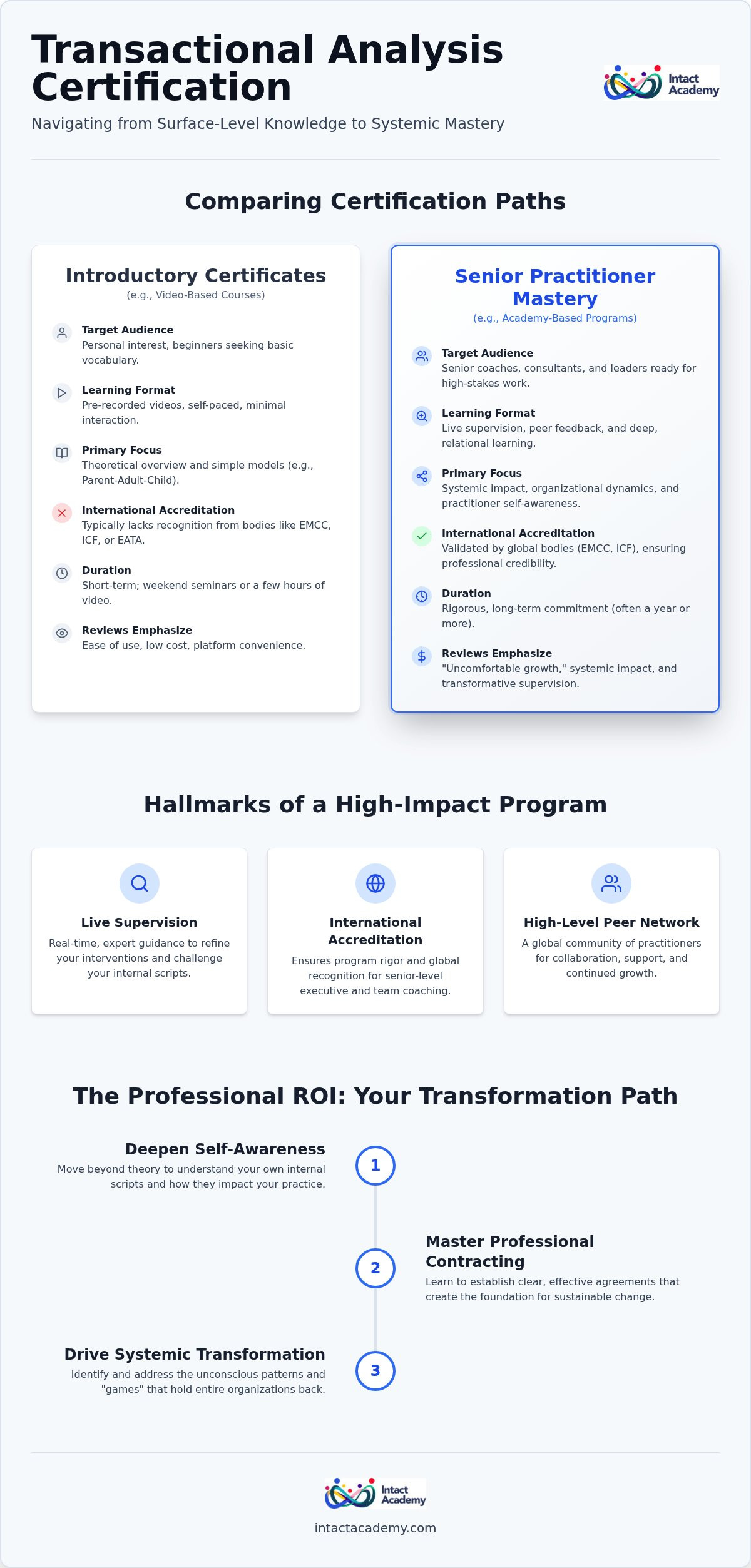
The marketplace is flooded with video-based courses that promise a quick understanding of TA. These are excellent for learning the vocabulary, but they're insufficient for professional practice. Mastery requires an academy-based approach where live supervision and peer feedback are the core components. You must decide if you're at a stage where you need a theoretical overview or if you're ready for a Senior Practitioner level of training. Mastery involves a commitment to a year-long process or longer, where your work is scrutinized by experts to ensure your interventions are safe, ethical, and effective. Choose the path that matches your professional ambition rather than your schedule's convenience.
Critical Criteria: What High-Level Reviews Reveal About Program Quality
When assessing transactional analysis certification reviews, the most telling feedback often lies in what isn't said about the interface or the price. Instead, look for mentions of "live supervision" and "systemic impact." High-level practitioners don't seek convenience; they seek a transformative experience that shifts their professional "Internal Operating System." A review that highlights how a program helped a coach identify a client's unconscious organizational script is far more valuable than one praising a user-friendly video portal.
A program's depth is often a reflection of its leadership. In the global TA community, the reputation of the founder acts as a beacon for quality. Programs led by international experts like Sari van Poelje are recognized for their ability to bridge complex psychological theory with pragmatic business application. This balance ensures that you aren't just learning abstract concepts but are developing the tools to manage high-stakes transitions in corporate environments. Look for feedback that mentions the integration of theory and practice as a seamless, lived experience.
The Value of Accredited Supervision
You cannot master Transactional Analysis in isolation. It is a relational theory that requires a relational learning environment. The most insightful reviews often describe "Aha!" moments that occur during live systemic sessions where a supervisor observes your transactions in real-time. Unlike a teacher who merely imparts knowledge, a mentor-supervisor holds a mirror to your practice. They help you navigate counter-transference and refine your interventions, ensuring you move from "doing" coaching to "being" a transformational presence. This live feedback loop is the hallmark of a mastery-level program.
International Recognition and Portability
A certification must hold weight across borders to be truly valuable in 2026. Global organizations require credentials aligned with the EMCC and ICF. These accreditations provide a universal language of excellence, making your expertise portable across different industries and countries. Practitioners who have graduated from programs with participants from over 14 countries often report a significant advantage in global consultancy. They possess a nuanced understanding of cultural scripts that a localized course simply cannot provide. If you are ready to elevate your practice, exploring a TA EMCC Senior Practitioner academy can provide the international recognition and systemic depth required for global impact.
Comparing Certification Paths: From Intro Certificates to Senior Practitioner Mastery
When you begin your journey, the sheer volume of transactional analysis certification reviews can feel overwhelming. Many of these testimonials focus on the convenience of digital modules or the simplicity of basic ego state models. However, for a professional working within complex organizational systems, there's a significant gap between a foundational certificate and a mastery-level accreditation. Choosing the right path requires an honest assessment of your current professional depth and your long-term aspirations for systemic impact.
It's vital to recognize that "Transactional Analysis for Professionals" requires a curriculum distinct from clinical models. While clinical TA focuses on long-term therapeutic healing, professional TA is designed for the high-stakes environment of executive coaching and organizational change. It prioritizes contracting, group dynamics, and the identification of cultural scripts that inhibit performance. If you seek to work with leadership teams, you need a program that speaks the language of business while honoring the depth of human psychology.
Self-Paced Learning: The Foundation
These entry-level options serve as a useful introduction to the core concepts of the field. You'll learn to identify Parent, Adult, and Child ego states, and perhaps begin to notice basic transactions in your daily life. They're excellent for building a theoretical vocabulary at a low cost. Yet, these courses often lack the ethical containment and supervised practice required to handle volatile human dynamics. Reviews frequently praise the flexibility of these programs, but they often ignore the professional isolation that comes with learning a relational theory in a vacuum. Without a peer group or a mentor, the theory remains a static intellectual exercise rather than a lived skill.
Professional Academies: The Mastery Path
This is where the "Senior Practitioner" gap becomes visible in most generic reviews. A professional academy, such as the TA EMCC Senior Practitioner academy, moves beyond individual psychology into the realm of systemic mastery. These programs are designed for executive coaches, team facilitators, and change agents who must navigate the unconscious scripts of an entire board of directors. The Intact Academy model, for instance, integrates TA with systemic team coaching to provide a holistic framework for transformation.
Reviews for these immersive experiences rarely mention "ease of use." Instead, they speak of a profound shift in professional identity. They describe moving from a state of "doing" to a state of "being" a coach who can hold the tension of organizational change. The ROI here isn't measured in hours saved, but in the depth of impact you offer your clients and the international recognition that opens doors to global consultancy roles.
The Professional ROI: How the Right TA Certification Transforms Your Coaching
The return on investment for a high-level certification manifests in the practitioner's ability to remain steady amidst organizational turbulence. When you examine transactional analysis certification reviews, the most significant transformations are reported by those who moved from surface-level interventions to deep systemic work. This evolution occurs through a structured process that redefines your professional value and your capacity for impact.
First, you must deepen your self-awareness to recognize and manage counter-transference. In high-stakes environments, your own internal scripts can inadvertently mirror the client's dysfunction, leading to a loss of objectivity. Second, you master the art of contracting. Sustainable change is impossible without a clear, multi-level agreement that addresses the psychological and social needs of the organization. Third, you learn to use TA scripts to diagnose toxic corporate cultures, shifting from individual symptoms to systemic causes. Finally, achieving senior-level accreditation allows you to command the consultancy rates that reflect your specialized expertise and the safety you provide to your clients.
From Individual Ego States to Systemic Wholeness
A mastery-level program teaches you to see the unspoken rules that govern a leadership team. It moves beyond the mechanics of ego states to foster a sense of systemic wholeness. This shift is essential for developing the executive presence required for C-suite interventions. When you can identify the parallel processes where individual growth mirrors organizational success, you become an indispensable partner to leadership. This isn't about fixing people; it's about facilitating a return to genuineness across the entire system. By aligning individual development with organizational goals, you ensure that transformation is both profound and permanent.
The Credibility Factor in 2026
In 2026, corporate clients are more discerning than ever. They are increasingly vetting coach certifications for psychological rigor and international recognition. Holding an EMCC Senior Practitioner status provides a distinct competitive advantage, signaling that your practice is grounded in supervised, ethical experience. Engaging in professional development for coaches is the most direct path to achieving this level of systemic mastery. By choosing a program with recognized transactional analysis certification reviews, you ensure your credentials carry weight in boardrooms across the globe. If you are ready to bridge the gap between coaching and transformation, consider joining our TA EMCC Senior Practitioner academy to solidify your professional standing.
Why Intact Academy is the Gold Standard for Systemic Mastery
Intact Academy represents the synthesis of the elements discussed throughout this guide: psychological depth, international accreditation, and systemic mastery. Under the guidance of Sari van Poelje, we offer a space where the "Art and Science" of human behavior meet the practical demands of organizational leadership. When you read transactional analysis certification reviews from our alumni, a recurring theme emerges. It's the shift from simply "doing" coaching to "being" a grounded, transformational presence. This evolution doesn't happen by chance; it's the result of a rigorous, supervised journey that honors the complexity of the human experience.
Our TA EMCC Senior Practitioner academy is designed specifically to bridge the gap between abstract theory and executive impact. We provide a stable, international container that allows for deep professional change. It is a place where you can explore your own scripts while learning to navigate the complex dynamics of global organizations. This dual focus ensures that your growth as a practitioner is always linked to the success of the systems you serve.
Our Systemic Curriculum for 2026
The curriculum we've refined for 2026 goes beyond the basics. We start by exploring what is transactional analysis from a purely systemic perspective. This foundation allows us to focus on leading organizational change through a psychological lens that most business schools overlook. By understanding the unconscious patterns that drive corporate behavior, you gain the tools to facilitate sustainable transformation.
Our sessions are delivered in a hybrid format, combining live online interactions with in-person deep dives. This structure ensures that modern global professionals can engage with the material without sacrificing the intimacy of supervised practice. We don't just teach models. We facilitate the evolution of your professional identity, ensuring you have the "internal operating system" to handle high-stakes interventions with confidence and grace.
Your Journey to Senior Practitioner Level
The path to becoming a Senior Practitioner is a year-long commitment to excellence. It begins with a deliberate enrollment process designed to ensure your readiness for this level of depth. Once inside, you enter a steady, methodical learning rhythm that mirrors the process of deep change itself. You'll join a peer network of practitioners from over 14 countries, creating a global citizenship that enriches every session. The long-term impact of this journey isn't just a credential. It's the confidence to stand in the center of a turbulent system and provide a calm, authoritative point of reference. If you're ready to move beyond transactional work and embrace your role as a systemic master, we invite you to Explore our TA EMCC Senior Practitioner Academy.
Your Evolution into Systemic Mastery
The journey toward professional mastery is rarely a straight line. It's a deliberate process of unlearning old patterns to make space for a deeper, more genuine way of being. As you've explored throughout these transactional analysis certification reviews, the difference between a functional coach and a transformational one lies in the quality of their internal operating system. Choosing a path that prioritizes live supervision and systemic rigor ensures that your interventions don't just solve immediate problems but facilitate long-term organizational health.
You're now equipped to distinguish between surface-level certificates and the profound depth of an accredited academy. The landscape of 2026 rewards those who have the courage to look inward and the discipline to master complex human systems. If you're ready to join an international community of practitioners from over 14 countries, we invite you to take the next step in your professional journey. Led by international expert Sari van Poelje, our programs provide the EMCC Senior Practitioner accreditation you need to command authority in any boardroom. Join the TA EMCC Senior Practitioner Academy at Intact Academy and begin your return to wholeness today. You possess the potential to be the stable center of change that your clients require.
Frequently Asked Questions
How do I know if a Transactional Analysis certification is internationally recognized?
International recognition is determined by a program's alignment with global governing bodies such as the EMCC, ICF, ITAA, or EATA. A recognized program will explicitly state its accreditation levels, such as EMCC Senior Practitioner. This ensures the curriculum meets rigorous international standards for both theory and supervised practice. This commitment to quality is also found in other sectors; for instance, you can discover Ventiva Care Institute to see how health and social care training follows similar accredited pathways. When evaluating transactional analysis certification reviews, verify if alumni have successfully utilized their credentials in global corporate environments across different industries and countries.
What is the difference between TA for coaching and TA for psychotherapy?
The primary difference lies in the professional contract and the intended outcome of the work. TA for coaching focuses on professional performance, organizational systems, and future-oriented change within the social realm. In contrast, clinical TA addresses deep-seated psychological healing. Intact Academy specializes exclusively in the organizational and coaching applications of TA. We help practitioners understand systemic dynamics without crossing into clinical psychotherapy, which requires a distinct legal and professional framework.
Are online TA certification reviews reliable for professional coaches?
Reviews on mass-market platforms often prioritize convenience and price over professional depth. For a serious coach, these star ratings can be misleading. You should prioritize transactional analysis certification reviews that mention the quality of live supervision and the impact on the reviewer's professional identity. Look for testimonials from practitioners who work with high-stakes leadership teams. These insights provide a more accurate measure of a program's ability to facilitate deep, systemic transformation.
How long does it typically take to earn a Senior Practitioner TA certification?
Achieving a Senior Practitioner level typically requires a year-long specialized academy program. This journey involves intense theoretical study combined with 250 coaching hours and regular supervision sessions. It's a methodical process designed to ensure you've integrated the concepts into your "being" as a coach rather than just your "doing." While introductory courses might take only a few days, true mastery and professional accreditation require a sustained commitment to your professional evolution.
Do I need prior psychological training to enroll in a TA academy?
You don't necessarily need a formal degree in psychology to enroll in a mastery-level TA academy. However, a high degree of professional maturity and experience in leadership or coaching is essential. The curriculum is designed to build upon your existing expertise, providing a psychological lens to view organizational systems. We look for participants who are ready to engage in deep self-reflection and who possess the courage to challenge their own internal scripts.
What is the cost difference between a Udemy TA course and an accredited academy?
The price gap reflects the difference between passive information and active transformation. A Udemy course provides a theoretical overview at a low cost but lacks live supervision and professional accreditation. An accredited academy is a significant investment that includes mentoring, a peer network from over 14 countries, and international credentials. This path offers a higher professional ROI by enabling you to command senior consultancy rates. It's the difference between buying a book and joining a lineage.
Can I use TA certification hours toward ICF or EMCC renewal?
Yes, hours earned in an accredited TA program can usually be applied toward ICF or EMCC renewal. Programs that offer CCE credits or are EMCC recognized provide the necessary documentation for your professional portfolio. This ensures that your specialized training in Transactional Analysis also serves your broader professional standing. It's a strategic way to deepen your psychological expertise while maintaining your core coaching credentials in a competitive and increasingly discerning global market.
Who is Sari van Poelje and what is her role in Intact Academy?
Sari van Poelje is the founder and director of Intact Academy and an internationally recognized expert in systemic transformation. With decades of experience in executive coaching and organizational change, she bridges the gap between complex psychological theory and pragmatic business leadership. Her role is to act as a wise mentor for participants, guiding them through the "Art and Science" of TA. Her personal insights and proprietary frameworks form the backbone of our systemic mastery programs.


