

Recent organizational audits suggest that 68% of recurring team conflicts stem from a leader's script-driven need for control or approval, revealing why transactional analysis for organizational development has become essential for modern leadership. This invisible architecture often dictates the success of your most vital projects. You've likely experienced the quiet exhaustion of watching a well-designed change initiative stall, or felt the weight of psychological games that drain team productivity while leadership defaults to passivity. It's a common struggle for those who sense that something deeper is at play beneath the surface of daily operations.
This article provides a sophisticated framework to diagnose these cultural patterns and resolve systemic friction. By applying this psychological depth, you can move beyond surface-level fixes to achieve sustainable transformation. We'll examine practical tools for team interventions and the path toward professional accreditation that honors your growth as a senior practitioner. Together, we'll map a journey toward returning your organization to a state of wholeness, moving from fragmented communication to genuine connection. You'll discover how to lead with a calm authority that fosters both individual flourishing and organizational success.
Key Takeaways
- Learn how to shift from individual coaching to a systemic perspective that treats the organization as a living entity striving for wholeness.
- Master the application of transactional analysis for organizational development to identify the Parent-Adult-Child dynamics that either fuel or frustrate your team meetings.
- Recognize the "Organizational Script" and the psychological games that cause change initiatives to fail despite having a clear strategy.
- Discover the nuances of the three-cornered contract to align expectations between the coach, the client, and the wider organizational system.
- Explore the path toward becoming an EMCC Senior Practitioner, moving beyond surface-level techniques into the realm of profound human and systemic transformation.
The Systemic Lens: What is Transactional Analysis for Organizational Development?
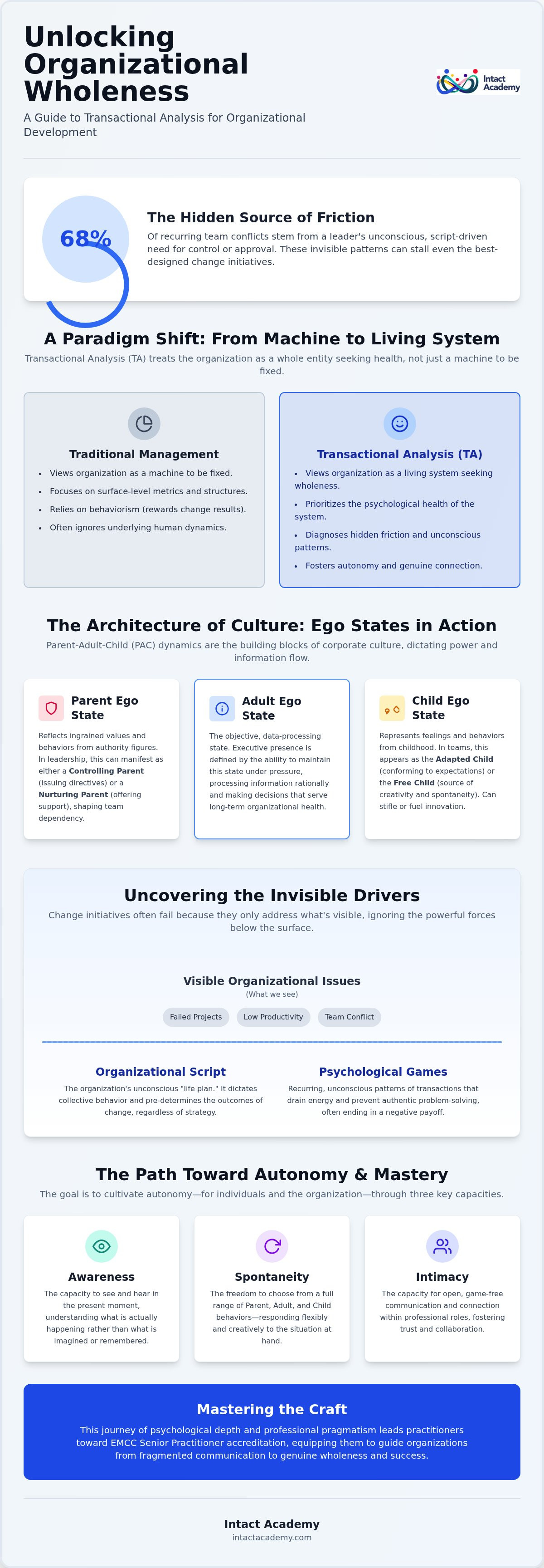
When we view an organization through a systemic lens, we see more than a collection of roles and functions; we see a living, breathing entity. Transactional analysis for organizational development serves as a social psychology that analyzes these intricate patterns of interaction within systems to facilitate profound growth. While many traditional approaches to change focus on surface-level metrics or structural reorganizations, they often fail because they ignore the underlying human dynamics. They treat the organization as a machine to be fixed rather than a system seeking health. By contrast, this methodology shifts the focus toward organizational "wholeness," ensuring that the psychological health of the system is prioritized alongside its commercial objectives.
Sari van Poelje advocates for this approach as a catalyst for agile systemic change. In her view, the depth of Transactional Analysis allows leaders to diagnose the hidden friction that stalls even the most brilliant strategies. It's about looking beneath the visible behavior to understand the scripts and transactions that define the corporate culture. Transactional analysis for organizational development is a methodology for returning organizations to a state of completeness by addressing the unconscious patterns that hinder collective growth.
The Core Philosophy of Organizational TA
At the heart of this work is the "I’m OK – You’re OK" life position. In a professional setting, this philosophy creates the foundation for true psychological safety, where individuals feel empowered to contribute without fear of judgment or retribution. The ultimate goal is autonomy, which is defined through three specific capacities: awareness of the present moment, spontaneity in response, and the capacity for intimacy within professional roles. When teams operate from this place of autonomy, they move away from rigid, defensive postures and toward a more fluid, creative way of working together.
TA vs. Traditional Management Theories
Traditional management theories often rely on behaviorism, assuming that if you change the rewards, you change the results. However, this surface-level focus misses the "unconscious" drivers that dictate how a culture actually functions. To truly master these deep-level diagnostics, practitioners must commit to rigorous professional development. Understanding what is transactional analysis in a systemic context allows coaches to move beyond simple communication tips. It provides the tools to map the invisible architecture of the workplace, helping senior practitioners guide their clients toward a more genuine and effective way of being. This journey requires a blend of psychological depth and professional pragmatism that few other frameworks can offer.
The Architecture of Corporate Culture: Ego States and Transactions
Corporate culture is often described as an intangible atmosphere, yet it's built on observable, repeatable building blocks. By applying transactional analysis for organizational development, we can decode the Parent-Adult-Child (PAC) dynamics that dictate how power is wielded and how information flows through a system. These ego states aren't just personal traits; they become the default operating modes for entire departments. Research into TA and Organizational Behavior illustrates how these internal states dictate the external health of a system, creating either a culture of accountability or one of dependency.
When a leader operates from a Controlling Parent state, the reporting lines often respond from an Adapted Child position. This creates a complementary transaction that feels stable but ultimately stifles initiative. Conversely, in moments of high-stakes pressure, the ability to maintain an Adult ego state is what defines executive presence. It allows a leader to process data objectively, acknowledge emotional undercurrents without being swept away by them, and make decisions that serve the organization's long-term wholeness rather than immediate anxiety.
Ego States in Leadership Roles
Management styles often fluctuate between the Nurturing Parent, who provides necessary support, and the Controlling Parent, who enforces standards. While both have their place, an over-reliance on either can lead to a culture of micro-management or passivity. The goal for sophisticated leadership is the development of the Integrating Adult. This state doesn't ignore the Parent or Child; instead, it integrates the ethics of the Parent and the creativity of the Child into a coherent, present-centered response. We also shouldn't overlook the Natural Child. This state is the engine of innovation and creative organizational change, providing the spontaneity and energy required to break through stagnant corporate scripts.
Mapping Team Dynamics Through Transactions
Team meetings are the primary laboratory for observing transactions in real-time. Complementary transactions, where the ego states align, keep the conversation moving but don't always lead to growth. Crossed transactions, while often felt as "clashes," are frequently the system's way of trying to break a dysfunctional pattern. The most challenging dynamics are Ulterior transactions. These occur when a socially acceptable message hides a psychological subtext, creating a "shadow culture" where the real work happens in the hallways rather than the boardroom. This complexity highlights the necessity of professional development for coaches who wish to navigate these waters with precision. If you're ready to deepen your impact, consider how the Senior Practitioner Academy can refine your diagnostic lens.
Uncovering the Invisible: Organizational Games and Cultural Scripts
Beyond the immediate exchange of transactions lies a deeper, more enduring layer of systemic behavior. In the field of transactional analysis for organizational development, we refer to this as the "Organizational Script." This is the unconscious plan that dictates whether a system is permitted to succeed or destined to repeat cycles of friction. While individual scripts are personal narratives, organizational scripts are collective blueprints. They often mirror the founder's own psychological history, manifesting as unwritten rules that govern everything from risk-taking to how the company celebrates its wins.
When these scripts are restrictive, the system defends itself through psychological games. These are repetitive, dishonest sequences of transactions that lead to a predictable, negative payoff. You might recognize the game of "Why Don’t You – Yes But" in strategy meetings. It appears as a genuine request for help, yet every suggestion is systematically rejected. The goal isn't a solution; it's the reinforcement of a specific psychological position. Another frequent dynamic is "See What You Made Me Do," where responsibility is deflected to avoid the vulnerability of a genuine Adult-to-Adult encounter. These games create a "shadow culture" that drains productivity and stalls innovation.
The Anatomy of an Organizational Script
An organization's culture is rarely accidental. Often, the founder’s Life Script becomes the DNA of the company. If a founder carries an internal injunction such as "Don't be successful," the organization may subconsciously sabotage itself just as it reaches a critical growth threshold. We look for these cultural injunctions—messages like "Don't grow" or "Don't be important"—that act as systemic glass ceilings. Sustainable transformation requires identifying these hidden barriers and consciously rewriting the script. This process isn't about blaming the past; it's about returning the organization to a state of completeness and genuineness in the present.
Interrupting Workplace Games
To break these cycles, leaders and coaches must learn to step out of the "Drama Triangle." In this dynamic, individuals rotate through the roles of Victim, Rescuer, and Persecutor. A manager might "Rescue" a struggling team, only to feel like a "Victim" when deadlines are missed, eventually becoming a "Persecutor" who micro-manages. Effective interventions require the practitioner to stay out of the Rescuer role, which can inadvertently validate the system's dysfunction. By fostering Adult-to-Adult cultures, we minimize the psychological payoff for these games. This shift is a cornerstone of leading organizational change, allowing the system to move from defensive routines to authentic, high-stakes engagement. Using transactional analysis for organizational development provides the diagnostic precision needed to make these invisible patterns visible and manageable.
The Art of Systemic Intervention: Contracting for OD Success
The success of any organizational change initiative hinges on the quality of the initial agreement. In the field of transactional analysis for organizational development, we move beyond simple service-level agreements to a model known as the Three-Cornered Contract. This framework acknowledges that an intervention involves a complex web of expectations between the coach, the individual client, and the sponsoring organization. Without this clarity, the practitioner risks being pulled into the system's existing dysfunction, becoming a pawn in the very games they were hired to resolve. Transactional analysis for organizational development requires a commitment to this transparency from the very first meeting.
Clean contracting is arguably the most reliable predictor of intervention ROI. When all parties operate from an Adult ego state, the goals are transparent and the metrics for success are shared. This process effectively handles resistance to change by making it a subject of open inquiry rather than a hidden obstacle. By addressing systemic redesign through this transparent lens, we ensure that the intervention remains focused on the organization's health rather than catering to the defensive routines of its leaders. It creates a stable container for the turbulent work of transformation.
The Multi-Level Contract in OD
A truly effective contract operates on three distinct levels: the administrative, the professional, and the psychological. While the administrative level covers the logistics of time and fees, and the professional level defines the desired outcomes, it is the psychological level that often determines the project's fate. This level contains the unsaid expectations, such as a CEO’s hidden desire for the coach to "fix" a difficult manager without the CEO having to change their own behavior. Making this unconscious contract conscious through systemic inquiry is essential for long-term success. Contracting serves as the primary tool for ethical OD practice, ensuring that every intervention is grounded in mutual consent and clarity.
Facilitating High-Impact Interventions
High-impact interventions require tools that foster immediate alignment and trust. The "OK-Corral" is one such instrument, helping teams visualize their current relational positions and move toward an "I'm OK, You're OK" stance. This shift builds the psychological safety necessary for profound systemic work. During periods of organizational flux, the coach acts as a systemic supervisor, maintaining an objective perspective while the system navigates its own evolution. This agile approach is a hallmark of the methodology used by Sari van Poelje. If you want to master these complex dynamics and lead with deep psychological expertise, the TA EMCC Senior Practitioner Academy provides the rigorous training required for elite-level practice.
Mastering the Craft: The TA EMCC Senior Practitioner Academy
General coaching certificates often focus on essential competencies like active listening or goal-setting. While these tools are valuable, they frequently fall short when you're faced with the heavy, invisible forces of a restrictive corporate script. Senior practitioners need a framework that can withstand the pressure of complex systemic work and provide the intellectual rigor to diagnose why a system stays stuck despite its best intentions. This is where transactional analysis for organizational development provides a distinct advantage, moving beyond surface-level behavior into the profound depths of human and systemic interaction.
The journey through Intact Academy isn't merely about gaining a title; it's a process of returning to wholeness. As we look toward the 2026 accreditation updates, the TA EMCC Senior Team Coach Academy stands as a beacon for those who wish to lead sustainable change. This program integrates systemic depth with the practical requirements of senior-level coaching, ensuring that you can facilitate transformation that lasts. We also emphasize the role of systemic supervision. It's the stable container that allows you to maintain professional integrity while navigating the often-turbulent waters of organizational shifts.
Accreditation and Global Recognition
There's a powerful synergy between TA theory and the core competencies defined by the EMCC and ICF. Deep psychological training doesn't just add to your toolkit; it fundamentally increases your impact as an executive coach by allowing you to work at the level of identity and system rather than just behavior. For those seeking a formal path to this level of expertise, exploring an executive coaching certification that prioritizes systemic impact is the next logical step. It signals to the global market that you possess the psychological depth required for high-stakes leadership development and organizational healing.
Joining a Global Community of Practitioners
Transformation rarely happens in isolation. When you join our academy, you enter an international cohort of professionals coming from over 14 countries. This diversity enriches the learning process, offering a global perspective on how transactional analysis for organizational development manifests across different cultures and industries. Your evolution doesn't have to stop at the practitioner level. The TA EMCC Senior Supervisor academy offers a path for those who feel called to support the growth of other coaches, ensuring the wisdom of the system continues to flow. It's a journey of becoming, both for yourself and the organizations you serve. Explore our accredited TA Academies and master the art of systemic OD to begin your own path toward professional mastery.
Embracing the Path to Systemic Wholeness
To master this craft, you need a learning environment that matches the depth of the work. Our EMCC and ICF accredited programs, led by international expert Sari van Poelje, offer a stable container for your professional evolution. You'll join a global network of practitioners from over 14 countries, all committed to the process of becoming. Enroll in the TA EMCC Senior Practitioner Academy today and begin your journey toward systemic mastery. The courage to look inward is the first step toward changing the world around you.
How does Transactional Analysis differ from other organizational development tools?
Transactional analysis for organizational development focuses on the social psychology of interaction rather than just structural or behavioral metrics. While traditional tools might analyze workflows or KPIs, this methodology maps the unconscious ego states and psychological games that drive those metrics. It offers a systemic depth that allows leaders to see the hidden drivers behind team dysfunction, facilitating a return to wholeness rather than applying a temporary patch to a broken process.
Can TA be used for resolving team conflict without it feeling like therapy?
TA is applied as a professional development tool that focuses strictly on observable transactions and professional roles. By using the Parent-Adult-Child model, teams can analyze their communication patterns objectively without delving into personal histories. The focus remains on the "here and now" of the workplace. It provides a structured methodology to move from defensive games to authentic Adult-to-Adult interactions, ensuring the intervention feels grounded in professional pragmatism rather than clinical exploration.
What are the benefits of an EMCC Senior Practitioner accreditation in TA?
This accreditation signals a high level of expertise in managing complex systemic interventions. It combines the psychological depth of TA with the globally recognized standards of the EMCC. For an executive coach, it provides the intellectual rigor needed to handle high-stakes organizational shifts. Participants in our academy benefit from a global network of practitioners in over 14 countries, ensuring their practice is informed by a diverse, international perspective on systemic transformation.
How can I identify 'Organizational Scripts' in my current company?
You can identify these scripts by observing the repetitive patterns that dictate how the company responds to success, failure, and change. Look for unwritten rules or "injunctions" like "don't be important" or "don't grow," which often mirror the founder's original vision or struggles. When a team consistently stalls at the same stage of a project, you're likely seeing the script in action. Mapping these patterns reveals the unconscious plan directing the organization's future.
What is the 'Three-Cornered Contract' in organizational coaching?
This framework manages the complex expectations between the coach, the individual client, and the sponsoring organization. It ensures that all parties are aligned on the administrative, professional, and psychological levels of the intervention. By making these unsaid expectations conscious, you prevent the coach from being pulled into the system's existing games. This clarity is the best predictor of ROI, as it grounds the work in mutual consent and systemic integrity.
Is Transactional Analysis still relevant for modern agile organizations in 2026?
TA is more relevant than ever as organizations in 2026 prioritize trust and psychological safety as critical capabilities. In agile environments, the ability to maintain an Adult ego state during rapid shifts is essential for stability. Transactional analysis for organizational development provides the tools to foster spontaneity and awareness, which are the hallmarks of an agile mindset. It helps teams move away from rigid, script-driven behaviors toward more fluid and genuine ways of working.
How long does it take to become a certified TA practitioner for organizations?
The journey to becoming a certified practitioner typically spans one to two years, depending on the specific accreditation path chosen. Our TA EMCC Senior Practitioner Academy is designed to provide a steady, methodical rhythm of learning that respects the complexity of the material. This duration allows for the deep integration of theory and practice, ensuring you have the stable container needed to facilitate profound human and organizational transformation in high-pressure environments.


