

What if the subtle tension you feel during a supervision session isn't just a reflection of the coach's struggle, but a mirror of the entire organizational system's dysfunction? You've likely felt that traditional supervision often stops at the surface, leaving the deeper, unconscious currents of parallel processes unaddressed. This gap can leave even the most experienced practitioners feeling uncertain when navigating complex human dynamics. By engaging in specialized transactional analysis supervision training, you'll move beyond these limitations to master the systemic frameworks required for world-class accreditation. It's a process of becoming a more perceptive observer of the human condition.
You recognize that true professional mastery requires more than just a toolkit; it demands a robust psychological framework that honors the complexity of the human experience. This article explores how you can acquire the depth needed to spot unconscious patterns and gain your EMCC Senior Supervisor accreditation in 2026. This journey bridges the gap between individual growth and organizational success, providing a stable container for the often-turbulent work of change. We'll preview the structured pathway toward becoming a wise mentor, capable of returning systems to a state of completeness and genuineness.
Key Takeaways
- Understand how Transactional Analysis transforms supervision into a collaborative, systemic inquiry that addresses the intersection of the coach, the client, and the organization.
- Master the 7-Eyed Model and parallel processes through transactional analysis supervision training to identify and resolve unconscious patterns mirrored in the coaching relationship.
- Learn how systemic supervision creates a ripple effect throughout an entire organization, serving as a powerful catalyst for sustainable organizational change.
- Navigate the evolving landscape of professional accreditation by comparing EMCC Global and ICF supervisor requirements for the 2026 cycle.
- Discover how joining a global community at the TA EMCC Senior Supervisor Academy facilitates a journey toward professional wholeness and mastery.
Defining Transactional Analysis Supervision in a Professional Context
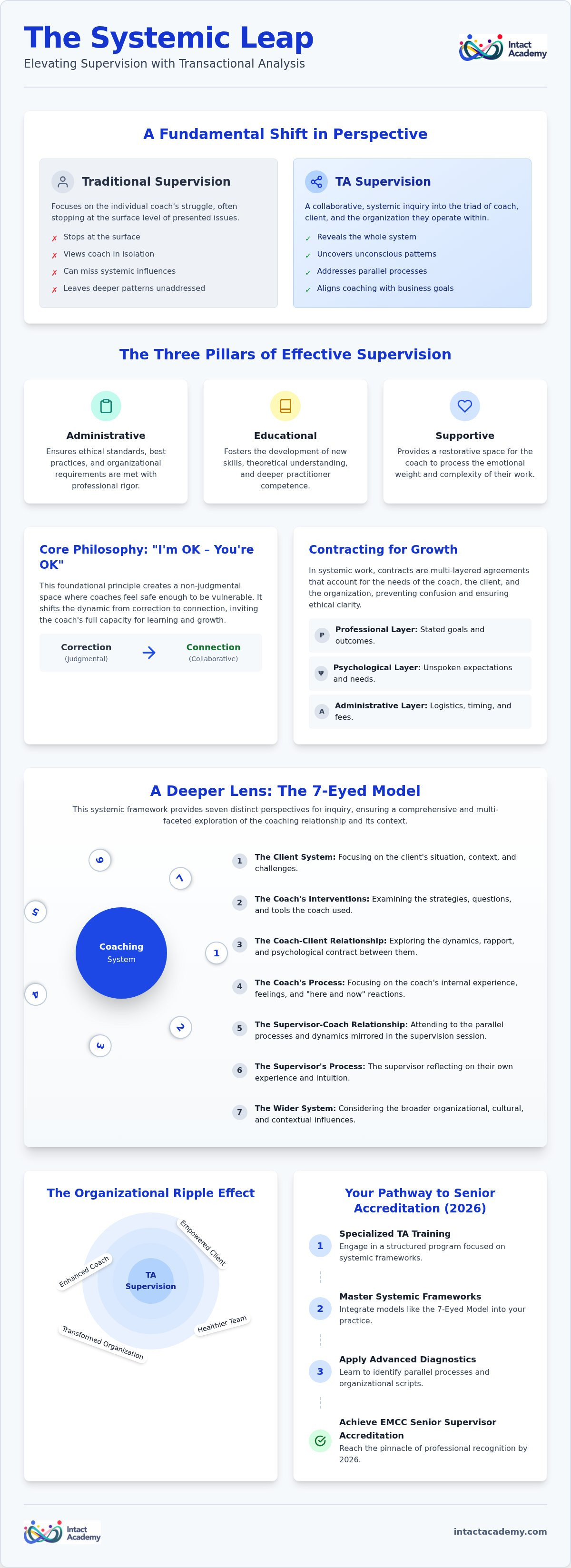
Supervision in a professional setting is far more than a simple review of coaching sessions. It is a collaborative, systemic inquiry into the intricate triad formed by the coach, the client, and the organization. Within this space, we don't just look at what happened; we look at why it happened and how the broader organizational system influenced the interaction. This approach is central to Transactional Analysis, a framework that provides the surgical precision needed to untangle complex organizational scripts. By examining these dynamics, we ensure that the coaching intervention remains aligned with the larger goals of the business system.
Professional supervision serves three distinct functions that are vital for high-level practitioners. The administrative function ensures that ethical standards and organizational requirements are met. The educational function fosters the development of new skills and theoretical understanding. The supportive function provides a restorative space for the coach to process the emotional weight of their work. Transactional Analysis is uniquely suited for this work because it focuses on ego states and the underlying "contracts" that govern human interaction. The supervisor acts as a container. They provide a stable environment where professional transformation occurs. This is why many practitioners seek specialized transactional analysis supervision training to deepen their impact in 2026.
The Philosophy of 'I'm OK – You're OK' in Supervision
The foundational philosophy of "I'm OK – You're OK" creates a non-judgmental space where coaches feel safe enough to be vulnerable. In this environment, we move from a culture of correction to one of connection. When a supervisor maintains an Adult ego state, it invites the coach into their own Adult capacity for learning. This mutual respect allows for a profound exploration of professional identity without the fear of being found lacking. It's about moving toward a state of completeness together.
Contracting for Growth: The Foundation of TA Supervision
In systemic work, the contract is never just between two people. Multi-party contracts must account for the needs of the coach, the client, and the paying organization. We distinguish between the professional layer of stated goals, the psychological layer of unspoken expectations, and the administrative layer of logistics. Within advanced transactional analysis supervision training, we learn that clarity at the start prevents confusion at the end. Contracting is the ethical heartbeat of systemic supervision.
The Psychological Architecture: Operational Models and the 7-Eyed Framework
Mastering the psychological architecture of supervision requires moving beyond the surface of a coaching session into the deep structures of the human system. High-level transactional analysis supervision training provides the diagnostic precision needed to see what remains hidden in plain sight. We don't just observe the coach; we observe the invisible threads connecting the coach to the client and the client to their organization. By adhering to Transactional Analysis certification standards, we ensure that these diagnostic tools are applied with the ethical rigor required for senior-level practice in 2026.
Diagnostic precision often begins with Mazzetti’s Operational Model. This tool allows us to move from intuition to insight, identifying the specific ego states and script patterns at play. Script Analysis helps us understand a coach's recurring professional blocks, treating them not as failures, but as opportunities for systemic resolution. When we identify a parallel process, we realize that the tension in the room often mirrors the hierarchy of the client's organization. If a supervisor feels uncharacteristically silenced or pressured, they may be experiencing the very culture that stifles the coach's client. For those seeking to lead at this level, the TA EMCC Senior Supervisor Academy offers a path to this profound professional mastery.
The 7-Eyed Model: A Systemic TA Perspective
Integrating the 7-eyed model of supervision with systemic team coaching allows us to see the organization as a living organism. When we focus on Eye 3, we analyze the transactions between the coach and the client system. Does the coach stay in an Adult ego state when the team enters a chaotic Child state? Eye 6 becomes a vital instrument; the supervisor’s own somatic and emotional responses provide clues about the organizational culture. This depth of insight is a hallmark of advanced transactional analysis supervision training, where the supervisor becomes a sensitive antenna for systemic health.
Identifying Games and Drama Triangles in Supervision
Psychological games can easily derail the supervisory process if left unaddressed. A coach might unconsciously invite the supervisor into a Rescuer role by presenting a "hopeless" case, or into a Persecutor role by being overly defensive about their methodology. By recognizing these invites, we can use crossed transactions to break the cycle and return to a contract of mutual growth. Moving toward the Winner’s Triangle, we replace Rescuing with empathetic listening and Persecuting with clear, Adult feedback. This transition is essential for maintaining professional integrity and autonomy within complex corporate systems.
Systemic Impact: Why TA Supervision Transcends Individual Coaching
Supervision isn't a private dialogue. It's a systemic lever. When we engage in transactional analysis supervision training, we learn that our influence extends far beyond the coach sitting across from us. Every insight gained in the supervisory space ripples through the organization, affecting how leaders lead and how teams collaborate. This systemic perspective is what distinguishes a senior supervisor from a practitioner. You aren't just supporting a person; you're stewarding a system. It's about recognizing that the coach's struggle is often a symptom of the organizational field.
TA provides a unique lens for leading organizational change through supervised coaching. By identifying the underlying psychological structures of a business, supervisors help coaches navigate the unspoken rules that often derail progress. This responsibility to the wider field requires a level of maturity and systemic awareness that honors the complexity of global corporate environments in 2026. We look past the individual's performance to see the patterns that govern the collective.
Untangling Organizational Scripts
Every business follows a narrative that dictates its destiny. An Organizational Script is the collective life plan of a business entity, often formed during its founding and reinforced through decades of habit. These unconscious rules manifest in coaching sessions as resistance or recurring team conflicts. When a supervisor helps a coach recognize script behavior in C-suite leaders, they unlock the potential for genuine transformation. Identifying a "Don't Succeed" or "Be Perfect" driver at the organizational level allows for targeted interventions that move the company toward a state of wholeness and genuineness.
The Supervisor as a Systemic Change Agent
The transition from individual supervision to systemic team coaching supervision is a significant leap in professional mastery. It involves managing multiple layers of transactions simultaneously while staying grounded in the Adult ego state. Within a large-scale systemic organizational change project, the supervisor must navigate intense ethical complexities. Corporate politics often invite the supervisor into the drama triangle, yet TA provides the tools to maintain neutrality. By refusing to play the role of Rescuer or Persecutor, the supervisor remains a stable container for the often-turbulent work of change. This advanced level of transactional analysis supervision training ensures that practitioners can handle high-stakes environments with calm authority and deep empathy.
Path to Mastery: Choosing the Right Supervision Training and Accreditation
The evolution from a senior coach to an accredited supervisor is a profound shift in professional identity. It requires a move from the direct facilitation of change to the stewardship of those who facilitate it. For those seeking professional development for coaches, the path to mastery is paved with rigorous standards and psychological inquiry. In 2026, the landscape of accreditation remains diverse. While the ICF integrates supervision into its continuing education framework, the EMCC Global provides a dedicated pathway via the ESIA (European Supervision Individual Award). This distinction is vital. A transactional analysis supervision training program offers the depth required to meet these international standards while providing a lens that sees beyond surface-level interactions.
Mastery isn't achieved in isolation. It is forged through recorded practice and the vulnerability of peer supervision. By analyzing your own work through a TA lens, you begin to see the subtle ego state shifts that occur when you're under pressure. This reflective practice ensures that you remain a stable container for your supervisees, allowing them to bring their most complex cases to you without fear. It's a journey of becoming. If you're ready to take this step, the TA EMCC Senior Supervisor Academy provides the structure and community needed for this transformation.
Navigating the EMCC Senior Supervisor Pathway
The journey toward EMCC Senior Supervisor status is methodical. It begins with establishing a baseline of at least 5 years of senior coaching experience, ensuring you have the "miles on the clock" to support others. Next, you must enroll in an EQA (European Quality Award) accredited program that honors systemic depth. Finally, you'll document 50 or more hours of supervision practice with a diverse range of clients. These steps ensure that your practice is grounded in real-world complexity as you work toward the 120 hours of practice required by the EMCC revised framework.
Criteria for Choosing an International Academy
When selecting an academy, look for faculty who embody the wise global mentor persona. Leaders like Sari van Poelje bring decades of experience in systemic change and transactional analysis to the table. A high-quality transactional analysis supervision training must balance the art of psychological insight with the science of structured methodology. Consider the value of a global cohort. Engaging with peers from 14 or more countries provides cross-cultural insights that are indispensable in our interconnected business world. This diversity enriches your perspective and prepares you for the complexities of global executive coaching.
Join the TA EMCC Senior Supervisor Academy at Intact Academy
The TA EMCC Senior Supervisor Academy at Intact Academy represents a culmination of professional experience and a return to a state of genuineness. It's a systemic journey designed for those who have already mastered the fundamentals and are now ready to hold the space for others. This program isn't merely a series of lectures. It's a stable container where complex organizational issues feel manageable through insight and structured methodology. By joining our transactional analysis supervision training, you're not just earning a credential; you're entering a community of global mentors committed to the flourishing of individuals and organizations alike.
Our unique "Intact" approach merges the psychological depth of Transactional Analysis with the professional pragmatism of agile systemic change. This combination ensures that profound psychological concepts remain accessible and actionable in high-stakes corporate environments. Through a blend of online modules and immersive in-person sessions, you'll engage with a global community of peers from over 14 countries. This program prepares you for the highest levels of executive coaching certification and supervision, providing the stability and wisdom required to lead in a complex world.
Curriculum Highlights: Beyond the Basics
The curriculum moves fluidly between high-level theoretical frameworks and direct, punchy directives. You'll explore advanced TA concepts such as symbiosis, discounting, and redefinition, learning how these dynamics manifest within large-scale organizational hierarchies. We integrate systemic mapping and constellation work directly into the supervision context, allowing you to visualize and untangle the invisible threads of organizational scripts. A key focus of the academy is the development of your unique "Supervision Signature." This process helps you define your authoritative and empathetic voice as a wise global mentor, ensuring your practice is both authentic and impactful.
Take the Next Step in Your Professional Evolution
Mastery is a process of becoming, and the next cohort of the TA EMCC Senior Supervisor Academy is ready to begin this evolution. The application process for the 2026 cycle is now open for advanced practitioners who seek to deepen their systemic impact. Whether you're an internal consultant or an independent coach, this academy supports your long-term growth by providing a rigorous, accredited pathway to professional wholeness. We invite you to step into this space of quiet power and global citizenship. Register for the TA EMCC Senior Supervisor Academy today and begin your path to world-class supervision mastery.
Step Into Your Role as a Wise Global Mentor
The journey toward professional mastery is rarely a straight line; it's an unfolding of depth and an expansion of systemic awareness. By integrating the psychological precision of transactional analysis supervision training, you move beyond the surface of coaching to address the unconscious currents that shape organizational life. You've explored how untangling collective scripts and mastering the 7-Eyed Model provides a stable container for professional transformation. This evolution is not just about a credential, but about the courage to return to a state of wholeness in your practice.
Our EMCC Accredited Program, led by international TA expert Sari van Poelje, connects you with a diverse global network of participants from 14 or more countries. It's a space where your professional pragmatism meets profound human insight. We invite you to embrace this next stage of your career and lead with a quiet power that fosters genuine change. Apply for the TA EMCC Senior Supervisor Academy and begin your systemic path to professional mastery.
Frequently Asked Questions
What is the difference between coaching supervision and mentoring?
Mentoring focuses on skill development and specific ICF or EMCC competencies, while supervision is a systemic inquiry into the coach's work. Supervision explores unconscious patterns, parallel processes, and the emotional weight of the coaching relationship. It's a reflective space for professional evolution rather than a checklist for performance. While mentoring is often transactional, supervision is deeply relational and systemic. It provides a stable container for the coach's growth.
How does Transactional Analysis improve the quality of supervision?
Transactional Analysis provides a precise language for describing complex human interactions through ego states, scripts, and psychological games. It allows supervisors to move beyond surface level observations to identify the unspoken contracts in an organizational system. By using transactional analysis supervision training, practitioners can untangle parallel processes with surgical precision. This depth ensures that the supervisory container remains stable and transformative for the coach and their clients.
Is the TA EMCC Senior Supervisor Academy recognized by the ICF?
Yes, the academy is recognized by the ICF as well as the EMCC and EATA. This multi-body recognition ensures that your training meets global standards for executive and team coaching supervision in 2026. While the curriculum is rooted in TA, it aligns with the core competencies of all major professional bodies. This makes it a robust choice for senior practitioners seeking a globally respected credential that honors professional pragmatism.
Do I need to be a TA expert to join a TA-based supervision training?
You don't need to be a TA expert, but a foundational understanding of concepts like ego states and transactions is beneficial. The program is designed for advanced practitioners who are ready to integrate psychological depth into their systemic work. While we use specialized terminology, the curriculum is inclusive and focuses on professional application. We guide you through the process of applying these frameworks to real-world organizational challenges and human dynamics.
What are the requirements for EMCC Senior Supervisor accreditation in 2026?
For the 2026 cycle, the EMCC Revised Supervision Framework requires 120 hours of supervision practice for the ESIA accreditation. Candidates must also demonstrate a baseline of five years of senior coaching experience and complete an EQA accredited program. This rigorous pathway ensures that senior supervisors possess the maturity and systemic insight required to support other professional coaches. Documenting diverse client work is essential for achieving this level of professional mastery.
Can I practice TA supervision in an organizational setting without being a therapist?
Absolutely, as our focus is strictly on organizational, executive, and team coaching contexts. We don't offer or teach clinical psychotherapy. Transactional Analysis is a versatile framework used globally in business settings to understand human behavior and organizational scripts. By maintaining a clear boundary between developmental work and clinical intervention, you can safely use TA to foster professional growth and systemic change within corporations and executive leadership teams.
What is the 7-Eyed Model of Supervision and how does TA fit in?
The 7-Eyed Model is a systemic framework that explores different perspectives in the supervisory relationship, from the client's system to the supervisor's own process. TA fits perfectly into this model by providing tools to analyze transactions and script patterns. It helps the supervisor use their own internal reactions as data for understanding the organization's culture. This integration creates a comprehensive diagnostic map that makes complex systemic issues feel manageable through structured methodology.
How long does it typically take to complete a professional supervision certification?
Completing a professional supervision certification typically takes between 9 and 18 months, depending on your prior experience and the specific accreditation requirements. This duration allows for the deep learning and reflective practice necessary to shift your professional identity. It's a methodical process that mirrors the steady rhythm of personal evolution. The journey includes live sessions, peer supervision, and the documentation of practice hours to ensure you achieve a state of professional wholeness.


