

What if the most powerful intervention in a complex organizational system isn't the model you're teaching, but the psychological presence you embody? Many experienced coaches reach a point where basic scripts and ego states feel insufficient against the weight of deep-seated organizational resistance. You've likely felt that plateau, where your coaching tools are sharp, yet the systemic "stuckness" of a group remains unchanged. It's a common frustration for those who aim for profound transformation rather than surface-level behavioral shifts.
You recognize that true mastery requires a more nuanced lens. By integrating advanced transactional analysis techniques, you move beyond the role of a mere facilitator and step into your power as a systemic instrument of change. We'll explore how to decode intricate group dynamics and align your practice with prestigious international standards like the EMCC Senior Practitioner accreditation. This article provides a roadmap for transitioning from individual interventions to systemic mastery, ensuring you have the depth and authority to lead in high-stakes executive environments. We will examine the psychological frameworks that allow you to hold a stable space for transformation while achieving the global recognition your expertise deserves.
Key Takeaways
- Master the transition from simply using psychological tools to embodying a professional presence that serves as a systemic instrument of change.
- Gain insight into advanced transactional analysis techniques to identify 3rd degree games and hidden scripts within complex corporate cultures.
- Clarify how your developmental progress maps to global accreditation standards like the EMCC Senior Practitioner level.
- Follow a structured, five-step roadmap to achieve international certification and deepen your mastery of group dynamics.
- Discover a training model that prioritizes wholeness and systemic intervention over surface-level coaching skills.
What is a TA Master Practitioner? Beyond the Basics
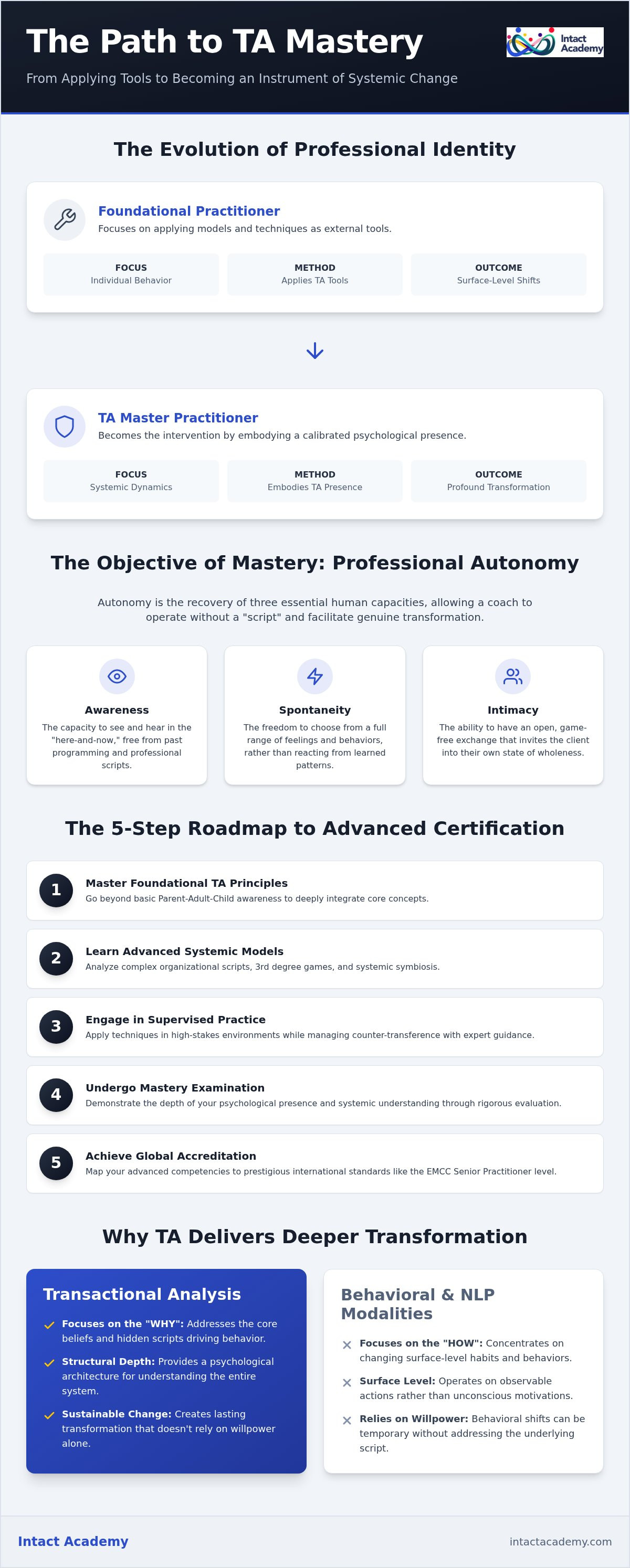
Mastery isn't just about knowing more; it's about being more. In the context of Transactional Analysis, reaching the level of a Master Practitioner signifies that the boundary between the coach and the methodology has dissolved. You no longer reach for a tool; you become the intervention. While a foundational practitioner might identify a Parent-Child transaction in a meeting, a Master Practitioner senses the systemic pressure that makes such a transaction inevitable. They move from applying advanced transactional analysis techniques as external observers to using their own psychological presence as a calibrated instrument of change.
The ultimate objective of this developmental journey is Autonomy. In TA, autonomy isn't just independence; it's the recovery of three essential human capacities: awareness, spontaneity, and intimacy. For an executive coach, this means operating without the "script" of professional expectations, allowing for a genuine, "here-and-now" encounter that invites the client into their own state of wholeness. This depth is critical for high-stakes executive coaching, where the complexity of the environment demands a leader who can hold space for profound human transformation without losing their professional grounding.
The Evolution of Professional Identity
Moving beyond basic Parent-Adult-Child awareness requires a shift toward analyzing complex cultural and organizational scripts. You're no longer just looking at why one person is angry; you're looking at how the organization's history demands that anger as a survival mechanism. This evolution marks the transition from individual interventions to systemic organizational change. It's a move from the micro to the macro, where the coach understands that the individual is often a symptom of the wider system's health.
A critical component of this mastery is the management of counter-transference. In high-pressure coaching environments, the system will often try to "pull" the coach into a specific role, perhaps as a savior or a scapegoat. A Master Practitioner recognizes these subtle invitations in real-time. They use their internal reactions as data to understand the system's unconscious needs, rather than reacting from their own unresolved patterns. This level of self-awareness ensures that the coach remains a stable container for the client's growth.
Transactional Analysis vs. Other Modalities
While many behavioral coaching methods or NLP-based approaches focus on surface-level habit changes, TA offers a psychological architecture that addresses structural depth. It doesn't just ask how we can change a behavior, but what is the underlying script that makes this behavior feel safe? This focus on the "why" allows for sustainable transformation that doesn't rely on willpower alone. It addresses the core beliefs that drive organizational culture.
Mastery in TA is also defined by the sophistication of 'Contracting.' At an advanced level, contracting isn't just a business agreement; it's a multi-layered psychological alignment that addresses overt goals, professional boundaries, and the hidden psychological expectations of the system. TA Mastery is the ability to map unconscious organizational patterns in real-time. By utilizing advanced transactional analysis techniques, you provide a level of clarity that other modalities often miss, ensuring that the work penetrates the deep structures of the organization.
Advanced TA Competencies: The Psychological Architecture
To achieve systemic mastery, one must view the organization as a living, breathing organism. At this level, you move beyond the surface of individual behavior to analyze the deep psychological architecture of the collective. This involves the application of advanced transactional analysis techniques to decode the invisible threads that bind teams to specific outcomes. When an executive team remains stuck despite having high-quality data, it's often because they're playing 3rd Degree Games. These are not merely office politics; they are destructive, repetitive patterns that carry significant professional and personal risks, often mirroring the unresolved scripts of the leadership.
Symbiosis models are particularly revealing in large organizations. They help us understand why some departments fail to innovate, remaining in a state of dependency on a single leader or a legacy process. This lack of agility is frequently a symptom of a symbiotic relationship where Adult-level responsibility is discounted. By recognizing these patterns, a Master Practitioner can invite the system back into a state of wholeness and functional independence. This focus on wholeness and brain-based development is mirrored in specialized pediatric care; for instance, autismbraininstitute.com provides speech and occupational therapy for children with neurodevelopmental differences. It's a process of returning to a state of completeness that allows for genuine organizational movement.
Every organization carries a 'Founders Script,' a set of unconscious directives established at the company's inception. While these scripts often provide the initial spark for success, they can become limiting as the environment evolves. Techniques for rewriting these collective narratives involve facilitating a cultural 're-decision.' You're not just changing a policy; you're helping the system let go of an outdated survival strategy. This work requires the coach to hold a steady, empathetic presence while the group navigates the anxiety of change. It's about moving from a historical narrative of survival to a present-day reality of flourishing.
The Art of Master-Level Contracting
In complex corporate environments, the 'Hidden Agenda' is often the most significant barrier to progress. Master-level contracting involves navigating multi-party agreements where the interests of stakeholders, the organization, and the individual coachee may conflict. It's about ensuring psychological safety while simultaneously challenging deep-seated systemic patterns. As noted in this discussion by Forbes on Transactional Analysis, the goal is often the discovery of a more authentic professional self. To truly master these dynamics, consider how a structured systemic developmental path can refine your intuition into a professional instrument. Using advanced transactional analysis techniques allows you to map these unconscious patterns in real-time, providing the clarity needed for sustainable transformation without losing intellectual rigor.
Accreditation: Mapping TA to EMCC Senior Practitioner
Professional mastery requires a bridge between internal psychological depth and external global standards. While advanced transactional analysis techniques provide the profound insight necessary for organizational change, international accreditation from bodies like the EMCC or ICF offers the portable validation required in the executive world. This alignment ensures that your developmental journey is recognized not just as personal growth, but as a rigorous professional evolution. The EMCC Senior Practitioner status has emerged as the definitive benchmark for this mastery, as it values the practitioner's ability to operate as a systemic instrument rather than a mere technician.
To reach this level, the requirements are specific and demanding. You must document a minimum of 250 coaching hours, demonstrating a consistent application of systemic models in diverse professional contexts. A cornerstone of this accreditation is the commitment to supervised practice. The recommended ratio is one hour of supervision for every 35 hours of coaching, ensuring that you remain aware of your own psychological processes while navigating the complex scripts of your clients. This structured reflection is where theory becomes integrated into your professional identity, allowing you to maintain ethical vigilance in high-stakes environments.
Why EMCC Senior Practitioner Status Matters
Obtaining this accreditation grants you global recognition across more than 140 countries. It serves as a clear signal to major corporations that you possess the sophistication to handle systemic resistance and deep-seated organizational patterns. This status validates your capacity to work beyond individual behavioral shifts, focusing instead on the wholeness of the organizational organism. For those seeking to elevate their practice, understanding the broader context of professional development for coaches is essential for navigating these global benchmarks.
The Bridge Between TA and ICF Mastery
Many practitioners find that the competencies gained through TA study align seamlessly with the ICF Core Competencies, particularly at the Master Certified Coach (MCC) level. The structural depth of advanced transactional analysis techniques enhances your executive presence and active listening, allowing you to hear the "unspoken" transactions in a coaching session. By choosing an academy that offers a path toward dual or cross-accreditation, you ensure that your expertise is legible to multiple professional bodies. This versatility is vital for a global career, providing the quiet power and authority needed to lead transformation in both developmental and executive settings. It creates a stable container for your work, ensuring that your interventions remain both intellectually rigorous and deeply human.
The Path to Mastery: 5 Steps to Advanced Certification
Becoming a systemic instrument of change isn't an accidental shift; it's a methodical evolution. This journey requires a structured roadmap that balances intellectual rigor with psychological depth. To reach the level of a Master Practitioner, you must follow a path that integrates theory, practice, and profound self-awareness. It's a process of returning to a state of completeness where your professional identity and your psychological presence become one. By following these five steps, you ensure that your practice is both deeply human and professionally authoritative.
- Step 1: Foundational TA Knowledge. This phase begins with the TA 101 and continues through intermediate years of study. It provides the essential vocabulary and structural understanding of human behavior necessary for any intervention.
- Step 2: Advanced Application. You move beyond general concepts into specialized organizational or coaching applications. You begin utilizing advanced transactional analysis techniques to address complex systemic resistance and cultural scripts.
- Step 3: Supervised Practice. Regular systemic supervision is the crucible of growth. It acts as a mirror, helping you see the unconscious dynamics you might otherwise miss in high-pressure executive environments.
- Step 4: Portfolio Development. You document your impact through detailed case studies and systemic interventions. This proves your ability to facilitate sustainable change across multiple organizational layers.
- Step 5: Final Assessment. The culmination of your work involves a live demonstration of your coaching mastery and a comprehensive integration of theory and practice.
Finding the Right Supervision
A Master Practitioner doesn't work in isolation. You need a supervisor who understands the nuances of systemic TA and can challenge your professional blind spots. The 7-Eyed Model of Supervision is particularly effective at this level. It examines the coachee, the coach's interventions, the relationship between them, and the wider organizational context. For those seeking expert guidance on this journey, the insights of Sari van Poelje offer a profound bridge between theory and high-level practice. This level of oversight ensures that your work remains grounded, ethically sound, and effective.
Developing a Master-Level Portfolio
Your portfolio is more than a collection of hours; it's a narrative of transformation. A master-level case study doesn't just show that a client improved; it demonstrates how you navigated the systemic scripts of the entire organization. You must reflect on your own professional 'Script', the unconscious patterns that dictate how you show up as a coach. Understanding these tendencies is vital for maintaining your autonomy and ensuring you don't inadvertently play into organizational games. Gathering multi-stakeholder feedback adds a layer of objective reality, ensuring your impact is felt across the whole system. To begin your own professional evolution, explore our advanced certification programs and take the first step toward systemic mastery using advanced transactional analysis techniques.
Join the TA EMCC Senior Practitioner Academy
The decision to deepen your practice is an invitation to step into a state of professional wholeness. At Intact Academy, our flagship TA EMCC Senior Practitioner academy is designed specifically for those who've moved past the basics and are ready to embody the role of a systemic instrument. This program isn't merely a series of workshops; it's a 'Systemic Journey' that weaves together advanced transactional analysis techniques with the practical realities of organizational change. By participating, you join a legacy of practitioners who value integrity, depth, and the courage required to facilitate true transformation.
Led by international expert Sari van Poelje, the academy provides a rare opportunity to learn from someone who's navigated the inner workings of global organizations for decades. The curriculum is meticulously structured to move you from the micro-analysis of advanced ego states to the macro-complexity of systemic team coaching. You'll learn to identify the invisible scripts that hold teams back and develop the presence needed to invite them into a more agile, autonomous future. This is the professional equivalent of Master level training, positioning you as a leader at the intersection of human behavior and business.
A Stable Container for Deep Growth
Mastering complex psychological work requires a safe and stable environment. We provide a "stable container" where you can explore your own professional script without judgment. Our international cohort, featuring participants from more than 14 countries, ensures that your learning is enriched by a global perspective. This diversity fosters the cultural agility necessary for modern executive coaching, allowing you to see how advanced transactional analysis techniques translate across different organizational contexts. If you're still exploring the foundations, you might first want to understand what is Transactional Analysis in a systemic context.
Next Steps: Enrollment and Inquiry
The path to becoming a Senior Practitioner is deliberate and methodical. We offer a blend of online and in-person sessions hosted from our base in Utrecht, providing flexibility without sacrificing the depth of human connection. Each cohort is carefully selected to ensure a high level of peer interaction and professional maturity. If you're ready to transition from using tools to becoming a systemic force in the corporate world, we invite you to begin your application. You can apply for the TA EMCC Senior Practitioner academy today and join a global community dedicated to the flourishing of individuals and organizations alike.
Embarking on Your Systemic Evolution
The journey toward professional mastery is a process of returning to a state of completeness, where your psychological depth becomes your most effective tool. You've explored how advanced transactional analysis techniques allow you to decode complex organizational scripts and move beyond the surface of behavioral coaching. By aligning your practice with global standards, you don't just gain a title; you secure the authority to lead profound transformation in high-stakes environments. This evolution requires a stable container and a commitment to the steady, methodical work of deep learning.
Our academy offers an EMCC Global Quality Award (EQA) accredited path led by international expert Sari van Poelje, TSTA-O. You'll join a sophisticated network of practitioners from 14+ countries, all dedicated to the flourishing of human systems. It's time to move from applying models to becoming a systemic instrument of change. Master the art of systemic change at our TA EMCC Senior Practitioner academy. We look forward to supporting your path toward wholeness and professional excellence.
Frequently Asked Questions
What is the difference between a TA Practitioner and a TA Master Practitioner?
A TA Practitioner applies models and tools to facilitate individual change, while a Master Practitioner embodies the methodology as a systemic instrument. This shift involves moving from conscious application to integrated intuition. While the practitioner focuses on Parent-Adult-Child transactions, the Master Practitioner analyzes the deep organizational scripts that drive those behaviors. It's a transition from doing coaching to being a presence that invites wholeness and structural transformation within the client's wider professional system.
How long does it take to become a TA Master Practitioner?
Reaching the level of a Master Practitioner is a methodical process that usually spans several years. It begins with the TA 101 introductory course and continues through intermediate years of study. For those seeking the EMCC Senior Practitioner accreditation, the journey involves a year-long specialized academy. This timeframe allows for the integration of advanced transactional analysis techniques and the completion of the required 250 coaching hours and regular supervision sessions.
Is TA Master Practitioner certification recognized by the ICF or EMCC?
Yes, advanced TA certifications are highly recognized by global bodies through accredited training routes. Programs like our Senior Practitioner academy are specifically designed to align with the EMCC Global Quality Award (EQA) standards. This ensures that your mastery is legible to international organizations and professional associations like the ICF. By mapping TA competencies to these frameworks, you gain a credential that is portable across more than 140 countries.
Can I use TA Master Practitioner skills in an organizational setting?
These skills are specifically designed for high-stakes organizational environments where traditional coaching tools often fall short. You can apply advanced transactional analysis techniques to decode cultural scripts, resolve systemic "stuckness", and identify destructive team games. By seeing the organization as a living organism, you facilitate sustainable change that addresses the root causes of resistance. This approach is invaluable for executive coaching, where understanding the unconscious dynamics of power is essential for success.
Do I need a background in psychology to pursue TA Mastery?
You don't need a formal degree in psychology, but you must be prepared for rigorous psychological inquiry. TA was designed to be an accessible yet profound framework for understanding human behavior. While many participants come from diverse business or leadership backgrounds, they all share a commitment to deep self-reflection. The training provides the necessary psychological architecture to handle complex human dynamics, ensuring that technical expertise remains grounded in human empathy.
What are the core competencies required for TA Master-level certification?
Mastery requires a blend of technical precision and psychological awareness. Key competencies include sophisticated multi-party contracting, the ability to analyze 3rd-degree games, and the management of complex counter-transference. You must also demonstrate a capacity for systemic life script analysis within corporate cultures. These competencies ensure you can hold a stable container for transformation, allowing you to challenge deep-seated organizational patterns while maintaining a high level of psychological safety for all stakeholders.
How does systemic coaching integrate with Transactional Analysis at the master level?
Systemic coaching and TA integrate by treating the individual coachee as a representative of their wider professional system. At the master level, you use TA to map the transactions not just between people, but between the person and the organization's history. This integration allows you to see how personal scripts interact with "Founders Scripts" and cultural narratives. It transforms your work from individual behavioral adjustment into a profound intervention that shifts the entire system's health.
Who is the TA EMCC Senior Practitioner academy designed for?
The academy is tailored for experienced executive coaches, team leaders, and organizational consultants who feel they've plateaued with basic developmental tools. It's designed for those who seek international accreditation and the authority to handle complex systemic resistance. If you're looking to move beyond surface-level interventions and become a truly systemic instrument of change, this program provides the intellectual rigor and stable community needed for that professional evolution.


