

What if the invisible resistance you encounter in the C-suite isn't a problem to be solved, but a systemic script waiting to be understood? If you find yourself stuck in the shallow waters of transactional coaching, it's likely because you're treating the symptoms of organizational friction rather than the underlying psychological dynamics. Choosing an executive coaching certification in 2026 requires more than just checking a box for accreditation; it demands a return to professional wholeness and a deeper understanding of human systems.
You've likely felt the weight of a high-level engagement where traditional tools hit a wall of silent resistance, leaving you searching for a more profound level of impact. It's a common struggle for mature professionals who crave the confidence that comes from true mastery. This article explores how a psychologically grounded executive coaching certification can bridge the gap between business pragmatism and deep human insight, leading you toward prestigious EMCC and ICF credentials. We'll examine the evolving 2026 landscape of accreditation, the power of Transactional Analysis in a corporate context, and the path to becoming a Senior Practitioner who moves with quiet power and systemic mastery.
Key Takeaways
- Understand why 2026 requires a shift from surface-level performance coaching to deep systemic transformation that addresses the root of organizational behavior.
- Master the application of Transactional Analysis to decode complex leadership dynamics and navigate the unconscious scripts that influence executive decision-making.
- Navigate the nuances between EMCC and ICF accreditation to choose an executive coaching certification that aligns with the Senior Practitioner level of mastery.
- Learn how to move beyond individual interventions to facilitate systemic team coaching, acting as a catalyst for sustainable organizational change.
- Discover a path to professional wholeness through a psychologically grounded curriculum that integrates your personal growth with your professional impact.
The Evolution of Executive Coaching: Why Certification Matters in 2026
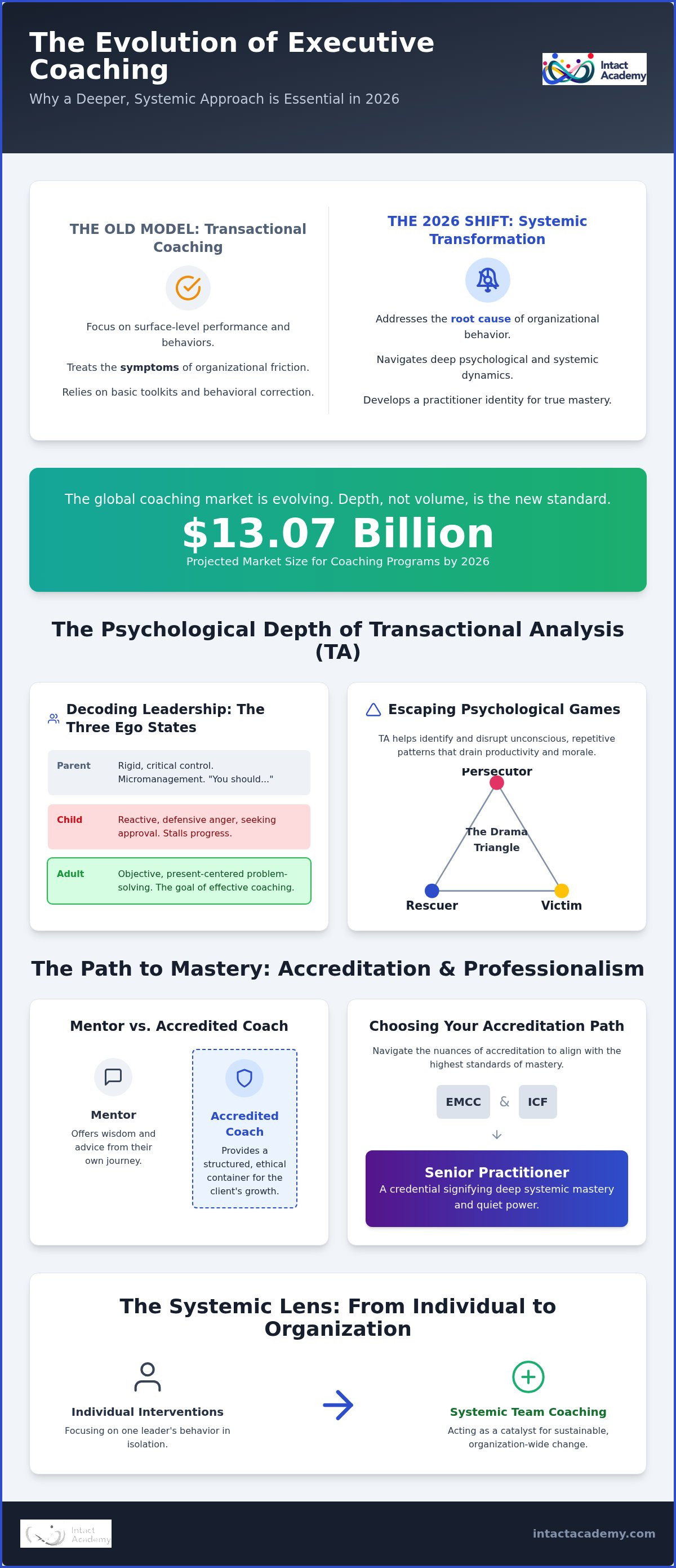
The landscape of leadership has shifted. By 2026, the global market for coaching programs is projected to reach $13.07 billion, yet the value isn't found in the volume of coaches, but in the depth of their practice. We've moved beyond the era of performance coaching, where the focus was merely on optimizing output or correcting surface-level behaviors. Today, the call is for systemic transformation. An executive coaching certification in 2026 isn't just a credential; it's an invitation to develop a practitioner identity that can hold the complexity of modern organizational life.
As AI begins to handle the transactional elements of performance management, the human coach's role becomes more specialized. The Evolution of Executive Coaching reflects this transition from being a provider of tools to becoming a container for change. You aren't just teaching a leader how to speak; you're helping them understand the silence between the words. This move from a transactional mindset to a developmental practitioner identity requires a commitment to rigorous training that goes far beyond a basic toolkit.
The Increasing Demand for Psychological Depth
C-suite challenges have grown increasingly multi-layered. When a CEO struggles with a resistant board or a fractured culture, a basic behavioral toolkit often falls short. These aren't just performance issues but manifestations of deeper systemic patterns. Behavioral-only coaching treats the symptoms, but it leaves the underlying structure untouched. Leaders in 2026 are actively seeking coaches who can navigate the unconscious scripts that drive organizational behavior. They need someone who understands why a team repeats the same mistakes despite having the right data. This requires a level of psychological literacy that only a rigorous executive coaching certification can provide. It's about moving from what a leader does to who a leader is within their system.
Certification as a Professional Boundary
There's a significant distinction between being a seasoned mentor and an accredited executive coach. While a mentor offers the wisdom of their own journey, an accredited practitioner provides a structured, ethical container for the client's growth. This boundary is essential. It ensures that the coaching space remains a place of professional development rather than an unstructured conversation. Professional standards, such as those set by the EMCC and ICF, serve to protect both the coach and the client. They establish a clear ethical framework and a commitment to continuous reflective practice. In a complex corporate environment, this rigor acts as a stabilizing force. It transforms coaching from a casual interaction into a disciplined, transformative process that honors the intelligence of the executive.
Beyond Surface-Level Skills: The Psychological Depth of Transactional Analysis
Transactional Analysis (TA) offers a robust, actionable framework that moves beyond the vague mentions of psychoanalytic theory found in many general programs. It provides a precise language for the invisible forces at play in every boardroom, turning abstract human behavior into a manageable systemic map. At the heart of an executive coaching certification rooted in TA is the mastery of ego states: Parent, Adult, and Child. When a CEO reacts to a board member's critique with defensive anger (Child) or a manager micromanages with rigid, critical control (Parent), the organizational system stalls. Mastery involves inviting the "Adult" back to the table, fostering a state of objective, present-centered problem-solving that honors the intelligence of all parties involved.
Effective change begins with "Contracting." This isn't just a legal agreement or a statement of work; it's a multi-layered psychological pact that defines what is being worked on, how success is measured, and the boundaries of the coaching relationship. Without a clear contract, coaches often fall into "Psychological Games"—repetitive, unconscious patterns like the "Victim-Rescuer-Persecutor" triangle that drain productivity and morale. By identifying these games in real-time, the coach acts as a systemic disruptor, stopping the cycle of blame and dependency before it sabotages organizational results. This clarity allows the coach to remain a neutral, powerful observer rather than another player in the company's internal drama.
Mapping Life Scripts in the Boardroom
Boardroom culture is often just a collection of individual "Life Scripts"—the unconscious narratives we wrote in childhood to survive and succeed. If a leader’s script is "I must do it all alone to be safe," the organization will likely struggle with delegation, trust, and burnout. Using TA, a coach helps leaders rewrite these scripts to allow for "Adult-to-Adult" communication even in high-pressure environments. This shift is vital when Evaluating Accreditation: EMCC vs. ICF, as the depth of psychological understanding often separates a surface-level coach from a truly transformative practitioner. In one instance, transforming a toxic leadership dynamic required mapping a CEO's script of "perfectionism at all costs," which was unintentionally stifling innovation across three global departments.
Developing the "Intact" Coach
Broadening your understanding of the cultural and spiritual origins that shape human behavior can offer deeper insights into these narratives; you might visit African Ancestral Traditional School to discover how their courses on traditional wisdom can enhance your systemic perspective.
The "Intact" coach operates from a philosophy of wholeness, returning to a state of genuineness that invites the client to do the same. Your self-awareness as a coach determines the ceiling of your client's growth; you cannot lead someone through a door you haven't opened yourself. Integrating this psychological rigor with pragmatic business results is the hallmark of a high-level executive coaching certification. It’s about becoming a stable container for the client’s transformation, ensuring that your own internal "scripts" don't interfere with the systemic work at hand. This process of becoming "intact" allows you to hold the space for others to find their own path to professional and personal completeness.
Evaluating Accreditation: EMCC vs. ICF and the Senior Practitioner Path
The decision between the International Coaching Federation (ICF) and the European Mentoring and Coaching Council (EMCC) represents a pivotal choice for those seeking an executive coaching certification. While the ICF is the largest global body with over 50,000 members, its framework is primarily competency-based, focusing on observable behaviors. The EMCC, with over 10,000 credential holders, adopts a different philosophy rooted in reflective practice and professional maturity. For a practitioner aiming for systemic mastery in 2026, the EMCC Senior Practitioner level is often the ideal destination. It demands over 125 hours of synchronous learning and 500 hours of documented practice; however, the true metric of success is the coach's ability to think systemically rather than just follow a script.
A systemic accreditation carries an authority that generic certificates cannot match. It signals to C-suite clients that you possess the internal stability to navigate their most turbulent organizational dynamics. This isn't a mere checklist of skills. It's a verification of your professional maturity and ethical grounding, ensuring you can hold a safe container for the often-turbulent work of leadership change. By prioritizing reflective practice, you ensure that your coaching remains a disciplined, transformative process rather than an unstructured conversation.
The EMCC Senior Practitioner Advantage
The EMCC Senior Practitioner accreditation is designed for those who work with complex, multi-layered client issues. At this level, you're expected to demonstrate a high degree of independence and the capacity to work within the client’s broader organizational system. Unlike entry-level credentials, this accreditation recognizes your ability to act as a catalyst for change in volatile environments. It distinguishes you from the crowded market of mid-tier coaches by validating your ability to handle "wicked problems" that lack easy answers. You aren't just helping an executive hit a KPI; you're helping them evolve their entire leadership presence and systemic impact.
Choosing the Right Training Institute
Selecting an institute is a decision that shapes your entire professional trajectory. The mentor's experience is paramount. You need someone who's seen the inner workings of global organizations and can bridge deep psychological theory with pragmatic reality. International cohorts are equally vital. In an increasingly connected world, learning alongside peers from 14 or more countries provides a global perspective that's indispensable for C-suite work. You should look for a program that balances the flexibility of digital engagement with the profound depth of intensive synchronous sessions. This ensures that your journey toward an executive coaching certification is as much about your own transformation as it is about your client’s success.
The Systemic Lens: How Certification Transforms Organizational Impact
Individual brilliance is rarely enough to sustain change if the surrounding system remains rigid. When you pursue an executive coaching certification, you're learning to see the invisible threads that bind a team together. It's about moving toward systemic team coaching mastery. Certified coaches act as catalysts for leading organizational change by addressing the collective unconscious of the firm. They uncover the "Unconscious Map" that dictates how decisions are really made, regardless of the official org chart. This depth of insight allows you to intervene at the root rather than pruning the leaves.
Psychological safety becomes a tangible business asset in this framework. It isn't a soft metric. It's the foundation for innovation and risk-taking. A systemically trained coach creates this safety by identifying and neutralizing the blame cycles that stifle growth. This level of intervention transforms the coach from a service provider into a strategic partner. You're no longer just helping one person; you're shifting the entire field in which they operate.
The Coach as a Systemic Interventionist
Solving an individual executive's problem often fails because the system's homeostasis pulls them back into old patterns. Systemic awareness allows you to map these organizational scripts and cultural patterns. You learn to balance the executive's personal growth with the needs of the whole system. It's a delicate dance. You aren't just fixing a leader; you're evolving a culture. By recognizing how the system resists change, you can design interventions that feel natural and sustainable for the organization.
Measuring Sustainable Transformation
We must move beyond "Happy Sheets" and surface-level feedback. True ROI is found in deep cultural shifts that persist long after the coaching engagement ends. This is where professional development for coaches becomes vital. Mastery requires ongoing reflection and systemic supervision to ensure your impact remains sharp. Systemic mastery creates long-term value by building an organization's internal capacity to adapt. If you're ready to expand your impact from individual sessions to organizational transformation, explore our TA EMCC Senior Practitioner academy to deepen your systemic lens.
Joining the Intact Academy: Your Path to Senior Practitioner Certification
The journey toward an executive coaching certification is rarely just about the diploma; it's about the evolution of your professional soul. At the Intact Academy, the TA EMCC Senior Practitioner academy offers a rigorous 12 to 18-month immersion designed for those who've outgrown transactional tools. This isn't a passive learning experience. It's a deliberate, rhythmic process of synchronous learning and intensive systemic supervision. You'll move through 125 hours of structured training, yet the true value lies in the reflective space where your experience meets our psychological framework.
Central to this experience is the unique mentorship of Sari van Poelje. With her decades of experience in global organizational change, Sari provides a bridge between profound psychological theory and the pragmatic demands of the C-suite. Her presence creates a stable container for your growth, allowing you to explore complex systemic issues with clarity and courage. You aren't just learning a methodology; you're learning to remain "intact" while navigating the turbulent unconscious of the organizations you serve.
A Global Community of Mature Practitioners
Growth happens best in the company of peers who share your commitment to depth. Our cohorts bring together professionals from 14 or more countries, creating a rich tapestry of cultural and professional perspectives. In this psychologically safe environment, peer-to-peer learning becomes a catalyst for transformation. You'll challenge your assumptions, refine your presence, and build a lifelong network of systemic change agents. This global citizenship is a hallmark of our academy, ensuring that your executive coaching certification carries weight in any boardroom, anywhere in the world.
Your Next Steps Toward Wholeness
Evaluating your readiness for the Senior Practitioner level requires an honest look at your current practice. Are you prepared to move beyond individual behavioral change to embrace systemic mastery? The application process is a collaborative exploration to ensure a fit between your career goals and our developmental philosophy. We don't just look for credentials; we look for the maturity and curiosity required to work at the deepest levels of human systems. If you're ready to deepen your impact and return to a state of professional wholeness—a path that can also include physical rejuvenation through services like هاني عمشة- العلاج الطبيعي وإعادة التأهيل في التشيك—your journey begins with a conversation. We invite you to step into this stable container for change and discover the practitioner you're meant to become.
The shift toward systemic transformation in 2026 demands a practitioner who can navigate the invisible scripts of organizational life. You've seen how Transactional Analysis serves as the foundation for this work, moving beyond surface-level behaviors to address the root of human dynamics. By choosing a rigorous executive coaching certification, you're not just gaining a credential; you're developing the internal stability required to hold space for profound change. This journey is as much about your own evolution as it is about the success of your clients.
The Intact Academy provides this stable container through our EMCC and ICF accredited programs. Led by international expert Sari van Poelje, our academy connects you with a global community of mature practitioners from over 14 countries. This is your invitation to move beyond transactional tools and step into a role of quiet power and professional wholeness. Apply for the TA EMCC Senior Practitioner Academy today and begin your journey toward mastery. Your evolution as a coach is the catalyst for the evolution of the leaders you serve. We look forward to welcoming you into our community.
Frequently Asked Questions
What is the difference between an executive coaching certificate and EMCC accreditation?
An executive coaching certificate is often a local or institute-specific diploma, whereas EMCC accreditation is a globally recognized professional credential. While a certificate proves you completed a specific course, EMCC accreditation validates your professional maturity and reflective practice against international standards. It signals to C-suite clients that you operate within a rigorous ethical framework and have achieved a verified level of systemic mastery that transcends basic skill acquisition.
How long does it take to complete an executive coaching certification at the Senior Practitioner level?
Completing an executive coaching certification at the Senior Practitioner level typically requires 12 to 18 months of dedicated study and practice. This timeframe allows for the integration of 125 synchronous learning hours alongside the 500 hours of documented coaching experience required by global bodies. This duration ensures that you don't just learn the theory but have the space to embody the systemic principles in real-world executive engagements.
Can I use Transactional Analysis in a corporate environment without sounding too "clinical"?
Transactional Analysis is highly effective in business when translated into organizational language like "ego states" and "contracting." Instead of clinical diagnosis, you use TA to map communication patterns and neutralize psychological games that stall productivity. It provides a pragmatic map for boardroom dynamics, helping leaders move from defensive reactions to Adult-to-Adult problem solving without ever needing to reference its therapeutic origins or clinical history.
Is the Intact Academy program recognized by the International Coach Federation (ICF)?
The programs at Intact Academy are recognized by both the EMCC and the International Coaching Federation (ICF). While we specialize in the EMCC Senior Practitioner path, our curriculum is designed to meet the rigorous competency standards of the ICF as well. This dual alignment provides you with maximum global flexibility, ensuring your executive coaching certification carries authority across North American, European, and Middle Eastern corporate procurement processes.
What are the prerequisites for the TA EMCC Senior Practitioner academy?
Applicants should ideally possess significant leadership experience or an existing foundation in coaching before entering the Senior Practitioner academy. We look for mature professionals who are ready to move beyond basic behavioral tools into deeper systemic work. While a specific degree isn't always mandatory, the ability to reflect on complex organizational challenges and a commitment to personal growth are essential for success in this psychologically grounded program.
How much time should I allocate for supervision and reflective practice during the certification?
You should allocate approximately two to four hours per month for formal systemic supervision and structured reflective practice. This commitment is a core requirement for high-level accreditation because it ensures your coaching remains objective and "intact." Reflective practice isn't just an administrative task; it's the developmental engine that prevents burnout and allows you to process the complex unconscious dynamics encountered within C-suite client systems.
Does the certification cover team coaching and organizational change as well?
Our certification naturally integrates team coaching and organizational change as these are inseparable from systemic mastery. You'll learn to apply Transactional Analysis to groups, identifying cultural scripts that influence entire departments. While we offer specialized academies for team coaching, the Senior Practitioner program provides the foundational psychological literacy needed to act as a catalyst for sustainable change across the whole organizational system.
Is the training delivered online or in-person in Utrecht?
The training is delivered through a sophisticated blend of synchronous online sessions and intensive learning blocks. While our physical roots are in Utrecht, our global community of practitioners from 14 or more countries benefits from a hybrid approach that balances digital flexibility with profound human connection. This structure allows you to integrate deep learning into your professional schedule while still participating in the intensive group dynamics essential for systemic growth.


