

What if the persistent friction in your team isn't a lack of skill, but an invisible script that no one has learned how to read? You've likely felt the frustration of surface-level coaching tools that fail when workplace dynamics turn complex. It's exhausting to watch the same negative patterns repeat despite your best efforts to intervene. Integrating transactional analysis in leadership development provides the systemic depth needed to move beyond these cycles. It offers a way to see the underlying structures of human interaction that remain hidden to the untrained eye, allowing for a more profound level of professional intervention.
In this article, you'll discover the comprehensive modules of a TA foundation year and how this psychological framework transforms organizational coaching into a journey of profound change. We'll explore the roadmap to achieving international certification through the TA EMCC Senior Practitioner academy. You'll learn how a robust, accredited framework provides the practical tools required to resolve workplace games and foster a state of professional wholeness. This is your path toward mastery and a more genuine way of leading others through the complexities of the modern workplace.
Key Takeaways
- Understand how a one-year intensive study of Transactional Analysis provides a structured psychological map for navigating complex professional interactions and fostering organizational wholeness.
- Explore core modules such as Ego States and Structural Analysis to decode the inner architecture of behavior and improve how you connect with others.
- Master the application of transactional analysis in leadership development to identify hidden group scripts and transform organizational culture from the inside out.
- Learn how international accreditation from EMCC and ICF ensures ethical rigor and elevates your credibility as a systemic coach or leader.
- Discover the developmental pathway from the foundation year to the TA EMCC Senior Practitioner academy for sustained professional mastery.
What is a TA Foundation Course Curriculum?
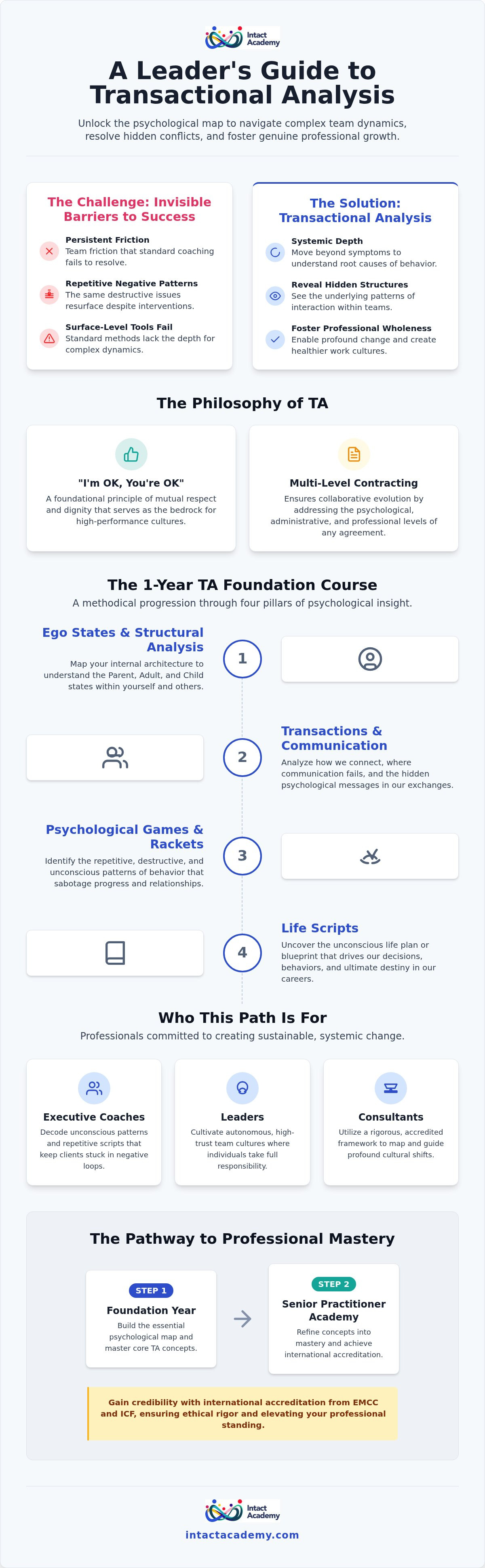
A TA Foundation Course is a one-year intensive study designed to provide a comprehensive map of human behavior and its systemic application within the workplace. It isn't merely a collection of techniques to be added to a toolkit. Instead, it represents a deep dive into the psychological underpinnings of how we relate to ourselves and others. As we move toward 2026, the demand for this level of insight has never been higher. Leaders are facing environments where traditional, linear problem-solving often falls short. Using transactional analysis in leadership development allows for a fundamental shift from simply doing coaching to being a systemic practitioner who understands the hidden currents within an organization.
The curriculum serves as a stable container for professional growth. It moves beyond the "what" of behavior to the "why," offering a structured methodology to navigate the turbulence of organizational change. By building this psychological map, you gain the ability to anticipate friction before it escalates into conflict. This isn't about clinical diagnosis; it's about professional pragmatism. It's about having the intellectual and emotional capacity to hold space for complex human dynamics while remaining focused on organizational flourishing.
The Philosophy of Transactional Analysis
At the heart of this curriculum lies the "I'm OK, You're OK" principle. In a professional context, this isn't a naive sentiment. It's a radical stance of mutual respect and dignity that serves as the bedrock for high-performance cultures. Another pillar is the concept of Contracting. Unlike traditional behavioral coaching that focuses only on external goals, TA uses contracting as a multi-layered agreement. This process addresses the psychological, administrative, and professional levels of any intervention. It ensures that change isn't forced but is instead a collaborative evolution. This focus on clarity distinguishes transactional analysis in leadership development from more surface-level models that often ignore the unconscious agreements between people.
Who is this Curriculum Designed For?
This path is built for those who recognize that sustainable change requires looking beneath the surface. It serves three primary groups of professionals:
- Executive coaches: Professionals who want to decode the unconscious patterns and repetitive scripts that keep their clients stuck in negative loops.
- Leaders: Those aiming to cultivate autonomous, high-trust team cultures where individuals take full responsibility for their psychological and professional roles.
- Consultants: Systemic experts who specialize in organizational change and require a rigorous, accredited framework to map cultural shifts.
This foundation acts as the essential first step before progressing to the TA EMCC Senior Practitioner academy, where these concepts are refined into senior-level mastery and international accreditation.
Core Modules: A Breakdown of the TA Foundation Year
The foundation year provides a methodical progression through four essential pillars of psychological insight. It begins with Ego States and Structural Analysis, where you map your internal architecture to understand the Parent, Adult, and Child within. This is followed by Transactions and Communication, which moves the focus outward to how we connect and where those connections fail. Psychological Games and Rackets identifies the repetitive, often destructive, patterns that stall progress, while Life Scripts uncovers the unconscious blueprint driving every professional choice. Each module builds upon the last, creating a stable container for using transactional analysis in leadership development.
A critical, often overlooked element in this journey is the mastery of Contracting. Unlike surface-level coaching agreements, TA contracting ensures that every intervention is grounded in clear, multi-level consent. This prevents the "rescuer" dynamic where coaches take more responsibility than the client. By establishing these boundaries early, you create a safe environment for deep work. This rigorous approach to alignment is what prepares you for the advanced challenges found in the TA EMCC Senior Practitioner academy.
Advanced Communication: Transactions and Strokes
In the boardroom, communication is rarely just about the words spoken. Ulterior transactions occur when a social message hides a psychological one, often leading to confusion or hidden agendas. Analyzing these patterns allows a leader to bring the conversation back to an Adult-to-Adult level. Central to this is the Stroke Economy. Strokes are units of recognition; they're the psychological "currency" of any organization. When recognition is scarce or filtered through negative patterns, performance withers. Learning to manage the flow of strokes shifts a culture from one of scarcity and reactivity to one of abundance and autonomy.
Uncovering the Script: The Blueprint of Professional Life
Every leader carries a Life Script, an unconscious narrative formed in early life that dictates how they handle success, failure, and conflict. These scripts often manifest as "Drivers" such as Be Perfect, Hurry Up, or Please Others. While these drivers can fuel initial career success, they often become liabilities in high-pressure environments, leading to burnout or rigid decision-making. The process of re-decision allows you to update these old blueprints. It's a journey toward wholeness where you move from reacting to your past to responding to the present. This transformation is the hallmark of a truly systemic practitioner.
Applying the Curriculum to Organizational Systems
Transitioning from the internal architecture of the individual to the vast landscape of the organization requires a shift in perspective. In transactional analysis in leadership development, we view the organization as a living system with its own scripts and repetitive patterns. A coach doesn't just look at a leader's personal drivers; they look at how those drivers harmonize or clash with the broader organizational culture. This systemic approach allows for the identification of "group scripts," which are unconscious narratives that dictate how a company responds to crisis or success. By mapping these dynamics, you can resolve deep-seated conflicts that surface-level interventions often miss.
The role of the coach in this environment is to act as a systemic facilitator. It's about moving beyond individual performance to understanding the "unspoken rules" that govern multi-stakeholder environments. When you apply TA to organizational systems, you're not just fixing a problem; you're updating the system's operating manual. This allows for a more fluid movement between different departments and levels of authority, ensuring that the psychological contracts between the organization and its people remain clear and productive.
Team Coaching and the Group Ego State
Teams are more than the sum of their parts. They possess a "Group Imago," a collective mental map of how members relate to one another and their leader. When a team feels stuck, it's often because they're operating from a collective Child ego state, waiting for a Parent figure to provide answers. By viewing the 5 Dysfunctions model through a TA lens, we see that a lack of trust is often a lack of safe "strokes," and a fear of conflict is an avoidance of "crossed transactions." For those looking to deepen this specific skill set, exploring a team coaching course provides the tools to facilitate this shift from dysfunction to high-performing autonomy.
Navigating Power and Authority in Organizations
Hierarchies naturally invite Parent-Child dynamics. A manager might slip into a Critical Parent role, triggering a Rebellious or Adapted Child response in their team. This cycle stifles innovation and creates a culture of dependency. Using TA, leaders learn to establish healthy boundaries and invite Adult-to-Adult interactions. This isn't about removing authority; it's about exercising it with psychological clarity. Systemic interventions might include redesigning communication flows or redefining roles to ensure that every stakeholder feels "OK." This level of cultural transformation is what distinguishes a transactional manager from a systemic leader who fosters genuine professional wholeness.
Evaluating Accreditation and Quality Standards
Accreditation isn't just a badge of completion. It's a commitment to ethical rigor and professional scrutiny. In 2026, clients and organizations expect more than just a certificate; they require evidence of a structured, proven methodology that can withstand the pressures of complex environments. High-quality programs map their curriculum directly to the competencies of global bodies like the EMCC and ICF. This alignment ensures that the use of transactional analysis in leadership development meets the highest international standards of practice and safety.
Systemic supervision is a non-negotiable component of this quality framework. It provides a reflective space to examine the parallel processes occurring between the coach, the leader, and the wider organizational system. Without this oversight, it's easy for even experienced practitioners to lose their Adult perspective and become entangled in the very dynamics they're trying to resolve. A global training institute should offer this level of support, ensuring that your practice remains grounded in integrity and psychological wholeness.
EMCC and ICF: The Global Gold Standard
The foundation year is meticulously designed to serve as the essential first step toward a recognized executive coaching certification. It moves beyond academic theory into the realm of reflective practice, where you analyze your own professional interactions through a TA lens. This deep work is what allows you to eventually achieve the status of a TA EMCC Senior Practitioner academy graduate. It's about the seamless integration of psychological depth with the pragmatism required to drive results in the boardroom.
The Value of an International Learning Community
Mastery isn't achieved in a vacuum. Learning within an international community of participants from 14+ countries provides a rich tapestry of cultural perspectives that reflect the reality of the modern corporate world. This diversity challenges your assumptions and expands your capacity for empathy and systemic insight. By blending rhythmic online sessions with intensive in-person deep dives, the curriculum offers a stable container for profound change. You aren't just joining a training program; you're entering a global network of systemic coaches dedicated to human and organizational flourishing.
Ready to elevate your professional standards? Explore the accredited programs at Intact Academy to begin your journey toward systemic mastery and international recognition.
Next Steps: From Foundation to Professional Mastery
The conclusion of a TA Foundation Year marks a significant threshold in your professional evolution. It's the moment where the map you've painstakingly studied begins to merge with your lived experience as a practitioner. Integrating transactional analysis in leadership development isn't about performing a set of techniques; it's about embodying a new way of seeing. You've moved from the "what" of human behavior to the "how" of systemic change. This transition requires a commitment to ongoing growth and the courage to look inward before intervening outward.
As you integrate these concepts into your existing practice, you'll find that the tools of TA become invisible yet omnipresent. You'll recognize games before they start. You'll hear the ulterior messages in a negotiation. You'll spot the script decisions driving an executive's burnout. This isn't a destination but a lifelong journey of systemic mastery. It invites you to call upon the "Wise Global Mentor" within yourself, staying committed to the flourishing of the systems you serve while maintaining your own state of professional wholeness. This is how you move from being a coach who does to a practitioner who is.
The TA EMCC Senior Practitioner Academy
For those ready to deepen their impact, the path leads toward the TA EMCC Senior Practitioner academy. This advanced training is where theory is forged into senior-level mastery. You might choose to specialize through the TA EMCC Senior Team Coach Academy or the TA EMCC Senior Supervisor academy, depending on where your calling lies. These programs offer a stable container for sustainable transformation, ensuring that your work as a coach or consultant isn't just effective in the short term but leads to lasting, systemic health within organizations.
The Sari van Poelje Approach to Systemic Change
The philosophy of Intact Academy is deeply rooted in the insights of Sari van Poelje, a global expert who has seen the inner workings of countless organizations across 14+ countries. Her approach emphasizes returning to a state of completeness and genuineness. It's a rejection of transactional, surface-level fixes in favor of profound human transformation. By joining this community, you align yourself with a standard of professional excellence that values depth, integrity, and the courage to change. We invite you to join a global academy dedicated to organizational flourishing and your own professional mastery.
Stepping into Professional Wholeness and Systemic Mastery
The journey through a TA foundation year is more than an academic pursuit; it's a profound transition toward professional wholeness. You've explored how understanding ego states and life scripts provides the clarity needed to navigate complex human systems. By integrating transactional analysis in leadership development, you shift from surface-level coaching to becoming a systemic practitioner capable of fostering deep organizational change. This roadmap ensures your practice is grounded in the ethical rigor of EMCC and ICF standards, providing a stable container for your growth as a leader or coach.
As you look toward 2026, the demand for this depth has never been more urgent. You have the opportunity to learn within a global community representing participants from 14+ countries, led by world-renowned expert Sari van Poelje. Whether you aim to resolve workplace games or seek EMCC Senior Practitioner Level Training, the foundation year is your essential first step toward mastery. Explore the TA Foundation Year at Intact Academy and begin your evolution. The courage to look inward is the first step toward transforming the world around you.
Frequently Asked Questions
Is a TA foundation course only for people who want to become therapists?
No, a TA foundation course isn't just for therapists. While TA has clinical roots, this curriculum is specifically designed for professionals in organizational settings. Executive coaches, team leaders, and systemic consultants use these tools to decode workplace dynamics and foster autonomy. It provides a robust psychological map that's as valuable in a boardroom as it is in a developmental space, focusing on professional flourishing rather than clinical treatment.
How long does it take to complete the TA foundation curriculum?
The TA foundation curriculum is structured as a one-year intensive study. This duration allows for a steady, methodical integration of theory and practice, ensuring that profound psychological concepts become actionable. Throughout the year, you'll move through rhythmic modules that build upon each other, creating a stable container for deep learning. This pacing respects the complexity of the material and allows for the necessary reflective practice required for systemic mastery.
What is the difference between a TA foundation year and a TA 101 course?
A TA 101 is a two-day introductory workshop, whereas the foundation year is a comprehensive, deep-dive program. The 101 provides a high-level overview of basic concepts like ego states and transactions. In contrast, the foundation year offers the systemic depth needed for professional application. It bridges the gap between knowing about TA and actually using transactional analysis in leadership development to transform organizational cultures and resolve complex interpersonal patterns.
Do I need prior psychological training to enroll in a TA foundation course?
You don't need a formal degree in psychology to enroll in the foundation course. The curriculum is designed to be inclusive, welcoming leaders and coaches from diverse professional backgrounds. What's more important is a maturity of perspective and a willingness to look inward. The program provides the necessary technical terminology and theoretical frameworks from the ground up, ensuring that complex systemic issues feel manageable and accessible for all participants. This commitment to accessible learning is also seen in the digital education sector, where platforms like EtütAI use AI to provide students with clear, structured explanations of academic subjects.
Can I apply the TA curriculum to corporate leadership and team coaching?
Yes, applying the curriculum to corporate leadership and team coaching is a primary focus of the program. Using transactional analysis in leadership development allows you to identify group scripts and navigate the Parent-Adult-Child dynamics inherent in hierarchical structures. These tools are exceptionally effective for resolving workplace games and establishing healthy, Adult-to-Adult communication. It's a pragmatic framework for anyone tasked with managing the often-turbulent work of professional and organizational change.
Is the Intact Academy TA foundation course accredited by the EMCC?
Yes, the programs at Intact Academy are accredited by both the EMCC and the ICF. This international recognition ensures that your training meets the highest global standards for ethical rigor and professional excellence. The foundation year serves as the essential first step toward achieving the TA EMCC Senior Practitioner academy status. It provides a credible, accredited pathway for those who value integrity and the courage to lead with psychological depth.
What kind of career opportunities does a TA foundation certificate open up?
Completing the foundation year opens doors to senior roles in executive coaching, team leadership, and organizational change consultancy. It distinguishes you as a practitioner who possesses the systemic depth to handle complex human dynamics. Many graduates move on to specialize in systemic supervision or team coaching, leveraging their international accreditation to boost credibility with global clients. It's a roadmap to mastery that elevates your professional standing and your capacity for impact.
For leaders who also wish to apply this same growth mindset to their financial future, The Tax Deed Collective offers specialized training and guides for those looking to master the complexities of tax deed auctions.
Can I attend the TA foundation course online from another country?
You can absolutely attend the course from another country, as we foster a truly global learning community. Intact Academy welcomes participants from over 14 countries, blending rhythmic online sessions with intensive deep dives. This structure allows for a rich exchange of cultural perspectives while providing a safe, stable environment for learning. It reflects our commitment to global citizenship and ensures that profound developmental work remains accessible regardless of your geographic location.


