

Why do so many breakthrough coaching sessions result in nothing more than a temporary shift that vanishes the moment a leader returns to their organizational reality? You've likely felt the frustration of facilitating a profound individual insight, only to watch the heavy gravity of the system pull your client back into old, scripted behaviors. If you're tired of surface-level results that don't stick, seeking a systemic coaching certification is the essential evolution of your practice. It's the difference between treating a symptom and understanding the complex, underlying architecture of human systems.
We recognize that the complexity of modern organizational dynamics can feel overwhelming, especially when you're uncertain which accreditation carries the most weight in 2026. This guide provides a sophisticated map for your professional growth. You'll discover how to earn a globally recognized senior-level credential while deepening your own psychological impact as a leader. We'll examine the shifting industry standards between the ICF and EMCC, showing you how to move beyond transactional models toward a state of completeness and genuine organizational transformation.
Key Takeaways
- Understand the vital shift from individual-focused interventions to eco-centric models that address the complex architecture of entire organizational systems.
- Learn to use Transactional Analysis as a diagnostic lens to decode the hidden psychological scripts that drive culture and dictate collective performance.
- Evaluate the most effective path toward a systemic coaching certification by comparing accreditation weight and theoretical depth for the 2026 landscape.
- Identify how to align your professional evolution with senior-level credentials that foster deep, sustainable change rather than temporary behavioral shifts.
- Discover the value of a reflective practitioner model that integrates your personal growth with the mastery of complex, high-level organizational dynamics.
What is Systemic Coaching and Why is Certification Essential in 2026?
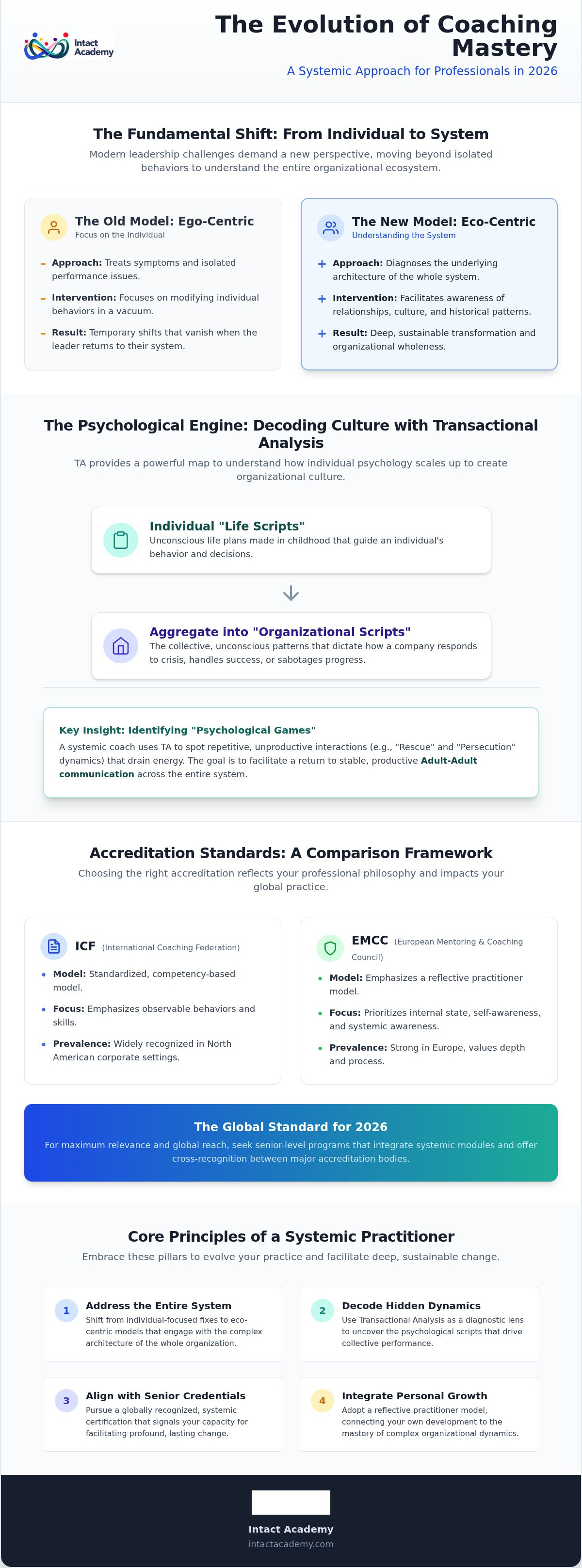
Systemic coaching is the art of seeing the unseen. It involves coaching an individual or a team while remaining acutely aware of the wider organizational, social, and cultural systems that shape their reality. In 2026, we've moved beyond the "ego-centric" model where the coach focuses solely on the individual's performance or isolated team behaviors. Instead, we embrace an "eco-centric" approach. This shift acknowledges that no leader exists in a vacuum. Every action ripples through a network of relationships, historical patterns, and future aspirations. Obtaining a systemic coaching certification provides you with the sophisticated tools needed to navigate these ripples with precision and empathy.
Global organizations now view specialized certification as a non-negotiable standard for ensuring ethical and sustainable change. While a generic certificate might cover basic listening and questioning, a specialized program offers a deep dive into organizational psychology. It moves the practitioner from being a mere observer to a strategic partner who understands how individual "life scripts" aggregate into "organizational scripts" that either facilitate growth or hinder performance. This distinction is vital; a generic approach often fails to address the gravity of the system, leading to results that quickly dissipate.
This emphasis on specialized, licensed training is a hallmark of professional excellence across all sectors. For instance, in the wellness and beauty industry, institutions like 5T Beauty Academy provide the accredited curriculum necessary for practitioners to move from basic skills to professional mastery. Whether in organizational coaching or esthetics, the right certification ensures that the practitioner can provide safe, ethical, and high-impact services.
The Evolution of Executive Coaching in 2026
The complexity of global markets in 2026 demands that coaches perceive the "invisible lines" connecting stakeholders, cultural scripts, and market pressures. As leaders face unprecedented volatility, the focus of professional development for coaches has shifted from quick fixes to long-term transformation. This evolution is grounded in Systems theory, which suggests that changing a single part of a system requires understanding the whole. A systemic coach acts as a facilitator of organizational wholeness rather than a behavior modifier.
Accreditation Standards: ICF vs. EMCC
The choice between accreditation bodies often reflects a coach's professional philosophy. The ICF focuses on a standardized, competency-based model with observable behaviors, which remains popular in North American corporate settings. The EMCC emphasizes a reflective practitioner model, prioritizing internal state, self-awareness, and systemic awareness. Choosing a program that offers cross-recognition is vital for global practice. An executive coaching certification must now integrate systemic modules to remain relevant in a world where individual success is inextricably linked to collective health. This dual focus ensures that your systemic coaching certification carries weight across borders, catering to a sophisticated global audience that values both skill and depth.
The Psychological Engine: Integrating Transactional Analysis into Systemic Mastery
To understand a system, one must first understand the psychological architecture that sustains it. Transactional Analysis (TA) serves as the premier map for this exploration, providing a robust framework to decode organizational culture. While surface-level coaching addresses outward behaviors, a systemic coaching certification rooted in TA allows you to see how individual "life scripts", which are unconscious life plans made in childhood, aggregate into powerful "organizational scripts." These collective scripts dictate how a company responds to crisis, how it handles success, and why it might unconsciously sabotage its own progress.
Within these scripts, "psychological games" often emerge as repetitive, unproductive patterns of interaction between departments or teams. A systemic coach trained in TA doesn't just mediate a conflict; they identify the underlying game. They see the "Rescue" and "Persecution" dynamics that drain energy and stall innovation. By providing a stable container, TA allows the coach to remain grounded during high-stakes organizational turbulence, facilitating a return to Adult-Adult communication across the entire structure. This depth ensures that interventions aren't just temporary fixes but fundamental shifts in the system's way of being.
Mapping the Unconscious System
Mastery involves moving beyond the ego to identify Parent-Adult-Child dynamics within corporate hierarchies. A rigorous systemic coaching certification teaches you to "contract" for change at multiple levels simultaneously. This includes the individual, the team, and the organization itself. Consider a merger or acquisition. Without systemic insight, the "Parent" culture of the acquiring firm may unintentionally suppress the "Child" creativity of the new entity. Recognizing these unconscious scripts allows for a more integrated, harmonious transition that honors the integrity of all parties involved.
Sari van Poelje’s Approach to Systemic Change
The methodology championed by Sari van Poelje blends the psychological depth of TA with the speed of agile organizational change. Her approach emphasizes the concept of "returning to completeness," a thematic North Star for those seeking to move past transactional coaching. For senior practitioners, this depth is the primary differentiator. It's about having the courage to look at the wholeness of the human experience within the workplace. If you're ready to deepen your impact, exploring a TA-based systemic academy can provide the structured methodology needed to master these complex human systems.
Evaluating Systemic Coaching Certifications: A Comparison Framework
Choosing a systemic coaching certification requires more than a cursory glance at a syllabus; it demands a rigorous evaluation of the program's underlying philosophy and its capacity to handle the weight of real-world organizational complexity. A professional comparison framework should prioritize three essential pillars: the global weight of the accreditation, the intellectual depth of the psychological theory, and the lived, executive-level expertise of the faculty. While many providers offer "Team Coaching" certificates, these often focus on group dynamics in isolation. In contrast, a comprehensive systemic coaching certification prepares you to address the individual leader as a vital node within a vast, interconnected network of historical scripts and future possibilities.
High-quality programs distinguish themselves by integrating leading organizational change as a core competency. This ensures that the coach is not just facilitating a conversation but is actively participating in the evolution of the entire organizational system. It requires a shift from being a "support person" to a strategic partner who understands the structural and psychological levers that drive institutional transformation.
Practitioner vs. Senior Practitioner Levels
Under EMCC guidelines, the leap from Practitioner to Senior Practitioner represents a fundamental shift in professional identity. While a Practitioner often works with well-defined goals and individual performance, a Senior Practitioner navigates systemic ambiguity and high-stakes complexity with a deeply reflective lens. This level requires a rigorous commitment to professional practice, including documented coaching hours and a demonstrated ability to apply sophisticated theoretical frameworks to diverse, multi-layered scenarios. The TA EMCC Senior Practitioner academy is designed for those who seek to inhabit this highest tier of recognition, providing the intellectual rigor and practical mentorship necessary to move beyond standard competencies into the realm of true professional mastery.
The Role of Systemic Supervision
A systemic coaching certification is incomplete without a dedicated supervision component. Systemic Supervision acts as a critical mirror, helping the coach recognize when they have become "entangled" in the client’s organizational scripts or the emotional field of a team. It provides the necessary psychological distance to maintain professional integrity and safety. This reflective practice ensures that the coach remains a stable container for the client's growth rather than becoming a part of the system's existing problems. For those who wish to advance their career into the guidance of other professionals, the TA EMCC Senior Supervisor academy offers the specialized training required to oversee complex systemic work at the highest levels.
Choosing the Right Path for Your Coaching Career
Selecting a systemic coaching certification is a reflective process that demands you look both inward at your professional values and outward at the evolving needs of the global market. It's about finding a program that honors your maturity and challenges your current boundaries. To ensure your choice aligns with your long-term vision, consider these five essential steps:
- Identify your desired impact: Decide if you're called to support individual leaders, facilitate team dynamics, or lead full organizational transformation.
- Assess your current accreditation: Map out where you want to be in five years. If you aim for the C-suite, a senior-level credential is the logical progression.
- Evaluate the Theoretical North Star: Ensure the program offers a deep psychological framework, such as Transactional Analysis, to guide your interventions.
- Check for global accessibility: A peer group representing diverse cultures, such as the participants from over 14 countries at Intact Academy, enriches your learning.
- Review the faculty's experience: You need mentors who've navigated the very turbulence you're being hired to manage.
By following this structured inquiry, you ensure that your investment in a systemic coaching certification translates into a sustainable and deeply impactful career path. It moves you from being a practitioner who follows a script to a master who can rewrite the script of the entire system.
Aligning Certification with Market Demand
In 2026, the demand for systemic intelligence is surging in high-stakes sectors like tech, healthcare, and global NGOs. These industries face complex, multi-layered challenges that a traditional behavioral approach cannot solve. A specialized team coaching course often serves as the initial building block, providing the fundamental skills to manage collective dynamics before moving toward full systemic mastery. Finding a faculty with a "Global Mentor" personality ensures you're learning from those who view organizational change through a lens of human flourishing and integrity.
The ROI of Systemic Mastery
Systemic mastery fundamentally changes your business model. You move from the fragility of hourly coaching to the stability of long-term systemic partnership and consultancy. This shift allows for higher-value engagements because you're addressing the root causes of organizational stagnation rather than just the symptoms. A high-level certification provides the stable container required for high-fee executive work, giving you the confidence to hold space for intense change. If you're ready to transition from transactional coaching to profound organizational impact, consider applying for a senior-level systemic coaching program today.
Intact Academy: Accredited Systemic Training for Global Professionals
Finding a systemic coaching certification that respects your existing expertise while stretching your psychological boundaries is a rare discovery. Intact Academy serves as the premier international institute for those who recognize that effective coaching requires more than just a toolkit; it requires a deep, lived understanding of human systems. By centering Transactional Analysis (TA) as the primary diagnostic lens, our programs empower you to move from the role of a traditional coach to that of a sophisticated systemic change agent. This journey is about more than professional advancement. It's about returning to a state of completeness and genuineness in your practice.
Our learning environment is designed for the modern global professional, offering a rhythmic blend of online accessibility and immersive sessions. You aren't just learning in a vacuum; you're engaging with a diverse peer group that brings perspectives from across the world. This international dialogue is essential for mastering the "invisible lines" of global organizational culture. Whether you're entering the TA EMCC Senior Practitioner Academy or the Senior Team Coach Academy, you're entering a space where complex systemic issues feel manageable through structured methodology and empathetic insight.
The TA EMCC Senior Practitioner Academy
The curriculum of the TA EMCC Senior Practitioner academy represents the gold standard for systemic depth. It seamlessly integrates the psychological rigor of Transactional Analysis with the pragmatic demands of executive coaching. You'll learn to decode the unconscious scripts that dictate organizational life, ensuring your interventions lead to sustainable transformation rather than temporary shifts. The focus remains on organizational culture and the long-term health of the system. For those ready to elevate their practice, applications for the next cohort starting in 2026 are currently being accepted, providing a clear path toward professional mastery.
A Community of Global Mentors
Learning at Intact Academy means joining a vibrant community of global mentors led by Sari van Poelje, a recognized expert in systemic change and agile Transactional Analysis. Our participants come from over 14 countries, creating a rich tapestry of networking opportunities and shared wisdom. This global citizenship is a hallmark of our brand, ensuring you're as comfortable in a high-stakes executive boardroom as you are in a deep developmental dialogue. If you're ready to deepen your psychological impact and earn a credential that carries weight across borders, we invite you to join the next cohort of the TA EMCC Senior Practitioner academy and begin your evolution today.
Embracing the Future of Organizational Flourishing
The shift from individual performance to systemic intelligence isn't just a trend; it's a fundamental evolution in how we support human growth within complex organizations. You now understand how Transactional Analysis provides the psychological map needed to navigate unconscious scripts and how rigorous accreditation standards distinguish the master from the practitioner. Earning your systemic coaching certification is the vital bridge between facilitating temporary change and anchoring profound, sustainable transformation across an entire system.
It's time to step into your role as a global change agent. With Intact Academy, you gain access to a program that is both EMCC and ICF accredited, ensuring your credentials carry weight in any executive boardroom across the globe. Led by international expert Sari van Poelje, our methodology has already made a proven impact in participants from over 14 countries. You're invited to apply for the TA EMCC Senior Practitioner Academy today and join a community dedicated to wholeness and professional integrity. Your journey toward mastery is a path toward returning to your own state of completeness, and we're here to provide the stable container for that evolution.
Frequently Asked Questions
What is the difference between team coaching and systemic coaching?
Team coaching focuses on the dynamics and performance of a specific group, whereas systemic coaching views the individual or team within the context of the entire organizational web. It addresses the invisible threads of culture, history, and stakeholder expectations. While team coaching is often a subset of the work, systemic interventions require a broader lens to see how the wider system influences collective behavior.
Is systemic coaching certification recognized by the ICF?
High-quality programs are recognized by the International Coaching Federation (ICF) and frequently provide Continuing Coach Education (CCE) units. Many leading institutes ensure their systemic coaching certification meets the rigorous standards of both the ICF and the EMCC. This dual recognition is essential for practitioners operating in a global market where different accreditation bodies hold varying degrees of professional influence.
How long does it take to complete a systemic coaching certification?
The duration typically ranges from six months to a year, depending on the depth of the curriculum and the level of accreditation sought. A systemic coaching certification at the Senior Practitioner level requires a significant investment of time for theoretical learning, practical application, and reflective supervision. It isn't a rushed process; it mirrors the steady, methodical pace of deep psychological transformation.
Do I need to know Transactional Analysis before joining the academy?
Prior knowledge of Transactional Analysis (TA) is not a prerequisite for joining our foundational academies. We introduce TA as the primary map for understanding human systems, building your expertise from the ground up. This allows professionals from diverse backgrounds to integrate these psychological frameworks into their existing practice, fostering a shared language for decoding complex and often hidden organizational scripts.
What are the eligibility requirements for the EMCC Senior Practitioner level?
To achieve the Senior Practitioner level, you must demonstrate a substantial track record of professional practice and a commitment to ongoing development. This includes documenting a specific number of coaching hours along with evidence of regular supervision and a portfolio that showcases your ability to work with systemic complexity. It's a credential designed for experienced coaches ready to inhabit a more senior role.
Can I complete my systemic coaching certification online?
You can complete the certification through a blend of online and in-person sessions designed for global accessibility. Modern programs are structured to accommodate professionals from various time zones, utilizing digital platforms to maintain a high level of interactive, deep learning. This flexibility ensures that the rigorous standards of a professional academy remain accessible to a sophisticated international audience without compromising on intellectual depth.
How does systemic coaching help with organizational change?
Systemic coaching facilitates organizational change by addressing the root psychological scripts that sustain the status quo. Instead of focusing on isolated behaviors, it uncovers the "invisible lines" and psychological games that hinder evolution. By intervening at the systemic level, coaches help organizations return to a state of completeness, ensuring that change is not just a surface-level adjustment but a profound, sustainable transformation.
What is the role of supervision in a systemic certification program?
Supervision serves as a vital stable container that prevents the coach from becoming entangled in the client's organizational system. It provides a reflective space to analyze the parallel processes and psychological dynamics at play during an intervention. Without regular supervision, a coach risks losing their Adult-Adult perspective; this makes it a non-negotiable component for anyone seeking true mastery in the systemic field.


