

What if the persistent friction you're facing isn't a sign of a broken team, but a clear, unconscious signal about the system itself? You've likely tried the standard icebreakers and conflict resolution frameworks, yet you still find yourself drained by the same recurring patterns. It's frustrating when surface-level fixes fail to stick and teams remain trapped in a perpetual state of storming. Managing difficult group dynamics requires more than just patience; it demands a fundamental shift in how we perceive human interaction and organizational structure.
In this guide, you'll discover how to move beyond surface-level facilitation by using Transactional Analysis and systemic insights to transform challenging group energy into collaborative power. We'll explore how to develop a "third eye" to see the unconscious patterns that drive behavior. By the end, you'll have the high-level systemic tools needed to shift group energy and achieve lasting transformation rather than temporary compliance. It's time to stop managing symptoms and start addressing the soul of the system.
Key Takeaways
- Reframe challenging behavior as a systemic signal rather than a personality conflict to uncover the hidden undercurrents dictating group behavior.
- Utilize Transactional Analysis to map the interaction of Parent, Adult, and Child ego states, providing a clear lens for understanding complex group tension.
- Implement three-level contracting, covering Administrative, Professional, and Psychological layers, to create the stable foundation necessary for managing difficult group dynamics.
- Develop the skill of conducting systemic interventions by observing what is excluded, moving beyond surface-level fixes to achieve genuine collaborative power.
- Transition from a facilitator to a Senior Practitioner by aligning individual growth with systemic success, fostering a state of professional wholeness.
Redefining "Difficult" Group Dynamics: From Symptoms to Systems
When you step into a room to lead a team, you aren't just meeting a collection of individuals; you are engaging with a living, breathing entity. Most facilitators view friction as a problem of personality or a lack of clear communication. However, a truly systemic approach recognizes that what we see on the surface is merely the tip of an iceberg. The real work of managing difficult group dynamics happens in the hidden undercurrents that dictate behavior far more effectively than any formal agenda ever could.
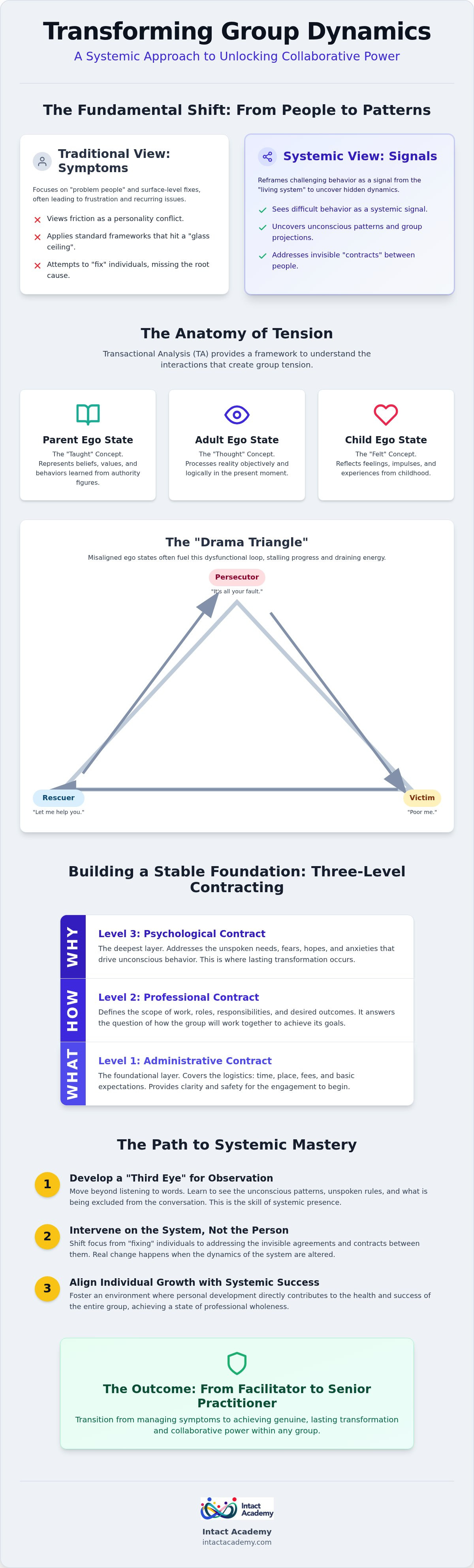
These undercurrents, often referred to as group dynamics, are the complex psychological forces that influence how a group functions and evolves. When a team member becomes "difficult," they are often expressing a symptom of a systemic imbalance. Perhaps they are carrying the unspoken anxiety of the entire department or acting out a role that the system requires to maintain its current, albeit painful, equilibrium. By shifting our perspective from the individual to the system, we stop seeing "problem people" and start seeing "systemic signals."
This phenomenon is deeply tied to the concept of the "Group Imago." Participants unconsciously project their past experiences, often from family systems or previous authority figures, onto the current team. This is why surface-level icebreakers often fail to create lasting change. They attempt to address the social layer while the deep-seated systemic resistance remains untouched, buried in the group's collective unconscious.
The Difference Between a Collection of People and a Living System
A group becomes a system when individual Ego States merge into a collective identity with its own rules and boundaries. A difficult dynamic is an unconscious survival strategy for the group, designed to preserve the status quo when the system feels threatened. It's essential to distinguish between functional conflict, which is task-based and moves the project forward, and dysfunctional conflict, which is ego-based and serves as a defense mechanism against change. Recognizing this distinction allows a coach to intervene at the right level of depth.
Why Traditional Facilitation Often Hits a Glass Ceiling
In high-stakes executive environments, linear models like Tuckman's "Forming, Storming, Norming, Performing" often prove insufficient. They assume a predictable progression that doesn't account for the complex psychological games played at the senior level. To move beyond this glass ceiling, a leader needs "Systemic Presence," the ability to remain grounded while observing the whole field. The most common mistake in managing difficult group dynamics is trying to "fix" individuals. Real transformation occurs only when we address the "contracts" and invisible agreements that exist between people, rather than the people themselves.
The Anatomy of Group Tension: Ego States and Psychological Games
If the organizational system is the field of play, Transactional Analysis (TA) serves as the operating system. It provides the precise language and diagnostic framework needed for managing difficult group dynamics by deconstructing every interaction into its component parts. When we look beneath the surface of a heated debate or a chilling silence, we often find individuals operating from different Ego States, creating a misalignment that stalls progress and drains energy.
Within any group, members cycle through three distinct Ego States. The Parent offers the taught concepts of the past; the Child carries the felt experiences of history; the Adult processes the reality of the present. Tension arises when these states misalign. For example, a leader acting from a "Critical Parent" state inevitably invites a "Rebellious Child" response from the team, stalling progress and preventing authentic collaboration. This misalignment often fuels the Drama Triangle, where individuals rotate through the roles of Persecutor, Rescuer, and Victim in a closed loop that produces no results.
These dynamics often crystallize into "Workplace Games." In the game of "Yes, But," a team member asks for guidance only to reject every suggestion offered. In "Now I’ve Got You," a colleague waits for a minor error to launch a disproportionate critique. These aren't just personality quirks. They are structured diversions from authentic work, designed to maintain a familiar, albeit dysfunctional, equilibrium.
Identifying Ego State Contamination in Groups
Groups often "act out" scripts from their organizational history, repeating the same failures because the collective "Adult" state is contaminated by past "Parent" or "Child" experiences. Effective coaching requires returning the group to an "Adult-Adult" transaction. This shift is essential for managing difficult group dynamics because it replaces reactive patterns with conscious, reality-based choices. When the group moves into a shared Adult state, problem-solving becomes a collaborative inquiry rather than a power struggle.
Breaking the Cycle of Psychological Games
A Psychological Game is a series of ulterior transactions with a predictable, negative payoff. To stop a game in its tracks, a leader must "cross the transaction" by responding from a different Ego State than the one invited. First, identify the repetitive pattern. Second, refuse the "payoff" by staying in your Adult state. Third, name the dynamic with empathy. For those seeking a deeper foundation in these concepts, understanding what is transactional analysis is a vital first step toward mastery. Developing this level of perception is a core focus of the TA EMCC Senior Team Coach Academy, where we move from theory to profound practice.
From Conflict to Collaboration: The Power of Systemic Contracting
Trust is often discussed in leadership circles as a nebulous, organic quality that either exists or doesn't. In the sophisticated practice of Transactional Analysis, we recognize that trust is not a happy accident; it's a structural achievement. When managing difficult group dynamics, the most potent tool at your disposal is "Contracting." This isn't a legal document, but a multi layered agreement that aligns expectations and creates a secure psychological boundary for the work to follow. Without a clear contract, the group lacks a container, and without a container, the energy of the system inevitably spills over into conflict or apathy.
Effective contracting happens at three distinct levels. The Administrative level covers the logistics: when we meet, where we meet, and the boundaries of our time. The Professional level defines the goals and the "what" of our work together. However, it's the Psychological level that determines success. This level addresses the "how" of our interaction, surfacing the unspoken expectations and fears that usually remain hidden. Hidden agendas are rarely malicious; they are simply unexpressed psychological contracts. When these remain unaddressed, they become the primary source of resistance and friction within the system.
The Administrative vs. The Psychological Contract
While the Administrative contract provides the skeleton of the engagement, the Psychological contract provides the nervous system. The Administrative layer is easy to agree upon, yet many leaders stop there, assuming that because the schedule is set, the team is ready to work. Real transformation requires diving deeper into the unspoken layer to ensure everyone feels seen and safe. A clear, explicit contract creates the stable container needed for profound change, allowing the group to move from defensive posturing to authentic Adult-to-Adult engagement.
Multi-Cornered Contracting in Organizations
In high-level organizational work, the dynamic isn't just between the coach and the team. It involves a complex web of expectations involving sponsoring executives, HR departments, and even the "invisible guest" in the room. This guest is the stakeholder who isn't physically present but whose influence, expectations, or perceived judgments dictate the group's behavior. If you don't contract with this invisible influence, you aren't truly managing difficult group dynamics; you're just managing the people who happen to be in the chairs.
Navigating these multi-cornered relationships requires a high degree of systemic awareness. As explored in the work of Sari van Poelje on systemic change, the coach must ensure that the contract with the sponsor doesn't undermine the contract with the team. When a dynamic turns sour mid-engagement, it's often a sign that a contract has been breached or was never fully formed. In these moments, the most professional move isn't to push through the resistance, but to stop and re-contract, bringing the hidden undercurrents back into the light of the Adult state.
Systemic Interventions for Shifting Group Energy
When a group reaches a state of paralysis, traditional behavioral coaching often falters because it treats the team as an isolated unit. A systemic approach recognizes that the team is a subsystem of a larger organizational whole. If you are managing difficult group dynamics, your interventions must address the energetic field of the entire system rather than just the individuals in the room. This requires a deliberate, four step process to move the group from a stuck state back into a flow of productivity.
- Step 1: Observation. Look for the "missing" elements. Who is being excluded? What topics are being avoided? Often, the group's tension is a direct result of something that is being "not said."
- Step 2: Naming the Pattern. Use clear, Adult language to describe the dynamic without assigning blame. For example, "I notice that whenever we discuss budget, the group shifts into a pattern of silence followed by individual side conversations."
- Step 3: Checking the Systemic Order. Ensure the leadership is in the right place and boundaries are clear. Is someone overstepping their role? Is the formal leader actually leading, or has an informal leader taken over?
- Step 4: Re-alignment. Use systemic questions to shift the group from the past to the present. Ask, "What does the organization need from this team right now that we are currently withholding?"
Mastering these interventions is the hallmark of a senior professional. If you are ready to deepen your impact, the TA EMCC Senior Team Coach Academy provides the rigorous training needed to hold these complex spaces with authority and grace.
Working with the "Unspoken" in the Room
In many organizations, "undiscussables" act as anchors that prevent any forward movement. Surface level values on a wall won't solve this; it requires systemic mapping to surface these hidden issues safely. Psychological safety isn't just a warm feeling; it's a structural requirement that emerges when boundaries are clear and contracts are honored. Understanding how these group interactions scale to leading organizational change allows a coach to see the ripples their interventions create across the entire company.
Managing Power and Hierarchy Systemically
High status disruptors often trigger a Persecutor/Victim dynamic that can derail a session. Instead of fighting for control, a systemic facilitator uses the principle of "Right of Place." This means acknowledging everyone in the system for their specific role and history. When people feel their place is respected, their need to disrupt usually diminishes. Your role is to maintain a state of neutrality, acting as a calm mirror for the system's own dynamics. This grounded presence allows you to remain effective even in the midst of high stakes conflict, ensuring the group stays focused on its primary task rather than its internal friction.
Mastering Group Dynamics: The Path to Systemic Impact
The journey of a Senior Practitioner is one of continuous evolution. It's not enough to understand the theory of Transactional Analysis; one must embody the presence required to hold the tension of a system in flux. Truly managing difficult group dynamics is an exercise in professional wholeness. It requires the courage to look inward before intervening outward, ensuring that your presence acts as a catalyst for the team's own growth. As you move from the role of a traditional facilitator to a Systemic Team Coach, you stop looking for problems to solve and start looking for the potential waiting to be released.
The Importance of Supervision in Group Work
Even the most seasoned coaches possess blind spots. When we are immersed in a group's energetic field, we risk being pulled into the very psychological games we aim to resolve. This is often a result of counter-transference, where our own history or ego states color our perception of the team's struggle. Supervision provides the "stable container" for the coach, ensuring that your interventions remain clean, objective, and Adult-to-Adult. Investing in professional development for coaches isn't just a career requirement; it's a commitment to a more sustainable and impactful practice that honors the intelligence of the systems you serve.
Join the TA EMCC Senior Team Coach Academy
Transformation is a journey, not a single event. While many facilitators focus on the logistics of a team offsite, a Systemic Team Coach focuses on the profound process of the system's becoming. At Intact Academy, we guide you through this transition, moving beyond surface-level fixes into the depth of organizational change. Our programs are led by international experts like Sari van Poelje and attract participants from over 14 countries, creating a rich, global environment for learning.
By joining the TA EMCC Senior Team Coach Academy, you align yourself with global standards of excellence. Our EMCC and ICF accreditations ensure your skills are recognized worldwide, providing the backbone for a sophisticated professional career. If you're ready to master the art of managing difficult group dynamics and return to a state of genuine professional completeness, we invite you to take the next step. Explore our Team Coaching Course today and begin your path toward systemic mastery and lasting impact.
Beyond Facilitation: Stepping into Systemic Mastery
True transformation within a team doesn't happen by accident; it's the result of a conscious, systemic approach to the human experience. By moving from a focus on individual behavior to an understanding of the collective undercurrents, you gain the power to reshape the energetic field of any organization. You've learned that managing difficult group dynamics isn't about control, but about creating a stable container through clear contracting and the precise application of Transactional Analysis. When you see a team through this "third eye," every conflict becomes an invitation for profound re-alignment.
This path requires more than just tools; it demands a commitment to your own professional wholeness and ongoing development. At Intact Academy, we provide the psychologically-grounded TA framework and EMCC Senior Practitioner Level Training necessary to navigate these complexities with confidence. Led by international experts like Sari van Poelje, our programs empower you to lead with a grounded, authoritative presence. Master the art of systemic team coaching with Intact Academy and begin your journey toward lasting organizational impact. You have the capacity to turn systemic friction into collaborative flow; the next step is yours to take.
Frequently Asked Questions
What are the most common causes of difficult group dynamics in 2026?
The most common causes involve unexpressed psychological contracts and the fragmentation of systemic identity in hybrid environments. When boundaries between roles become blurred, individuals often retreat into defensive ego states. Managing difficult group dynamics today requires addressing these invisible gaps. Misalignment between formal agendas and the unconscious "Group Imago" often triggers resistance, as members project past systemic failures onto current leadership, creating a cycle of reactive behavior that stalls collective progress.
How can Transactional Analysis help in managing a team that is constantly in conflict?
Transactional Analysis provides a precise map for deconstructing the "who" and "how" of every interaction. By identifying whether a team member is speaking from a Parent, Adult, or Child ego state, you can consciously shift the transaction back to an Adult level. This clarity stops the cycle of psychological games. It allows the team to move beyond reactive patterns, fostering a culture where genuine problem solving replaces the habitual acting out of old organizational scripts.
What is the "Drama Triangle" and how do I spot it in a meeting?
The Drama Triangle is a social model consisting of three roles: the Persecutor, the Rescuer, and the Victim. You can spot it when a meeting devolves into blame, over functioning to "save" others, or learned helplessness. These roles are interchangeable and produce a predictable, negative payoff. Recognizing this rotation is the first step in interrupting the game and returning the group to a state of healthy, Adult to Adult accountability.
Can a leader manage group dynamics without being an expert in psychology?
You don't need to be a clinical psychologist, but you must develop a sophisticated level of systemic awareness. Effective leadership involves observing the "undercurrents" of human interaction through a structured lens like Transactional Analysis. While you aren't performing therapy, you are managing the psychological environment. Acquiring foundational tools for managing difficult group dynamics allows you to see the system as a whole, making complex human issues feel manageable and actionable.
What should I do when a dominant personality takes over a group session?
Address a dominant personality by acknowledging their "Right of Place" while firmly re-anchoring the group in its primary task. Often, dominance is an unconscious survival strategy or a symptom of a systemic imbalance. Instead of entering a power struggle, use Adult to Adult contracting to clarify the group's boundaries. By validating their contribution without allowing it to exclude others, you restore the systemic order and ensure that all voices serve the collective goal.
How do I create psychological safety in a group that has a history of mistrust?
Psychological safety is built through structural integrity rather than social warmth. Start by making the unspoken contracts explicit and honoring the history of the system, including its past failures. When people see that boundaries are consistently held and that every role is respected, trust begins to emerge as a structural byproduct. This methodical approach provides the safety needed for the group to move from defensive "Child" states into a collaborative "Adult" reality.
What is the difference between team building and systemic team coaching?
Team building usually focuses on the social layer through event based activities designed to improve morale. Systemic team coaching is a deeper, journey based process that addresses the unconscious patterns and organizational structures dictating behavior. While team building might offer temporary relief, systemic coaching targets the root causes of friction. It aims for a fundamental shift in the group's "operating system," leading to lasting transformation and a return to professional wholeness.
How do I know if a group needs a coach or a consultant for their dynamics?
A consultant is typically needed when the group lacks specific technical expertise or requires a new process to achieve a task. A systemic coach is necessary when the group has the skills but is blocked by unaddressed relationships or unconscious patterns. If the problem feels repetitive and resistant to logical fixes, it's a sign that the system itself requires an intervention. Coaching helps the group see and resolve the hidden dynamics that a consultant might overlook.


