

What if the reason your change initiatives stall isn't a lack of process, but a lack of presence? We often treat organizational change management models as mechanical checklists; yet, the systems they aim to shift are alive, breathing, and often deeply resistant to being fixed. You've likely followed the steps of the most popular frameworks only to find that the culture remains untouched. It's exhausting to feel like a technician tightening bolts on a machine that refuses to run. You aren't alone in feeling that deep-seated resistance is unfixable, but perhaps the tools you're using are simply too shallow for the complexity of the human spirit.
This guide invites you to move beyond surface-level tactics into the systemic and psychological depth required for true mastery in 2026. You'll learn to integrate profound human insights with business pragmatism, transforming your role from a mere facilitator into a catalyst for genuine evolution. We'll explore how to navigate the unconscious patterns that hold organizations back and look at pathways toward professional accreditation with bodies like the EMCC and ICF. By the end, you'll have a framework that honors the intelligence of your team and the integrity of the system itself.
Key Takeaways
- Distinguish between external situational shifts and the internal psychological transitions that truly define the success of any transformation.
- Navigate the limitations of classic organizational change management models by integrating systemic depth and maturity assessments into your leadership approach.
- Uncover the unconscious organizational scripts and ego states that create invisible barriers to evolution and sustainable team growth.
- Develop a diagnostic lens to identify whether a challenge is a linear technical problem or a complex adaptive system requiring a deeper intervention.
- Transition from a technician of change to a facilitator of transformation, paving the way for advanced professional accreditation in systemic practice.
What is an Organizational Change Management Model?
An organizational change management model is far more than a sequence of checkboxes or a rigid project timeline. It's a conceptual framework that provides a roadmap for navigating the often-turbulent waters of evolution. At its core, a model serves as a stable container; it offers a structured methodology that holds the collective anxiety of a system, allowing individuals to move through uncertainty without losing their sense of purpose. Without this container, the energy of change often dissipates into chaos or hardens into resistance.
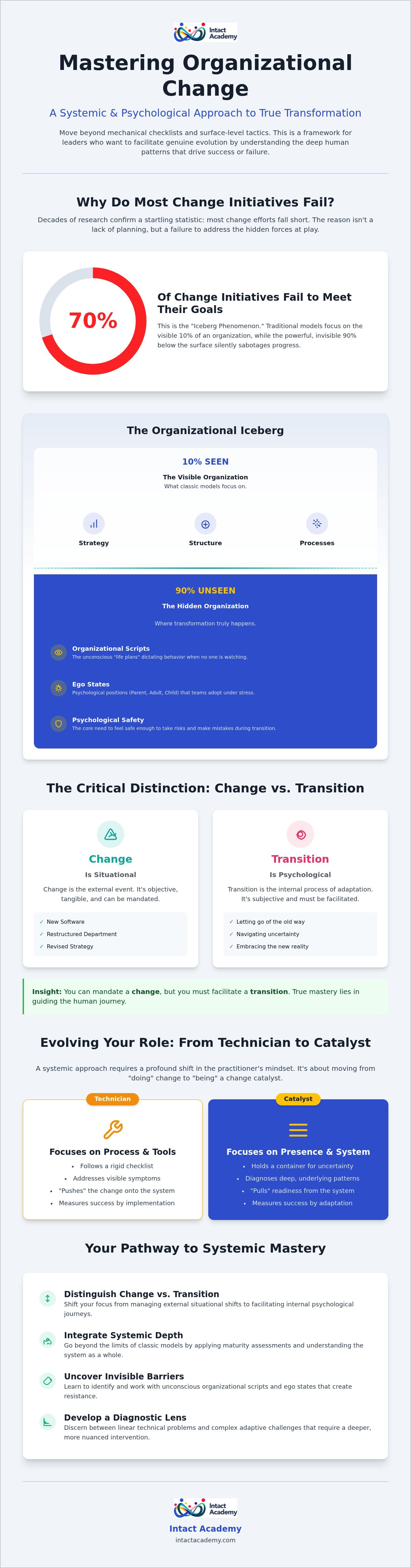
To master these frameworks, we must first distinguish between change and transition. Change is situational. It's the new software, the restructured department, or the revised strategy. In cases where these shifts involve physical renovations or property upgrades, you can learn more about the technical safety assessments required for owners. Transition, however, is psychological. It's the internal process people go through to come to terms with the new reality. Effective organizational change management models focus on the latter, recognizing that while you can mandate a change, you must facilitate a transition. Since the mid-20th century, these models have evolved from mechanical, linear approaches toward the systemic, interconnected frameworks we require in 2026.
The Role of the Change Practitioner as a Systemic Instrument
In a systemic approach, the practitioner isn't merely a technician applying a tool; they are an instrument of the change itself. Your own presence, your level of self-awareness, and your ability to remain grounded in the face of resistance determine the depth of the transformation. Moving from "doing" change management to "being" a change catalyst requires a shift in perspective. It's about understanding that leading organizational change requires psychological depth. When you embody the change you wish to see, you create a resonance that allows the entire system to shift with more ease and integrity.
Why 70% of Change Initiatives Still Fail
Despite decades of research, the industry still grapples with the reality that roughly 70% of change initiatives fail to meet their goals, a figure frequently cited in long-term studies by McKinsey and Harvard Business Review. This failure is rarely due to a lack of effort. It's usually the result of the "Iceberg Phenomenon." Most organizational change management models only address the visible 10% of organizational life: the strategy, the structure, and the formal processes. They ignore the 90% below the surface, including:
- Organizational Scripts: The unconscious "life plans" of a company that dictate how people behave when no one is watching.
- Ego States: The psychological positions of "Parent," "Adult," or "Child" that leaders and employees fall into during times of stress.
- Psychological Safety: The fundamental need for employees to feel they won't be punished for making a mistake during a transition.
Comparing the "Big Three" Classic Change Models
Most practitioners begin their journey with a core set of organizational change management models that have shaped the industry for decades. These "Big Three"-Lewin, Kotter, and ADKAR-provide a vital starting point, yet their application in 2026 requires a more nuanced, systemic lens than their original creators might have envisioned. While these frameworks offer structure, they often lack the psychological depth needed to address the hidden currents of human behavior that can sink even the most well-planned initiative.
Kurt Lewin's three-stage model (Unfreeze, Change, Refreeze) was pioneering for its time, recognizing that systems tend toward homeostasis. However, the concept of "refreezing" feels increasingly obsolete in a world defined by continuous disruption. Instead of seeking a new state of solid ice, modern leaders must learn to navigate a state of permanent fluidity. We no longer aim for a static end-point; we aim for a resilient, adaptive system that can evolve without breaking.
Lewin and the Force Field Analysis
Force Field Analysis serves as a diagnostic tool for systemic equilibrium by identifying the driving and restraining forces within a human system. To move a system, you don't just increase the pressure of the driving forces; you must understand and resolve the restraining forces that keep the status quo in place. This requires an empathetic look at the fears and organizational scripts that hold people back. When we reduce resistance rather than simply pushing harder, the transition becomes more natural and less traumatic for the collective.
Kotter vs. ADKAR: Top-Down Vision vs. Individual Readiness
The distinction between these two models lies in their direction of energy. John Kotter’s 8-Step Process excels at generating top-down momentum through urgency and vision. It is an organizational "push" designed to mobilize large groups toward a shared future. Conversely, Prosci’s ADKAR model focuses on the individual's internal journey-Awareness, Desire, Knowledge, Ability, and Reinforcement. This is the individual "pull," ensuring that each person has the internal capacity to meet the external demand.
The tension between Kotter’s systemic vision and ADKAR’s individual focus often leaves a gap where the actual human connection happens. To bridge this divide, we look toward What is Transactional Analysis? as a foundational method. Transactional Analysis provides the language to understand how leadership ego states influence employee readiness, turning a mechanical process into a relational one. For those ready to move beyond these basics toward profound impact, exploring advanced training at Intact Academy offers the depth needed for true mastery.
Psychological and Transition-Based Models
While the "Big Three" focus on the 'what' and 'how' of structure, psychological organizational change management models address the 'who' and the 'why' of the human experience. These frameworks recognize that organizations aren't just machines; they're living, breathing human systems. William Bridges’ Transition Model reminds us that change is external, but transition is internal. It begins with an Ending, moves through the Neutral Zone, and culminates in a New Beginning. Similarly, the Kubler-Ross Change Curve translates the stages of grief into a corporate context, acknowledging that losing a familiar process can feel like a loss of professional identity. By integrating these psychological perspectives, we move beyond the mechanics of change into the realm of profound human transformation. These frameworks are essential for systemic team coaching because they allow a coach to map the collective emotional state of a group, ensuring that no one's left behind in the rush toward progress.
The Neutral Zone: The Womb of Organizational Innovation
Most leaders feel an urgent need to rush through the "Neutral Zone." They see the ambiguity as a threat to productivity and attempt to skip straight to the "New Beginning." However, this space is the womb of organizational innovation. It's the only time the old rules are suspended, allowing for new, more functional patterns to emerge. A facilitator’s role is to hold the space, managing organizational anxiety by operating from an "Adult" ego state. This grounded presence prevents the system from regressing into a "Child" state of panic or a "Parent" state of rigid control. When we allow the Neutral Zone to exist, we give the organization permission to dream of a more authentic future.
The Satir Model and the "Foreign Element"
Unlike more linear organizational change management models, the Satir model identifies the "Foreign Element," which is any new idea, leader, or crisis that disrupts the system's equilibrium. This disruption triggers a period of chaos where performance inevitably drops as people struggle to let go of the familiar. The Satir model predicts a significant dip in performance before the "New Status Quo" emerges, helping leaders manage expectations and resist the urge to abandon the initiative too early. Instead of seeing chaos as a failure, we recognize it's a necessary phase of integration. By understanding these patterns of "Status Quo" preservation, we can guide the system toward wholeness without forcing premature results. This awareness turns a frightening decline into a manageable step in the process of becoming.
The Intact Perspective: Integrating Transactional Analysis into Change
Most traditional organizational change management models operate on the surface of observable behavior. They focus on what people do, rather than why they do it. To achieve sustainable transformation, we must look at the unconscious architecture of the organization through the lens of Transactional Analysis (TA). By integrating TA, we move from a mechanical view of change to a systemic one, where the focus shifts toward the relational dynamics and hidden "scripts" that either fuel or frustrate evolution. This approach turns the practitioner into a sophisticated observer of human systems, capable of identifying the psychological roadblocks that checklists simply cannot reach.
Mapping the Organizational Script
Every organization follows an unconscious "life plan" known as an organizational script. This script is composed of repetitive patterns, myths, and unwritten rules that dictate how the system responds to stress. When a change initiative fails, it's often because the proposed shift contradicts a core script injunction, such as "Don't Succeed" or "Don't Change." These injunctions act as invisible tethers, pulling the organization back to its old state regardless of how many new processes are introduced. Identifying these patterns is the first step toward genuine freedom. In her work, Sari van Poelje’s insights on mastering systemic change highlight how rewriting these scripts allows an organization to return to a state of wholeness and agility, moving beyond the trauma of past failures.
The 3 Ego States as a Diagnostic Tool
During times of transition, individuals and groups often regress into non-productive ego states. Leaders may adopt a "Critical Parent" style, issuing rigid directives that trigger a "Rebellious Child" or "Compliant Child" response from employees. This dynamic creates a cycle of resistance and micromanagement that stalls progress. Mastery involves moving the entire system toward an "Adult-Adult" transactional culture. In this state, communication is clear, objective, and grounded in the present reality rather than past fears. This diagnostic framework is a cornerstone for those pursuing an executive coaching certification, as it provides a precise language for shifting leadership behavior from control to facilitation.
In the fast-paced environment of 2026, we utilize Agile Transactional Analysis to facilitate rapid, systemic transformation. This involves "contracting for change," a TA secret that ensures every stakeholder has clear expectations and a sense of psychological safety from the outset. By making the implicit explicit, we reduce the "noise" of hidden agendas and create a stable container for growth. If you're ready to deepen your impact and master these sophisticated human systems, consider joining our TA EMCC Senior Practitioner academy to bridge the gap between theory and profound professional practice.
Choosing the Right Model for Systemic Mastery
Selecting from various organizational change management models isn't a superficial choice based on company size or industry trends. It's a discerning act of matching the intervention to the organization's current state of evolution. To lead with mastery, you must move beyond the "one size fits all" mentality and develop a diagnostic eye that sees the invisible forces at play. This selection process requires four critical steps of assessment to ensure the framework you choose can actually hold the weight of the transformation.
- Step 1: Assess Systemic Maturity. Is the organization ready for an "Adult-Adult" dialogue, or is it stuck in a "Parent-Child" power dynamic? A model that requires high transparency will fail in a low-trust system.
- Step 2: Technical vs. Adaptive. Determine if the change is technical, requiring expert knowledge and linear steps, or adaptive, requiring a shift in collective values and systemic behavior.
- Step 3: Capacity to "Hold" Weight. Evaluate your own ability as a practitioner to hold the psychological weight of the model. Deep systemic models require a grounded presence that can withstand the organization's projected anxiety.
- Step 4: Layer for Depth. Don't settle for a single framework. Layer a structural model like Kotter with a psychological one like Bridges to address both the logistics and the human soul of the transformation.
From Technical Technician to Systemic Master
True mastery in this field requires a commitment to psychological rigor that goes far beyond basic certifications. The path from being a technician who follows steps to a master who facilitates evolution is paved with deep inner work. High-level professional development for coaches must include a systemic understanding of human systems and the courage to look at one’s own impact on the group. For those ready to reach the next level of impact, our TA EMCC Senior Practitioner academy and TA EMCC Senior Team Coach Academy provide the accredited pathways needed to lead with authority and empathy. These programs don't just teach you what to do; they transform who you're being in the room.
The Future of Change: Wholeness and Genuineness
The future of organizational life isn't found in more complex tools, but in a return to wholeness. Leading from a state of completeness allows you to see the organization not as a problem to be solved, but as a system seeking its own genuineness. At Intact Academy, our philosophy is rooted in helping individuals and organizations return to this state of authenticity. We invite you to explore our advanced academies, where you'll gain the frameworks and the personal depth required to create a lasting, systemic impact. Let's move beyond the surface and lead the transformations that the future demands by returning to what's most human in our systems.
Embrace the Path to Systemic Mastery
Mastering the landscape of organizational change management models requires more than technical proficiency; it demands a shift in how you perceive the human systems you lead. You've explored the classic frameworks and the psychological depths of transition, yet the true work begins when you integrate these tools with your own grounded presence. By recognizing the hidden organizational scripts and the ego states that drive resistance, you move from managing tasks to facilitating profound evolution. This journey is one of returning to genuineness, where both the leader and the organization flourish in a state of completeness.
If you're ready to transcend surface-level checklists and lead with systemic authority, it's time to elevate your practice. Deepen your impact with our TA EMCC Senior Practitioner academy, where you'll learn from a global faculty with experience in over 14 countries. Led by Sari van Poelje, our EMCC and ICF accredited programs provide the stable container you need for professional growth. Step into your role as a catalyst for transformation. You have the capacity to guide your organization toward its highest potential, and we're here to support that becoming.
Frequently Asked Questions
What is the best organizational change management model for 2026?
There isn't a single best model; the most effective approach in 2026 is a systemic one that integrates psychological depth with structural frameworks. Mastery involves matching the model to the organization's maturity. While classic models provide a foundation, adding Transactional Analysis allows you to address the unconscious patterns that often cause initiatives to stall. Success depends on your ability to see the system as a living entity rather than a machine.
How does Transactional Analysis improve change management success?
Transactional Analysis improves success by providing a diagnostic lens for human behavior and communication. It helps practitioners identify ego states and organizational scripts that create invisible barriers to evolution. By moving leadership toward Adult-Adult transactions, you foster an environment of clarity and psychological safety. This ensures that the transformation is sustainable and deeply integrated rather than merely situational or surface-level. It's about changing the relational fabric of the company.
What is the difference between Kotter’s 8 steps and the ADKAR model?
The primary difference lies in the direction of focus. Kotter’s 8 steps provide a top-down organizational push centered on urgency and vision. In contrast, the ADKAR model focuses on the individual pull, ensuring each person has the readiness to change. A sophisticated practitioner often layers these organizational change management models to address both the collective strategy and the personal transition, bridging the gap between vision and individual ability.
Can I combine multiple change management models in one project?
Yes, layering multiple models is often the hallmark of systemic mastery. You might use Kotter for structural momentum, Bridges for psychological transition, and Transactional Analysis to navigate relational dynamics. This multi-dimensional approach ensures you address the visible strategy and the invisible currents of the human system simultaneously. It creates a more stable container for change, allowing you to handle both technical requirements and the complex psychological needs of the people involved.
How do I handle deep-seated psychological resistance to change?
Handling deep resistance requires moving beyond technical fixes and looking at the system's script. Resistance is often a survival mechanism protecting the organization's historical identity. By using Transactional Analysis to explore these unconscious injunctions, you can address the root fear rather than the symptom. This involves holding a grounded, empathetic space that allows the organization to mourn the old and move toward the new, transforming resistance into a catalyst for growth.
What qualifications do I need to become a Change Management Consultant?
Professional accreditation from bodies like the EMCC or ICF is becoming essential for high-level impact in 2026. Advanced certifications, such as those offered through our TA EMCC Senior Practitioner academy, signal a mastery of both business pragmatism and psychological depth. This level of training prepares you to act as a systemic instrument of transformation rather than just a process technician, ensuring you can lead complex human systems with authority and integrity.
How does systemic team coaching support organizational redesign?
Systemic team coaching supports redesign by ensuring the team’s internal dynamics align with the new organizational structure. It moves beyond individual performance to look at the relationships and patterns within the team. By addressing collective ego states and scripts, a coach helps the team integrate the redesign at a psychological level. This prevents a regression into old, dysfunctional ways of working and ensures the new structure is supported by a healthy human system.
Is there an EMCC-accredited course for organizational change?
Yes, Intact Academy offers accredited pathways specifically designed for those seeking systemic mastery. Our TA EMCC Senior Practitioner academy and Senior Team Coach Academy are tailored for professionals who want to lead deep human transformation. These programs are led by Sari van Poelje and provide the rigorous training required to navigate complex organizational change management models with integrity. They offer a path toward professional accreditation while ensuring you achieve profound impact in your practice.


