

What if the persistent friction you feel when a CEO’s hidden agenda clashes with a team’s collective needs isn't a barrier to your work, but the very heartbeat of the coaching process itself? Many practitioners find themselves navigating complex ethical dilemmas in team coaching, feeling caught between the pull of organizational politics and the sanctity of the group's psychological safety. It's common to experience a sense of vertigo when the boundaries between professional development and therapeutic intervention begin to blur, or when the weight of confidentiality feels impossible to hold in a multi-stakeholder environment.
You recognize that these moments require more than just a checklist of rules; they demand a sophisticated understanding of systemic contracts and professional maturity. In this exploration, we'll provide a clear framework for navigating conflicting agendas and maintaining robust professional boundaries. You'll discover how a systemic lens transforms ethical tension into a catalyst for organizational health, while clarifying the pathways toward EMCC Senior Practitioner accreditation. We'll move beyond the surface of "right and wrong" to find a state of completeness where your integrity as a coach serves as a stable container for deep, lasting change.
Key Takeaways
- You'll learn to define the primary client within the multi-stakeholder contract, ensuring alignment between individual needs and systemic goals.
- Identify the unconscious psychological games that lead to ethical breaches and learn to return to a stable, professional Adult ego state.
- Master the art of transparency to manage the myth of total confidentiality, creating a safer and more effective coaching environment.
- Gain a structured 5-step framework to resolve ethical dilemmas in team coaching while adhering to EMCC and ICF professional standards.
- Understand how systemic supervision and advanced training build the ethical resilience required for professional mastery and Senior Practitioner status.
The Complexity of the Multi-Stakeholder Contract in Team Coaching
In the quiet space of individual coaching, the bond is a simple dyad. Team coaching, however, shatters this simplicity. You're stepping into a complex web of overlapping interests where an Ethical dilemma often arises the moment you realize that what benefits the individual might not serve the team, and what the team desires might conflict with the organization’s strategic goals. Managing ethical dilemmas in team coaching requires you to hold these competing truths simultaneously without losing your professional footing.
Determining the primary beneficiary is a foundational challenge that demands clarity from the start. Is it the sponsoring organization paying the invoice, or the team members doing the vulnerable work? While a formal business contract defines the transactional parameters, the psychological contract carries the emotional weight. This unspoken agreement involves expectations of loyalty, change, and safety. Because team coaching involves more moving parts and higher visibility, ethical friction occurs far more frequently than in individual executive coaching. The layers of accountability are simply more dense.
The Three-Cornered Contract: A Systemic View
Visualize the relationship between the coach, the team, and the organizational sponsor as a triangle. Each point exerts a unique pressure. Hidden agendas, such as a leader using the coach to "filter out" low performers or bypass HR processes, create inevitable tension. You must navigate these forces with a steady hand and a clear eye. The systemic contract serves as the foundation of team safety by explicitly acknowledging these competing forces and creating a shared language for resolving conflict.
Identifying Conflicting Agendas Early
Professional mastery begins with spotting red flags during the initial contracting phase. If a sponsor asks you to "fix" a team without their own participation, or if a team member attempts to pull you into a private alliance, the potential for ethical dilemmas in team coaching spikes. Transparency is your most powerful tool here. By using what is transactional analysis to map organizational expectations, you can reveal the underlying scripts and drivers that might otherwise derail the coaching process. Setting these boundaries early doesn't just prevent conflict; it builds the container for genuine transformation.
Psychological Games and the Drama Triangle in Team Ethics
Deep within the systemic architecture of a team, unconscious patterns often override professional intentions. When a coach slips out of their Adult ego state, they stop observing the system and start reacting to it. This psychological shift is the silent engine behind many ethical dilemmas in team coaching. Instead of maintaining a clear, objective presence, you might become a player in a script you didn't write. True mastery requires the ability to recognize these "games" before they compromise the coaching container.
The Drama Triangle provides a vital lens for understanding these breaches. In this model, individuals rotate through three roles: the Persecutor, the Rescuer, and the Victim. Ethical failures rarely happen in a vacuum; they occur when the coach unconsciously accepts a role offered by the team. Adhering to the ICC Standards and Code of Ethics requires more than rule-following. It demands a level of self-awareness that allows you to stay grounded when the system tries to pull you into its drama.
The Coach as the 'Rescuer'
Rescuing is perhaps the most seductive trap for the empathetic practitioner. You might feel an intense pressure to fix a team that appears stuck, or to protect them from a demanding leader. While this feels like helpfulness, it's actually an ethical pitfall. When you take responsibility for the team’s outcomes, you diminish their agency. Professional integrity involves maintaining the "I'm OK, You're OK" stance, even when the team’s dysfunction feels overwhelming. Over-delivering is often a sign that you've lost your boundaries and entered a Rescuer role.
Transference and Countertransference in Teams
Teams carry a collective history that they often project onto the coach. If a team has felt abandoned by previous leaders, they might project a savior image onto you. If you accept this projection, you're no longer a neutral facilitator; you're an ally in a systemic drama. Siding with a marginalized member against a "bully" leader might feel virtuous, but it prevents the system from resolving its own conflict. Identifying these emotional hooks is critical for staying grounded. Those seeking to deepen this awareness often find that the TA EMCC Senior Team Coach Academy provides the necessary framework to process these complex dynamics.
Confidentiality vs. Transparency: The Great Team Dilemma
The promise of total confidentiality is often a comforting illusion in the context of a organizational system. While individual coaching thrives on the sanctity of the private dyad, team coaching operates within a multi-layered ecosystem where information is the lifeblood of change. Managing ethical dilemmas in team coaching requires a departure from the traditional, rigid rules of individual practice. When you promise a team that "everything stays in this room," you may inadvertently create a container for secrets that hinder the very growth you're there to facilitate.
Professional mastery involves shifting the focus from secret-keeping to radical transparency. Sari van Poelje advocates for this approach within systemic contracts, suggesting that the coach’s role isn't to hold information, but to help the system process it. This doesn't mean a lack of safety. Instead, it means being explicitly clear about what information belongs to the individual, what belongs to the team, and what must be shared with the sponsoring organization to ensure systemic health.
Defining the 'Confidentiality Boundary'
Establishing clear boundaries at the outset is the only way to avoid the trap of collusion. You might find a team leader attempting to share "off the record" performance data about a specific member, hoping you'll use it to influence the session. Accepting this information creates an unethical alliance that destroys your neutrality. To prevent this, many practitioners co-create a "Confidentiality Manifesto" during the first session. This document outlines exactly how reporting to HR or senior leadership will function, ensuring that no stakeholder is surprised by the flow of information. It transforms the coach from a vault of secrets into a facilitator of honest dialogue.
Managing Sensitive Information
The most testing ethical dilemmas in team coaching often occur in the "parking lot" or during a coffee break when a member pulls you aside to share a secret. You must distinguish between 'privacy', which is a person's right to their internal world, and 'secret-keeping', which often serves to protect dysfunctional patterns. If the information reveals illegal or harmful behavior, your duty of care to the organization and the law overrides any coaching contract. The transparency threshold represents the precise point where a private disclosure impacts the collective health of the system and must be brought into the light of the team’s awareness. Navigating this moment with empathy and firmness is what separates a practitioner from a master.
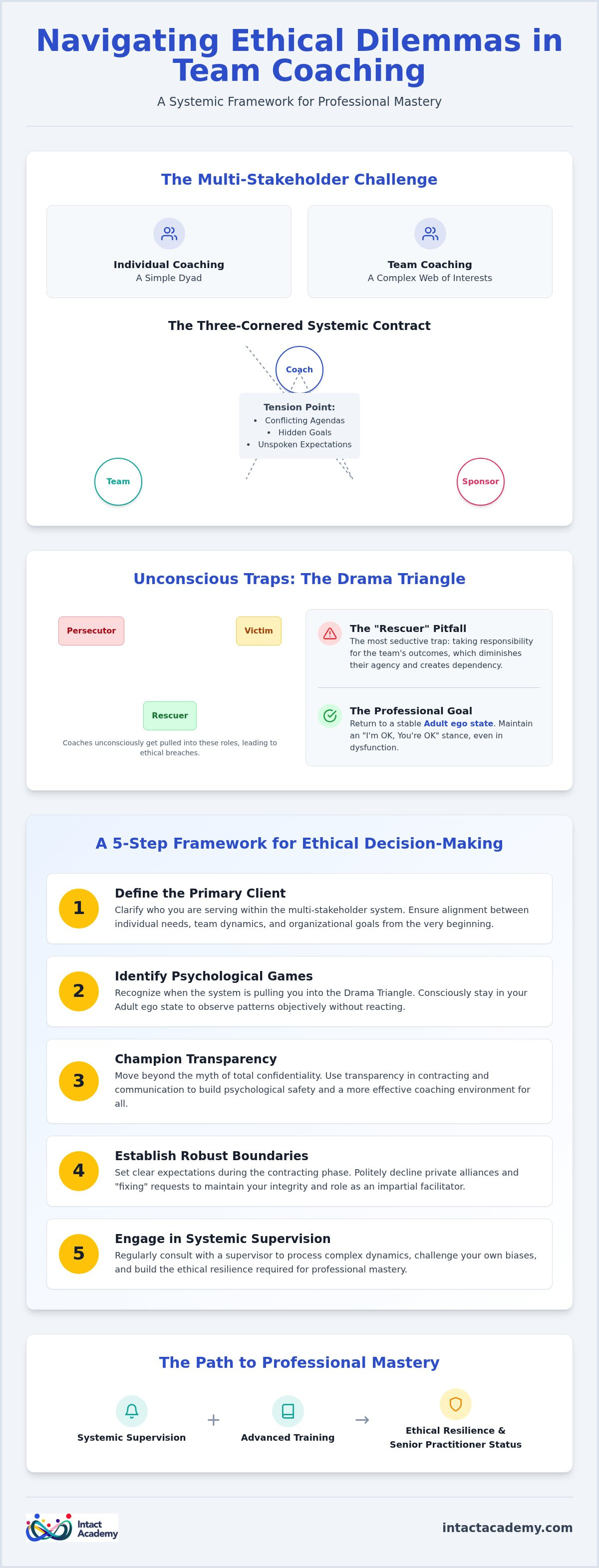
A 5-Step Framework for Ethical Decision-Making
Resolving ethical dilemmas in team coaching requires moving from a state of reactive anxiety to one of reflective action. When you're caught in the middle of organizational politics, a sequential framework provides the grounding needed to maintain your professional Adult ego state. This process isn't about finding a quick fix; it's about honoring the complexity of the system while upholding your integrity as a practitioner. By following these five steps, you can transform a moment of crisis into a profound opportunity for systemic growth.
- Step 1: Identify systemic stakeholders. Map the diverse interests of the sponsoring organization, the team leader, HR, and the team members themselves to see where agendas diverge.
- Step 2: Consult professional codes. Turn to the EMCC or ICF Code of Ethics to provide a neutral, external standard for your specific situation.
- Step 3: Analyze psychological payoffs. Honestly assess what you gain from a potential course of action. Are you seeking approval, avoiding conflict, or attempting to "rescue" the team?
- Step 4: Engage in professional supervision. Seek a "third-eye" perspective to uncover blind spots and process the emotional weight of the dilemma.
- Step 5: Re-contract with the team. Return to the coaching container with clarity and transparency, updating your agreements to reflect the ethical resolution.
Consulting the Professional Standards
The EMCC Global Code of Ethics serves as more than a list of restrictions. It's a vital mirror for your practice. Aligning your decisions with professional development for coaches ensures that your ethical choices contribute to long-term mastery rather than short-term convenience. At the Senior Practitioner level, integrity is viewed as a core competency. It requires the courage to challenge a sponsor’s agenda if it threatens the safety or efficacy of the team intervention. This alignment isn't just about compliance; it's about the art of becoming a more complete and genuine professional.
The Power of the 'Third-Eye' Perspective
Self-reflection is a powerful tool, yet it's often insufficient for resolving deep-seated organizational conflicts. Your own history and biases can easily cloud your judgment. Systemic supervision offers a "third-eye" perspective that allows you to see the invisible dynamics at play. When presenting a dilemma to a supervisor, focus on the emotional "hooks" you feel and the specific points where the contract feels breached. This collaborative inquiry provides the safety needed to hold tension without compromising your values. To truly master these complexities, consider joining the TA EMCC Senior Team Coach Academy to integrate these ethical frameworks into your daily practice.
Cultivating Ethical Resilience through Systemic Supervision
Ethical resilience is the hallmark of a seasoned practitioner. It's the capacity to remain in your professional Adult ego state while the system around you is in turmoil. When you're navigating ethical dilemmas in team coaching, you aren't just following a static code; you're embodying a presence. This presence provides a stable container for the team, allowing them to face their own systemic truths without the coach becoming part of the dysfunction. How often do you leave a session feeling ethically drained rather than professionally energized? This fatigue is often a sign that the boundaries of the system have begun to weigh on your own internal sense of wholeness.
The shift from transactional to transformational mastery occurs when you stop viewing ethics as a set of constraints and start seeing them as a strategic asset. There's a direct link between ethical clarity and the ROI of a coaching engagement. A coach who can navigate the multi-stakeholder contract without falling into collusion ensures that the organization's investment leads to genuine change rather than surface-level compliance. The TA EMCC Senior Team Coach Academy integrates this philosophy into every module, treating ethical decision-making as an art form that requires constant refinement and psychological depth.
Why Supervision is Non-Negotiable for Senior Coaches
Supervision isn't merely a requirement for accreditation; it's a vital practice for professional longevity. Without a dedicated space to process the emotional weight of systemic work, coaches often face ethical fatigue or burnout. By integrating ethical reflection into your weekly coaching practice, you ensure that your Adult ego state remains accessible and unclouded. Joining a global community of practitioners at Intact Academy provides the collective wisdom needed to navigate the most turbulent organizational environments. It's in this shared space that the "third-eye" perspective mentioned earlier becomes a permanent feature of your professional toolkit.
Next Steps for Your Professional Journey
As you look forward, consider evaluating your current ethical fitness. Where do you feel most vulnerable to the pull of the Drama Triangle? Where does your confidentiality boundary feel most porous? Identifying these areas is the first step toward Senior Practitioner status. The path to becoming an EMCC-accredited Senior Team Coach is one of deep personal and professional transformation. It's a journey toward wholeness where your technical expertise and your human integrity become one. Discover how the TA EMCC Senior Team Coach Academy can deepen your systemic impact and provide the framework for your next level of professional mastery.
Embracing the Art of Systemic Integrity
The journey from feeling caught in organizational politics to holding a space of professional mastery requires a shift in both perspective and practice. By moving beyond the binary of right and wrong, you've learned to identify the hidden psychological games that often derail team progress and discovered a 5-step framework to navigate the most complex stakeholder interests. Mastering ethical dilemmas in team coaching ultimately depends on your willingness to bring transparency into the coaching contract, transforming tension into a catalyst for systemic growth.
This path leads to a state of completeness where your presence alone serves as a stable container for change. To deepen this practice and secure your professional future, you can advance your mastery at the TA EMCC Senior Team Coach Academy. Our curriculum, designed by Sari van Poelje and recognized by the EMCC and ICF, focuses on the intersection of systemic change and profound human transformation. The courage to look inward and refine your ethical resilience is what will distinguish your work on the global stage. Your evolution as a coach is the very foundation of the transformation your clients seek.
Frequently Asked Questions
What is the most common ethical dilemma in team coaching?
The most common challenge involves navigating the triangular contract between the organization, the team leader, and the team members. Often, the sponsoring organization’s goals for productivity clash with the team’s need for psychological safety. Practitioners frequently face ethical dilemmas in team coaching when they're pressured to prioritize one stakeholder's interests over the collective health of the system. Success requires clear re-contracting and a commitment to radical transparency from the outset.
How do I handle a team leader who wants to use coaching to 'fire' a specific employee?
You must clarify that coaching is a developmental process, not a performance management tool or a proxy for HR actions. If a leader attempts to use you to justify an exit, they're inviting you into a psychological game. Your role is to remain in an Adult ego state. Facilitate a direct conversation between the leader and the employee. If the leader refuses to engage authentically, the ethical container of the coaching engagement is compromised.
Is it ethical to coach individual team members while also coaching the team as a whole?
It's ethically permissible only if you establish clear boundaries regarding confidentiality and information sharing during the contracting phase. You must ensure that individual sessions don't become "parking lots" for secrets that should be addressed within the team. Many senior practitioners prefer a co-coaching model or systemic supervision to manage the risk of collusion. Without these safeguards, the coach risks losing the neutrality required to hold the team system effectively.
What should I do if the organization's goals conflict with the team's psychological safety?
Your primary duty is to the health of the system, which includes both organizational goals and human safety. When these diverge, you must bring the conflict into the room rather than attempting to resolve it privately. Use your role to highlight the cost of achieving goals at the expense of safety. If the organization insists on a path that causes psychological harm, you may need to pause or terminate the engagement to maintain professional integrity.
How does the EMCC Code of Ethics differ for team coaching versus individual coaching?
The core principles remain the same, but the application shifts toward managing the multi-client reality. In team settings, the EMCC Code places a heavier emphasis on managing the complexity of the "three-cornered contract." It requires coaches to be more explicit about who the client is and how information flows between stakeholders. Navigating ethical dilemmas in team coaching under these standards demands higher levels of systemic awareness and the ability to manage overlapping layers of confidentiality.
When should a coach terminate a team coaching contract for ethical reasons?
Termination is necessary if the coaching process is being used to manipulate individuals, hide illegal activities, or bypass organizational justice. If you find yourself unable to maintain a neutral Adult ego state despite supervision, or if the sponsor repeatedly violates the agreed-upon ethical manifesto, the contract should end. A professional exit protects your integrity. It serves as a powerful systemic intervention, signaling that the current dynamics aren't conducive to genuine growth.
How can Transactional Analysis help me resolve ethical conflicts in the workplace?
Transactional Analysis provides a precise map for identifying when you've been pulled into a Drama Triangle role, such as the Rescuer. By recognizing these unconscious patterns, you can return to an Adult ego state and address the conflict with clarity. It helps you distinguish between the formal business contract and the underlying psychological contract. This awareness allows you to address root causes rather than just managing surface symptoms.
What is the role of a coaching supervisor in resolving ethical dilemmas?
A supervisor acts as a reflective partner. They help you see the systemic blind spots you might miss while inside the team dynamic. By providing a safe space to process ethical tension, they help you identify where your own biases might influence your judgment. Supervision is the non-negotiable container that allows senior coaches to hold the complexity of organizational change without losing their professional sense of wholeness.


